Best Master's in Accounting Programs in Rhode Island
Compare 5 accredited Accounting programs in Rhode Island, with graduate earnings, cost, debt, and completion data from IPEDS and the U.S. College Scorecard.

Public versus private shapes this decision more than curriculum does. Rhode Island's accounting master's field is small enough for a direct comparison, and the tuition spread is wide: $10,112 in-state at Rhode Island College, $18,028 in-state at the University of Rhode Island, and $38,970 at Bryant University.
All three are built around CPA exam eligibility and the 150-credit requirement, so the real variables are schedule, what graduates actually earn afterward, and master's in accounting total cost of attendance. The credential the state recognizes is the same regardless of the price paid for it.
Key Points
- 2027 tuition spans $10,112 at Rhode Island College to $49,860 at Bryant.
- Bryant graduates carry median debt of $14,194; URI reports $20,500.
- Rhode Island CPA pathways require 1,820 hours of verified experience.
Best Master's in Accounting Programs in Rhode Island: 2027 Rankings
Rhode Island's master's in accounting programs range from a private eight-month intensive to public university options with in-state tuition. The three ranked schools below offer different paths to CPA exam eligibility and career advancement. Each profile highlights distinctive program features, but the data behind the ranking tells the same story: value varies as much as format.
Bryant University
#1Smithfield, RI · ~$50,000/yr (est.)
Best for: STEM-minded international students needing OPT extension
Bryant University offers a Master of Science in Accounting in Smithfield that can be completed in about eight months of full-time study. The 30-credit program includes three track options in analytics, tax, or general accounting, and admission is test-optional with no GMAT required. The curriculum meets the 150-hour CPA requirement and is STEM-designated, supporting F1 students seeking a 24-month OPT extension. Graduates are placed at major public accounting firms including PwC, KPMG, Deloitte, and EY.
- 30 credit hours, 10 courses, and an 8-month full-time pace
- Three tracks: analytics, tax, or general accounting
- No GMAT required; test-optional admission
- STEM-designated with a 24-month OPT extension for F1 students
- Meets the 150-hour CPA requirement and prepares for the CPA Exam
- Graduates hired at PwC, KPMG, Deloitte, and EY
University of Rhode Island
#2Kingston, RI · ~$18,000/yr (est.)
Best for: Rhode Island residents seeking public university value
The University of Rhode Island's Master of Science in Accounting in Kingston is a public option that welcomes students from any undergraduate background and requires no professional work experience. The curriculum emphasizes critical thinking, communication, and teamwork with a global business perspective, and the AACSB-accredited program helps students reach the 150 credit hours needed for CPA exam eligibility. Graduates have moved into roles as CEOs, CFOs, controllers, and partners at major firms, with employers including EY, PwC, and KPMG.
- AACSB accredited program
- 50% licensure pass rate
- Employers include EY, PwC, and KPMG
- Meets 150 credit hours for CPA exam eligibility
- Open to students from varied educational backgrounds
- Careers span public accounting, industry, and government
Rhode Island College
#3Providence, RI · ~$10,000/yr (est.)
Best for: Accountants pursuing personal financial planning credentials
Rhode Island College's Master of Professional Accountancy (MPAc) in Providence builds technical and planning skills for the CPA exam and for financial planning roles. Students can choose an accounting concentration or a personal financial planning track that prepares them for the Certified Financial Planner exam, with coursework in income tax, estate planning, retirement planning, investment allocation, and risk management. The program reports high first-time CPA exam pass rates, and most RIC students receive financial aid, scholarships, or work-study support.
- Two concentrations: accounting or personal financial planning
- Covers income tax, estate, and retirement planning
- Prepares for CPA and Certified Financial Planner exams
- High first-time CPA exam pass rates
- 89% of faculty hold terminal degrees
- Financial aid, scholarships, and work-study support available
Cost & outcomes by school
Federal data for the highest-earning Accounting programs, independent of the ranking above. Earnings are this field's master's graduates four years after completing, where the Scorecard reports them.
| School | Earnings | Tuition / yr | Debt | Grads/yr | Format |
|---|---|---|---|---|---|
| Bryant University RI | $111,632 | $49,860 | $14,194 | — | Campus |
| University of Rhode Island RI | $93,081 | $18,028 | $20,500 | 12 | Campus |
| Rhode Island College RI | — | $10,112 | — | 6 | Campus |
| Johnson & Wales University RI | — | $15,156 | — | 8 | Online |
| Johnson & Wales University RI | — | $15,156 | — | 5 | Hybrid |
Sources: U.S. Department of Education. Tuition and graduates: IPEDS. Earnings and debt: College Scorecard, this field's master's graduates; a dash means no figure is reported.
Which Rhode Island Master's in Accounting Programs Waive the GRE or GMAT?
Standardized test policies vary across these accounting master's programs. The table below summarizes the current published GRE or GMAT stance and the waiver criteria each school lists, based on official graduate admissions pages. Because admissions pages change, confirm the policy for your entry term with the program before applying.
| Program | GRE/GMAT Policy | Waiver Criteria | Notes |
|---|---|---|---|
| University of Rhode Island M.S. in Accounting | An official GMAT or GRE score from the last five years is listed as an application requirement; eligible students may waive the GMAT. | A waiver is available for candidates who meet one of these criteria: URI graduate in any major with at least a 3.30 overall GPA; graduate of an AACSB-accredited business program with at least a 3.30 GPA; five or more years of full-time post-graduation work experience; a master's or Ph.D. in any discipline; or significant professional certificates such as CPA, CFP, or PMP. Waivers are considered case by case. | The program page says eligible students may waive the GMAT, while the waiver page describes the broader GMAT/GRE application requirement. |
| Bryant University Master of Science in Accounting (MSA) | Bryant's graduate catalog describes GMAT waivers for MPAc applicants; no GRE policy is stated. | MPAc applicants from an AACSB-accredited program with a cumulative GPA of 3.5 or higher, and Bryant undergraduate accounting majors with a final cumulative GPA of 3.4 or better. | The catalog uses the MPAc designation rather than MSA; additional waivers for MST applicants and doctorate or terminal degree holders are not specifically identified as MSA criteria. |
| Rhode Island College Master of Professional Accountancy (MPAC) | The official MPAC admissions page does not state a GRE/GMAT requirement, waiver, or test-optional policy. | Not stated. | Contact admissions for current requirements; no specific GRE/GMAT waiver criteria appear on the page. |
Online, Hybrid, and Part-Time Master's in Accounting Options in Rhode Island
The right Rhode Island accounting degree depends as much on pace and schedule as on curriculum. Working students have a clear evening option at URI, while Bryant offers a fast full-time in-person accelerated master's in accounting.
Evening and part-time study
The University of Rhode Island's M.S. in Accounting is available full-time or part-time. Most required courses and many electives are scheduled in the evening, which makes the program practical for students balancing a job. Full-time completion typically takes one to two years depending on undergraduate coursework, while part-time students generally finish in about two years. URI's official materials do not describe the program as a fully online master's in accounting or hybrid option.
Accelerated in-person format
Bryant University's Master of Science in Accounting is an in-person program in Smithfield, Rhode Island. It consists of 10 courses and 30 credits and can be completed in as little as two semesters, or roughly eight months, on a full-time basis. January, May, and September start terms give students several entry points across the year, including spring and summer sequences.
Rhode Island College's MPAC program does not publish enough scheduling detail on its official pages to confirm delivery format or part-time availability, so prospective students should contact the program directly. The official pages reviewed also do not spell out accelerated 4+1 pathways.
Related Articles
Tuition and Financial Aid for Rhode Island Master's in Accounting Programs
Bryant University lists its Master's in Accounting at $38,970 for both in-state and out-of-state students. Rhode Island College is the lowest published tuition among the programs below at $10,112 in-state and $18,806 out-of-state, while the University of Rhode Island sits at $18,028 in-state and $33,148 out-of-state. These are published Rhode Island masters programs tuition figures, not final cost.
Understanding the Public-Private Gap
The public universities charge separate resident and nonresident rates because state funding lowers the cost for Rhode Island taxpayers. Bryant, as a private institution, charges one flat rate regardless of residency.
Fees and Net Price
Bryant adds a $250 orientation fee and an $80 application fee, which is waived for Bryant alumni, current students, active-duty military, and veterans. These published tuition figures do not include books or living costs. After aid, the typical net price is lower: about $9,500 at Rhode Island College, $21,400 at URI, and $41,200 at Bryant, though your own aid package will differ.
Aid to Ask About
- Bryant has no graduate assistantships for the MSA, but eligible students may be considered for the Graduate Alumni Council Scholarship (minimum 3.5 GPA, financial need, work and community service) and an alumni tuition discount of up to 30% for the 2023-2024 year. Employer direct payment is accepted.
- URI gives all veterans in-state tuition and offers waivers for unemployment, senior citizens, disabled veterans, and Rhode Island National Guard members.
- Rhode Island College lists scholarships and financial aid for MPAc students; contact the program for current awards.
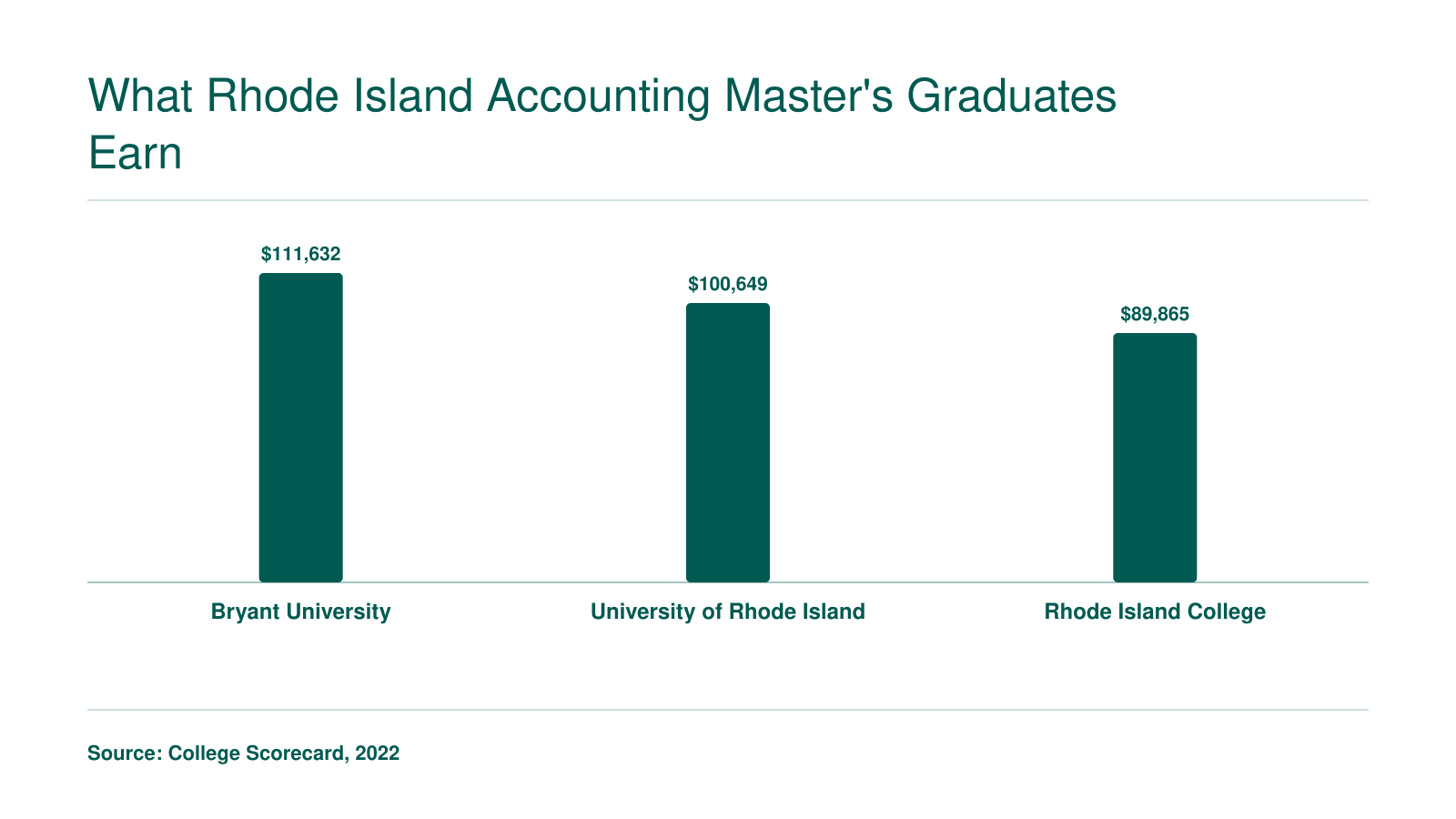
What Rhode Island Accounting Master's Graduates Earn
Program-level median earnings five years after completion show clear differences in payoff across Rhode Island accounting master's programs. Median program debt is $14,194 at Bryant and $20,500 at the University of Rhode Island, while Rhode Island College does not report program-level debt. These earnings figures come from federal College Scorecard data.
Rhode Island CPA Licensure Requirements
Rhode Island Master's in Accounting FAQs
Here are concise answers to common questions about Rhode Island master's in accounting programs, based on published program and licensure information.1
Which Rhode Island accounting master's program is the best overall?
Do all Rhode Island accounting master's programs meet CPA education requirements?
Can I enter a Rhode Island master's in accounting without an accounting bachelor's degree?
Can a Rhode Island master's in accounting qualify me for a CPA license in Massachusetts or Connecticut?
Compare Accounting programs on the data that matters
Explore more Business & Management specializations or browse every graduate field.
All Business & Management programs