Best Speech-Language Pathology Master's Programs
Compare 430+ accredited Speech Pathology programs at 330+ schools, with graduate earnings, cost, debt, and completion data from IPEDS and the U.S. College Scorecard.

A public health sciences campus in Texas lists graduate tuition near $7,200 a year for its speech-language pathology master's; a private university in Los Angeles lists more than $71,000. Both lead to the same credential: a degree from a program accredited by ASHA's Council on Academic Accreditation, which is what the CCC-SLP and most state licenses require.
That gap is the decision. Among the schools ranked here, average net price runs from roughly $6,500 to nearly $33,000 a year, and residency status alone can shift a public program's bill by tens of thousands. The credential at the end is identical. The debt is not.
Key Points
- The three lowest-cost ranked schools are public universities in the Southeast.
- Out-of-state tuition at those schools runs roughly $16,000 to $19,000 above in-state rates.
- First-year earnings for ranked SLP programs are not yet published, so compare cost and accreditation first.
Best Speech-Language Pathology Master's Programs: The Top 15 Schools
Each school below earned its place on federal outcome and affordability data, not reputation surveys. The ranked programs show a clear tradeoff: some large public universities deliver strong clinical training at a lower net price, while a few private programs pair deep specialty tracks with higher tuition. Use the program summaries to weigh each option against your budget, state licensure goals, and preferred clinical settings.
Columbia University in the City of New York
#1New York, NY · ~$58,000/yr (est.)
Best for: Bilingual SLP candidates in New York City
Columbia's Teachers College offers a campus-based master's in communication sciences and disorders with several certification and bilingual add-on tracks. Students train in the on-campus Mysak Clinic and can pursue New York State initial or professional certification, including a bilingual extension. The program is designed for both traditional SLP candidates and those who need to complete prerequisites, with a strong New York City clinical footprint.
- Campus-based MS in Communication Sciences and Disorders
- 55-credit program with clinical training at Mysak Clinic
- Prepares for New York State initial or professional certification
- Focuses on speech-language pathology across all ages
- 58-credit path adds bilingual extension to the MS in CSD
- Includes New York State initial certification with bilingual option
- Emphasizes bilingual and multicultural populations
- On-campus Mysak Clinic training
- 55-credit path with professional certification
- Eligible for New York State licensure
- Includes TSLD professional certification
- Covers bilingualism and swallowing disorders
- 55-credit path with initial certification in Teacher of Speech and Language Disabilities
- Full-time campus-based format
- Fall entry term only
- Requires five prerequisite courses
University of Virginia
#2Charlottesville, VA · ~$24,000/yr (est.)
Best for: Career changers needing structured clinical training
The University of Virginia's M.Ed. in Communication Sciences and Disorders uses two pathways: the Blue Path for students with a CSD background and the Orange Path for career changers. Clinical training starts in the on-campus Sheila C. Johnson Center and extends through three external placements, including a full-time internship. The program emphasizes medical and educational settings across the lifespan and prepares students for ASHA certification and the Praxis exam.
- 68 total credit hours
- 5-semester full-time program
- On-campus Sheila C. Johnson Center plus three external placements
- Blue Path for CSD backgrounds, Orange Path for career changers
- Prepares for ASHA certification and Praxis
- Starts fall, apply by December 1
- Full-time internship in final semester
University of Florida
#3Gainesville, FL · ~$13,000/yr (est.)
Best for: Florida students focused on affordability
The University of Florida's MA in Communication Sciences and Disorders is a five-semester, cohort-based program known for its strong licensure pass and job placement outcomes. Small classes of 25 to 30 students work with internationally recognized faculty and complete 400 clinical hours. A thesis track is available for students interested in research, alongside the clinical track.
- 5 semesters, full-time, campus-based
- 93 total credit hours
- 98% licensure pass rate
- 97.7% job placement rate
- 400 clinical hours
- Small cohorts of 25-30 students
- Optional thesis research track
- ASHA CAA accredited
University of North Carolina at Chapel Hill
#4Chapel Hill, NC · ~$13,000/yr (est.)
UNC-Chapel Hill's MS in Speech and Hearing Sciences offers a 60-semester-hour clinical track and a non-clinical research track, so students can aim for ASHA certification or broader industry roles. The curriculum emphasizes evidence-based practice and multicultural populations, with classroom, lab, and clinical experiences. Financial aid and prerequisites are part of the admissions picture.
- 60-semester-hour program
- Clinical and non-clinical tracks
- Meets ASHA certification and North Carolina licensure
- Evidence-based practice and multicultural populations
- Classroom, lab, and clinical experiences
- Prerequisites required
Texas Tech University Health Sciences Center
#5Lubbock, TX · ~$7,000/yr (est.)
Texas Tech HSC's MS in Speech-Language Pathology is a two-year residential program with rotations in the university clinic, hospitals, and schools. The program reports strong Praxis pass and employment rates, and includes a summer clinical rotation through its SPLASH opportunity. The fall-start cohort focuses on adult and pediatric language, dysphagia, and motor speech disorders.
- Two-year residential program
- Clinical rotations in university clinic, hospitals, and schools
- Starts fall, application deadline February
- 100% licensure pass rate
- 100% job placement rate
- Curriculum includes dysphagia, motor speech, and pediatric/adult language
- Summer clinical rotation via SPLASH
- ASHA CAA accredited
University of Illinois Urbana-Champaign
#6Champaign, IL · ~$19,000/yr (est.)
Illinois Urbana-Champaign's MA in Speech and Hearing Science offers both clinical and non-clinical tracks, with the clinical path meeting ASHA and Illinois school certification requirements. Students complete practica in medical and school settings and can pursue an optional thesis. Admission requires a 3.0 GPA and recommended background in phonetics and anatomy.
- 54 graduate hours required
- Clinical and non-clinical tracks
- Prepares for ASHA certification and Illinois state certification
- Fall admission only
- Minimum 3.0 GPA
- Campus-based program
- Clinical concentration within MA SHS
- 60 total credit hours
- 6-semester program
- Clinical practica in medical and school settings
- Optional thesis available
- ASHA CAA accredited
Northeastern University
#7Boston, MA · ~$29,000/yr (est.)
Northeastern's MS in Speech-Language Pathology is a full-time Boston program with four semesters of clinical placements at the on-campus Speech-Language and Hearing Center and affiliated hospitals and schools. The curriculum covers speech, language, swallowing, and audiology, with eligibility for state educator licensure and early intervention certification. The program is structured for fall entry and requires three recommendations.
- Full-time, on-campus program in Boston
- Four semesters of clinical placements
- On-campus Speech-Language and Hearing Center
- $116,760 total program tuition
- Minimum 3.0 GPA
- Three letters of recommendation required
- Eligible for state educator licensure and early intervention certification
- ASHA CAA accredited
Vanderbilt University
#8Nashville, TN · ~$58,000/yr (est.)
Vanderbilt's MS in Speech-Language Pathology combines early clinical training with customizable specialty tracks, including autism spectrum disorders and children with severe to profound hearing loss. No prior SLP background is required, and clinical experience begins in the first semester. The program reports strong Praxis and employment outcomes, with optional research and electives.
- 2-year full-time program
- 5-6 semesters
- Starts fall, no SLP background required
- Clinical training from first semester
- 100% Praxis pass rate
- 100% employment rate
- Optional research thesis and specialty tracks
- ASHA CAA accredited
- Specialty track for children with severe to profound hearing loss
- Clinical training in partner hospitals, clinics, and schools
- Expert clinical faculty
- Specialty track for autism spectrum disorders
- Customizable degree with electives
- Optional research thesis
Brigham Young University
#9Provo, UT · $5,000 – $10,000/yr (est.)
Brigham Young University's MS in Communication Disorders is a 63-credit, cohort-based campus program that includes a required thesis and clinical practicum experiences. Students prepare for ASHA Praxis and SLP licensure while working with a faculty advisor in varied clinical settings. The program operates within BYU's faith-based environment and requires an ecclesiastical endorsement.
- 63 total credit hours
- Thesis required
- On-campus program in Provo, Utah
- Prepares for ASHA Praxis and SLP licensure
- Clinical practicum in varied settings
- Ecclesiastical endorsement required
- ASHA CAA accredited
- Prerequisite courses required
The University of Texas at Austin
#10Austin, TX · ~$12,000/yr (est.)
UT Austin's MS in Speech, Language, and Hearing Sciences emphasizes bilingual Spanish/English and family-focused approaches, with optional bilingual certificate and thesis tracks. Students gain clinical experience through practicum placements and faculty advising tied to ASHA certification standards. The program prepares graduates for schools, hospitals, and clinics serving diverse populations.
- Bilingual Spanish/English and family-focused approach
- Clinical practicum placements
- Prepares for ASHA certification
- Campus-based
- Bilingual certificate in Spanish/English
- Emphasis on bilingual populations
- Experiential learning curriculum
Cost & outcomes by school
Federal data for the highest-earning Speech Pathology programs, independent of the ranking above. Earnings are this field's master's graduates four years after completing, where the Scorecard reports them.
| School | Earnings | Tuition / yr | Debt | Grads/yr | Format |
|---|---|---|---|---|---|
| California State University-Los Angeles CA | $101,094 | $8,688 | $40,968 | 23 | Campus |
| California Baptist University CA | $97,691 | $15,562 | $71,464 | 27 | Campus |
| San Francisco State University CA | $95,402 | $9,370 | $35,880 | 34 | Campus |
| California State University-East Bay CA | $93,943 | $9,107 | $39,757 | 26 | Campus |
| California State University-Sacramento CA | $91,632 | $9,542 | $33,556 | 39 | Campus |
| CUNY Hunter College NY | $91,520 | $11,398 | $41,000 | 18 | Campus |
| California State University-Fullerton CA | $90,382 | $8,994 | — | 34 | Campus |
| California State University-San Marcos CA | $88,196 | $9,606 | $70,750 | 28 | Online |
| San Diego State University CA | $87,991 | $10,252 | $38,020 | 36 | Campus |
| CUNY Lehman College NY | $86,743 | $11,570 | $38,404 | 3 | Campus |
| California State University-Long Beach CA | $86,502 | $8,898 | $21,738 | 47 | Campus |
| Biola University CA | $86,263 | $12,672 | $61,525 | 24 | Campus |
Sources: U.S. Department of Education. Tuition and graduates: IPEDS. Earnings and debt: College Scorecard, this field's master's graduates; a dash means no figure is reported.
Cost, debt & payoff
Median earnings of this field's master's graduates (4 yrs after completing) vs. their median federal loan debt · U.S. College Scorecard
Across these programs the median graduate earns about $66,866 and finishes with roughly $41,000 in debt — a ratio that clears a common rule of thumb (keep debt below first-year salary). Tuition and debt vary widely school to school, so check the per-school figures in the table above before you shortlist.
Inside the Scoring: IPEDS and College Scorecard Data Behind the List
Federal reporting on graduate programs has grown more granular, but it still leaves real gaps across Communications & Media Master's Programs, especially in a field as specialized as speech-language pathology.
Where the Numbers Come From
Institution-level figures such as graduate tuition, graduation rate, and delivery format come from IPEDS. Program-level earnings, median debt, and completions come from the U.S. Department of Education's College Scorecard. Schools were compared on graduate tuition, average net price, institution-wide graduation rate, and, where published, program-level earnings and median debt.
What the Data Can't Tell You
Graduation rates and net price describe the whole school, not the SLP program. A university with a strong overall rate may still run a small or uneven communication sciences cohort. Some programs also have no published Scorecard earnings, so comparisons for those schools rest on fewer measures.
Several factors that matter a great deal sit outside any federal dataset, including Praxis pass rates and the quality and variety of clinical placements. Treat the list as a cost-and-outcomes screen, then verify those points directly with each program. Later sections cover accreditation checks, how placements differ between online and on-campus formats, and what to ask admissions offices.
Checking a Program's ASHA CAA Accreditation Before You Apply
A master's degree in speech-language pathology is only as useful as the accreditation behind it. ASHA's CCC-SLP requires a master's from a program accredited by, or granted candidacy by, its Council on Academic Accreditation (CAA).1 Most state licenses lean on the same standard. Your graduate coursework and clinical practicum are reviewed when you apply for certification, and your Praxis results go into that same file, so a program with the wrong status can stall everything downstream.
Accredited vs. Candidate Programs
Accreditation is full recognition after a program shows it meets CAA standards. Candidacy is a developmental status for new programs, granted for a five-year term.2 Under ASHA's current certification rules, coursework and practicum started and finished in a candidacy program still count. The risk is uncertainty. A candidate program must file for initial accreditation no later than its fourth annual progress report, and status can change between review cycles.2 If you are considering a candidate program, ask where it stands in that timeline.
Verify It in Two Steps
- Step 1: Search the program in ASHA EdFind to see its listed status.
- Step 2: Confirm it on the CAA's accredited-programs list, which shows the status and the date of the most recent decision. A.T. Still University's Arizona School of Health Sciences, for example, appears as accredited with a decision date of 07/18/2026.3
Treat a school's own website as a starting point only. Pages saying "accredited" or "candidate" can lag behind the official listing.
What Is Changing
The CAA has revised its Standards for Accreditation. Candidacy applications filed after July 1, 2027, and accreditation reports and applications filed after August 1, 2027, must address the revisions.4 The published material does not summarize the specific text changes, so check the current standards document if a program's compliance matters to you. Separately, ASHA's 2027 certification standards add internationally equivalent programs to the accepted list, alongside CAA-accredited and candidacy programs.
Related Articles
Public vs. Private: The Lowest Graduate Tuition Among Ranked SLP Schools
At the public universities in this ranking, the in-state and out-of-state tuition gap runs from roughly $13,000 to over $32,000, so residency status can change total cost by tens of thousands of dollars. Net price is an institution-wide average after aid, not a personal quote, and it does not include program-specific costs such as clinic fees, background checks, liability insurance, Praxis registration, clinical tracking software, and travel to externships.
| School | Format | In-state tuition | Out-of-state tuition | Net price after aid |
|---|---|---|---|---|
| University of Florida | On-campus | $6,381 | $28,659 | $6,541 |
| Florida State University | Hybrid | $5,656 | $18,786 | $11,297 |
| University of North Carolina at Chapel Hill | On-campus | $8,994 | $41,203 | $11,655 |
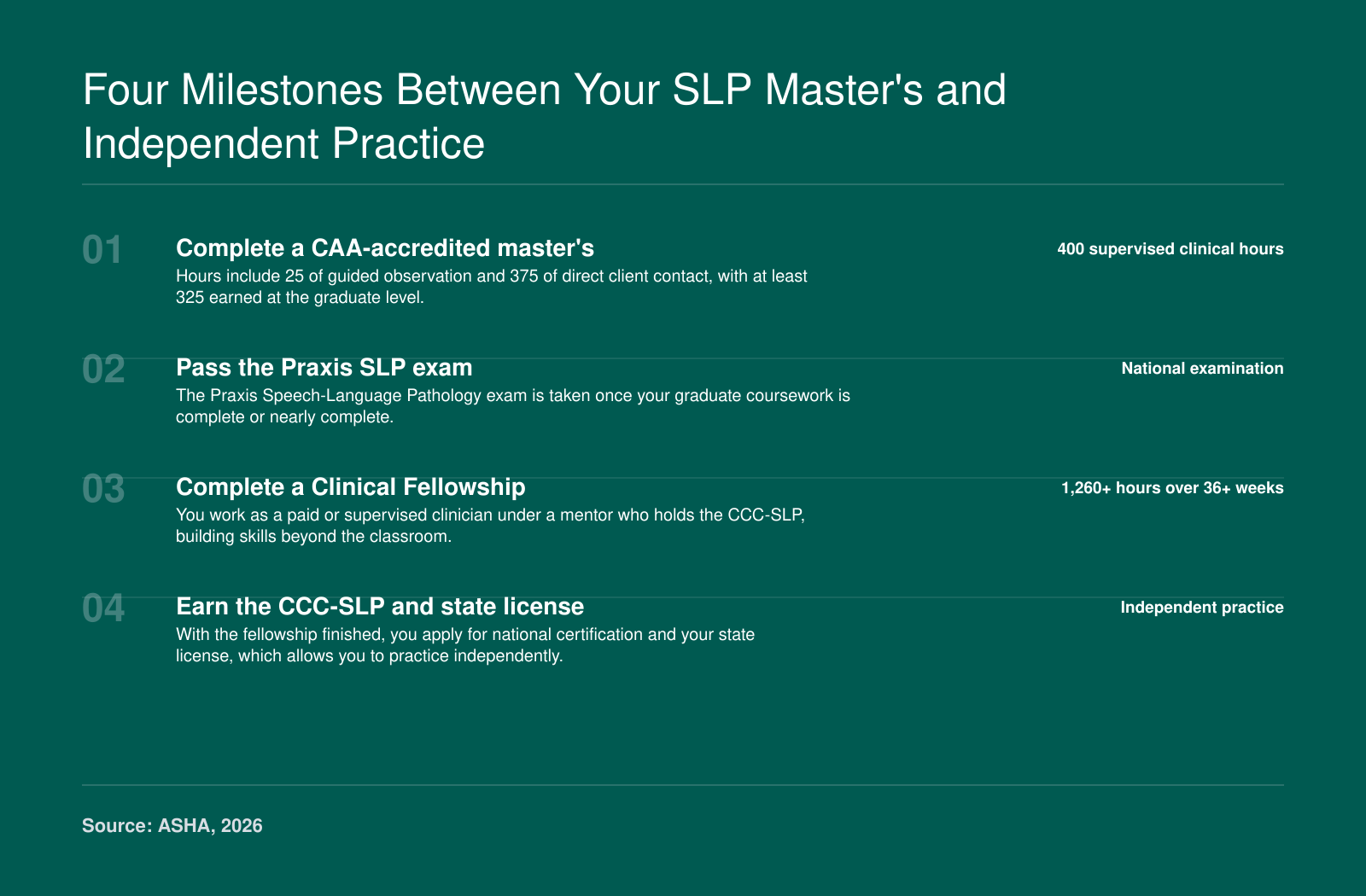
Four Milestones Between Your SLP Master's and Independent Practice
Becoming an independent speech-language pathologist follows a fixed sequence, and each step depends on the one before it. Note that state licensure requirements can add steps along the way, such as a jurisprudence exam or school certification for those who want to work in public schools.
Online or On-Campus? How SLP Delivery Formats Differ on Placements and State Access
Online and residential SLP master's programs lead to the same clinical degree, but they differ in who finds your practicum site and where you are allowed to enroll. Many online programs cannot admit residents of certain states because of state authorization rules or limits on placement sites. Each program publishes its own list, so check it before you apply. The examples below come from individual program pages and are not a complete picture of every school.
| Factor | Online (distance) programs | On-campus programs |
|---|---|---|
| Class format | University of Cincinnati delivers all academic courses asynchronously with recorded lectures. Cleveland State is primarily asynchronous. University of Wyoming uses online synchronous coursework in the fall semester. | Scheduled in-person classes, with set meeting times and little control over pacing. |
| On-campus immersion | Varies by program. Some require short campus visits, others do not. Confirm the requirement and travel cost before you apply. | Full-time attendance is the norm, so no separate immersion is needed. |
| Who arranges placements | Varies widely. South College states that all practicum occurs at sites with active affiliation agreements with the school. Other programs expect students to locate local sites and supervisors, so ask what support is guaranteed. | Usually built around a campus clinic plus partner sites. Indiana University Bloomington includes four semesters of practicum across its own clinic, school-based sites, and Camp Connections. Northeastern uses sites both on and off campus. |
| State availability | Often restricted. Programs may not enroll residents of certain states because of state authorization or placement limits. Check each school's state list for your home state. | Enrollment is not tied to home state, though the licensure rules of the state where you plan to practice still apply. |
| Schedule flexibility | High for coursework, especially in asynchronous formats. Practicum hours still follow site schedules, often during the workday. | Lower. Class and clinic times are fixed, which can make outside work difficult. |
| Cohort interaction | Mostly through discussion boards, video sessions, and occasional visits. Asynchronous formats offer less live contact. | Daily contact with classmates, faculty, and clinic supervisors. |
| Accreditation check | CAA includes a distance-education track in its accreditation decision when 50% or more of credit hours are delivered that way. South College's distance MSLP is listed as a Candidate for Accreditation, not fully accredited. | Indiana University Bloomington's residential program is listed as CAA accredited. Verify any program in the CAA listing. |
What SLP Graduate Programs Expect From Applicants
Requirements vary by school, so confirm each program's current policies before you apply. These are the common expectations.
- Bachelor's degree and CSD prerequisitesYou need a bachelor's degree. Applicants from other majors usually complete communication sciences and disorders prerequisites or follow a leveling plan, often called a bachelor's-to-master's pathway, before or alongside graduate work.
- ASHA background courseworkPlan on standalone courses in biology, chemistry or physics, social/behavioral science, and statistics or research methods. A general physical science course doesn't satisfy the chemistry-or-physics requirement. This coursework generally can't be CSD-related unless it also counts toward a general-education requirement open to non-CSD majors.
- GRE policySome programs have dropped the exam. The University of St. Augustine for Health Sciences, for example, no longer requires the GRE for its MS-SLP. No reliable 2026 national share of GRE-optional programs exists, so check each school.
- GPA, application materials, and observation hoursA 3.0 GPA is commonly cited as a minimum or preferred threshold, but there is no single nationwide cutoff. Admitted students are usually well above it: ASHA reported a median GPA range of 3.07–4.00 for 2023–2024 offers. Expect a personal statement, letters of recommendation, and often clinical observation hours. Many schools use the CSDCAS centralized application, but policies differ.
- SelectivityFor 2023–2024, about 45.3% of applications received an offer of admission, per a report citing ASHA's 2024 education survey. That figure is based on applications, not distinct applicants, so individual programs can be far more or less competitive.
Speech Pathology programs by state
Speech Pathology Graduate School: Common Questions
These answers draw on the program, cost, and accreditation findings covered above. Policies differ by school, so confirm details on each program's admissions page before you apply.
How long does it take to get a master's in speech pathology?
What are the prerequisites for a speech pathology master's program?
Do you need a GRE for speech pathology graduate school?
How much does a master's in speech pathology cost?
Can you complete a speech pathology master's degree online?
What happens if I enroll in a program that is still in CAA candidacy status?
Compare Speech Pathology programs on the data that matters
Explore more Communications & Media specializations or browse every graduate field.
All Communications & Media programs