Best Master's in Speech-Language Pathology Programs in New Jersey
Compare 12 accredited Speech Pathology programs in New Jersey at 10 schools, with graduate earnings, cost, debt, and completion data from IPEDS and the U.S. College Scorecard.
New Jersey has few SLP master's seats, and cohorts are small, so a poor fit is hard to undo. Rutgers targets classes of 18 to 25, and Seton Hall and Monmouth also admit in fixed cohorts.
Listed in-state program tuition runs from $16,963 at William Paterson University of New Jersey to $37,470 at Seton Hall University, a gap of more than $20,000.
Cost is only one variable. Nearly every program here requires full-time, lockstep enrollment, so the two-year commitment is set once you enroll.
Key Points
- Every school here uses CSDCAS, so one application reaches multiple New Jersey programs.
- Rutgers and Stockton state on their admissions pages that the GRE is not required.
- Clinical hours must be earned in person, even at Saint Elizabeth University's online-heavy format.
Best Master's in Speech-Language Pathology Programs in New Jersey for 2027
New Jersey's SLP master's options range from a pro bono clinic on the Rutgers Health campus in Newark to a six-year dual-degree route at TCNJ and a hybrid program in Morristown. Net price on each card is an institution-wide average for the whole university, not an exact quote for this program. The graduation rates cited below are also institution-wide, so they are not completion rates for the SLP cohort.
Rutgers University
#1New Brunswick, NJ · ~$23,000/yr (est.)
Best for: Bilingual students seeking diverse-population training
Rutgers' full-time, on-campus M.S. is built around the RU SLP Clinic, a pro bono clinic serving a multiethnic community, followed by two full-time externships in medical, educational, or private practice settings. Cohorts are small, with a target class of 18 to 25, and faculty include ASHA Fellows. The university's institution-wide graduation rate is about 84%, and in-state tuition is well below the private options in the state.
- Full-time, on-campus, completed in five consecutive semesters
- 65 total credit hours
- Accredited by the CAA of ASHA
- No entrance exam required
- 3.0 GPA minimum and two letters of recommendation
- Bilingual Competency Recognition in Spanish or Korean
- Two full-time externship placements
- Interprofessional education with Rutgers Health
The College of New Jersey
#2Ewing, NJ · ~$18,000/yr (est.)
Best for: Freshmen planning a straight-through bachelor's-to-master's path
TCNJ's route is a six-year dual degree: four years at TCNJ for a B.S. in Speech-Language Pathology and Audiology, then two years at Thomas Jefferson University for the M.S. It suits students who want the graduate seat settled as freshmen, and who can hold a 3.3 cumulative GPA. The cost figures shown reflect TCNJ's institution-wide numbers, so confirm Jefferson's graduate pricing for the final two years. TCNJ's institution-wide graduation rate is about 86%.
- B.S. from TCNJ, M.S. from Jefferson, over six years
- Hybrid delivery format
- 3.3 cumulative GPA and 3.0 in science prerequisites
- December 1 application deadline
- Supplemental application and interview for qualified candidates
- Contingent admission offered in mid-March
- Freshman applicants accepted
Monmouth University
#3West Long Branch, NJ · $25,000 – $30,000/yr (est.)
Best for: Career changers needing prerequisite bridge coursework
Monmouth's M.S.Ed. is a lockstep, in-person cohort program with a summer start, over 400 clinical hours, and a community clinic on campus that offers free treatment to local clients. It also offers a Bridge Program for applicants who lack the prerequisite coursework, which is useful for career changers. The school is private, so published tuition is higher than at the state institutions. The institution-wide graduation rate is about 72%.
- 60 credits over a two-year, six-semester sequence
- Full-time, in-person, summer start
- GRE not required
- 3.0 GPA minimum and two letters of recommendation
- Essay and oral audio recording required
- Applications through CSDCAS, $60 fee
- Prepares for NJ, NY, and PA licensure
- Capstone required
Seton Hall University
#4South Orange, NJ · ~$37,000/yr (est.)
Seton Hall's cohort-based, five-semester M.S. is based at its Interprofessional Health Sciences campus in Nutley. The program reports three guaranteed clinical placements, drawn from a network of 300+ sites, so students do not have to find sites on their own. Most placements are in New Jersey, with some in Pennsylvania. Sticker tuition is among the highest in the state, but the program says scholarships and graduate assistantships can cut cost substantially.
- 65 credits over five semesters, full-time, fall start
- 3.2 GPA minimum, prerequisite courses required
- Cohort-based structure
- Three guaranteed clinical placements
- No thesis or capstone required
- Partnership with Atlantic Health System
- Program reports 100% of graduates employed within one year
Stockton University
#5Galloway, NJ · ~$17,000/yr (est.)
Stockton pairs a low-cost public price tag with a hybrid structure: year one is in person with clinic and simulation lab work, then year two goes hybrid to support two 14-week full-time externships. Over 400 affiliated sites are available across the tri-state area, and the program reports a 97% Praxis pass rate among recent test-takers. A Bilingual English-Spanish Specialization is also offered. The institution-wide graduation rate is about 69%.
- Five semesters, full-time, fall start, one summer term
- Year one in person, year two hybrid for externships
- 400 supervised clinical hours
- No GRE required
- 3.0 GPA, five prerequisite courses, three recommendation letters
- Rolling review; March 20, 2027 deadline for fall 2027
- Thesis or capstone option
- Bilingual English-Spanish Specialization (BESS) track
- 63-credit curriculum, campus-based
- Faculty interview as part of admission
- CSDCAS application
- Comprehensive examination required
Kean University
#6Union, NJ · $20,000 – $25,000/yr (est.)
Kean is among the lower-cost public options, with a 63-credit, six-semester on-campus M.A. and an optional 12-credit NeuroAllies specialization in autism. Applicants must submit a video personal statement and, if invited, complete a departmental interview. GRE scores are required but waived for Summer and Fall 2027 applicants. The institution-wide graduation rate is about 47%, one of the lower figures on this list.
- 63 credits over six consecutive full-time semesters
- At least 400 supervised clinical hours
- Six credits of research and a comprehensive exam
- 3.0 GPA and three letters of recommendation
- Deadlines: January 15 (summer), February 15 (fall)
- No spring admission
- CSDCAS application required
- 12-credit optional specialization in autism
- On-campus delivery, summer or fall admission
- Interprofessional projects with PT and OT students
- Clinical training at the Center for Communication Disorders
William Paterson University of New Jersey
#7Wayne, NJ · $17,000 – $24,000/yr (est.)
William Paterson's campus-based M.S. is the shortest credit load here at 53 credits, and its public pricing is moderate. The curriculum covers speech sound, fluency, voice, acquired language, and motor speech disorders, with 12 practicum credits including an externship. Electives include cleft palate, autism spectrum disorder, and counseling in communication disorders. The institution-wide graduation rate is about 44%.
- 53 required credits, campus-based
- 12 practicum credits: diagnostic, clinical, and externship
- Three elective credits (e.g., cleft palate, autism spectrum disorder)
- Core courses in fluency, voice, and motor speech disorders
- Research methods and research seminar courses
Rutgers University-Newark
#8Newark, NJ · ~$23,000/yr (est.)
The Rutgers-Newark listing is for a five-semester, 65-credit, full-time M.S. with a Newark community focus. Students practice in the pro bono RU SLP Clinic in year one, then complete two full-time externships, with emphasis on multiethnic, bilingual, and dialectal speakers. Optional Bilingual Competency Recognition is available in Spanish and Korean. It carries the same public tuition as Rutgers, and the institution-wide graduation rate is about 64%.
- Full-time, completed over five consecutive semesters
- 65 total credit hours
- No entrance exam required
- 3.0 GPA minimum, two letters of recommendation
- Located on the Rutgers Health campus in Newark
- Work-study positions available
- Target class size of 18 to 25
Saint Elizabeth University
#9Morristown, NJ · $15,000 – $20,000/yr (est.)
Saint Elizabeth in Morristown offers a 60-credit hybrid M.S., with online academic courses and in-person clinical training. Note that the program is listed as a candidate for CAA accreditation (preaccredited), so verify its status before applying. Fieldwork can span NJ, NY, and PA, and bilingual faculty and clinicians are available. The institution-wide graduation rate is about 51%.
- 60 credits over two years, five semesters, fall start
- Hybrid: online coursework with in-person clinicals
- 375+ supervised clinical hours
- 25 clinical observation hours
- CAA candidate for accreditation (preaccredited)
- First-year clinical rotations, summer clinicals on campus
- Prepares for ASHA certification and teaching certification
Cost & outcomes by school
Federal data for the highest-earning Speech Pathology programs, independent of the ranking above. Earnings are this field's master's graduates four years after completing, where the Scorecard reports them.
| School | Earnings | Tuition / yr | Debt | Grads/yr | Format |
|---|---|---|---|---|---|
| Seton Hall University NJ | $74,497 | $37,470 | $76,292 | 40 | Campus |
| William Paterson University of New Jersey NJ | $72,447 | $16,963 | $40,758 | 35 | Campus |
| Stockton University NJ | $69,073 | $17,262 | $41,000 | 26 | Hybrid |
| Montclair State University NJ | $67,490 | $16,056 | $44,000 | 47 | Campus |
| The College of New Jersey NJ | — | $18,349 | — | — | Hybrid |
| Saint Elizabeth University NJ | — | $19,178 | — | — | Hybrid |
| Rutgers University-Newark NJ | — | $23,221 | — | — | Campus |
| Kean University NJ | — | $19,841 | — | 46 | Campus |
| Rutgers University NJ | — | $23,241 | — | 21 | Campus |
| Monmouth University NJ | — | $26,918 | — | 36 | Campus |
Sources: U.S. Department of Education. Tuition and graduates: IPEDS. Earnings and debt: College Scorecard, this field's master's graduates; a dash means no figure is reported.
Cost, debt & payoff
Median earnings of this field's master's graduates (4 yrs after completing) vs. their median federal loan debt · U.S. College Scorecard
Across these programs the median graduate earns about $69,073 and finishes with roughly $41,000 in debt — a ratio that clears a common rule of thumb (keep debt below first-year salary). Tuition and debt vary widely school to school, so check the per-school figures in the table above before you shortlist.
How Long It Takes to Become a Speech-Language Pathologist in NJ
How many years does it take to become an SLP in New Jersey? The direct path runs through a four-year bachelor's degree, a master's of about two years in one of the best speech pathology programs in New Jersey, and a 36-week clinical fellowship before full licensure.
Speech pathology master's programs vary by school. Monmouth's program is 60 credits over six semesters, starting in summer. Seton Hall runs five full-time semesters1, and Stockton runs five consecutive semesters over two years.
Career changers should plan longer. Kean requires applicants without a communication sciences major or minor to finish prerequisites such as phonetics and speech science before enrolling, and Stockton requires prerequisites completed by the end of the summer before entry. Sources don't confirm a formal three-year track at either school.
For a direct path, expect roughly six to seven years from starting college to licensure.
Most Affordable Master's in Speech-Language Pathology Programs in New Jersey for 2027
These schools are ordered by average net price after grant aid, using IPEDS and College Scorecard data from the U.S. Department of Education. Net price is an institution-level figure, so check each program's own tuition before you compare. Saint Elizabeth University is a private school with a single tuition rate, and its program is listed as a candidate for CAA accreditation, so confirm its status before you apply.
| School | City | Average net price | Program tuition (in-state) | Program format |
|---|---|---|---|---|
| Kean University | Union | $12,447 | $19,841 | Campus |
| William Paterson University of New Jersey | Wayne | $18,745 | $16,963 | Campus |
| Rutgers University-Newark | Newark | $19,703 | $23,221 | Campus |
| Stockton University | Galloway | $20,670 | $17,262 | Hybrid |
| Saint Elizabeth University | Morristown | $23,125 | $19,178 | Hybrid |
Online and Hybrid Speech Pathology Master's Programs in New Jersey
Online coursework is now common in speech-language pathology training, but clinical hours still have to be earned in person. None of the ranked speech-language pathology graduate programs is fully online. Saint Elizabeth University comes closest: academic courses run online, while clinical courses and summer clinicals take place on campus. It is CAA-accredited. Stockton University holds first-year classes and clinical work in person, then moves to a hybrid second year so students can complete full-time externships. Rutgers is campus-based, though second-year students take one online evening class a week from their externship sites.1
Part-time study is the real gap for working teachers and SLPAs. Rutgers, Monmouth, Seton Hall, Kean and Stockton all publish full-time-only structures.12 If you consider best online master's in speech-language pathology programs in other states, confirm they can arrange practicum placements in New Jersey.
Application Deadlines, CSDCAS, and Cohort Size by School
Most New Jersey deadlines fall in winter, roughly January to February, for fall entry, and Stockton is the one program here with a later March date. Every school below uses CSDCAS, so you can build one application and send it to several programs. Where a school gives no cohort size or acceptance rate, the table says "Not published" rather than guessing, and that includes Rutgers.
| School | Application System | Deadline (Fall Entry) | Cohort Size / Acceptance Rate | Out-of-Field Applicants |
|---|---|---|---|---|
| Rutgers University | CSDCAS | February 1 | Not published | Not published |
| Monmouth University | CSDCAS | February 1 for traditional and bridge candidates; December 1 for Monmouth bachelor's-plus-master's candidates | Not published | Not published |
| William Paterson University of New Jersey | CSDCAS | February 1 | Not published | Accepted with or without a speech-language pathology background |
| Kean University | CSDCAS (application must be completed and verified by the deadline) | February 15 (from the most recent posting; confirm for your entry year) | Not published | Not published |
| Stockton University | CSDCAS | March 20, 2027, for the Fall 2027 cohort | Not published; the cohort may fill before the deadline | Not published |
| Seton Hall University | CSDCAS | February 1 | Not published; students move through the program as a cohort | Accepted with a speech-language pathology degree or at least 18 credits of communication sciences and disorders coursework, grades of B or better |
Related Articles
Which New Jersey SLP Master's Programs Waive or Make the GRE Optional?
GRE policies vary widely among the programs ranked here, so verify each on CSDCAS before you apply.
- GRE not required: Rutgers University and Stockton University both state on their admissions pages that the GRE is not required, placing them among Master's in Speech-Language Pathology Programs With No GRE Required.
- GRE required (with a caveat): Kean University requires scores taken within five years, though it waives them for Summer and Fall 2027 applications. Monmouth University's current program page says the GRE is not required, while its 2026 graduate catalog lists it as required, so confirm which applies to your cycle.
- No published policy: Seton Hall University and William Paterson University do not state a GRE policy on their available admissions pages.
Where the GRE is optional or absent, as in No-GRE master's programs, expect holistic review to lean on GPA (Rutgers lists a 3.0 minimum1), prerequisite grades, a personal statement, and recommendation letters. Policies shift every cycle, so recheck each program before applying.
Cost of a Master's in SLP and New Jersey Licensure Requirements
The New Jersey Audiology and Speech-Language Pathology Advisory Committee sets a $245 state fee: a $75 nonrefundable application plus a $170 initial license, with renewal every two years.1 You also need a passing Praxis Speech-Language Pathology (5331) score and a completed clinical fellowship before independent practice.
Among the cheapest-ranked programs on our Most Affordable Master's in Speech-Language Pathology Programs list, the lowest in-state graduate tuition shown is William Paterson at $16,963, followed by Stockton at $17,262 and Kean at $19,841. Private Saint Elizabeth University lists a flat $19,178 rate, which is below Rutgers-Newark's $23,221 in-state figure, so don't assume a public program is always the lower-cost choice.
For public school work, you need a separate New Jersey Department of Education Speech-Language Specialist certificate. The standard certificate requires a master's or higher and a passing score of 162 on the Praxis II Speech-Language Pathology (5331).1
Published per-credit totals and SLP-specific aid vary among Master's Programs in New Jersey, so confirm graduate assistantships, department scholarships, and school-district tuition support directly. Net price figures are institution-wide averages, not the cost of the SLP program itself.
Where NJ Speech Pathology Graduates Earn the Most After Finishing
These figures are median earnings for master's graduates of each speech-language pathology program, from IPEDS and College Scorecard (2024), measured five years after finishing. William Paterson University of New Jersey leads on earnings and carries about $40,758 in median program debt. Stockton University has similar debt at $41,000 but lower earnings, and Seton Hall University graduates borrow far more, a median of $76,292, so weigh that gap against the pay.
| School | Median Earnings | Measured | Median Program Debt |
|---|---|---|---|
| William Paterson University of New Jersey | $77,676 | Five years after finishing | $40,758 |
| Seton Hall University | $74,275 | Five years after finishing | $76,292 |
| Stockton University | $64,502 | Five years after finishing | $41,000 |
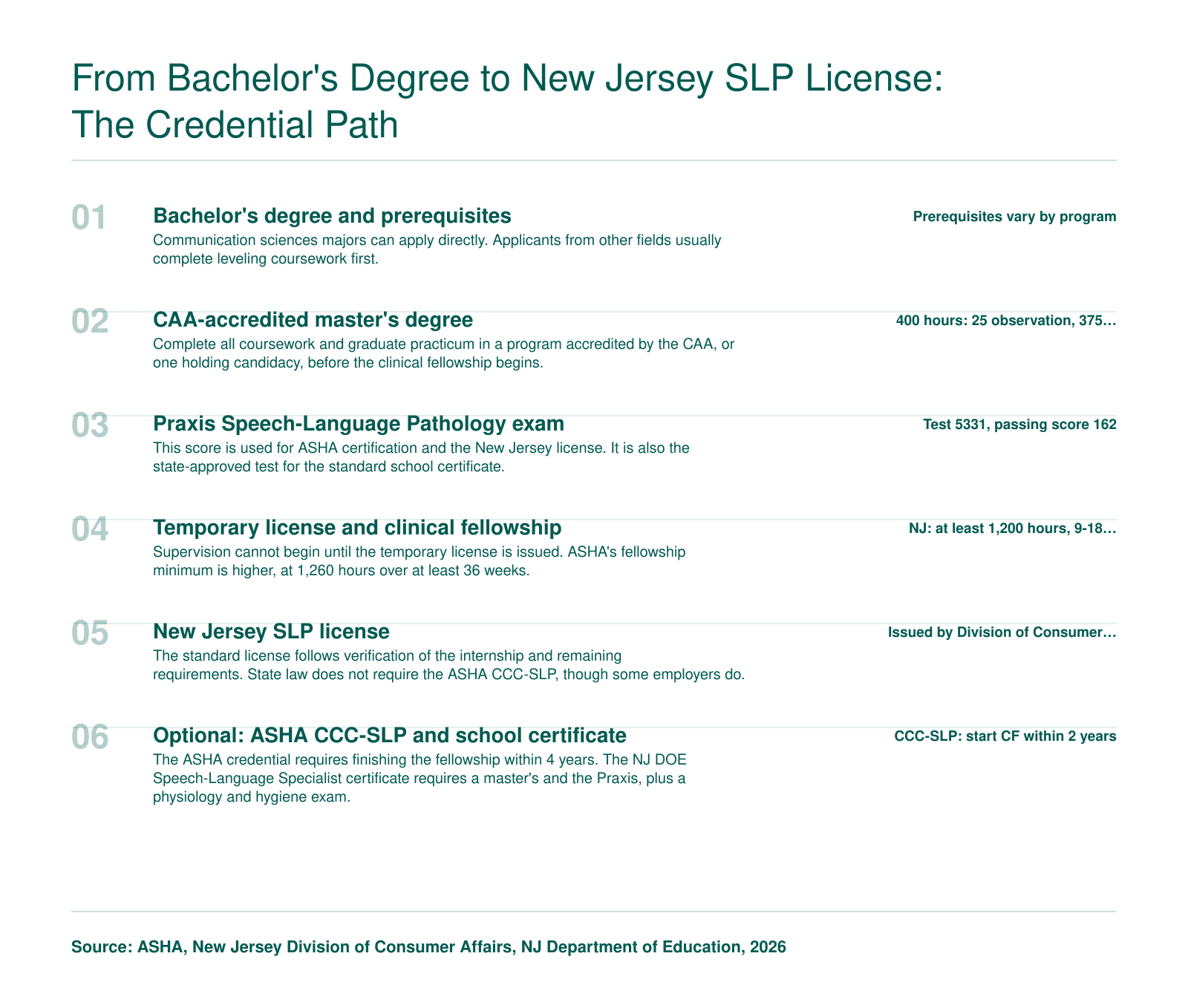
From Bachelor's Degree to New Jersey SLP License: The Credential Path
New Jersey licensure, ASHA certification, and the school certificate are separate credentials. The order below follows the state license first, with the optional credentials at the end. Confirm current rules with the Division of Consumer Affairs before you begin.
Comparing Clinical Placements and Specialties Across NJ Programs
A program built around its own on-campus clinic and one that leans on outside externships can both produce licensed clinicians, but they feel very different day to day. Clinical training is the biggest differentiator among the schools ranked here, because coursework looks similar from program to program while supervised hours do not. Ask each school how early students start seeing clients, how many hospital, school and outpatient settings it uses, and whether sites sit close enough to the New York or Philadelphia metros to give you varied caseloads without a punishing commute.
Specialty exposure works the same way. Bilingual or multicultural training, autism, medical SLP and fluency each depend on a program's faculty and placement partners, so confirm them on the program's own pages and with admissions staff before you count on them.
Praxis pass rates and employment rates are the fastest comparison. Programs post both on their accreditation-required outcomes pages.1 Check the reporting years and cohort definitions, since they differ.
Next step: shortlist two or three programs that fit your format, budget and clinical goals, then review each outcomes page before the winter deadlines.
Compare Speech Pathology programs on the data that matters
Explore more Communications & Media specializations or browse every graduate field.
All Communications & Media programs