Master's Programs in Hawaii
Every master's program reported by a school in Hawaii: 120+ programs at 5 graduate schools, with the online options, costs and outcomes behind each one.

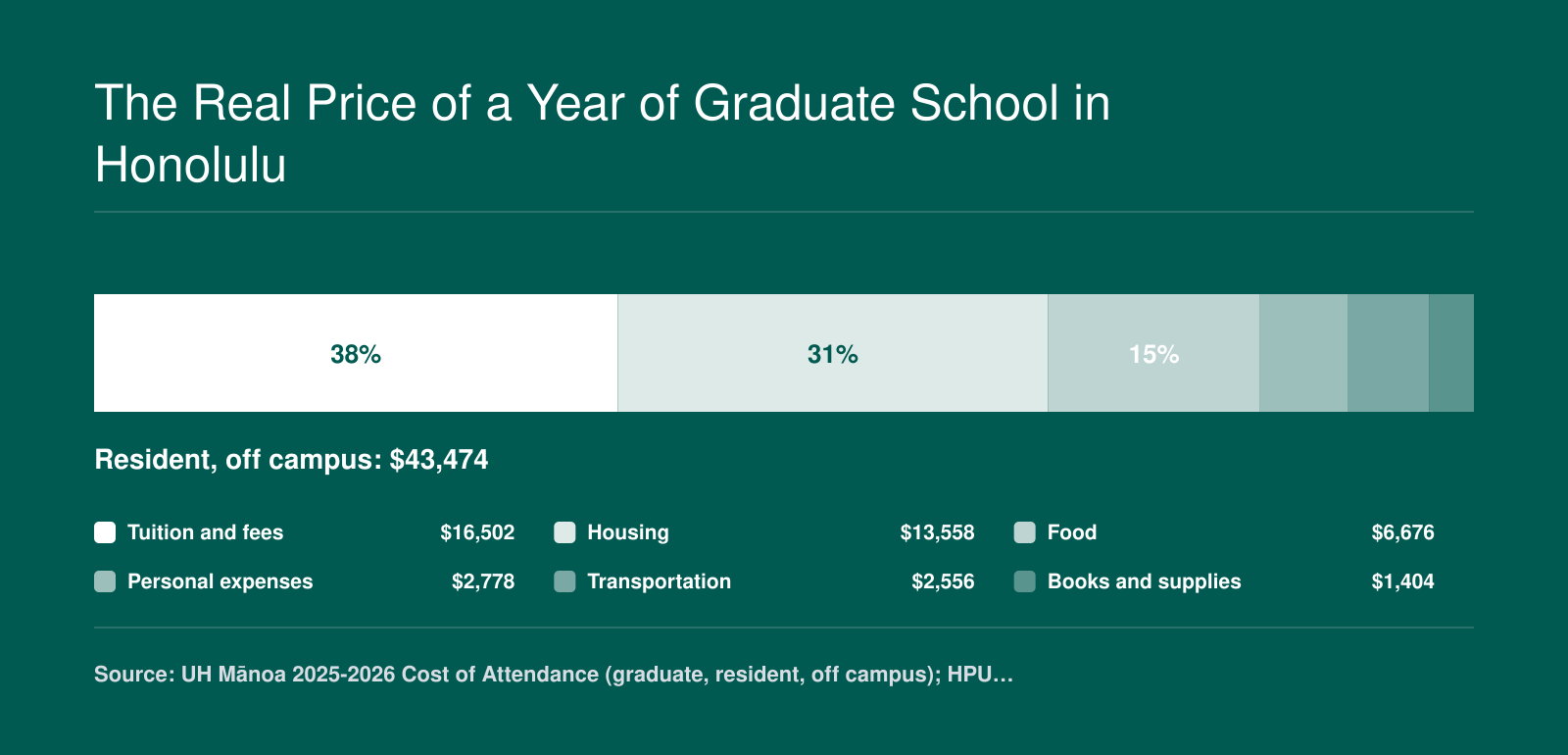
At UH Mānoa, graduate tuition runs $650 per credit for residents and $1,402 for nonresidents in 2025-26, with an off-campus year totaling $43,474 in Honolulu. With few graduate schools and one of the country's highest costs of living, cost, delivery format, and licensure fit matter more than the length of any program list.
The school and field directories on this page are a starting point. The harder questions are affordability, online or hybrid delivery, GRE requirements, assistantship funding, and Hawaii's separate licensing rules.
A longer clinical program that satisfies Hawaii's supervised-hour rules can be safer financially than a shorter degree that never leads to a license.
Key Points
- UH Mānoa charges residents $650 per credit and nonresidents $1,402 per credit in 2025-26.
- A resident's off-campus budget at Mānoa totals $43,474, with housing near tuition's size.
- Hawaii's counselor license requires 48 credits and 3,000 supervised hours after the degree.
Popular degrees in Hawaii
Master's programs in Hawaii by field
Education & Teaching
- Teaching9 programs
- Educational Leadership5 programs
- Special Education4 programs
- Secondary Education4 programs
- Educational Technology or Instructional Design3 programs
- Elementary Education3 programs
- Mathematics Education3 programs
- STEM Education or Science Education or Mathematics Education3 programs
Business & Management
- Public Administration4 programs
- Accounting3 programs
- General Business2 programs
- Management1 program
- Marketing1 program
- Human Resource Management or HR Management1 program
- Healthcare Administration or Healthcare Management1 program
- Healthcare Management1 program
Communications & Media
- Communication9 programs
- Speech Pathology1 program
- Communication Disorders1 program
- Social Media1 program
- Strategic Communication1 program
Social Work & Social Sciences
- Social Work4 programs
- Sociology3 programs
- Social Work Advanced Standing2 programs
- Political Science, Government1 program
Psychology
- Educational Psychology or School Psychology2 programs
- Counseling Psychology2 programs
- General Psychology1 program
- Clinical Psychology1 program
- Applied Behavior Analysis1 program
- Developmental Psychology1 program
- Social Psychology1 program
- Psychopharmacology1 program
Science & Engineering
- Geography3 programs
- Sustainability or Environmental Management3 programs
- Environmental Science1 program
Religion & Theology
- Divinity2 programs
- Theology2 programs
- Christian Leadership1 program
- Christian Ministry1 program
Counseling
- Clinical Mental Health Counseling3 programs
- School Counseling2 programs
Healthcare
- Public Health2 programs
- Speech Pathology1 program
- Clinical Research Management1 program
Nursing
- Psychiatric Mental Health Nurse Practitioner1 program
- Direct Entry MSN (MENP) or (DEMSN)1 program
- Adult Gerontology Acute Care Nurse Practitioner1 program
- Family Nurse Practitioner (FNP)1 program
Arts & Design
- Creative Writing1 program
Criminal Justice & Law
- Master of Laws1 program
Computers & IT
- Cybersecurity1 program
Cost and Tuition: What Hawaii Master's Programs Actually Charge
At the University of Hawaiʻi at Mānoa, general graduate tuition in 2025-26 is $650 per credit for residents and $1,402 per credit for nonresidents, before mandatory fees. That gap, plus campus-specific fees, drives the real cost difference across Hawaii master's programs.
Public tuition depends on campus and residency
UH Hilo charges $489 per credit for resident regular graduate students and $1,107 for nonresidents in 2025-26. The published UH West Oʻahu schedule lists $312 per credit for residents and $852 for nonresidents up to 11 credits, though the available source does not identify a separate graduate rate. Mandatory fees add $451 per semester at Mānoa for students under 12 credits and $324.50 per semester at Hilo for students taking one or more credits.
What a full 30 to 36 credit degree costs
Tuition alone, before fees, looks like this: - UH Mānoa: $19,500 resident and $42,060 nonresident for 30 credits; $23,400 resident and $50,472 nonresident for 36 credits. - UH Hilo: $14,670 resident and $33,210 nonresident for 30 credits; $17,604 resident and $39,852 nonresident for 36 credits. - UH West Oʻahu: $9,360 resident and $25,560 nonresident for 30 credits; $11,232 resident and $30,672 nonresident for 36 credits, based on the published per-credit rates.
These figures are tuition only. Mandatory fees, course fees, books, and graduate student health insurance are extra. For a student below 12 credits each term, Mānoa's $451 fee would add roughly $1,804 over four semesters and Hilo's $324.50 fee would add $1,298 over four semesters. Full-time loads often use a different fee schedule, so verify the exact amount before comparing net cost.
Private schools and professional-program pricing
Hawaiʻi Pacific University and Chaminade University of Honolulu generally use a single graduate tuition rate regardless of residency, so out-of-state students do not pay the public nonresident premium. The 2025-26 system schedule does not include HPU or Chaminade rates, so confirm those figures directly in each school's current catalog. Professional programs can also diverge from standard graduate pricing: UH Mānoa lists higher tuition for nursing, architecture, and the PhD in Business Administration, while UH Hilo's $489 and $1,107 rates apply to regular graduate students, excluding pharmacy and nursing. Online, outreach, and executive-format courses may carry separate per-credit or flat rates, so check those schedules before comparing programs by tuition alone.
The Real Price of a Year of Graduate School in Honolulu
Tuition is only part of the bill in Honolulu. UH Mānoa's 2025-2026 budget for a resident graduate student living off campus totals $43,474, and housing at $13,558 comes close to tuition and fees combined. It assumes 8 credits per semester, and everything except tuition and fees is an estimate, not a charge from the university. Renting a one-bedroom alone would cost more: reported 2026 medians run $1,951 to $2,100 a month. Hawaiʻi Pacific University's independent-living graduate budget is $63,092 for most programs, with $35,784 of that in tuition.
Online, Hybrid, and Campus Formats for Hawaii Master's Programs
Can you earn a master's degree in Hawaii without living on Oʻahu, or without living in Hawaii at all? Sometimes, but the answer depends on the program, and the public information is uneven. Confirm delivery details with each graduate office before you apply.
Where Fully Online Options Exist
Chaminade University of Honolulu is the clearest case. Chaminade's graduate admissions page lists 100% online master's degrees in Curriculum & Instruction Leadership (30 credits, about 15 months), Educational Leadership (30 credits, about 18 months), and a Master of Education (about 18 months). The Master of Pastoral Theology (34 credits, about 20 months) is hybrid. Chaminade describes its schedules as built for busy adults, with online and evening courses.
UH Hilo delivers several master's programs at a distance. The M.Ed. is a 30-credit distance program, with courses for practicing teachers offered online, in the evenings, and in summers. Students typically take 4 to 6 credits a semester over four semesters and two summers. The M.A. in Counseling Psychology and the M.A. in Indigenous Language & Culture Education are delivered by videoconferencing.
UH Mānoa's Outreach College advertises flexible, year-round delivery for professional programs, and Hawaiʻi Pacific University also serves working adults. Published details on which specific master's degrees are fully online were limited, so check program pages directly.
Synchronous vs. Asynchronous, and the Time Zone
Asynchronous courses let you watch lectures and submit work on your own schedule. Synchronous courses, including videoconferenced classes, meet at set times. Hawaii has no daylight saving time, so evening sessions can land in the middle of the day or the early afternoon on the mainland, and the gap changes through the year. Ask whether live sessions are required and whether they are recorded.
Residencies, Practicums, and Neighbor Islands
An online label does not always mean fully remote. Counseling, teaching, and other licensure-track degrees usually include practicums or clinical placements that you complete in person, and some programs add residencies. Ask for placement rules before enrolling.
For students on Hawaiʻi Island, Maui, Kauaʻi, and other neighbor islands, distance and videoconference formats can remove the cost of relocating to Oʻahu.
A Practical Takeaway for Working Professionals
Look for programs with evening courses, summer terms, and a 4 to 6 credit semester load. Confirm the deadline too: UH Hilo's M.Ed. listed an April 1, 2026 priority date and a June 30, 2026 final date for Fall 2026, and its graduate page points to a Fall 2027 cohort.
What a Typical Hawaii Graduate Application Requires
Hawaii has no single graduate standard. Requirements are set program by program at UH Mānoa, UH Hilo, Hawaiʻi Pacific University and Chaminade, so treat the items below as a pattern and confirm the details with your program.
- Bachelor's degree and GPAExpect to need a bachelor's degree from an accredited institution. UH Mānoa sets no university-wide minimum GPA, so each program decides. UH Hilo lists a 3.0, applied to your last 60 semester credits, and a graduate degree with a 3.0 can also satisfy it. Chaminade accepts a bachelor's or master's degree. Check HPU program pages directly.
- Transcripts, statement and lettersTranscripts and a statement of purpose or academic goals are standard. UH Hilo requires a statement and three recommendation letters, and the UH Mānoa Pacific Islands Studies M.A. also asks for three. Other programs vary.
- English proficiencyMost applicants who are not native English speakers must submit scores, and minimums vary by program. UH Hilo lists TOEFL 67, IELTS 6.0, Duolingo 100 and Cambridge 161. Chaminade lists TOEFL 79, IELTS 6.5, PTE 53 and Duolingo 95.
- Program-specific itemsMany programs add a resume, writing sample, prerequisite coursework or an exam. UH Hilo's exam requirement is program-specific, and its catalog wording on the GRE is inconsistent, so ask the department.
- DeadlinesThe UH Mānoa Graduate Division does not set a universal fall or spring deadline, and the departments do. The English M.A., for example, has a January 1 fall deadline and no spring admission. UH Hilo's 2025–26 priority deadlines ran from December 1 to April 1 depending on the program. Chaminade's priority deadline is 30 days before each term starts. Don't plan around a general university date; use your department's.
Which Hawaii Master's Programs Don't Require the GRE?
A No-GRE master's program is one where you can be admitted without submitting a standardized graduate exam score, either because the program never asks for it or because it grants waivers under specific conditions. In Hawaii, whether you need the GRE or GMAT depends almost entirely on the individual program, not the university, so the honest answer to "does this school require a test?" is usually "it depends on the department."
The University of Hawaii System
UH Manoa has no university-wide GRE requirement. Its Graduate Division states that the exam may be required by some programs, recommended by others, and ignored by the rest. That means you cannot assume anything from the institution's name alone; you have to read the admissions page for the specific master's you want.
UH Hilo requires the GRE for some applicants but builds in a clear waiver: if you have already completed a graduate program at a regionally accredited U.S. institution (or an equivalent credential abroad), you generally do not need to submit scores. Individual programs there may also accept a professional licensing exam instead, and they set their own minimum scores.
The Private Universities
At Hawaii Pacific University, most of the 20-plus graduate programs do not require a standardized test at all. The notable exceptions are the MBA and the MS in Information Systems, which accept either the GMAT or the GRE, and the MS in Marine Science, which asks for the GRE. HPU also offers a limited GMAT fee waiver worth $250 for economically disadvantaged business applicants, but that covers the test cost, not the admissions requirement itself.
We could not confirm Chaminade University's current test policies from reliable 2026 sources, so treat anything you read secondhand with caution and verify directly.
Confirm Before You Apply
Common waiver criteria across these schools include a strong undergraduate GPA, substantial professional experience, or a prior graduate degree. Because departments revise these rules often, check the program page for your exact entry term before you decide to skip or sit the exam.
Funding, Assistantships, and Financial Aid
The sticker price of a Hawaii master's degree and what you actually pay can be two very different numbers, but closing that gap usually depends on landing a funded position rather than filling out one more aid form. In Hawaii, the largest discounts come from working for your department, not from applying for aid.
Graduate assistantships at the UH campuses
At UH Mānoa, a half-time (0.50 FTE) graduate assistantship carries a 100% tuition exemption for eligible fall and spring Mānoa coursework, paid alongside a stipend disbursed across the year. Student fees are not covered, and anything outside the exemption's scope remains your responsibility. The appointment has to run at least 12 weeks, or you become liable for the full tuition bill. Law and medical students are not eligible.
UH Hilo works similarly: a 0.50 FTE appointment (20 hours per week) exempts full-time graduate tuition for approved fall and spring courses, while a quarter-time appointment exempts half. Fees are excluded in both cases. You generally need to be in good standing and enrolled in at least six credits, and the tuition exemption form has to be submitted every semester, by August 1 for fall and December 1 for spring.
The practical point for applicants: assistantships at both campuses are awarded by academic departments, not the financial aid office. Ask the graduate chair about availability before you apply, and ask early. Aid applications do not put you in the queue.
Private campus awards
Hawaiʻi Pacific University offers graduate assistantships that provide roughly 25% or 50% tuition remission, renewable for up to four continuous semesters, in exchange for 9 or 18 hours of work per week in research or administrative duties outside your degree requirements. These target newly enrolled full-time students in selected programs, and the number of awards varies. Remission is tuition only; no cash stipend is published. Chaminade has advertised a one-time $5,000 scholarship toward eligible graduate programs for applicants who apply and complete a response form, though the eligible programs and renewal terms are not spelled out publicly.12 Confirm both directly with the school.
Hawaii-specific and federal sources
The Hawaiʻi Community Foundation administers a large scholarship portfolio, and Kamehameha Schools funds Native Hawaiian students at the graduate level. Current award amounts, deadlines, and eligibility for 2026 are not clearly published, so treat these as leads to verify rather than budget line items. Native Hawaiian students at UH should also ask about support through Kuaʻana Native Hawaiian Student Development Services. State teacher and healthcare workforce stipends and loan repayment surface periodically; confirm whether any are open before counting on them.
Federal Direct Unsubsidized loans and Grad PLUS fill the remainder for most students. If you are heading into public school teaching, state agencies, or nonprofit health systems, Public Service Loan Forgiveness is worth modeling before you borrow.
Licensure: Which Hawaii Master's Degrees Lead to a License
In clinical and school-based fields, a Hawaii master's degree is only half of the credential, because the license is issued separately and the state sets its terms, not the university. DCCA Professional and Vocational Licensing handles social work, clinical mental health counseling, and marriage and family therapy. The Board of Nursing oversees advanced practice nurses, and the Hawaii Teacher Standards Board (HTSB) licenses educators.
Social Work, Counseling, and Family Therapy
- LCSW: A master's in social work from a CSWE-accredited MSW program (or an otherwise recognized one), then at least 3,000 post-graduate supervised agency hours over no fewer than two and no more than five years. That includes at least 100 hours of direct supervision. Applicants must pass the ASWB clinical exam.1 The official material reviewed here covers the LCSW, not the entry-level LSW, so confirm LSW requirements with DCCA directly.
- LMHC: A graduate counseling or allied-field degree from an accredited institution, with at least 48 semester hours of graduate counseling coursework and at least three semester hours in each required subject. Expect 3,000 hours of post-graduate supervised experience and the National Counselor Examination. The supervision breakdown is in DCCA's application instructions.2
- LMFT: A master's or doctoral degree in marriage and family therapy, or an allied field with at least 33 semester hours across listed course areas.4 The program must include a one-year practicum with 300 supervised client-contact hours. Before applying, you need 1,000 direct hours and 200 supervision hours over at least 24 months, then the NMFT exam.3
Hawaii also has an associate MFT pathway. It requires the same degree and practicum but no exam,6 and it lets you accrue supervised hours while working toward full licensure.5
Nursing and Education
MSN and DNP graduates seeking APRN recognition apply through the Hawaii Board of Nursing. School counselors and administrators go through HTSB, which looks at your degree, supervised experience, and exams. The sources reviewed do not spell out current APRN or HTSB specifics, so get certification, clinical-hour, and exam details from those agencies before you choose a program.
Accreditation and Online Programs
Program accreditation from CSWE, CACREP, or CCNE is often a licensure prerequisite, or at least the easiest way to prove your coursework qualifies. An unaccredited program can leave you filing for individual coursework review or retaking classes.
Online students enrolled in out-of-state programs carry the most risk. A mainland program may be fully accredited and still miss Hawaii's required subjects, practicum structure, or supervision rules. Before you pay a deposit, ask the program for written confirmation that its curriculum meets Hawaii board standards, and check that same point with the licensing board yourself.
Hawaii Licensing Snapshot: Mental Health Counselors
What Master's-Level Jobs Pay in Hawaii vs. the U.S.
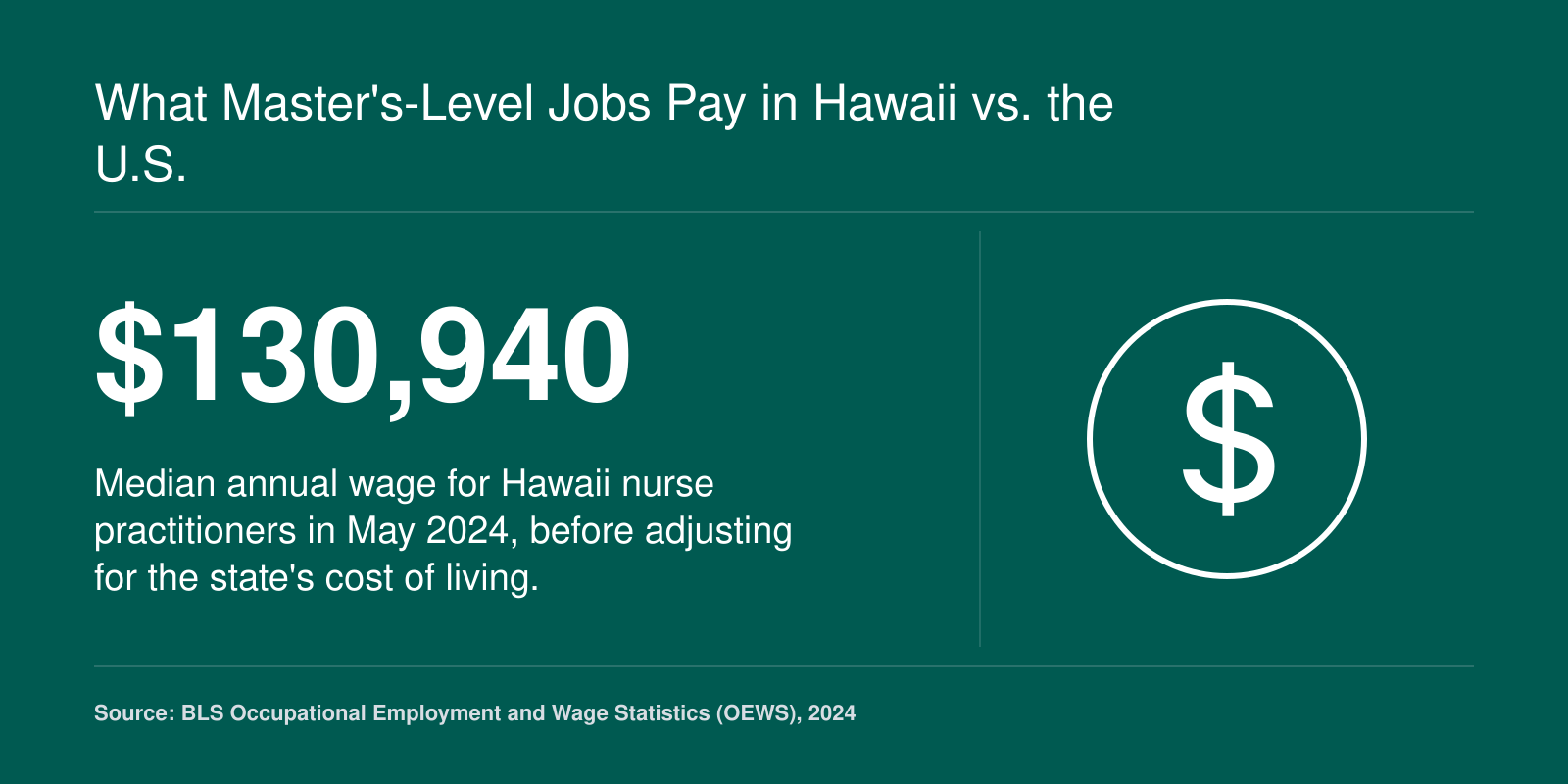
Master's-level jobs in Hawaii can pay well, but the state's high housing and living costs absorb much of the difference. Nurse practitioners are the clearest example, and the Hawaii median is shown below. We have not verified matching national medians for the other master's-level occupations, so we are not charting a Hawaii versus U.S. comparison for them. Check current BLS figures for your specific field before judging a degree's payoff.
Accreditation: How to Choose a Reputable Program
Chaminade University of Honolulu has held WSCUC accreditation since 1960, and the commission's most recent action on its status came on April 27, 2026.1 That kind of institutional seal is the baseline every legitimate Hawaii graduate school should clear.
Institutional Accreditation Comes First
UH Mānoa, UH Hilo, UH West Oʻahu, Hawaiʻi Pacific University, and Chaminade are all accredited by the WASC Senior College and University Commission (WSCUC), the regional accreditor for Hawaii, California, and the Pacific.2 Institutional accreditation affects your eligibility for federal student aid, whether credits transfer, and whether employers and other universities take your degree seriously. You can confirm any school's standing in WSCUC's institution directory and in the U.S. Department of Education's accreditation database.
Specialized Accreditation Matters for Licensed Fields
In professional fields, a second layer often decides whether your degree leads anywhere. Key accreditors include CSWE for social work, CACREP for counseling, CCNE or ACEN for nursing, AACSB for business, CAEP or AAQEP for teacher preparation, and ASHA's accrediting council for speech-language pathology. Licensing boards, certifying bodies, and many employers look for graduates of programs holding one of these.
A few confirmed examples: HPU's Master of Social Work is a CSWE-accredited online MSW program available in Honolulu and online, with its next review set for June 2029. UH Hilo's College of Business and Economics holds AACSB accreditation, and Chaminade reports full AAQEP accreditation for its listed programs through December 31, 2030.3 Public records don't offer a complete program-by-program picture, so a missing listing isn't proof a program lacks accreditation. Check directly.
Red Flags in Online Marketing
Online providers advertising to Hawaii residents vary widely in quality. Be wary of:
- No recognized accreditor: Or an accrediting body you can't find in federal or CHEA databases.
- Guaranteed admission: Legitimate graduate programs actually review transcripts and qualifications.
- Flat per-degree pricing: One sticker price with no per-credit breakdown hides what you're paying for.
A Five-Minute Check
Before applying, search the school in the Department of Education database, then look up the specific program in the relevant specialized accreditor's directory, such as the CSWE Program Directory for social work. If either search comes up empty, ask admissions for written documentation before you pay an application fee.
Accreditation and state board approval matter more than format or brand; they make a master's degree usable for licensure and reputable in hiring.
Graduate schools in Hawaii with the most master's programs
| School | City | Type | Master's programs | Online | Grad tuition / yr |
|---|---|---|---|---|---|
| University of Hawaii at Manoa | Honolulu | Public | 71 | 19 | $16,502 |
| Hawaii Pacific University | Honolulu | Private nonprofit | 24 | 19 | $21,485 |
| Chaminade University of Honolulu | Honolulu | Private nonprofit | 18 | 12 | $26,880 |
| University of Hawaii at Hilo | Hilo | Public | 10 | 1 | $12,230 |
| Pacific Rim Christian University | Honolulu | Private nonprofit | 3 | 1 | $13,710 |
Program counts are the verified master's listings in our directory; tuition is the school-wide average for a full-time graduate student (IPEDS).
Hawaii Master's Programs: Common Questions
These are the questions prospective students ask most often when weighing a Hawaii master's. Details vary by program, so confirm specifics with the department you are considering.
How long does it take to complete a master's degree in Hawaii?
Can out-of-state students qualify for Hawaii resident tuition?
Can I enroll in a Hawaii school's online master's from the mainland or abroad?
Is a master's worth it given Hawaii's cost of living?
Compare programs nationwide
Many Hawaii residents study online. Every ranked list above has an online lens, or browse every field.
Online master's programs Browse all fields