Accelerated Master's Programs
Programs whose published length is a year or less, or that describe themselves as accelerated. Facts come from each program's own page, so the lists are conservative.
At many U.S. universities, an accelerated master's cuts the bachelor's-to-master's route by a year or more. A typical 4+1 pathway lets a junior count up to 12 graduate credits toward both degrees.
Yet accelerated is not one format. The field and program directory above organizes options, but the same label can mean a shared-credit 4+1, a 3+2 professional sequence, or a one-year online master's. GPA cutoffs and billing rules differ enough to change real cost.
Savings hinge on how many graduate credits are billed at undergraduate rates and how many semesters disappear, so the label alone is no guarantee of value.
Key Points
- In 4+1 pathways, up to 12 graduate credits can count toward both degrees.
- Savings come from fewer semesters and graduate credits billed at undergraduate tuition rates.
- Federal earnings data doesn't separate accelerated graduates, so verify accreditation and licensure fit first.
Business & Management
Education & Teaching
Nursing
Healthcare
Communications & Media
Psychology
Social Work & Social Sciences
Counseling
Computers & IT
Science & Engineering
Religion & Theology
Arts & Design
Criminal Justice & Law
What Is an Accelerated Master's Program? 4+1, Shared-Credit, and 1-Year Formats
In a typical 4+1 pathway, a student applies during junior year and starts graduate-level coursework in senior year, with up to 12 graduate credits counting toward both the bachelor's and the master's degree.
Three Common Formats
- 4+1 or combined bachelor's/master's: Universities offer joint BS/MS or BA/MA tracks. Students apply in junior year, begin graduate courses in senior year, and complete the master's in one additional year.
- Shared-credit or double-counting: A set number of credits, often 6 to 12, counts toward both degrees. This reduces total credits, tuition, and time compared with earning the two degrees separately.
- Standalone 1-year or intensive master's: For students who already hold a bachelor's, these programs pack a full master's curriculum into roughly 12 months, usually through full-time study and summer terms.
How These Differ from a Traditional Master's
The clearest difference is timing. In a traditional master's, students usually apply after finishing a bachelor's, begin graduate study the following fall, and spend 1.5 to 2 years enrolled. In a 4+1 or shared-credit model, graduate coursework starts during the senior year, so the total time from first enrollment to master's completion shrinks to about five years. Standalone 1-year programs do not start early, but they compress the post-bachelor's timeline.
What Online 1-Year Programs Actually Do
One-year online master's programs often accelerate through compressed terms, such as 7- or 8-week courses and year-round enrollment, rather than through shared undergraduate credits. Students complete the same required coursework in a shorter calendar window, which generally means a heavier weekly workload.
A Label That Requires Checking
The term accelerated is used loosely. One school's 4+1 program may be another school's shared-credit option, while a third uses the label for a fast-paced online degree. The verification steps that follow show how to confirm exactly what a given admissions page is offering.
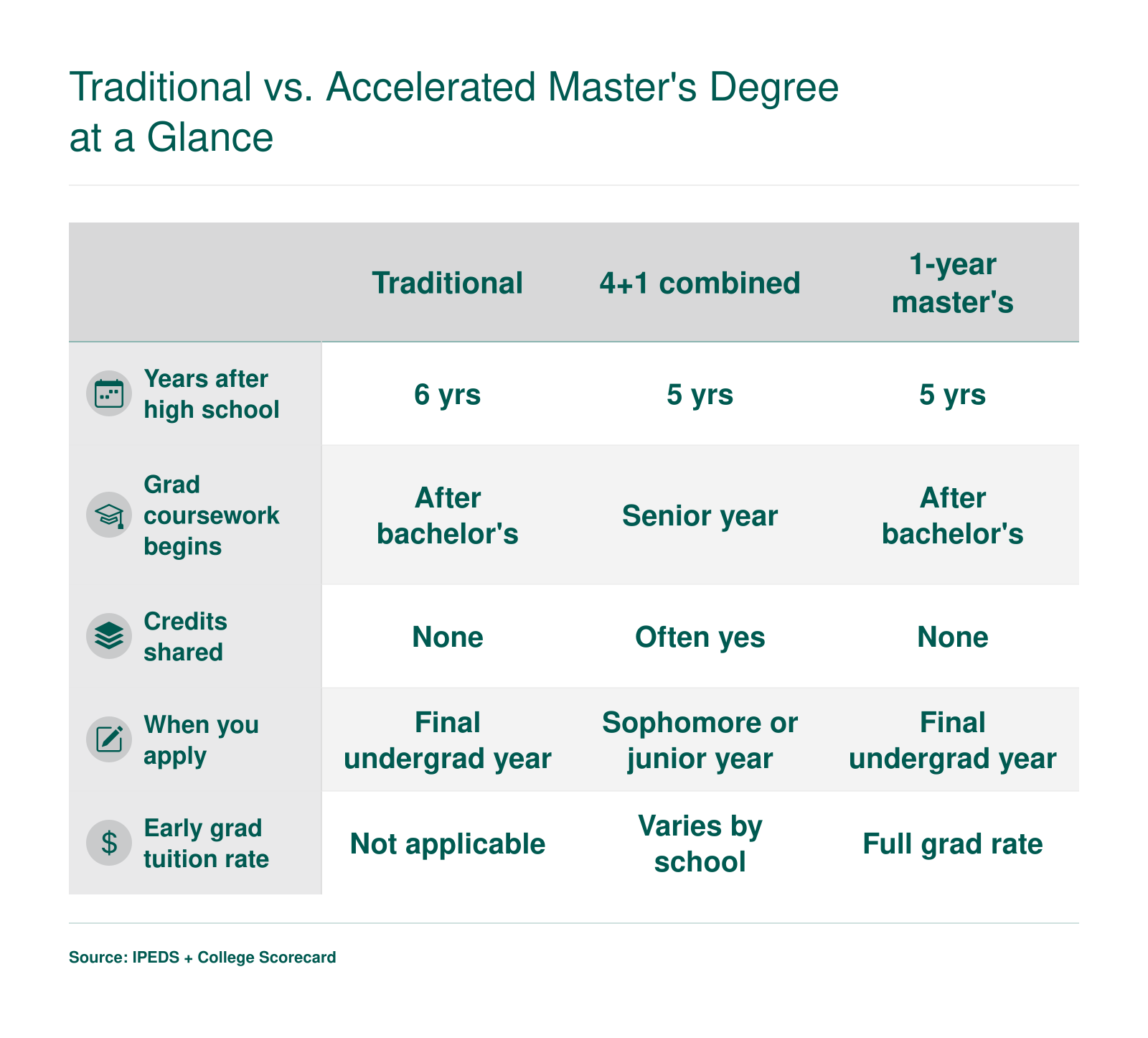
Traditional vs. Accelerated Master's Degree at a Glance
The three routes below differ mostly in structure: when graduate coursework starts, whether credits count twice, and what you pay for early graduate courses. Ranges are typical, so confirm details with each program.
How Much an Accelerated Master's Program Costs and Where the Savings Come From
How much does an accelerated master's program cost, and where do the savings actually come from? The honest answer: it depends on how many graduate credits get billed at undergraduate tuition rates and how many semesters disappear from your timeline. There is no single national dollar figure. Published savings range from roughly 25% in Bushnell's Accelerated Dual Degree Pathways to as much as 40% in Lehigh's Bioengineering 4+1 M.S., and the conditions behind each number differ.
The Two Savings Mechanisms
Savings in a 4+1 or shared-credit pathway come from two levers. The first is double-counting: when 12 to 18 graduate credits satisfy both your bachelor's and master's requirements, those are credits you never pay for twice. At Lehigh, 12 credits count toward both degrees, leaving 18 of the 30 required master's credits billed at the graduate rate.
The second lever is tuition rate. Graduate courses you take during your senior year are often absorbed into flat-rate undergraduate tuition. At Lehigh, undergraduate tuition is a whole-balance charge, so 12 credits cost the same as 12 or more, which is how the program reaches a 40% reduction for students taking only 18 credits at the graduate rate.
A Worked Example
Tulane University's School of Professional Advancement publishes a concrete Fall 2026 estimate for its Accelerated 4+1 Master's Programs, a 33-credit program. Taking two courses at undergraduate rates saves about $1,800, and a 20% discount available for two years after admission trims another $5,580. That drops a $29,700 sticker to a $22,320 net cost; Tulane markets the total potential savings as over $10,000. After the two-year discount window closes, full graduate tuition applies.
Add the Opportunity Cost, Then Check the Fine Print
Finishing a year early carries a value the tuition tables miss: a full year of salary earned while traditional-track peers are still in school. For many fields that extra year of earnings rivals or exceeds the tuition you saved.
Savings shrink in two situations. Some programs bill graduate rates the moment graduate coursework begins, erasing the undergraduate-rate advantage. One-year master's programs with premium tuition can also cost as much as a two-year track despite the shorter calendar. Lab fees and graduate-equivalent premiums may apply even where credits transfer, as at University of Michigan-Dearborn.1 Confirm the per-credit rate and which credits qualify before assuming the discount.
Shared-Credit Limits and GPA Cutoffs at Sample Universities
Published 4+1 and combined-degree rules vary widely, so this table illustrates the range and does not rank schools. The cap on graduate credits that can be double-counted runs from about 6 to 15 credits, with 9 credits a common ceiling, and one school sets its cap as a share of the graduate program instead. Policies change, so confirm current rules in each school's graduate catalog before you plan your course schedule.
| University | Max Shared/Double-Counted Credits | Minimum GPA to Enter | Minimum Grade in Shared Courses | When to Apply |
|---|---|---|---|---|
| Arizona State University (Accelerated Master's) | Up to 15 credit hours | N/A | N/A | Junior year, working with the accelerated program advisor |
| Loyola University Chicago (Accelerated Master's Pathways) | Up to 50% of the graduate credit hours required; the catalog sets the exact maximum percent | N/A | N/A | Ideally junior year, approaching 60 to 90 credit hours |
| Miami University (Combined Degree Programs) | Up to 9 graduate credit hours | 3.00 | N/A | Starting junior year, on earning junior or senior standing |
| University of Hawaiʻi at Mānoa (BAM/BAP Combined Degree Pathways) | Up to 9 credits | 3.0 | B or better | N/A |
| Sacred Heart University (Combined Program) | Up to 6 graduate-level swing credits | Set by the applicable graduate degree program | N/A | N/A |
| Villanova University (Combined Bachelor-Master Programs) | Up to 9 credits | 3.0 graduate GPA must be maintained | N/A | N/A |
| University of Michigan-Dearborn (Applied Behavior Analysis 4+1 Concentration) | Up to 15 credits | 3.25 | B or better in each double-counted or transferred 500-level class | After at least 60 undergraduate credit hours, through a two-stage process with undergraduate and graduate advisors |
| Case Western Reserve University (Integrated BS/MS) | Up to 9 credits | 3.0 | N/A | After 60 semester hours and before senior status (90 semester hours) |
How to Verify an Accelerated Program on an Admissions Page
Accelerated pathways have no national standard, so the details that matter sit in each university's own policy. Look for these six items on the program page or in the advising handbook before you commit. Utah State, Stony Brook and Saint Louis University all publish GPA minimums, but the rules around them differ.
- Credit capFind the exact number of graduate credits that count toward both degrees. Don't assume a school-wide limit applies to your department.
- GPA thresholdLook for two numbers: the entry GPA and the GPA you must keep once graduate courses begin. Published entry minimums run from 3.0 at Purdue Engineering to 3.25 at Saint Louis University, 3.3 at Stony Brook and 3.5 at Utah State. Some schools allow exceptions, and others don't.
- Automatic vs. competitive admissionCheck whether meeting the criteria guarantees a seat or only makes you eligible to apply. At UMass Amherst, an early offer is conditional and comes at the graduate program's discretion. At Utah State, eligibility is confirmed but a graduate application is still required.
- Program agreement or course designation formCheck whether courses must be approved as shared before you enroll. Arizona State's English program requires a signed Accelerated Master's Program Agreement Form, and UMass Dartmouth asks for a combined BS/MS program of study. Missing a form can cost you the shared credit.
- Billing rateConfirm whether early graduate courses are charged at undergraduate or graduate tuition. This determines how much the pathway actually saves, so ask the bursar's office if the page doesn't say.
- Exit optionFind out what happens to shared credits if you leave the pathway and graduate with only the bachelor's. At Purdue, dual-counted status no longer applies after an exit and readmission as a master's student. Stony Brook uses a complete-withdrawal form. Ask whether the credits stay on your bachelor's record.
Accreditation and Quality Checklist for Accelerated Pathways
The appeal of an accelerated master's is clear: you are trading time and money for a faster route. The tradeoff to verify is whether the shorter path still gives you a credential that licensing boards, employers, and future doctoral programs treat the same as the traditional master's. Accreditation is the first test, but it is not a single checkbox.
Start with institutional accreditation
An accelerated pathway typically inherits the university's regional or institutional accreditation. If the school is accredited, the degree awarded is the same master's degree as the standard route, even when you share undergraduate credit or compress terms. Confirm the institution in the U.S. Department of Education's DAPIP database or the CHEA directory.3 Check the specific campus or location you will actually attend, because branch campuses can differ. DAPIP relies on accrediting agency and state reports and is not audited1, so if a record looks outdated or contradictory, contact the accreditor directly.2
Check the program, not just the institution
Institutional accreditation does not prove a specific program meets licensing or hiring standards. For business, look for AACSB accreditation; for engineering, ABET; for counseling, CACREP. These are program-specific, and an accelerated or combined degree is not automatically covered just because the standard track is. Ask the school in writing whether your exact accelerated pathway, including any shared undergraduate courses, falls within the accredited program's approved scope. For CACREP, also confirm practicum, internship, and supervision requirements are met.3
Look for same-degree signals
Quality cues beyond accreditation include the same faculty and courses as the standard master's, the same diploma and transcript with no "accelerated" caveat, and published completion or earnings outcomes. Be cautious around unaccredited "fast-track" providers and credentials labeled as certificates rather than degrees. A certificate can be useful, but it is not a master's, and it should not be sold as one.
Career and Salary Outcomes: What Federal Data Shows
An accelerated master's program is a shorter calendar path to the same graduate credential, not a separate degree. Federal labor and earnings data therefore does not sort graduates by accelerated, combined, or traditional route. The useful comparison is plain: master's degree holders versus workers with less education.
The realistic earnings benchmark is the master's degree
The Bureau of Labor Statistics reports median usual weekly earnings of $1,876 for master's degree holders age 25 and over in 2025. Their unemployment rate was 2.6 percent. By comparison, workers with some college but no degree earned $1,062 per week and faced 3.8 percent unemployment, while workers across all education levels earned $1,268 and had a 3.4 percent unemployment rate.1 The 2025 figures are an 11-month average because October data were not collected during the federal shutdown.1 These are descriptive snapshots, not proof that an accelerated format causes higher pay.
How to verify a specific program on College Scorecard
Do not rely on the national average alone. Search the school on College Scorecard, open the graduate or program-level data section, and find the field you plan to study. That page reports median earnings and median debt for graduates, typically measured among students who received federal aid. Because accelerated and traditional tracks produce the same diploma, this program-level view is your clearest public check for whether the specific master's degree is worth it in your target field. We did not find a published university or peer-reviewed placement study that isolates accelerated or 4+1 graduates.
Employer perception and the work-experience tradeoff
Employers generally see the same credential. Most transcripts and diplomas do not mark a master's as accelerated, combined, or 4+1, so the screening process treats it like any other master's in the field. The main tradeoff is calendar time and professional seasoning. A student who compresses the degree may enter the post-master's job market with fewer internships or fewer full-time work years than someone who took a traditional two-year route. If the degree is meant to support a career pivot or a salary step up, weigh that shorter runway against the earlier access to a master's-level salary.
The Master's Degree Earnings Premium
Median usual weekly earnings for full-time workers age 25 and over with a master's degree
Online vs. Campus Accelerated Master's Programs
Online accelerated programs and campus 4+1 pathways both shorten the route to a master's, but they work differently. Many 4+1 and 3+2 pathways admit only the school's own undergraduates, while online one-year programs generally take applicants from outside. Fields with classroom or clinical placements can limit how much can be done online, so check the format details before you apply.
| Dimension | Online accelerated (1-year or compressed) | Campus 4+1 or shared-credit pathway |
|---|---|---|
| Who is eligible | Typically open to bachelor's holders. ASU Thunderbird's online Accelerated Master of Leadership and Management is built for students finishing the master's one year after the bachelor's. | Often limited to the school's own undergraduates. Tulane's 4+1 is for eligible School of Professional Advancement undergraduates, and Indiana O'Neill's pathway is for eligible O'Neill undergraduates. |
| Pace and course length | Trevecca's online MA in Organizational Leadership takes 15 months or less. ASU Thunderbird runs a 1-year program. Check the admissions page for term length, since compressed terms mean a heavier weekly load. | Time is saved by overlapping credits. ASU's 4+1 shares 12 credit hours between the major and the graduate program, so the master's takes one year instead of two. |
| Start dates | Year-round entry is common: ASU Thunderbird and University of Southern Maine each list six start dates per year. Creighton's online teaching MEd lists one. | Tied to the undergraduate calendar. Graduate courses are taken during the senior year, so entry follows your bachelor's timeline. |
| Residency or in-person requirements | Varies by field. Trevecca lists no residency requirements. Creighton's teaching MEd combines online coursework with a full-year classroom residency and required synchronous summer classes. | Field-specific placements still apply. Tulane reserves six credit hours of its MAT for residency placement and coursework. |
| Tuition structure | Generally billed at the graduate rate for the full program. Confirm per-credit cost and fees with the school. | Shared credits can lower cost. At ASU, students pay undergraduate tuition for the 12 shared credits. |
| Networking and research access | Cohort and faculty contact happen through virtual channels. Research access and campus resources depend on the program. | You already know faculty and campus resources, and you take graduate courses alongside your senior-year coursework. That makes it easier to build relationships and join research. |
Are Accelerated Master's Degrees Worth It? Pros and Cons
Whether an accelerated master's pays off depends on the field, the format, and what you give up to finish faster. The strongest cases combine real tuition savings with a credential employers in your field already recognize. Weigh the tradeoffs below against your own career target and budget.
Pros
- Finishing in about one year instead of two cuts tuition and living costs and gets you back into full-time earning sooner.
- Shared-credit and 4+1 formats let some courses count toward both degrees, which can lower the total credits you pay for.
- Less time out of the workforce means fewer months of forgone salary, often the largest hidden cost of a master's degree.
- Many accelerated programs carry the same accreditation and degree title as the traditional version, so the credential itself is not diluted.
Cons
- A compressed schedule leaves little room for internships, part-time work, or recovering from a difficult term, so workload is heavy.
- Shared-credit options usually carry GPA cutoffs and credit caps, so you can lose eligibility or the savings if your grades slip.
- A one-year timeline can limit networking, research, and specialization depth compared with a two-year format in fields that value them.
- Some fields reward experience or licensure more than speed, so a faster degree may not raise your pay or open different roles.
A 2007 National Center for Education Statistics study found that U.S. master's students who completed within 10 years took an average of three years to finish, even though most programs are designed for two. An accelerated format can compress that timeline to roughly one year.