Accelerated Clinical Mental Health Counseling Master's Programs
Compare 670+ accredited fastest Clinical Mental Health Counseling programs at 580+ schools, with graduate earnings, cost, debt, and completion data from IPEDS and the U.S. College Scorecard.
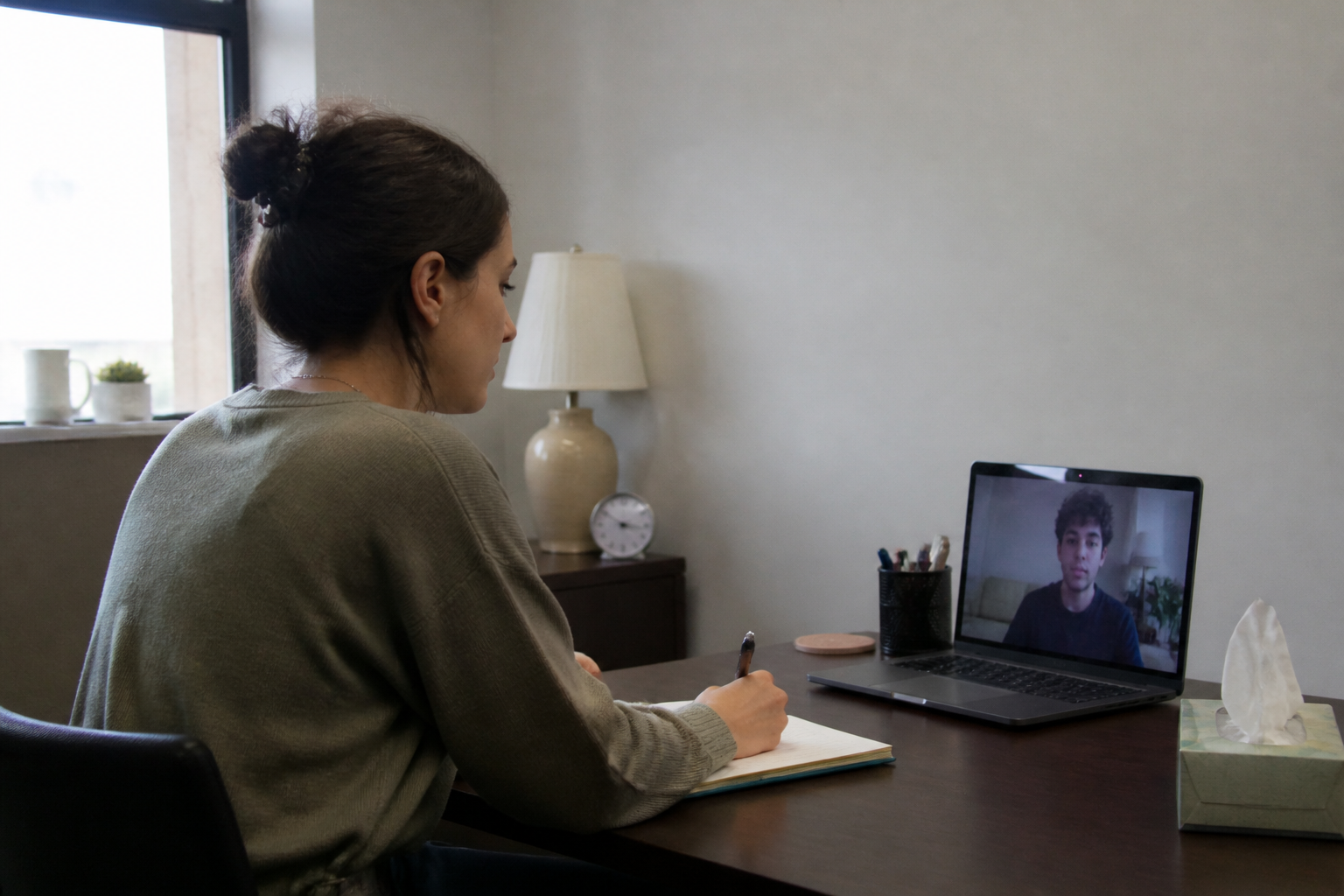
Reaching a counseling caseload sooner is the draw: some CACREP-accredited programs now fit the required 60 credits, including a 100-hour practicum and 600-hour internship, into two years of year-round terms.
Speed comes from summer terms and heavier course loads, not fewer requirements, since accreditation fixes those minimums.
The degree is only the first clock. Every state still requires thousands of post-degree supervised hours before independent licensure, and no accelerated schedule shortens that stretch.
Key Points
- John Carroll's accelerated online M.A. fits all 60 credits into two years.
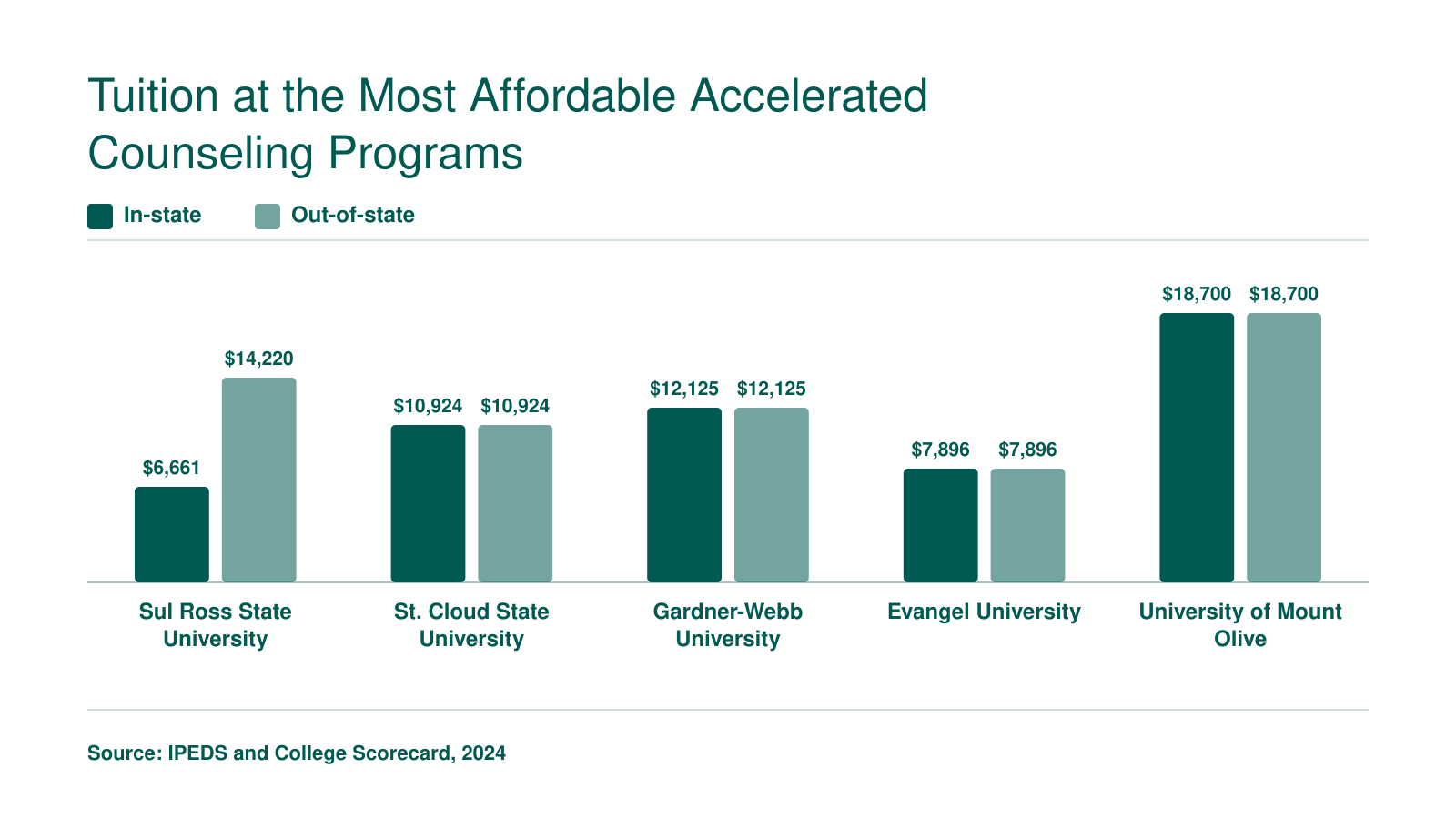
- The most affordable accelerated counseling programs charge $6,661 to $18,700.
- CACREP accreditation, not speed, controls cross-state license portability.
Best Accelerated Clinical Mental Health Counseling Programs for 2027
This list puts the quickest credible routes to a counseling credential first, then weighs cost and outcomes. Each entry below shows delivery format, location, in-state and out-of-state graduate tuition, and net price where data are available, plus notes on CACREP accreditation and licensure fit.
Yeshiva University
#1New York, NY · ~$33,000/yr (est.)
Best for: NYC students seeking five-year BA/MA
Yeshiva University's Ferkauf Graduate School of Psychology offers a 60-credit MA in Mental Health Counseling with online and Bronx campus options. The program blends asynchronous coursework with five live clinical instruction courses and requires at least 600 supervised field placement hours. Psychology majors at Stern College and Yeshiva College can complete the BA and MA in five years, and graduates prepare for New York LMHC licensure through the NCMHCE.
- 60 total credit hours with 42 core credits
- At least 600 supervised field placement hours
- About 75% asynchronous online plus five live clinical courses
- Campus option in the Bronx
- BA/MA accelerated option in five years for Stern and Yeshiva College psychology majors
- Prepares for NCMHCE and New York LMHC licensure
- New York State Education Department accredited
- Military benefits accepted
Marist University
#2Poughkeepsie, NY · ~$17,000/yr (est.)
Best for: Full-time students wanting two-year completion
Marist University runs a 60-credit, classroom-based MA in Clinical Mental Health Counseling with a two-year accelerated full-time track and a three-year schedule that includes summer terms. Students complete 700 supervised clinical hours, and the program is approved by NYSED for New York LMHC licensure while preparing to apply for CACREP accreditation. Federal outcomes data show median earnings of about $49,900 one year after graduation and $74,200 four years after.
- 60 total credit hours
- Two-year accelerated full-time track or three-year with summers
- 700 supervised clinical hours (100 practicum, 600 internship)
- Approved by NYSED for New York LMHC licensure
- CACREP accreditation application planned
- Graduate assistantships up to $4,500 per year
- No entrance exam required; GRE optional
- Prerequisite courses required for non-psychology majors
Viterbo University
#3La Crosse, WI · ~$10,000/yr (est.)
Best for: Child-focused counselors needing evening classes
Viterbo University's CACREP-accredited MS in Mental Health Counseling emphasizes child and adolescent counseling with play therapy labs and electives in addictions, psychopharmacology, family counseling, and trauma. The campus program requires 600 clinical internship hours, including 240 direct client hours, and reports a 95% licensure pass rate and 95% job placement rate. Median earnings for federal aid recipients were about $46,100 one year after graduation and $73,500 four years after.
- CACREP accredited
- 600 clinical internship hours, 240 direct client hours
- 95% licensure pass rate and 95% job placement rate
- Child and adolescent focus with two play therapy labs
- Evening and weekend classes for working professionals
- Small classes of 10 to 20 students
- Licensed professional counselor faculty
- Seven-semester accelerated path available
Carlow University
#4Pittsburgh, PA · $20,000 – $25,000/yr (est.)
Carlow University's CACREP-accredited MS in Professional Counseling with a Clinical Mental Health Counseling track requires 60 credits and 700 supervised clinical hours, with concentrations in adult, child and adolescent, trauma-informed, corrections, and clinical evaluation counseling. The Pittsburgh campus program offers rolling admissions, no application fee, and an accelerated pathway for undergraduates, and it meets Pennsylvania LPC licensure requirements. Median earnings were about $46,800 one year after graduation and $57,200 four years after.
- CACREP accredited
- 60 total credit hours, 700 clinical hours
- Seven concentration options including trauma and corrections
- No entrance exam, test optional, rolling admissions
- Complete in 2.5 to 3.5 years
- Meets Pennsylvania LPC licensure requirements
- $1,083 per credit
- Accelerated pathway for Carlow undergraduates
Rider University
#5Lawrenceville, NJ · ~$20,000/yr (est.)
Rider University offers a CACREP-accredited MA in Clinical Mental Health Counseling with both a standard track and a Dance/Movement Therapy concentration. The standard track requires 60 credits and 700 clinical hours, while the dance/movement therapy concentration requires 65 credits and 950 hours of fieldwork. Both report a 90% NCE pass rate and 100% employment rate, and an accelerated BA-MA option supports faster progression.
- CACREP accredited and ADTA approved
- 65 total credit hours
- 950 hours of fieldwork
- Dance/Movement Therapy concentration
- 90% NCE pass rate, 100% employment rate
- Small classes max 25 students
- Meets LPC licensure in NJ and PA
- CACREP accredited through 2031
- 60 total credit hours
- 700 clinical hours
- 90% licensure pass rate, 100% job placement
- Elective specialties in play therapy, trauma, creativity
- NCC and BCC certification eligible
- Prepares for LPC licensure in NJ and PA
Gardner-Webb University
#6Boiling Springs, NC · ~$12,000/yr (est.)
Gardner-Webb University's CACREP-accredited MA in Clinical Mental Health Counseling is available in person, hybrid, or fully online and prepares students for LPC licensure. The program includes practicum and internship experiences in diverse settings and offers an accelerated pathway for psychology undergraduates along with an ACE program focused on rural and underserved communities. Median earnings were about $47,100 one year after graduation and $56,300 four years after.
- CACREP accredited
- In-person, hybrid, or fully online options
- Accelerated pathway for psychology undergraduates
- ACE program for rural and underserved communities
- Prepares for LPC licensure
- Practicum and internship in diverse settings
- Prerequisite coursework required
- Small cohorts and dedicated faculty
Thiel College
#7Greenville, PA · ~$33,000/yr (est.)
Thiel College offers a Master of Arts in Clinical Mental Health Counseling with a five-semester master's completion and an accelerated BA to MA pathway that can finish both degrees in about 4.5 years. The program emphasizes live supervision, interactive peer review, and preparation for Pennsylvania LPC licensure through a liberal arts foundation in creativity and social justice advocacy. Over 99% of students receive tuition assistance.
- Five-semester master's completion
- Accelerated BA to MA pathway, both degrees in 4.5 years
- Live supervision and interactive peer review
- Prepares for Pennsylvania LPC licensure
- Liberal arts foundation with social justice advocacy
- Career options in geriatric, substance abuse, sports counseling
- Over 99% of students receive tuition assistance
- Financial aid available
Saint Cloud State University
#8Saint Cloud, MN · ~$11,000/yr (est.)
Saint Cloud State University's CACREP-accredited Clinical Mental Health Counseling MS uses a reflective-practitioner model with a trauma-informed framework and a cohort of 18 full-time students. The campus program includes a one-year supervised clinical experience before internship, access to the Eastman Training Clinic, and a reported 100% internship placement rate. Median earnings were about $43,100 one year after graduation and $56,700 four years after.
- CACREP accredited
- Cohort of 18 full-time students
- 100% internship placement
- Classes two days per week
- 6:1 faculty-to-student ratio for clinical instruction
- Access to Eastman Training Clinic
- One-year supervised clinical experience before internship
- Prepares for National Counseling Exam
Evangel University
#9Springfield, MO · ~$8,000/yr (est.)
Evangel University's hybrid MS in Clinical Mental Health Counseling combines online synchronous classes with required on-campus residencies and can be completed in as few as seven semesters through an accelerated track. The CACREP-accredited program prepares students for the NCMHCE or NCE exams, with two start dates per year and integration of Christian faith into the curriculum. The university reports authorization to enroll distance students in 37 states.
- CACREP accredited through 2027
- Seven-semester accelerated plan
- Hybrid format with online synchronous classes and on-campus residencies
- Two start dates per year, spring and summer
- Prepares for NCMHCE or NCE
- Christian faith integration
- Financial aid available
University of Mount Olive
#10Mount Olive, NC · ~$19,000/yr (est.)
University of Mount Olive offers a fully online, CACREP-accredited MS in Counseling with a Clinical Mental Health concentration built around accelerated 7.5-week courses and weekly live virtual classes. The program prepares students for dual licensure as an LCMHC and LCAS, with supervised practicum and internship training, no application fee, and no entrance exams.
- CACREP accredited
- 100% online format
- Accelerated 7.5-week courses
- Complete in as few as two years
- Weekly live virtual classes
- Prepares for dual LCMHC and LCAS licensure
- No application fee or entrance exams
- Supervised practicum and internship
None of the ranked Clinical Mental Health Counseling programs match the fastest lens yet. The full ranking is at the link above.
Cost, debt & payoff
Median earnings of this field's master's graduates (4 yrs after completing) vs. their median federal loan debt · U.S. College Scorecard
Across these programs the median graduate earns about $59,927 and finishes with roughly $56,013 in debt — a ratio that clears a common rule of thumb (keep debt below first-year salary). Tuition and debt vary widely school to school, so check the per-school figures in the table above before you shortlist.
What Makes a Clinical Mental Health Counseling Program 'Accelerated'?
At John Carroll University, the accelerated online master's in clinical mental health counseling fits 60 credits into two years, and Nova Southeastern spreads the same 60 credits across nine-credit terms in fall, winter, and summer.1 CACREP-accredited clinical mental health counseling master's programs require 60 semester credits. Programs not on an accelerated schedule often need 2.5 to 3 years full-time, as Commonwealth University lists, so acceleration is mostly a calendar change.
Three Ways Programs Compress the Timeline
Year-round full-time enrollment, often at nine credits per term, finishes near two years. Bachelor's-to-master's pathways such as 3+2 or 4+1 programs let a few graduate credits count toward both degrees; the tuition saving is simply shared credits times the graduate per-credit rate. Seven- to eight-week terms let students stack courses more quickly.
Coursework Compresses, Clinical Hours Do Not
Credit overlap varies by school and is not universal. Published timelines at schools described here run from 2 years at John Carroll to 30 months at Oklahoma2 and 3 years at Slippery Rock3. Acceleration compresses coursework, not clinical training: the 600-hour internship and practicum clock hours remain fixed because state licensure boards require that supervised experience.
CACREP Accreditation and Licensure: What a Faster Degree Can't Skip
Will a faster degree still get you licensed in your state? The answer hinges on accreditation, not calendar time. CACREP accreditation, not how quickly you finish, determines how portable your license is, and a growing number of states now require or strongly favor a CACREP-accredited master's for professional counselor licensure.1
States That Require CACREP
As of 2026, CACREP and the American Counseling Association identify Florida, Kentucky, North Carolina, and Ohio as requiring a CACREP-accredited master's for licensure.1 Florida's requirement took effect July 1, 2025, with case-by-case review of equivalent credentials.1 Because exact board pathways and exceptions vary, confirm the rule with the licensing board where you plan to practice.
The Path After Graduation
Earning the degree is only one step. Most states also require passing a national counseling exam (the NCE or NCMHCE, depending on the board) plus roughly 2,000 to 4,000 supervised clinical hours completed over about two to four years, along with a background check and jurisprudence exam.2 Texas, for example, lists 3,000 hours including 1,500 of direct client contact.1
An accelerated program shortens your timeline only by the months saved in the classroom. The supervised hours stay the same. Before applying, verify any program's status in the official CACREP directory.
Related Articles
Tuition at the Most Affordable Accelerated Counseling Programs
The lowest-cost programs here run from $6,661 to $18,700 in tuition, with some public schools adding a residency premium. Sul Ross State University charges $14,220 for out-of-state students versus $6,661 for Texas residents, while St. Cloud State University and the private options shown list the same rate for all students. Net price is an institution-wide average after aid, not a promise for any individual student.
Online vs. Campus Accelerated Formats: Residencies and Internship Placement
Does an online accelerated counseling degree mean skipping in-person training? No. CACREP standards still call for a 100-hour practicum and a 600-hour internship, and many online clinical mental health counseling programs add on-campus residencies. Seattle University requires two four-day summer residencies, Saybrook two five-day residential experiences a year, and Husson two trips to Bangor, Maine. CACREP's 2026 rules also require in-person synchronous experiences for fully online and hybrid programs.
University of Mount Olive is the fully online option in this ranking. Yeshiva, Gardner-Webb, and Evangel are hybrid, and the rest are campus-based.
Placement support varies
John Carroll and Commonwealth provide placement coordinators. Seattle assists and must approve your site. UNC Pembroke's coordinator sends potential sites, but you contact them yourself, and a slow reply can push back your start.
Attendance and pace
Seattle is asynchronous in its first two years, with weekly deadlines. Husson, Commonwealth, and Mount Olive expect live, real-time classes. Mount Olive's 7.5-week courses make missed sessions costly for working students, so check meeting times against your work schedule before you apply.
The Bureau of Labor Statistics' Occupational Outlook Handbook projects 18% employment growth for substance abuse, behavioral disorder, and mental health counselors from 2025 to 2035. An accelerated degree can get you to licensure, and into that growing field, sooner.
What Accelerated Counseling Programs Ask for at Admission
- Undergraduate recordA regionally accredited bachelor's degree is the baseline. GPA minimums vary, 3.0 at Syracuse, Indiana State, Elon, and Lamar; 2.5 at Denver and Nova Southeastern; 2.7 at Nebraska Omaha.
- 4+1 pathway prerequisitesFor 4+1 bridge options, expect junior or senior standing, a declared psychology or related major, and a separate major GPA around 3.0.
- Written materialsA personal statement and letters of recommendation are standard parts of the file.
- InterviewA group or individual interview is common. Syracuse and Northwestern require group interviews; Indiana State invites selected applicants; UNC Greensboro interviews selected candidates.
- GRE policyMost programs here do not require the GRE. Nova Southeastern accepts a combined 300 as an alternative basis.
- Deadlines and start termsDeadlines vary from November 15 at UNC Greensboro to January 15 at Syracuse, with later spring and summer dates elsewhere; Northwestern offers January, April, June, and September starts.
Clinical Mental Health Counseling programs by state
Accelerated Counseling Degree Questions, Answered
What is the fastest route to becoming a licensed clinical mental health counselor?
Does finishing an accelerated master's actually speed up licensure?
Are accelerated counseling master's programs CACREP-accredited?
How much does an accelerated clinical mental health counseling master's cost?
Can a clinical mental health counseling master's be completed entirely online?
Can I keep a full-time job during an accelerated counseling program?
Compare Clinical Mental Health Counseling programs on the data that matters
Explore more Counseling specializations or browse every graduate field.
All Counseling programs