Best Clinical Mental Health Counseling Master's Programs in Minnesota
Compare 13 accredited Clinical Mental Health Counseling programs in Minnesota at 11 schools, with graduate earnings, cost, debt, and completion data from IPEDS and the U.S. College Scorecard.

For the LPCC in Minnesota, you need 48 semester credits, 700 supervised field hours, and a pass on the NCMHCE. In this state, the master's that matters is the one that moves you near that threshold without leaving you overleveraged.
Campus and online clinical mental health counseling programs are ranked together on graduate earnings, net price, and debt, not name prestige. That comparison matters because a CACREP-accredited program with 700 to 900 built-in clinical hours can shorten the gap between coursework and licensure, while tuition differences across the state make the value question real.
Key Points
- Minnesota LPCC licensure requires a 48-credit master's, 700 supervised field hours, and a passing NCMHCE score.
- No licensable program here drops in-person clinical training, even when coursework is online or hybrid.
- Per-credit tuition, not school name, drives cost, and fees and practicum charges come on top.
Minnesota's Best Clinical Mental Health Counseling Master's Programs, Ranked
These programs earned their spots on what graduates take home, owe, and complete, using IPEDS and College Scorecard figures. Graduation rates below describe each institution as a whole, not this program alone, and earnings appear only where federal data reports them. CACREP status is noted on every card because it directly affects Minnesota LPCC licensure.
Bethel University
#1Saint Paul, MN · ~$10,000/yr (est.)
Best for: Faith-minded students preferring campus classes
Bethel University's M.A. in Counseling with a Clinical Mental Health Counseling concentration is a CACREP-accredited, evening-based campus program built to meet Minnesota LPC and LPCC requirements. Schools offering this program graduate about 71% of students, the highest rate among the Minnesota options listed here. Its curriculum is faith-informed and pairs coursework with a 12-month clinical training series. Eligible Bethel undergraduates in Psychological Sciences can take selected graduate counseling courses early through a fast-track pathway, pending admission.
- CACREP accredited
- 60 total credit hours over a 33-month sequence
- Evening classes on campus, fall start
- 12-month clinical training series with practicum and internships
- Faith-informed curriculum covering trauma, addictions, and family systems
- Fast-track option for Bethel Psychological Sciences undergraduates
- Designed to meet Minnesota licensure requirements
Minnesota State University Moorhead
#2Moorhead, MN · ~$12,000/yr (est.)
Best for: Working adults needing evening hybrid classes
Minnesota State University Moorhead offers a Master of Science in Counseling with a Clinical Mental Health Counseling emphasis, delivered in a hybrid format with all courses meeting after 4:30 p.m. The school states the emphasis is CACREP accredited, though the exact directory dates were not confirmed in our research. Schools offering this program graduate about 57% of students. The program meets Minnesota and North Dakota licensure standards and prepares graduates for National Certified Counselor eligibility.
- CACREP accredited per the school; confirm directory dates
- 60 total credit hours, two-year full-time path
- Part-time option available
- Hybrid online and face-to-face, evening classes after 4:30 p.m.
- 150-hour practicum and 750-hour internship (900 clinical hours)
- Thesis or capstone option
- 3.0 GPA minimum listed
- Meets Minnesota and North Dakota licensure standards
Winona State University
#3Winona, MN · ~$11,000/yr (est.)
Best for: Winona-area students eyeing Wisconsin licensure
Winona State University's Clinical Mental Health Counseling master's is CACREP accredited and delivered in a hybrid format. Graduates are eligible for LPCC licensure in Minnesota and LPC licensure in Wisconsin, which suits students in the southeast corner of the state. Schools offering this program graduate about 57% of students. Supervised clinical experiences prepare graduates for community mental health, social services, and residential care roles.
- CACREP accredited
- Hybrid delivery format
- Eligible for Minnesota LPCC and Wisconsin LPC licensure
- Supervised clinical experiences built into the curriculum
- Coursework in assessment, diagnosis, treatment planning, and ethics
- Career paths in community mental health, social services, and residential care
Minnesota State University-Mankato
#4Mankato, MN · $10,000 – $20,000/yr (est.)
Minnesota State University, Mankato offers a 60-credit Counseling and Student Personnel M.S. with a Mental Health Counseling emphasis. It is CACREP accredited, with the current cycle running through October 2033. Schools offering this program graduate about 54% of students. Admission is rolling with January 15 priority consideration, and students pass a comprehensive exam to finish.
- CACREP accredited; current cycle runs through October 2033
- 60 total credit hours, two years full time
- Part-time option, fall and summer starts
- 100-hour practicum and 600-hour internship
- Rolling admissions, priority consideration by January 15
- Abnormal Psychology prerequisite and three recommendation letters
- Counselor Preparation Comprehensive Exam required to graduate
Bethany Lutheran College
#5Mankato, MN · $10,000 – $15,000/yr (est.)
Bethany Lutheran College's M.A. in Clinical Mental Health Counseling pairs asynchronous online coursework with three on-campus residencies, with practicum and internship completed in your home community. Its CACREP listing reads Accredited (Progress Report Required), with the cycle running through April 2034, so confirm the report's status with the school. Schools offering this program graduate about 55% of students. The program lists $600 per credit and no required undergraduate major, and it integrates a Christian worldview.
- CACREP listing: Accredited (Progress Report Required), cycle through April 2034
- 60 total credit hours, two- and three-year pathways
- Asynchronous online classes with three on-campus residencies
- $600 per credit listed
- Rolling admissions, fall and summer starts
- No specific undergraduate major required
- Practicum and internship completed in your community
- Capstone and three recommendation letters required
Crown College
#6Saint Bonifacius, MN · ~$12,000/yr (est.)
Crown College's M.A. in Counseling is delivered online with an annual four-day on-campus residency each May. It is designed for Minnesota LPCC licensure and offers state-by-state licensure guidance for students who may practice elsewhere. Crown is CACREP accredited through 2034, but sources differ on the effective date (July 2026 on the program page, August 7, 2026 in the college's announcement). Schools offering this program graduate about 45% of students.
- CACREP accredited; effective date varies by source, cycle through 2034
- Online format with an annual four-day May residency
- 700 clinical hours
- Concentrations in Clinical Mental Health Counseling and Addictions Counseling
- Designed for Minnesota LPCC licensure
- State-by-state licensure guidance
- Faith-integrated curriculum with licensed Christian faculty
Saint Cloud State University
#7Saint Cloud, MN · ~$11,000/yr (est.)
Saint Cloud State University's Clinical Mental Health Counseling M.S. is a campus cohort program of 18 full-time students, with classes two days per week and a one-year supervised clinical experience before internship. Its CACREP reaffirmation is in process, and the prior cycle was dated to end October 31, 2026, so verify current status with CACREP before applying. Schools offering this program graduate about 40% of students. Federal data show median graduate earnings of about $43,100 one year after completion and about $60,000 five years out.
- CACREP reaffirmation in process; prior cycle ended October 31, 2026
- Cohort of 18 full-time students, fall start
- Classes two days per week
- One year of supervised clinical experience before internship
- Access to the Eastman Training Clinic
- 6:1 faculty-to-student ratio for clinical instruction
- Prepares for LPC or LPCC licensure and the national counseling exam
Cost & outcomes by school
Federal data for the highest-earning Clinical Mental Health Counseling programs, independent of the ranking above. Earnings are this field's master's graduates four years after completing, where the Scorecard reports them.
| School | Earnings | Tuition / yr | Debt | Grads/yr | Format |
|---|---|---|---|---|---|
| Walden University MN | $60,034 | $10,885 | $80,386 | 888 | Online |
| Capella University MN | $59,050 | $15,092 | $45,797 | 1,261 | Hybrid |
| Saint Mary's University of Minnesota MN | $58,266 | $12,474 | $49,350 | 44 | Hybrid |
| Saint Cloud State University MN | $56,652 | $10,924 | $37,572 | 6 | Campus |
| Minnesota State University Moorhead MN | — | $11,902 | — | — | Hybrid |
| Minnesota State University-Mankato MN | — | $10,449 | — | 30 | Campus |
| Bethel University MN | — | $10,260 | — | 18 | Campus |
| Bethany Lutheran College MN | — | $10,815 | — | 12 | Hybrid |
| Winona State University MN | — | $10,886 | — | 14 | Hybrid |
| Crown College MN | — | $11,740 | — | — | Hybrid |
| Adler Graduate School MN | — | $14,700 | — | 46 | Online |
Sources: U.S. Department of Education. Tuition and graduates: IPEDS. Earnings and debt: College Scorecard, this field's master's graduates; a dash means no figure is reported.
Cost, debt & payoff
Median earnings of this field's master's graduates (4 yrs after completing) vs. their median federal loan debt · U.S. College Scorecard
Across these programs the median graduate earns about $59,050 and finishes with roughly $45,797 in debt — a ratio that clears a common rule of thumb (keep debt below first-year salary). Tuition and debt vary widely school to school, so check the per-school figures in the table above before you shortlist.
Studying Online or Hybrid: Minnesota CMHC Master's Formats and Residencies
Online delivery has widened access to counseling degrees, but among Minnesota master's programs, no licensable program here removes the in-person requirement entirely.
Bethel University, Minnesota State University-Mankato, and Saint Cloud State University are campus-based. Saint Cloud State meets two days a week and builds in a year of on-campus clinical work before internship. Minnesota State University Moorhead and Winona State University are listed as hybrid. Moorhead holds classes after 4:30 p.m. and offers full-time and part-time paths. Neither school's residency requirements are spelled out in the program details here, so confirm them with admissions.
Bethany Lutheran College pairs asynchronous online coursework with three on-campus residencies. Crown College is the most online-oriented option, with two residencies, including a four-day session each May. Neither school describes a path with zero campus visits.
Practica and internships happen in person at approved sites, usually near where you live. If you consider an online master's in clinical mental health counseling based outside Minnesota, check its coursework against Minnesota's LPCC requirements first, because the state evaluates your transcript course by course.
Minnesota LPCC Licensing at a Glance
Which Minnesota Master's Programs Waive or Make the GRE Optional?
Minnesota State University-Mankato does not list a GRE requirement, so applicants can consider it among No-GRE master's programs while still confirming details. Its 2.75 GPA is described as competitive rather than a hard floor, and Abnormal Psychology must be finished before or during the first year. Its established deadline is January 15 for summer entry. No fall or spring deadline is published for U.S. applicants.
Saint Cloud State University's page is silent on the GRE, GPA, and prerequisites.1 It does list an interview, recommendations, a statement of intent, and a resume. Its January 3 priority and February 3 extended dates come from a November 2024 update, so confirm them for the next cycle.1
Bethel University, Minnesota State University Moorhead, Winona State University, Bethany Lutheran College, and Crown College: the admissions material reviewed did not establish a GRE policy for these schools. Silence is not a waiver; check directly whether the program belongs on a list of clinical mental health counseling programs without gre. Bethany Lutheran does note that no specific undergraduate major is required, and it uses rolling admissions.
Tip: ask each admissions office whether an interview, including a group interview, stands in for test scores, and get the answer in writing.
Related Articles
Cost, Return on Investment, and What Comes After the Master's in Minnesota
Per-credit price, not school name, decides what clinical mental health counseling graduate programs in Minnesota cost you. These are tuition estimates only. Mandatory fees, practicum charges and liability insurance are not included, so ask each school for those.
Estimated Program Tuition
- Saint Cloud State: $564 per credit across 61 credits, about $34,404.
- Bethel: $618 per credit across 60 credits, about $37,080.
- Crown College: $685 per credit across 60 credits, about $41,100.
- Minnesota State Mankato: $548 to $795 per credit, roughly $32,880 to $47,700.
- Winona State: $530 to $800 per credit, roughly $31,800 to $48,000.
The ranges reflect in-state versus out-of-state rates, and listings can differ from the school's current bill. Winona State's annual program tuition runs $10,886 in-state against $15,953 out-of-state, and Mankato's $10,449 against $19,989. Minnesota State Moorhead lists $619 per credit.
Net Price and Outcomes
Institution-wide average net price after aid is a guide, not a quote. It runs from $13,529 at Saint Cloud State to $28,556 at Bethel, with Winona State at $17,503 and Crown at $26,672.
Saint Cloud State is the one program with earnings and debt figures: a median of $43,135 one year after finishing and $56,652 four years out. Median debt is $37,572, which works out to about $427 a month over 10 years.
Cost and the Licensure Timeline
You will not earn full LPCC pay right after graduation. Most graduates work as supervised clinicians first, so plan loan payments around that lower early income.
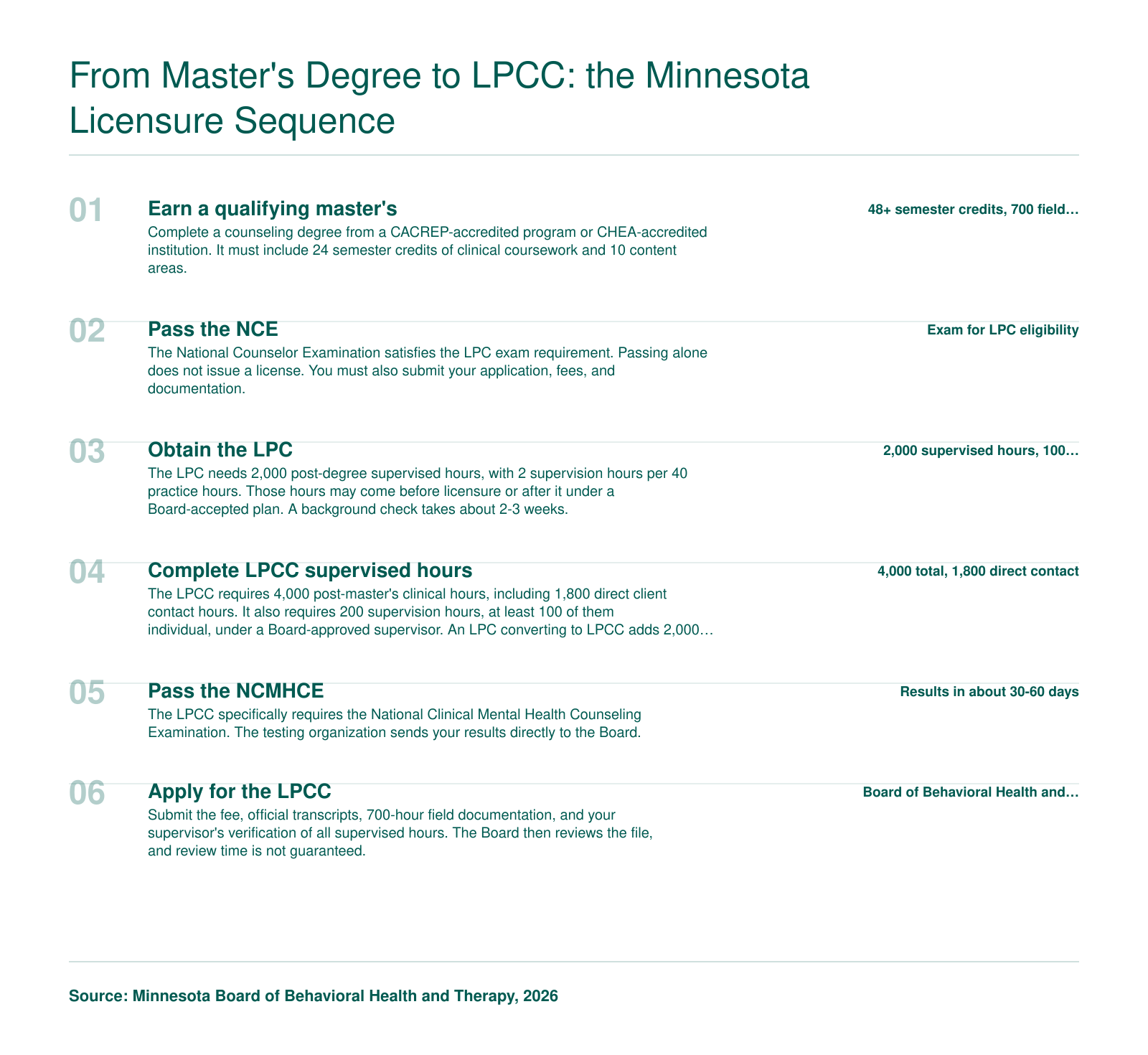
From Master's Degree to LPCC: the Minnesota Licensure Sequence
Minnesota treats the LPC as an interim license and the LPCC as the full clinical license, both issued by the Minnesota Board of Behavioral Health and Therapy. The Board sets no single typical timeline. Total time after graduation depends on your work schedule, supervisor availability, exam dates, and processing delays.
Practicum and Internship Hours in Minnesota Counseling Master's Programs
The practical tension in clinical training is between a program's minimum hour count and the reality of securing a site, especially for online students in Greater Minnesota. CACREP sets a national floor of 100 practicum hours plus 600 internship hours, a floor met by University of Wisconsin-Superior's online M.S.Ed. in Clinical Mental Health Counseling; Minnesota State Moorhead exceeds it with a 150-hour practicum and 750-hour internship, while Crown College lists 700 clinical hours. In-program hours are separate from the post-degree supervised hours counted toward the LPCC, which begin only after you graduate under a board-approved supervisor.
Placement support varies more than the hour totals. St. Cloud State's Clinical Mental Health Counseling page advertises a 100% internship placement rate and access to an on-campus training clinic, a useful sign if you want a guided pipeline. Bethany Lutheran describes a clinical internship in your community, which may mean you take the lead finding a site; Minnesota State Moorhead's published materials do not make clear whether the school assigns sites. Before committing, ask admissions how site matching works in the Twin Cities and across Greater Minnesota.
Quick Answers on Minnesota CMHC Master's Programs and the LPCC
These short answers cover the questions students ask most when comparing Minnesota counseling master's programs and planning the path to licensure. Requirements come from the Minnesota Board of Behavioral Health and Therapy and state statute.
What is the best master's program for mental health counseling in Minnesota?
Which clinical mental health counseling programs in Minnesota hold CACREP accreditation?
How many post-degree supervised hours does Minnesota require before you can become an LPCC?
Can you practice as an LPC in Minnesota while earning LPCC supervision hours?
Compare Clinical Mental Health Counseling programs on the data that matters
Explore more Counseling specializations or browse every graduate field.
All Counseling programs