Master's Programs in Utah
Every master's program reported by a school in Utah: 320+ programs at 13 graduate schools, with the online options, costs and outcomes behind each one.

A master's program in Utah is a graduate degree, usually one to three years of coursework, earned at a public research university such as the University of Utah or Utah State, a regional campus like Weber State, Southern Utah, or Utah Valley, privately run BYU, or an online-first school such as Western Governors University. Price, format, and funding differ sharply across those models.
Most applicants trying to find the best master's programs want three answers: what it costs, how flexible it can be, and whether it pays. Nationally, master's holders earned a median $1,876 a week in 2025, about $15,000 a year more than bachelor's holders.
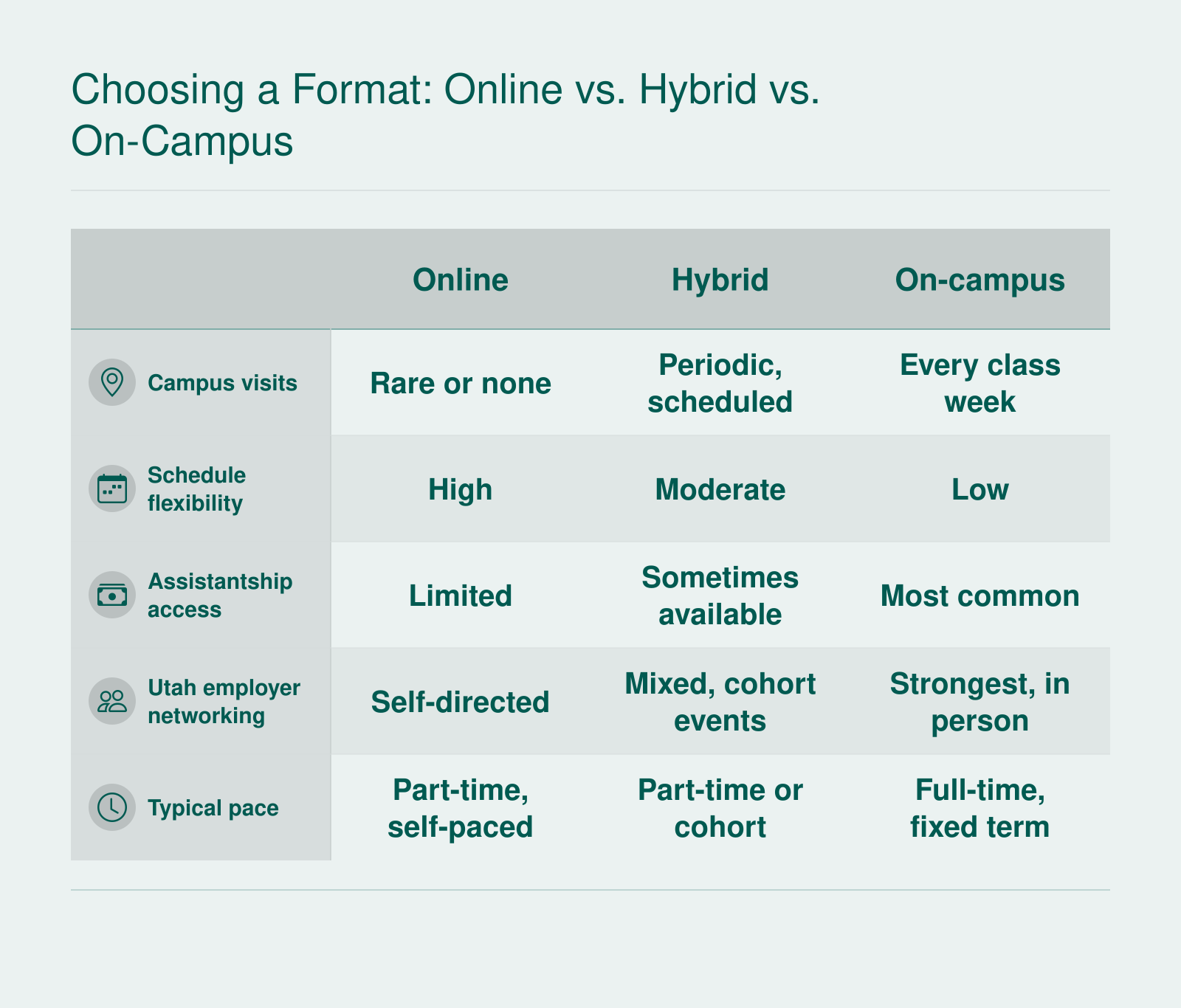
Flexibility carries its own price: assistantships and tuition waivers cluster in on-campus research programs, so online students usually pay full tuition.
Key Points
- Total cost runs well above sticker tuition once fees, books, and housing are added.
- Utah counseling and social work graduates need 3,000 supervised hours after the degree for licensure.
- Nationally, master's holders earned about $15,000 more per year than bachelor's holders in 2025.
Popular degrees in Utah
Master's programs in Utah by field
Business & Management
- Accounting13 programs
- Healthcare Management8 programs
- Marketing7 programs
- Healthcare Administration7 programs
- Analytics6 programs
- Finance5 programs
- Human Resource Management or HR Management5 programs
- Public Administration4 programs
Education & Teaching
- Educational Leadership12 programs
- Teaching9 programs
- Curriculum & Instruction5 programs
- Educational Technology or Instructional Design5 programs
- Special Education5 programs
- Higher Education or Adult Education4 programs
- Secondary Education4 programs
- STEM Education or Science Education or Mathematics Education4 programs
Nursing
- Nursing Education or Nurse Educator10 programs
- Family Nurse Practitioner (FNP)6 programs
- Nurse Administrator5 programs
- Psychiatric Mental Health Nurse Practitioner4 programs
- Health/Nursing Informatics4 programs
- Adult Gerontology Acute Care Nurse Practitioner1 program
- MSN/MBA1 program
- Nurse Educator1 program
Healthcare
- Nutrition6 programs
- Public Health5 programs
- Health Administration5 programs
- Speech Pathology4 programs
- Exercise Science2 programs
- Health Education2 programs
Communications & Media
- Communication10 programs
- Communication Disorders4 programs
- Speech Pathology4 programs
- Journalism1 program
- Media Communication1 program
- Technical Communication1 program
- Strategic Communication1 program
Social Work & Social Sciences
- Social Work Advanced Standing8 programs
- Social Work5 programs
- Sociology5 programs
- Political Science, Government2 programs
Counseling
- Marriage and Family Therapy or Marriage and Family Counseling7 programs
- School Counseling4 programs
- Clinical Mental Health Counseling4 programs
- Addiction Counseling1 program
Arts & Design
- Creative Writing8 programs
- Fine Arts4 programs
Science & Engineering
- Sustainability or Environmental Management5 programs
- Environmental Science4 programs
- Geography2 programs
Computers & IT
- Information Security & Assurance5 programs
- Cybersecurity2 programs
- Machine Learning2 programs
- Data Analytics1 program
Psychology
- Applied Behavior Analysis5 programs
- Counseling Psychology2 programs
- General Psychology1 program
- School Psychology1 program
- Educational Psychology or School Psychology1 program
Criminal Justice & Law
- Public Policy3 programs
- Master of Laws2 programs
- Legal Studies1 program
What a Master's Degree Really Costs in Utah
Sticker tuition and total cost are two different numbers, and in Utah the distance between them can be wide. Budget for the second one.
Beyond the Per-Credit Rate
Mandatory fees, program differentials, books, and housing all sit on top of base tuition. At the University of Utah, one 2026-27 schedule lists about $1,075 per credit in tuition and roughly $333 in mandatory fees.1 Graduate engineering courses at the 6000 level and above add $101.70 per credit, which brings that schedule to about $1,510 per credit.1 The university's own estimate for a typical graduate year is about $9,264 in tuition and fees, and a separate estimate that includes a living budget is $16,178.2 Those are averages, not program quotes. Confirm department differentials for MBA, nursing, and engineering, especially when comparing Best MBA Programs, since we could not verify them for every Utah public school. Living costs along the Wasatch Front, especially rent in Salt Lake City and Provo, often outweigh the tuition gap between schools.
Resident vs. Nonresident Pricing
Utah's public universities charge nonresidents substantially more. Utah State and the University of Utah also recognize a Western regional category, and Utah State charges Western Regional Graduate (WRG) students the in-state graduate rate. Moving to Utah just to study rarely qualifies you for residency. Schools generally expect established domicile, commonly a year of living and working in the state for reasons other than school. Exceptions exist, so ask the registrar before assuming a reclassification will lower your bill.
BYU's Two-Tier Pricing
Brigham Young University prices graduate study by Church membership.3 For 2026-27, two semesters of graduate tuition run $8,936 for Latter-day Saint students and $17,872 for others. Marriott School and Law rates are higher, at $16,472 and $32,944, and the Executive MBA is $28,540. BYU counts 8.5 credits as full-time.4
Finding the Cheapest Option
The lowest sticker prices usually come from regional public universities and flat-rate online programs, a pattern visible in lists of the Most Affordable Master's Programs, but we could not verify a full 2026-27 comparison for Weber State, UVU, SUU, or Utah Tech, so check each school's current schedule. For nonresidents, online per-credit rates can undercut on-campus tuition, sometimes by a wide margin, because many programs bill online students at one rate regardless of residency. Add fees before you compare, since online courses may carry technology charges. Total cost, not the headline rate, is what tells you which degree is cheapest.
Graduate Tuition at Utah Universities Side by Side
Graduate tuition in Utah depends more on your program and residency status than on which campus you pick, and the University of Utah shows why. Only some of the figures below could be confirmed at the time of writing, and the rest should be checked directly with each school.
University of Utah (2026 Figures)
- Resident: About $11,198 per year for full-time study at 12 graduate credits per semester. This is the proposed 2026 rate, which reflects a 3.50% increase.1
- Nonresident: About $36,836 per year on the same credit load, a proposed 3.33% increase.1
- Differential tuition: Graduate courses numbered 6000 and above add $729.47 per credit hour in the School of Business and $101.70 per credit hour in the College of Engineering.2
- Online (2026-27): $695 per credit hour for the online Master of Financial Planning and Counseling, charged at the same rate to residents and nonresidents.3 All-online programs carry no mandatory student fees, though online rates vary by program and can rise each year.
One quirk to know: in summer terms, most U of U graduate students are assessed resident rates regardless of home state.4 Law, dental, medical, and some other programs are exceptions.
Other Utah Schools
- Utah State University, Weber State University, Utah Valley University, Southern Utah University, Utah Tech University: Current graduate resident, nonresident, and online per-credit rates could not be verified for this page. Each publishes a graduate tuition page, and many programs set their own rates, so look up your specific program.
- BYU and Westminster University: Both are private. Expect per-credit pricing set by program, and note that BYU has historically priced differently for members of its sponsoring church than for others.
- Western Governors University: WGU is the contrast case. It charges a flat rate per six-month term rather than per credit, so finishing faster lowers your total cost. The current term rate was not confirmed here, and residency generally does not change it.
No figure above should be treated as final for the 2026-27 year until you match it against the school's official page. Some of the U of U numbers are proposed rates.
Who Tends to Be Cheapest
For Utah residents, the regional public universities have historically priced below the flagship and the private schools, though this is a general pattern, not a verified comparison. Nonresidents face the sharpest gap at the University of Utah, where the nonresident rate is more than three times the resident rate. Nonresidents will usually do better with a flat-rate online option such as WGU, or with a program that charges one rate to all online students, as UOnline does.
Online, Hybrid, and On-Campus Master's Options in Utah
Many programs that carry an "online" label still require supervised, in-person work, and that gap is where Utah applicants most often get surprised. The available sources do not give a complete 2026 inventory of online offerings at every Utah university, so treat the school-by-school notes below as a starting point and confirm details with each program.
Which Utah Universities Offer Online Master's Programs?
The University of Utah has the broadest documented footprint, with more than 40 online graduate and certificate programs across fields. Examples include the online MHA (online, in-person, or hybrid), nursing education (asynchronous online), and online special education with an ABA focus (fully online). Utah Tech lists online or hybrid master's options in healthcare administration, nursing education and leadership, software development, sport management, user experience design, and technical writing and digital rhetoric. Utah State (including USU Online), Weber State, SUU, and WGU are widely known for online graduate offerings, but we could not verify which specific master's programs are fully online at each, so check their current catalogs. UVU's MSW, by contrast, is hybrid with weekly in-person classes.
Fully Online, Hybrid, and Residency-Based Formats
The formats differ in ways that affect your schedule and budget.
- Fully online: Coursework is delivered remotely, though clinical or field components may still apply.
- Hybrid: Online learning is paired with scheduled campus time. The U's athletic training program adds labs and clinicals, and its clinical mental health counseling program requires 800 in-person clinical hours, including 350 of direct client service.
- Residencies or intensives: Some programs bring students to campus for concentrated sessions. We found no confirmed residency requirement for the University of Utah's online programs, but other schools may differ.
Practicum is a separate issue. The U's online MSW requires a local field placement, and its 2026 materials describe the online cohort as a three-year track with a Fall 2026 start and no hybrid option built around periodic campus intensives.
State Authorization and Pacing
If you plan to study from outside Utah, or you are a Utah resident considering another state's online program, check state authorization first. Programs leading to licensure (counseling, social work, nursing, teaching) often cannot enroll residents of certain states, because placements and licensing rules vary by state. Ask the admissions office in writing whether your state is approved.
Online programs are frequently designed for working professionals, and many run on accelerated 7- or 8-week terms rather than a traditional semester. That pace lets you finish sooner, but each term moves quickly, so ask how many courses you can take at once and how placements are scheduled around a full-time job.
Choosing a Format: Online vs. Hybrid vs. On-Campus
The right format depends on how much schedule flexibility you need and whether you want funded, research-focused study. Assistantships and tuition waivers are mostly tied to on-campus, research-oriented programs, so format can change what you pay as well as how you learn.
Admission Requirements, GRE Policies, and Deadlines
Standardized tests are losing ground in graduate admissions, as No-GRE master's programs become more common, and Utah departments are part of that shift. No single rule governs every program at a given university, though, so the official page for your program always controls.
Do I Need the GRE for Utah Master's Programs?
Often not. The University of Utah History program no longer requires the GRE, and its Mathematics program does not require it but allows applicants to submit scores.1 Westminster University's Master of Public Health has no GRE requirement.3 For Utah State, BYU, UVU, Weber State, and SUU, current testing rules are program-specific, and we could not confirm a school-wide policy for any of them. Treat a department's own admissions page as the only reliable answer, and check GMAT rules separately for business degrees.
Baseline Requirements
Expect these from nearly every program:
- Degree: An accredited bachelor's degree, sometimes in a related field or with prerequisite courses.
- GPA: The University of Utah Graduate School sets a 3.0 floor for master's coursework.2 Individual departments can go higher: History asks for a 3.2, waivable in exceptional cases.
- Application materials: Letters of recommendation, a statement of purpose, and a résumé are common, though the exact mix varies by department.
Deadline Patterns
Deadlines are set by department, and the verified examples show how much they differ. University of Utah History accepts fall entry only, with a December 1 deadline. Mathematics lists March 15 for fall and summer and November 1 for spring, though the same page also mentions a January 1 date, so confirm it directly.1 Funded research and assistantship tracks tend to close early for fall, because funding decisions are made in the winter.
Professional programs often work differently. Westminster's MPH admits on a rolling basis with an August 1 priority date for fall entry.3 Some programs offer no spring or summer start at all, so do not assume a second chance later in the year.
Accelerated and One-Year Options
Several Utah master's degrees can be finished in about a year, which cuts both tuition and lost income. At the University of Utah, the Master of Accounting and MS in Finance run 9 to 12 months, the MS in Financial Technology runs 12 months, and the PHTX-MS in Pharmaceutical and Toxicological Sciences is a one-year, 30-credit program.4 Westminster's MPH takes about 10 months and is the only CEPH-accredited MPH program in Utah under a year.3
These Accelerated Master's Programs move fast because they assume you arrive prepared. Expect required background in accounting, finance, quantitative methods, or the relevant science, and a full-time commitment. Part-time versions of the same degrees stretch to four or more semesters.
Paying for It: Assistantships, Scholarships, and Employer Benefits
The cheapest master's degree in Utah is usually the one a university pays you to earn, and that path is narrower than most applicants assume. Assistantships cluster in thesis and research programs, while professional and online master's students mostly pay their own way.
Graduate Assistantships
At the University of Utah, the Tuition Benefit Program is aimed at research and education-mission graduate students, which means research master's and PhD students. Stipends vary by department and listing. For MPA programs, the School of Public Affairs posts a half-time (20 hours a week) assistantship at $21,500 for the 2026-27 academic year1, Student Affairs lists $25,0002, and the Graduate School cites $28,500 for full-time teaching assistants, who also receive subsidized health insurance.3 First-year students are not eligible for that teaching role. The tuition benefit is not automatic, requires 9 to 12 credits a semester, and excludes differential tuition and special fees.4
For sociology master's programs with assistantships, Utah State University publishes policy minimums rather than a single rate: $10,000 a year for master's students and $20,000 for PhD students. Its tuition awards cover up to 9 credits a semester for students with a 3.0 GPA and a half-time assistantship, and only for credits that count toward the degree. Nonresident U.S. citizens generally get that award for one year before they must establish Utah residency.
Federal Aid and Departmental Scholarships
Graduate students cannot receive Pell Grants. Federal aid comes as Direct Unsubsidized Loans and Grad PLUS loans, so borrowing is the default when no assistantship exists. Departmental and Graduate School scholarships and fellowships are the main grant money, and they are awarded program by program.
State and Employer Support
Utah teacher-pipeline and nursing incentives are worth investigating for MSN programs, but current amounts, eligibility rules, and service obligations were not confirmed for 2026, so verify them with the program and the state before counting on them. The same goes for employer tuition assistance at large Utah employers: caps, waiting periods, and repayment terms differ by company and were not confirmed here. Ask your HR office for the written policy and find out whether it covers your specific degree.
Ask Before You Accept
Before accepting any offer, ask the department in writing whether assistantships exist for your degree, how many go to master's students, what the stipend is, whether tuition and fees are covered, and how long the funding lasts. A school's published numbers are a starting point, not a guarantee.
Which Utah Master's Degrees Lead to Licensure
A master's degree leads to licensure in Utah only when the program meets the accreditation and coursework standards the licensing board requires, and the diploma alone is never enough. Several of the state's most common graduate fields are built around this rule.
Degrees That Lead to a License
- Clinical mental health counseling: Leads to CMHC licensure through the Division of Professional Licensing (DOPL). Look for clinical mental health counseling programs with CACREP accreditation.
- Social work (MSW): Leads toward the LCSW. Look for CSWE-accredited MSW programs.
- Marriage and family therapy: Regulated by DOPL under its own licensing act. COAMFTE is the programmatic accreditor to look for.
- Nurse practitioner: Look for CCNE or ACEN accreditation, plus national certification after graduation.
- School counseling and educator licensure: Handled by the Utah State Board of Education, which ties licenses to approved preparation programs.
- School psychology: Also an educator-licensure route. Check that the program is approved for Utah school psychologist licensing.
- Speech-language pathology: Look for ASHA CAA accreditation, then a supervised clinical fellowship.
Why Accreditation Can Make or Break a License
Utah's counseling statute asks for a qualifying degree from a CACREP program, or from an equivalent program at a CHEA-recognized institution, with at least 60 semester credits (90 quarter credits).1 A cheaper, unaccredited program may leave you short on credits or course content, and you may only learn that after you have paid tuition. Confirm the accreditation status with the accreditor and DOPL before you enroll, not after you graduate.
Supervised Hours After the Degree
Based on the statutes available, clinical mental health counselors need at least 4,000 hours of supervised training over a minimum of two years.1 That includes 2 hours of suicide prevention training, and at least 1,000 hours of supervised mental health therapy, with 100 of those hours in direct supervision.1 Clinical social workers also face a 4,000-hour, two-year standard in the current text we reviewed,2 though an earlier version of the law set 3,000 hours.3 Rules change, so check DOPL for the version in force today. Both professions require passing an exam set by Division rule. Utah also requires internship supervisors to hold certification or an applicable exemption,4 and supervisors in this field generally need two years of clinical experience and may oversee up to six trainees.5
One caution: the marriage and family therapy requirements for degree, hours, and exam were not fully verified here, so confirm them directly with DOPL.
Online Students Outside Utah
If you live in another state and are eyeing Utah's online master's programs, the license that matters is the one in your home state. Many states set their own rules on credit hours, coursework, practicum placement, and supervision, and an out-of-state program may not satisfy them. Contact your home licensing board in writing before you apply, and ask whether the specific program qualifies.
Utah Licensing Authority for Counselors and Social Workers
What Master's Graduates Earn in Utah
Nationally, workers with a master's degree earned a median of $1,876 per week in 2025, compared with $1,578 for those holding only a bachelor's.1 That gap, roughly $300 a week or about $15,000 a year, is the clearest signal of what advanced study adds to earning power. Utah tracks the national pattern, though the state does not publish a tidy Utah-specific master's-versus-bachelor's comparison that we can report with confidence, so treat the national figures as the reliable benchmark.
What Specific Fields Pay in Utah
Occupation wages tell a more concrete story than degree-level averages, because they reflect the actual jobs master's graduates move into. Based on the most recent Utah wage data:
- Financial managers: a median of about $150,450 a year, with roughly 8,860 jobs statewide, one of the larger and better-paid master's-level fields.2
- Nurse practitioners: about $130,920 a year across roughly 2,740 positions.2 A competing wage source reports a slightly higher $131,680, so expect variation depending on employer and metro area.
- Education administrators (kindergarten through secondary): about $128,880 a year, with roughly 2,940 jobs, a path that typically requires an accredited M.Ed. program plus a state administrative credential.2
These are occupation medians, not guaranteed starting salaries. Early-career pay generally lands below the median, and experienced professionals in the Salt Lake and Provo metros often clear it.
Who Hires Master's Graduates in Utah
Three sectors do most of the hiring. The Silicon Slopes technology corridor stretching from Lehi through southern Salt Lake County draws graduates in data, finance, and management. Healthcare systems such as Intermountain Health employ nurse practitioners, graduates of the Best MHA Programs, and clinical specialists across the Wasatch Front. Public education, through districts and the state's universities, absorbs administrators, counselors, and instructional leaders. Each of these sectors rewards the specific credentials a master's program delivers.
Check Your Program Before You Enroll
State and occupation averages are a starting point, not a forecast for your situation. Before committing to any Utah program, look up its graduates' earnings in the federal College Scorecard, which reports outcomes by individual program rather than by broad field. A nursing master's and an education master's at the same university can produce very different earnings, and Scorecard lets you see that program-level reality. For some newer or smaller programs, those earnings figures are not yet published; when that is the case, lean on the occupation wages above and ask the program directly for its placement and salary data.
How to Choose a Utah Master's Program With Confidence
The hardest choice in a Utah master's search is usually the cheapest-looking program against the one that fits your career plan. A low sticker price means little if the degree doesn't qualify you for the job you want. Work through the decision in this order.
A Four-Part Framework
- Accreditation and licensure fit: Confirm the school's regional accreditation, then check programmatic accreditation for your field. Nothing else matters if the credential won't count.
- Total cost after funding: Subtract assistantships, scholarships, and employer aid from tuition and fees. Compare what you will actually pay, not the published rate.
- Format: Match online, hybrid, or on-campus delivery to your work schedule, clinical or practicum requirements, and how you learn.
- Employer connections: Ask where recent graduates work, whether the department places students in internships, and how local employers view the degree.
Compare Net Cost, Not Sticker Tuition
Two programs with similar tuition can end up thousands of dollars apart once a tuition waiver or a company benefit is applied. Ask each department what share of admitted students receive funding, and whether awards continue past the first year. Then ask your HR office about tuition assistance caps and any requirement to stay with the company after graduation.
Verify Licensure Before You Apply
If you are headed toward counseling, social work, teaching, or another regulated field, check eligibility before submitting an application. For counseling and social work, confirm any affordable MSW programs you compare meet Utah Division of Occupations and Professional Licensing (DOPL) requirements. For school-based roles, such as a master's in reading and literacy, confirm it leads to a Utah State Board of Education (USBE) license or endorsement. Ask the department in writing, since a program's website may not reflect current rules.
Your Next Step
Shortlist two or three programs that pass the accreditation test. Contact each department about funding, application deadlines, and format options. Then look up each school's graduate outcomes on College Scorecard to check earnings and debt against what you expect to borrow. That comparison, more than reputation, will show which program is the better value for you.
Graduate schools in Utah with the most master's programs
| School | City | Type | Master's programs | Online | Grad tuition / yr |
|---|---|---|---|---|---|
| University of Utah | Salt Lake City | Public | 86 | 22 | $8,724 |
| Utah State University | Logan | Public | 51 | 17 | $7,828 |
| Western Governors University | Salt Lake City | Private nonprofit | 42 | 42 | $9,320 |
| Southern Utah University | Cedar City | Public | 39 | 37 | $8,577 |
| Brigham Young University | Provo | Private nonprofit | 34 | 1 | $8,416 |
| Utah Valley University | Orem | Public | 21 | 13 | $10,224 |
| Weber State University | Ogden | Public | 18 | 10 | $9,066 |
| Rocky Mountain University of Health Professions | Provo | Private for-profit | 10 | 10 | $20,920 |
| Westminster University | Salt Lake City | Private nonprofit | 9 | 1 | $27,126 |
| Utah Tech University | Saint George | Public | 8 | 5 | $8,647 |
| Eagle Gate College-Murray | Murray | Private for-profit | 5 | 5 | $16,548 |
| Nightingale College | Salt Lake City | Private for-profit | 3 | 3 | — |
| Joyce University of Nursing and Health Sciences | Draper | Private for-profit | 3 | 2 | $11,760 |
Program counts are the verified master's listings in our directory; tuition is the school-wide average for a full-time graduate student (IPEDS).
Frequently Asked Questions About Utah Master's Programs
These answers draw on 2026 figures from Utah universities. Tuition, credit loads, and residency rules vary by program, so confirm details with the graduate office before you apply.
What is the cheapest master's degree in Utah?
Can I complete a master's degree in Utah in one year?
Can I enroll in an online master's from a Utah university if I live in another state?
Can I establish Utah residency during grad school to lower my tuition?
Compare programs nationwide
Many Utah residents study online. Every ranked list above has an online lens, or browse every field.
Online master's programs Browse all fields