Best Master's in Sustainability Programs in Utah
Compare 5 accredited Sustainability programs in Utah at 3 schools, with graduate earnings, cost, debt, and completion data from IPEDS and the U.S. College Scorecard.
Utah's water supply, winter inversions, and fast-growing development along the Wasatch Front give sustainability master's programs a local application that most states can't claim.
BYU, the University of Utah, and Utah State all offer campus programs, and the ranking presents them together. The programs differ more than their names suggest: one is a thesis-based science degree, one sits inside a geography department, and one is built around policy.
GRE rules, actual graduate tuition, and federal earnings and debt data separate these programs more than their branding does.
Key Points
- Rankings weigh net price, graduation rates, and published earnings and debt.
- All ranked programs are campus-based; no fully online option is listed.
- BYU lists one graduate tuition rate; Utah public universities charge nonresidents more.
Best Master's in Sustainability Schools in Utah: Ranked List
This list ranks Utah's sustainability master's programs using federal IPEDS and College Scorecard outcome data, with a focus on net price after aid, institution graduation rates, and program-level earnings and debt where published. Net price is an institution-wide average after aid, not a program-specific price.
Brigham Young University
#1Provo, UT · $5,000 – $10,000/yr (est.)
Best for: Thesis-driven environmental science researchers
BYU's MS in Environmental Science & Sustainability combines thesis research with graduate coursework in soil science, biology, and related environmental fields. The program emphasizes environmental protection and remediation, with faculty research areas that include plant growth, physiology, bioremediation, invasive species, and urban landscapes. Graduate tuition is listed at $6,688, and the school's graduation rate is 81%. Confirm BYU's current NWCCU accreditation directly with the university because available program materials do not clearly publish it.
- 30 total credit hours, including 6 thesis hours
- Thesis, oral defense, and publication manuscript required
- Research focuses on environmental protection and remediation
- Plant growth and physiology research emphasis
- Coursework spans soil science, biology, and environmental fields
- Prepares for state, federal, PhD, or junior college roles
University of Utah
#2Salt Lake City, UT · $9,000 – $28,000/yr (est.)
Best for: Geography and climate specialization students
The University of Utah offers both an MS in Geography with environmental, climate, GIS, and sustainability concentrations, and an MS in Environmental Science with a sustainability emphasis. Faculty and student research spans Utah water and air-quality issues as well as international settings. In-state graduate tuition is $9,620, out-of-state is $30,860, and the school's graduation rate is 65%. The university holds NWCCU accreditation continuously since 1933.
- Concentrations include environment, environmental justice, and sustainability
- 20 concentration options available
- Coursework plus field, lab, and community-based research
- Training in GIS, remote sensing, and spatial data science
- Addresses climate, water resources, hazards, and urban systems
- GRE entrance exam required for admission
- Graduates pursue careers in private and public sectors
- Professional science master's with sustainability concentration
- 36 total credit hours and a two-year pathway
- Full-time and part-time options available
- 3.0 GPA minimum and capstone required
- STEM coursework plus policy and law
- Applied project in a real work environment
- Hands-on ArcGIS Pro and data analysis with R
Utah State University
#3Logan, UT · $8,000 – $25,000/yr (est.)
Best for: Applied policy and climate adaptation students
Utah State's MS in Environment and Society pairs ecology and social science with natural-resource management, with faculty research strengths in sustainability, policy analysis, environmental communication, and conflict negotiation. The Climate Adaptation Science specialization includes two-part internships with agencies, NGOs, and industry partners. In-state graduate tuition is $9,228, out-of-state is $24,802, and the school's graduation rate is 59%. USU does not clearly publish its current NWCCU accreditation in available program materials, so confirm directly with the university.
- Climate Adaptation Science specialization with two-part internships
- Thesis (Plan A) or non-research project (Plan B)
- 3.2 GPA minimum and three letters of recommendation
- Rolling admissions until capacity, with February 15 fall deadline
- Research assistantships commonly fund graduate students
- Faculty contact recommended before applying
- Prepares for environmental policy, planning, and outreach roles
Cost & outcomes by school
Federal data for the highest-earning Sustainability programs, independent of the ranking above. Earnings are this field's master's graduates four years after completing, where the Scorecard reports them.
| School | Earnings | Tuition / yr | Debt | Grads/yr | Format |
|---|---|---|---|---|---|
| Brigham Young University UT | — | $8,416 | — | — | Campus |
| University of Utah UT | — | $8,724 | — | 35 | Campus |
| Utah State University UT | — | $7,828 | — | 4 | Campus |
Sources: U.S. Department of Education. Tuition and graduates: IPEDS. Earnings and debt: College Scorecard, this field's master's graduates; a dash means no figure is reported.
Online and Hybrid Master's in Sustainability Options in Utah
Utah's sustainability master's programs emphasize on-campus access over scheduling flexibility. BYU, the University of Utah, and Utah State are all listed as campus programs, and none is flagged Online or Both. No fully online sustainability master's appears on this list. Because nothing here is flagged for online delivery, synchronous versus asynchronous scheduling does not apply to the ranked programs.
- BYU's Environmental Science & Sustainability MS: Campus-based, 30 credit hours, with a required thesis and research in areas like bioremediation and plant physiology. It suits students who want daily lab access.
- Utah State's Environment and Society MS: Campus-listed, with a thesis or capstone option and two-part internships with an agency, NGO, or industry partner. It fits students who want field and placement experience.
- University of Utah's Environmental Science Professional Science Master's: Requires a 3-credit Professional Experience Project in a real work environment.1 That fits people already working in business or science, though the program pages don't state its delivery format.
If you need to keep a full-time job, confirm scheduling with each program before applying. If you want assistantships and fieldwork, campus is the stronger fit.
Which Utah Sustainability Master's Programs Waive or Make the GRE Optional
Admissions policies change each cycle, so use this table as a starting point and confirm the current GRE rule and deadline on the program's official admissions page before applying. Keep in mind that deadlines and requirements can vary by degree track even within the same university.
| Program | GRE Policy | Key Prerequisites | Application Deadline |
|---|---|---|---|
| Brigham Young University - Environmental Science and Sustainability MS | Required | STAT 511 or PWS 633 | February 1 |
| Utah State University - Environment and Society MS | Not required; applicants may submit scores if they believe they strengthen their application | Statement of interest, transcripts, and 3 letters of recommendation | February 1 |
| Utah State University - Environmental Planning MS | Required; score at or above the 40th percentile | GPA of 3.0 or higher on the last 60 semester or 90 quarter credits; online application; $55 application fee; transcripts; three contacts for letters of recommendation | February 15 |
| University of Utah - Environmental Humanities graduate program | Optional | N/A | No specific fall deadline published; fall 2027 application window is open |
| University of Utah - Master of Science in Sustainable Systems (MSSDS) | Not required; applicants may self-report scores if they wish to share them | N/A | April 15 |
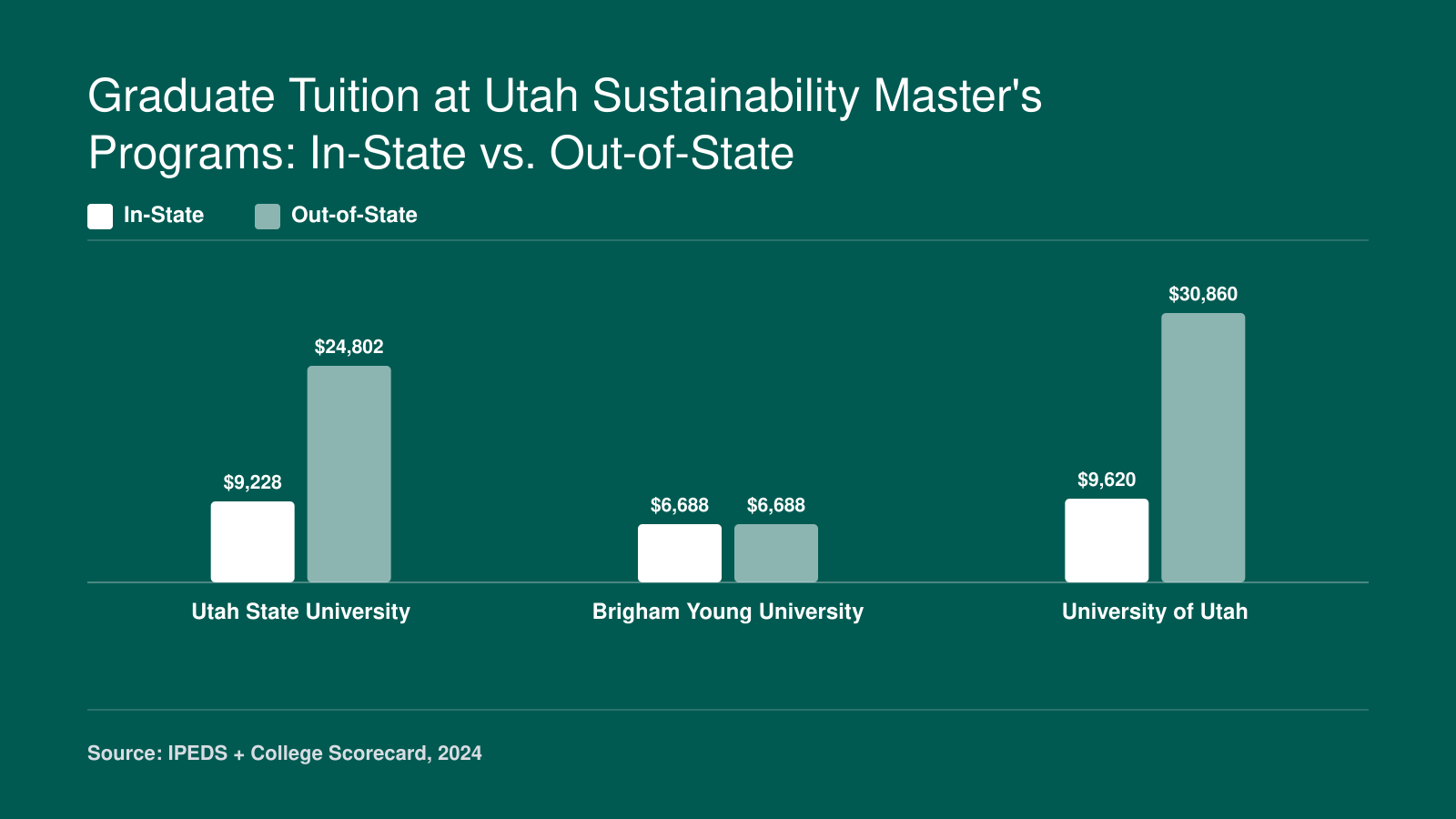
Graduate Tuition at Utah Sustainability Master's Programs: In-State vs. Out-of-State
Published graduate tuition and fees for 2024 show a clear in-state discount at Utah's public universities. Utah State University and University of Utah charge out-of-state students substantially more, while Brigham Young University lists one tuition rate for all graduate students. Figures are annual published rates before financial aid.
Related Articles
Cost, Funding, and Utah Licensure or Certification for a Master's in Sustainability
How much does a master's in sustainability cost in Utah? The answer depends on where you enroll among Master's Programs in Utah and whether you pay resident or nonresident rates. At the programs ranked here, annual graduate tuition and fees for Utah residents land roughly between $6,700 and $9,600, with nonresident figures climbing toward $25,000 to $31,000 at the two public universities. Program length matters as much as the sticker price: a 30 to 36 credit master's, the common range here, means budgeting for that annual cost across two years or so of full-time study.
Funding routes worth pursuing
Don't assume you pay full price. Several related University of Utah departments fund master's students through teaching and research assistantships that typically pair a stipend with a full or partial base-tuition waiver and selected fees, generally at 10 to 20 hours per week.1 Some tracks offer multi-year stipend support.2 These awards are competitive, so contacting faculty early strengthens your case.
Residents of the 16 WICHE states may also qualify for the Western Regional Graduate Program, which caps tuition at 150 percent of the resident rate (and in some cases the in-state rate) on eligible programs.3
Sustainability itself carries no state license. See the credential callout below for the certifications that do matter in Utah.
Utah Credentials for Sustainability and Environmental Careers
Career Outcomes: Earnings and Debt for Utah Sustainability Graduates
Career outcomes for a sustainability master's come down to two numbers you can measure: what graduates earn after finishing and how much debt they carry out the door. For the Utah programs here, federal outcome records do not yet publish program-level earnings one year after graduation, nor median debt or a typical 10-year monthly payment tied to these specific degrees. We will not substitute an institution-wide figure as if it were the program's result, so treat earnings as unreported for now rather than inferred.
How the Degree Structure Builds a Resume
What you can compare is how each program builds real experience before you leave. Utah State's Environment and Society MS offers a research thesis (Plan A) or a non-research project (Plan B), and its Climate Adaptation Science track runs a two-part internship with agency, NGO, and industry partners. The University of Utah's professional master's replaces a thesis with a Professional Experience Project that must exceed an internship, sponsored by a local employer.1 Utah State's Master of Natural Resources requires a capstone with a formal report.
Where Graduates Land
Realistic Utah paths include state environmental agencies, utility sustainability roles, municipal sustainability offices, and private consulting.
Utah Sustainability Master's FAQs
Prospective students often weigh cost, residency status, and program fit when deciding where to pursue a master's in sustainability. These FAQs cover the questions asked most frequently about Utah programs.
Which Utah universities have sustainability master's programs?
How much does a master's in sustainability cost in Utah?
Can out-of-state students qualify for Utah resident tuition during a master's program?
Compare Sustainability programs on the data that matters
Explore more Science & Engineering specializations or browse every graduate field.
All Science & Engineering programs