Most Affordable Master's in Sustainability Programs
Compare 410+ accredited most affordable Sustainability programs at 320+ schools, with graduate earnings, cost, debt, and completion data from IPEDS and the U.S. College Scorecard.

A sustainability master's does not require private-university tuition to be credible. Employers keep adding sustainability specialist and environmental management roles, yet the total price of the degree still differs by tens of thousands of dollars from one school to the next.
At the public universities ranked here, average net price after aid runs from $3,776 to $10,440, with the typical figure near $7,000.
Residency, mandatory fees, and delivery format decide where a program lands in that range. A low price only counts if the credential holds up with employers.
Key Points
- Published tuition starts near $8,589 at UT Rio Grande Valley.
- University of Florida charges $17,393 more for out-of-state students.
- LinkedIn 2025 found green-skilled workers were hired 47% above others.
The 10 Most Affordable Master's in Sustainability Programs
These ten programs pair a serious sustainability curriculum with public-university tuition and payment structures that can keep the degree within reach. Several offer online or hybrid tracks, evening cohorts, and specialized concentrations for working professionals. The list includes California, Florida, and New York options with notably different in-state and out-of-state price points.
California State University-Los Angeles
#1Los Angeles, CA · ~$9,000/yr (est.)
Best for: California residents choosing low-cost environmental science
Cal State LA pairs a flexible M.S. in Environmental Science with four technical tracks, including an Environmental Engineering Science focus on pollution, water, and sustainability. The program offers professional and research pathways, admits in spring and fall, and requires only Cal State Apply without a separate department application. For California residents, the in-state graduate rate is among the lowest on this list.
- Offers 4 concentrations including Environmental Engineering Science
- Professional and research experience pathways
- No separate department application after Cal State Apply
- Covers water quality, climate change, GIS, and remote sensing
- Hydrology focus on watershed management
CUNY City College
#2New York, NY · ~$11,000/yr (est.)
Best for: Working professionals wanting hybrid urban sustainability
CUNY City College's Sustainability in the Urban Environment master's is a hybrid, no-GRE program that blends architecture, engineering, science, and social sciences. Students can study synchronously online or mostly in person on the Harlem campus, and full-time students can finish in about three semesters. New York State residents get a lower graduate rate and can tap scholarships plus partnerships with New York City, NOAA, and NASA.
- 30-credit degree with full-time and part-time options
- No entrance exam required
- Synchronous online or mostly in-person study
- 3.0 GPA minimum and 3 recommendation letters
- Interdisciplinary: architecture, engineering, science, social sciences
- Capstone teams can partner with New York City, NOAA, and NASA
- CUNY Baccalaureate 4+1 pathway can apply nine graduate credits
The University of Texas Rio Grande Valley
#3Edinburg, TX · $5,000 – $10,000/yr (est.)
Best for: Aspiring agricultural and environmental scientists
UTRGV's Master of Science in Agricultural, Environmental, and Sustainability Sciences is a multidisciplinary degree grounded in the Rio Grande Valley's agriculture and natural-resource challenges. It emphasizes sustainable agriculture, ecosystem stewardship, and sustainable systems, with financial aid and scholarships available. The program prepares graduates for agricultural, conservation, and environmental specialist roles across academia, industry, and the public sector.
- Multi-disciplinary program linking agriculture, natural resources, and sustainability
- Focus on sustainable agriculture and ecosystem stewardship
- Covers food systems, watersheds, biodiversity, and functional ecosystems
- Financial aid and scholarships available
- Careers: agricultural/food scientists, conservation scientists, environmental specialists
California State University-Fullerton
#4Fullerton, CA · $9,000 – $19,000/yr (est.)
Cal State Fullerton's M.S. in Environmental Studies draws faculty from 18 departments, so students can build an individual study plan across natural sciences, social sciences, planning, and policy. Cohort-based evening classes at 4 or 7 p.m. make it practical for working students. Graduates move into environmental consulting, planning, water and air quality, sustainable business, and public administration.
- Faculty expertise across 18 departments
- Cohort-based classes at 4 or 7 p.m.
- Individual study plan with advisor and electives
- Core work in research strategies, planning, and sustainability politics
- Careers in consulting, planning, water/air quality, sustainable business
California State University-Northridge
#5Northridge, CA · ~$9,000/yr (est.)
CSUN's Sustainability M.A. offers four concentrations: Environmental Science, Water Resources and Technology; Community Well-Being and Social Justice; Corporate Sustainability; and Sustainability Policy and Government. The campus-based program pairs thesis or capstone work with interdisciplinary faculty from geology, engineering, media, and marketing. Students can connect with the Institute for Sustainability for volunteer, grant, and consulting opportunities.
- Maps, analyzes, and manages natural resources with GIS
- Core courses cover sustainable systems and resource management
- Electives include environmental chemistry, hydrogeology, and water quality
- Thesis or capstone solves a real local or global problem
- Prepares for environmental technician and water engineer roles
- Analyzes environmental decisions through financial and quantitative lenses
- Connects environmental issues to economy and community health
- Builds leadership skills for planning projects
- Volunteer and grant opportunities through the Institute for Sustainability
- Focus on community well-being and social justice
- Focuses on corporate sustainability strategy and leadership
- Combines science with ethics in business settings
- Examines energy crisis, climate change, and global health impacts
- Careers in environmental restoration and corporate sustainability
- Policy and government leadership focus
- Covers sustainability regulatory frameworks and planning
- Links public decisions to environment, economy, and health
- Balances structural change with financial costs
- Roles in community and regional planning
California State University-Long Beach
#6Long Beach, CA · $9,000 – $19,000/yr (est.)
Cal State Long Beach's M.S. in Sustainability Management and Policy is a 36-unit evening program designed for working professionals. It blends science, economics, law, and business, and includes a 12-week capstone with partner companies. The no-GRE, cohort-based format and a transparently priced curriculum make it a practical value for career changers into sustainability roles.
- 36 units over six semesters with evening classes
- No entrance exam required
- Curriculum blends science, economics, law, and business
- 12-week capstone project with partner companies
- Mentorships with sustainability professionals
- Careers: sustainability analysts, consultants, corporate responsibility managers
University of Florida
#7Gainesville, FL · ~$13,000/yr (est.)
The University of Florida offers two distinct sustainability master's paths: a STEM-designated Master of Integrated Sustainable Development on campus and a fully online M.S. in Interdisciplinary Ecology. Both draw on strong interdisciplinary faculty and carry focused career tracks in sustainable design, planning, ecology, and policy. The online program's low per-credit pricing and state employee tuition waiver expand access beyond Gainesville.
- STEM-designated program in built environment sustainability
- Covers building energy modeling and sustainable construction
- Six-credit practicum plus electives in urban planning and wastewater treatment
- Prepares for design, construction management, urban planning, consulting
- 30-credit fully online degree with 5 concentrations
- $14,534 total program tuition or $484 per credit
- Thesis or capstone option and state employee tuition waiver
- Online degree equals on-campus degree with SNRE Academic Hub access
Florida International University
#8Miami, FL · ~$11,000/yr (est.)
Florida International University offers a Professional Science Master's in Environmental Policy and Management plus a broader M.S. in Environmental Studies. The PSM is a 31-credit, skills-based path built for working professionals, while the M.S. adds thesis and non-thesis options, internships, and accelerated pathways. Miami students get face-to-face classes and small cohorts.
- 31-credit program built for working professionals
- Covers environmental regulations, resource management, and data analysis
- Team projects build stakeholder communication skills
- Careers in local, state, national agencies, nonprofits, firms
- 36 credit hours with thesis and non-thesis tracks
- Non-thesis track for working professionals
- Internships with agencies and nonprofits
- Accelerated BA in Sustainability to MS and combined BS/MS pathways
- Up to six transfer credits accepted
Florida Atlantic University
#9Boca Raton, FL · $7,000 – $18,000/yr (est.)
FAU's M.S. in Environmental Science offers thesis and non-thesis options, with research projects tied to active restoration or management work. Students select courses with an advisor across a broad curriculum, making it flexible for research and non-research careers. Graduates pursue research, management, regulatory, or NGO roles.
- Thesis and non-thesis options
- Non-thesis track for students not planning research careers
- Research projects tied to active restoration or management
- Broad curriculum selected with a faculty advisor
- Careers in research, management, regulation, and NGOs
California State University-Sacramento
#10Sacramento, CA · $10,000 – $20,000/yr (est.)
Sacramento State's M.S. in Environmental Studies combines research methods, data science, and policy with electives across biology, economics, geology, and public policy. The Sacramento location puts students close to state and federal agencies, and internships with government, business, and nonprofits are common. Graduates move into environmental science, policy, and governance roles or continue to doctoral study.
- Research methods and data science plus policy coursework
- Five electives across biology, economics, geology, and public policy
- Research project or thesis with government or industry partners
- Internships with government, business, and nonprofits
- 2.8 GPA minimum and 2 recommendation letters
Cost & outcomes by school
Federal data for the highest-earning Sustainability programs, independent of the ranking above. Earnings are this field's master's graduates four years after completing, where the Scorecard reports them.
| School | Earnings | Tuition / yr | Debt | Grads/yr | Format |
|---|---|---|---|---|---|
| University of Redlands CA | $128,897 | $25,172 | — | — | Hybrid |
| Columbia University in the City of New York NY | $123,641 | $57,973 | $61,500 | 273 | Campus |
| Columbia Southern University AL | — | $3,936 | — | — | Online |
| Texas A&M University-Kingsville TX | — | $6,157 | — | — | Campus |
| Texas A&M University-Central Texas TX | — | $6,242 | — | — | Online |
| Georgia Southern University GA | — | $6,646 | — | — | Campus |
| Sul Ross State University TX | — | $6,661 | — | — | Campus |
| Florida Atlantic University FL | — | $6,693 | — | — | Campus |
| Sitting Bull College ND | — | $6,710 | — | — | Campus |
| Youngstown State University OH | — | $6,848 | — | — | Campus |
| University of Nevada-Reno NV | — | $7,032 | — | — | Campus |
| Texas A & M University-Corpus Christi TX | — | $7,179 | — | — | Campus |
Sources: U.S. Department of Education. Tuition and graduates: IPEDS. Earnings and debt: College Scorecard, this field's master's graduates; a dash means no figure is reported.
Cost, debt & payoff
Median earnings of this field's master's graduates (4 yrs after completing) vs. their median federal loan debt · U.S. College Scorecard
Across these programs the median graduate earns about $70,670 and finishes with roughly $38,500 in debt — a ratio that clears a common rule of thumb (keep debt below first-year salary). Tuition and debt vary widely school to school, so check the per-school figures in the table above before you shortlist.
How Much a Master's in Sustainability Really Costs, Including Fees and Aid
The real price of sustainability master's programs is per-credit tuition multiplied by required credits (commonly 30 to 36), plus mandatory university fees, any distance-learning charge, and books. Total program tuition among the programs here starts near $8,589 at UT Rio Grande Valley and $8,700 at American Public University, moves up through $11,402 at CUNY City College, and reaches $27,000 for nonresidents at the University of Florida. American Public's flat online rate does not change with residency, which makes it the cheapest finished degree for anyone who would otherwise pay out-of-state prices.
What the sticker leaves out
UW-Madison's sustainable management tuition is $750 per credit, or $25,500 over 34 credits, with no extra course fees reported and textbooks billed separately.1 Oklahoma's online MS lists $1,015 per credit, $30,450 for 30 credits, bundling fees but not books. At American University, a $50 graduation activity fee and a support services fee of $165 part-time or $450 full-time sit on top of tuition.2 Flat online rates for an online master's in sustainability beat nonresident tuition but can exceed an in-state campus seat.
Bringing the number down
Graduate assistantships (Arizona State has offered remote roles to online sustainability students, though availability varies by term), school scholarships, employer reimbursement, and FAFSA-based federal aid all help. WICHE's WRGP caps tuition at 150% of resident rates across 60-plus public institutions,3 averaging $15,179 in savings in 2025-26,4 but confirm your program participates.
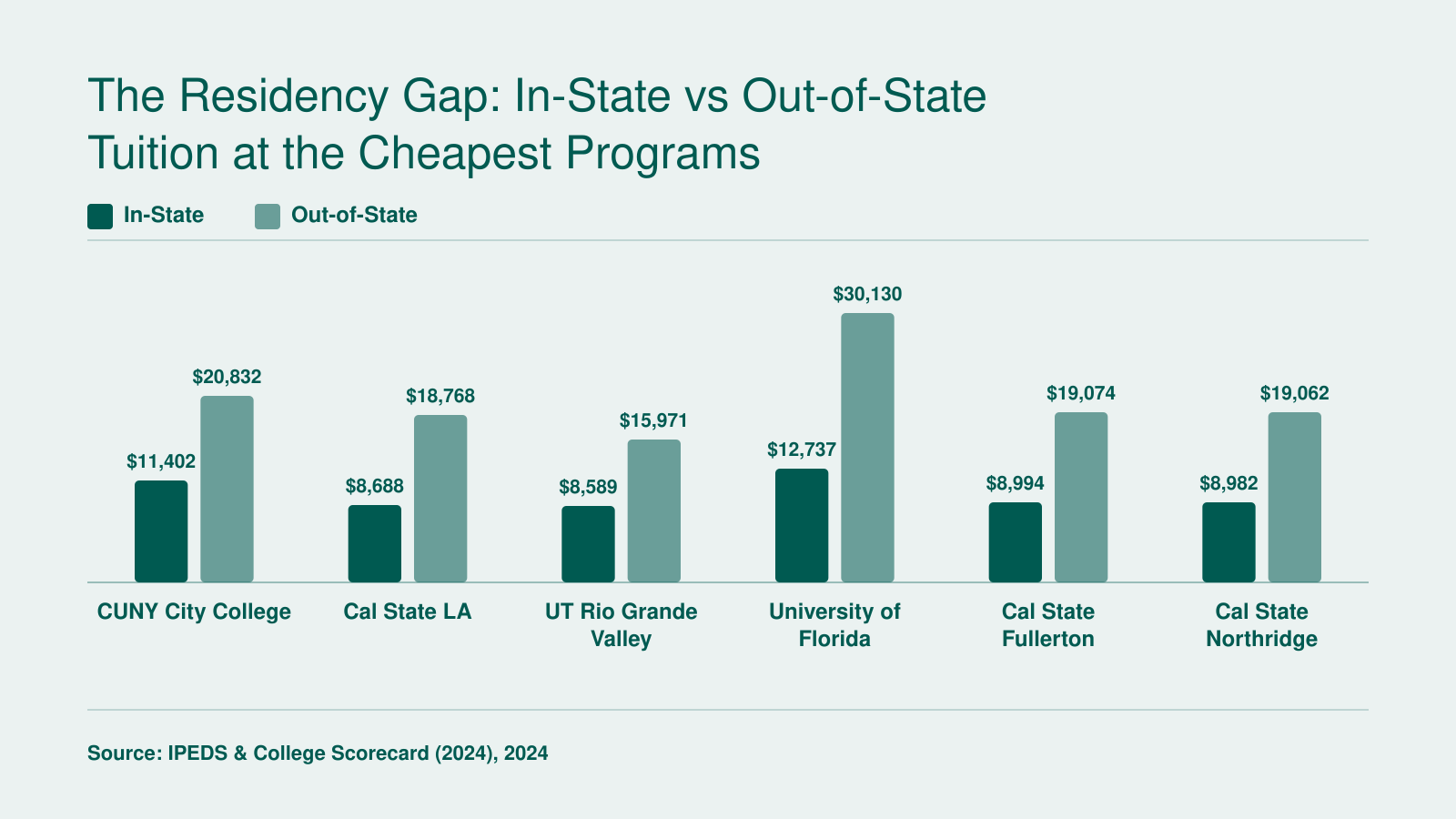
The Residency Gap: In-State vs Out-of-State Tuition at the Cheapest Programs
All six schools charge more for out-of-state students, but the gap varies widely. The largest difference is at the University of Florida, where out-of-state tuition is $17,393 higher than in-state.
Accreditation and STEM Designation: Quality Checks Before You Apply
Does a sustainability master's need special accreditation? No. No programmatic accreditor exists for the field, so what matters is institutional accreditation from a body such as HLC, SACSCOC, or MSCHE. That status qualifies students for federal financial aid and employer recognition. UTK's program is SACSCOC-accredited1, and both ASU sustainability degrees are HLC-accredited34.
STEM Designation and OPT
International students should look at the CIP code. A degree on the DHS STEM list can qualify for the 24-month OPT extension. UTK's program carries CIP 30.33011, and MSU's MURP has a sustainability STEM designation tied to the same code5. ASU's MS in Sustainability and IU's MES both advertise STEM OPT eligibility32, but ASU's Sustainable Food Systems degree does not4. The word "sustainability" alone guarantees nothing.
Quick Verification
- Look up the school in the Department of Education's DAPIP database.
- Ask admissions for the program's exact CIP code and compare it with the current DHS STEM list.
Sustainability vs. Environmental Science
Sustainability degrees are interdisciplinary, blending policy, business, and systems thinking, while environmental science master's programs center on lab and field work. Pick the one that fits your career goal.
Related Articles
Online, Hybrid, or Campus: Delivery Formats and Transfer Credits
Live online classes on a fixed schedule and self-paced asynchronous courses make for very different weeks. CUNY City College's Sustainability in the Urban Environment program is a hybrid: synchronous online classes with occasional in-person sessions on its Harlem campus, plus a fully online option, though international students may need in-person study. Campus sustainability master's programs often suit working adults too. Cal State Fullerton schedules classes at 4 or 7 pm, and Cal State Long Beach offers evening courses and a 12-week capstone with partner companies.
Transfer rules vary by school, so get them in writing. At Arizona State, all 15 credits of the online Sustainability graduate certificate can count toward the online Master of Sustainability Leadership.1 You must apply and be admitted, earn a B or better, and finish the courses within seven years under the 2026-27 handbook. The certificate's capstone cannot be shared with the master's.1
Employers judge an online degree by the school's accreditation, not its delivery mode. Before enrolling remotely, ask whether any capstone, practicum, or field project must be completed in person or with a local partner organization.
A low tuition sticker means little if fees, residency rules, or missing accreditation inflate the total cost or weaken the degree. Compare the full price and the credential first.
Career Outcomes and Salary Potential by Sustainability Focus
Employers are hiring for green skills faster than workers are building them. LinkedIn's 2025 research found demand for green hires grew 8% over two years against 4% growth in supply, and green-skinned workers were hired at a rate 47% above the general workforce.1
So is a master's in sustainability worth it? The program-level numbers suggest yes at the low-cost end. Four years after finishing, Cal Poly Humboldt graduates earned a median $77,785 against $24,185 in median debt, about $275 a month over 10 years. American Public University graduates earned $77,714 four years out, with $31,665 in debt and roughly $360 a month. Cal State Fullerton graduates reported $91,697 four years out.
Roles and pay by focus
- ESG and corporate sustainability: Sustainability manager or ESG analyst roles at corporations and consultancies. Environmental scientists in consulting had a May 2025 median of $79,320.2
- Climate policy: Policy analyst posts at state agencies, federal agencies, and nonprofits. Environmental scientists earned a median $80,500 in state government and $116,110 in federal government.2
- Renewable energy: Energy analyst or project manager roles at utilities and developers. Energy Management was the fastest-growing green skill, up 17.4% in 2025.1 Environmental engineers had a median of $107,110.3
For reference, the national median for environmental scientists and specialists is $82,220.2
Sustainability programs by state
Frequently Asked Questions About Affordable Sustainability Master's Degrees
What is the cheapest master's in sustainability?
Are online sustainability master's degrees respected?
What is the difference between sustainability and environmental science?
Can I finish a master's in sustainability part-time while working?
Compare Sustainability programs on the data that matters
Explore more Science & Engineering specializations or browse every graduate field.
All Science & Engineering programs