Best Master's in Sustainability Programs in North Carolina
Compare 14 accredited Sustainability programs in North Carolina at 12 schools, with graduate earnings, cost, debt, and completion data from IPEDS and the U.S. College Scorecard.
Sustainability hiring in North Carolina has moved from nonprofit advocacy onto corporate and utility payrolls, clustered in the Research Triangle and Charlotte, plus coastal resilience work.
We rank campus and online master's programs together on cost, earnings and debt, not reputation. In-state tuition starts near $8,100 at UNC Wilmington; Duke's Master of Environmental Management runs past $66,000 a year.
Few programs publish graduate outcomes at all, which makes price the variable most applicants can actually control.
Key Points
- Duke University leads on graduation rate and reported earnings, but costs the most.
- In-state tuition runs from about $8,100 at UNC Wilmington to $12,751 at UNC Chapel Hill.
- UNC Greensboro's MSSE is the only ranked program officially classed as online.
The 10 Best Master's in Sustainability Programs in North Carolina
Duke University is the best overall pick. It pairs the highest graduation rate on this list with the strongest reported graduate earnings and employment among programs that publish outcomes. It is also the most expensive option, and several public universities cost far less for in-state students. Graduation rates below describe the whole school, not the program. Graduate tuition is shown as in-state and out-of-state.
Duke University
#1Durham, NC · ~$67,000/yr (est.)
Best for: Career changers choosing among many concentrations
Duke's Nicholas School of the Environment has students pair a subject concentration with a practice concentration such as business, policy, or data analytics. It is offered on campus, with a hybrid track for mid-career professionals. Graduate tuition is $65,120 whether you live in North Carolina or not, and the school graduates 96.8% of its students. Federal data show median earnings of about $67,500 one year after graduation for its program group. The MEM ends with a Master's Project, and summer internships run 10 to 12 weeks.
- Campus program, about two years, fall start
- 8 concentration options
- Capstone required, via a Master's Project
- Internships last 10-12 weeks
- Duke Forest and a Beaufort coastal campus
- Certificate in Geospatial Analysis available
- Dual degree options with law, business, and policy
- Apply by 2026-12-15
- Hybrid format for mid-career professionals
- 5 concentration options
- Integrates science, policy, and business
- Includes place-based learning
- Designed so students apply new knowledge at work
University of North Carolina at Chapel Hill
#2Chapel Hill, NC · ~$13,000/yr (est.)
Best for: Aspiring researchers focused on water systems
UNC Chapel Hill's M.S. in Environmental Sciences and Engineering, Sustainable Water Resources concentration, is a residential, research-first degree on campus. Graduate tuition is $10,764 in-state and $29,421 out-of-state, and the school graduates 91.2% of its students. Students complete a thesis built around their own research question over about two years and 31 credit hours. The program accepts applicants without an entrance exam.
- Campus, research-focused, about two years
- 31 total credit hours
- Thesis built on an original research question
- No entrance exam required
- STEM-designated, with a 24-month OPT extension for F-1 students
- Fall and spring starts
- Bachelor's in science, math, or engineering expected
- 3 letters of recommendation minimum
North Carolina State University at Raleigh
#3Raleigh, NC · $12,000 – $33,000/yr (est.)
Best for: Policy-minded students targeting natural resource agencies
NC State's Master of Natural Resources, Economics and Management option, is a 30-credit campus degree run by Forestry and Environmental Resources. It stands out for its natural resource economics core, and students may take approved courses at Duke and UNC Chapel Hill. Graduate tuition is $9,837 in-state and $30,610 out-of-state, and the school graduates 84.8% of its students. Up to 6 credits of thesis or supervised research can count toward the degree.
- Campus program, 30 total credit hours
- 11-credit core including policy, statistics, and research methods
- 9 credits in natural resource economics or management
- 10 credits chosen with an advisor and committee
- Approved courses available at Duke and UNC Chapel Hill
- Prerequisite courses required, up to 12 credits
- Topics include non-market valuation and forest certification cost analysis
Wake Forest University
#4Winston-Salem, NC · $35,000 – $40,000/yr (est.)
Wake Forest's Master of Arts in Sustainability is a structured 30-credit campus program in Winston-Salem. It blends science, policy, and management, with six elective credits to tailor the degree. Graduate tuition is $38,292 for all students, and the school graduates 89.2% of its students. Students finish with an internship or thesis research.
- Campus program, 30 total credit hours
- Core in natural science, environmental law, and organizational management
- Natural capital valuation and ecosystem services coursework
- Six credits of electives
- Finish with an internship or thesis research
University of North Carolina Wilmington
#5Wilmington, NC · $8,000 – $24,000/yr (est.)
UNC Wilmington's M.S. in Environmental Studies is an interdisciplinary campus degree with a Coastal Management concentration and a Marine and Coastal Education concentration. Graduate tuition is $5,278 in-state and $21,364 out-of-state, and the school graduates 70.6% of its students. Students complete 3 credits of applied learning, either a practicum or a final project.
- Campus program, 33 total credit hours
- 15-credit core plus 15 credits in the concentration
- Capstone required
- 3.0 GPA minimum
- No environmental degree required
- Fall and spring starts
- Campus program, 33 total credit hours
- Final project or practicum
- Site placements in marine and coastal education
- Personal essay required, writing sample optional
- 3.0 GPA minimum
- Scholarships available
Appalachian State University
#6Boone, NC · $9,000 – $25,000/yr (est.)
App State's M.A. in Appalachian Studies offers a Sustainability in Appalachia concentration on the Boone campus, drawing on sustainable agriculture, rural planning, and environmental policy. Graduate tuition is $5,233 in-state and $21,904 out-of-state, and the school graduates 74.5% of its students. Full-time students finish in about two years. Graduate assistantships are available.
- Campus program, about two years
- Interdisciplinary, drawing on social sciences, humanities, and natural resources
- Home to the Center for Appalachian Studies
- Graduate assistantships available
- Accelerated bachelor's to master's path
- Fall and spring starts
University of North Carolina at Greensboro
#7Greensboro, NC · ~$9,000/yr (est.)
UNC Greensboro's M.S. in Sustainability and Environment is the one fully online option on this list, with live and self-paced classes. Graduate tuition is $5,375 in-state and $20,090 out-of-state, and the school graduates 56.3% of its students. Students choose a final project: a 3-credit internship, a 3-credit capstone, or a 6-credit thesis.
- Fully online, with synchronous and asynchronous options
- Full-time and part-time, as little as two years
- Online authorization in all 50 states and Puerto Rico
- Electives in climate action, urban planning, and corporate responsibility
- Business electives in sustainable development
- Final project: internship, capstone, or thesis
North Carolina A & T State University
#8Greensboro, NC · ~$8,000/yr (est.)
North Carolina A&T's M.S. in Agricultural and Environmental Systems, Natural Resources and Environmental Systems concentration, is a campus program in Greensboro at a historically Black university. It combines soil and water science, ecology, land management, and environmental policy. Graduate tuition is $5,095 in-state and $17,895 out-of-state, and the school graduates 57.2% of its students.
- Campus program in Greensboro
- 3 concentration options
- Coursework in soil and water science, ecology, and land management
- Environmental policy component
- Applied fieldwork emphasis
University of North Carolina Asheville
#9Asheville, NC · $5,000 – $10,000/yr (est.)
UNC Asheville's M.S. in Environmental Resilience is a new one-year, 30-credit campus cohort program focused on community climate resilience. Graduate tuition is $4,914 in-state and $21,236 out-of-state, and the school graduates 54.5% of its students. Students complete an internship and proposal, then a 6-credit applied research project for a community partner in the final summer.
- Campus cohort, 1-year program, fall start only
- 30 total credit hours
- Climate science, GIS, economics, ethics, and data science
- Community partners include NOAA and NEMAC
- Prerequisite courses required, 3.0 GPA minimum
- $11,068 total program tuition
- Apply by 2027-01-15
- No F-1 sponsorship available
Montreat College
#10Montreat, NC · $10,000 – $15,000/yr (est.)
Montreat College's M.S. in Environmental Education is a 31-credit cohort program that mixes online coursework with summer and weekend intensives. Graduate tuition is $11,070 for all students, and the school graduates 50.3% of its students. Students close with a thesis or capstone project, and coursework aligns with North Carolina's environmental education certification.
- 31 total credit hours, about 1.66 years
- Cohort model combining online work and campus intensives
- Two-week biome field study
- Thesis or capstone option
- 3.0 GPA minimum
- $20,520 total program tuition
- Military benefits and employer reimbursement supported
Cost & outcomes by school
Federal data for the highest-earning Sustainability programs, independent of the ranking above. Earnings are this field's master's graduates four years after completing, where the Scorecard reports them.
| School | Earnings | Tuition / yr | Debt | Grads/yr | Format |
|---|---|---|---|---|---|
| Catawba College NC | — | $7,188 | — | — | Online |
| North Carolina A & T State University NC | — | $8,368 | — | — | Campus |
| University of North Carolina Asheville NC | — | $8,293 | — | — | Campus |
| University of North Carolina Wilmington NC | — | $8,112 | — | — | Campus |
| Appalachian State University NC | — | $8,570 | — | — | Campus |
| University of North Carolina at Greensboro NC | — | $8,614 | — | — | Online |
| Montreat College NC | — | $11,820 | — | — | Campus |
| North Carolina State University at Raleigh NC | — | $12,101 | — | — | Campus |
| University of North Carolina at Chapel Hill NC | — | $12,751 | — | — | Campus |
| Lenoir-Rhyne University NC | — | $13,020 | — | 5 | Campus |
| Wake Forest University NC | — | $39,141 | — | 15 | Campus |
| Duke University NC | — | $66,523 | — | — | Campus |
Sources: U.S. Department of Education. Tuition and graduates: IPEDS. Earnings and debt: College Scorecard, this field's master's graduates; a dash means no figure is reported.
Online and Hybrid Master's in Sustainability Options in North Carolina
Most of the master's programs in North Carolina are campus-based, but more than one ranked option is built for distance learners, including the Master's in Sustainability and Environment (MSSE) at UNC Greensboro. It is one of the ranked sustainability master's programs officially classed as online, and it can be completed fully online.
How the MSSE is delivered
The six core courses are 100% asynchronous, with weekly or biweekly deadlines instead of set class meetings. Occasional one-on-one faculty meetings and group projects happen online on flexible schedules. Electives are where the format varies: they may be online synchronous, online asynchronous, or face-to-face, and some departmental electives are offered only on campus. A student can finish the degree entirely online by choosing asynchronous electives, while another may take some or all electives in person.
UNC Greensboro does not require an on-campus residency or immersion. The degree is 36 credits.1 Full-time study means about 9 credits per semester and part-time means 3 to 6, with completion typically in two years. A thesis, capstone, or internship option is available.
The MSSE is one flexible program, not separate online and campus tracks, and no other ranked school appears as a hybrid.
A tip for working professionals
Before enrolling, ask the department which electives are campus-only and whether your capstone or thesis involves any in-person fieldwork or travel to North Carolina.
Which Ranked Master's Programs Waive or Skip the GRE
A GRE policy determines whether a standardized admissions test is required. Across the sustainability and environmental management master's programs on this list, the trend in North Carolina runs strongly toward no test at all, a pattern common among no-GRE master's programs, though the published detail varies school by school.
Programs that do not require the GRE
- UNC Chapel Hill: The graduate admissions page for its environment, ecology and energy master's programs states plainly that the GRE is not required.1 No waiver process or eligibility threshold is published, because none is needed.
- NC State: The Master of Environmental Assessment lists no entrance exam in either its catalog entry or online admissions page.23 The Master of Environmental Management describes the GRE requirement as waived program-wide, with applicants free to submit scores voluntarily if they think it helps.4 For the Master of Environmental Engineering, the waiver is automatic for applicants holding an engineering degree from a U.S. institution; what applies to everyone else is not spelled out.5
Where policies are not published
UNC Greensboro's online sustainability and environment master's does not publish a current GRE or GMAT statement on its program page. Treat that as unstated rather than as a requirement, and ask the admissions office directly.
No ranked program here advertises a mandatory GRE or GMAT. Still, test policies get revisited each admissions cycle, so confirm the rule for your specific entry term before you plan around it.
Application Deadlines and Prerequisites for NC Sustainability Master's Programs
Requirements vary by program and cycle, so confirm every date on the official admissions page.
- Bachelor's degreeUNC-Chapel Hill wants science, math, or engineering; NC State's environmental assessment program wants a related field; UNC Asheville and Duke accept any accredited bachelor's.
- Minimum GPAUNC Asheville and NC State's Master of Environmental Assessment ask for 3.0; NC State's environmental engineering program asks for 3.5 overall; UNC-Chapel Hill states no minimum.
- Recommendation lettersUNC-Chapel Hill asks for three, UNC Asheville two, and Duke one, preferably from a professional supervisor.
- Statement and resumeResumes are required at UNC-Chapel Hill, NC State, UNC Asheville, and Duke; UNC Asheville also wants a 500–1,000 word essay.
- Prerequisite courseworkUNC Asheville requires introductory natural science, economics or finance, and statistics; UNC-Chapel Hill requires none.
- Fall deadlinesUNC-Chapel Hill's preferred date is December 15, 2026, with a final date of February 9, 2027; NC State's assessment program closes April 15; Duke lists March 5, 2027 for visa applicants.
- Spring entryUNC-Chapel Hill listed October 13, 2026 and NC State's assessment program September 30. Neither school publishes rolling admission, and several schools here do not post dates.
Related Articles
Master's in Sustainability Cost and Certifications in North Carolina
What the degree costs
The biggest price driver is residency at public schools. Listed in-state graduate tuition runs from about $8,100 at UNC Wilmington to $12,751 at UNC Chapel Hill, while out-of-state rates climb to $21,000 to $33,000. UNC Asheville is $8,293 in-state versus $24,615 out-of-state.
Total program costs are more useful than annual figures. UNC Asheville lists $11,068 in total tuition for 30 credits, and Montreat lists $20,520 for 31 credits. NC State's MS in Sustainability and Environment totals $22,492 to $23,113 for 2026-27, per the UNC System tuition authorization. Lenoir-Rhyne's 33-credit program totals about $43,000. Treat each school's net price as a rough institution-wide average, not a program quote.
Licenses and credentials
North Carolina has no state license for sustainability professionals. Employers instead look for voluntary credentials. LEED Green Associate, from the U.S. Green Building Council, suits building, facilities, and real-estate roles, and LEED AP requires the Green Associate first. USGBC's Sustainability Excellence Associate and Sustainability Excellence Professional credentials were developed with ISSP.1 The older ISSP-SA and ISSP-CSP labels could not be confirmed as current for 2026.1
A regulated license applies only when the work is engineering practice. In that case, a PE license through the NC Board of Examiners for Engineers and Surveyors becomes relevant.
One way to save
Choose an in-state public program. Non-residents should look at Catawba's online option, which lists the same tuition regardless of residency.
North Carolina is already a sizable green building market: Site Selection counted 2,708 LEED-certified projects in the state as of summer 2024, tenth nationally by total certified projects. That existing building stock is where many sustainability graduates do their first work.
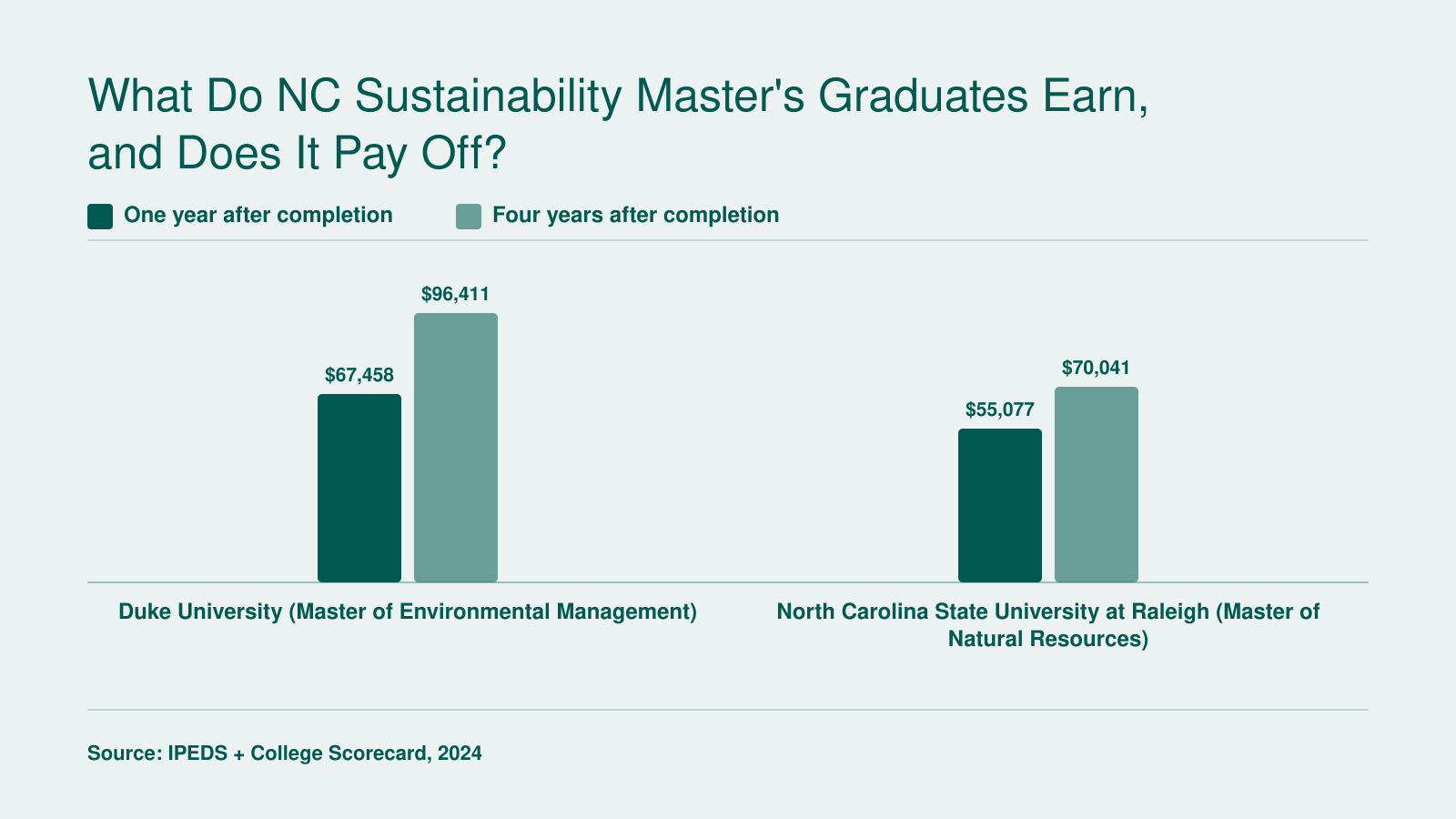
What Do NC Sustainability Master's Graduates Earn, and Does It Pay Off?
Program-level earnings are published for only some of the schools here, so the chart shows only those that report them. Each bar is a median, measured one year and four years after completion. Duke University's Master of Environmental Management graduates carry median program debt of $48,310, which works out to about $550 a month over 10 years. North Carolina State University at Raleigh does not publish program debt for its natural resources master's. Typical roles in the state include sustainability manager, environmental consultant, and energy analyst, but this page gives no salary figures for them.
How We Ranked These Master's in Sustainability Programs
No single accreditor has kept pace with the growth of sustainability master's degrees, so outcomes matter more than labels. We compared graduate tuition and net price, program-level earnings and debt from College Scorecard, and institution-wide completion rates. Many prestige-based lists lean on reputation instead.
Every school here holds institutional accreditation from SACSCOC, the regional accreditor for North Carolina colleges.1 Confirm it on each school's own accreditation page. Most sustainability master's degrees have no dedicated programmatic accreditor. A program housed in a business school, such as an MBA in Sustainability, may sit under AACSB accreditation2, and public affairs programs may fall under NASPAA, but that covers the school, not automatically the degree. NC State's Master of Environmental Assessment, for example, is not identified as holding its own specialized accreditation.3 UNC Greensboro's Master's in Sustainability and Environment lists affiliations with AESS, AASHE, and NCSE. Those are memberships, not accreditation.
Data has limits. Graduation rates cover the whole institution, not the individual program, and earnings are unpublished for some smaller programs. Treat those figures as context, not guarantees.
Compare Sustainability programs on the data that matters
Explore more Science & Engineering specializations or browse every graduate field.
All Science & Engineering programs