Best MBA in Sustainability Programs
Compare 30+ accredited MBA in Sustainability programs at 20+ schools, with graduate earnings, cost, debt, and completion data from IPEDS and the U.S. College Scorecard.

What actually separates a sustainability MBA from a standard MBA with one corporate responsibility elective? Sometimes 77 credit hours and a three-year dual degree, as at Michigan's Erb Institute. Sometimes a 12-credit specialization layered onto the regular core, as at Minnesota's Carlson School.
That spread shows up in price too, and it makes comparing affordable MBA programs essential. Published tuition runs from roughly $9,400 a year in-state at the University of South Dakota to about $66,000 at Carnegie Mellon, and the net price after aid rarely matches either number.
Accredited green MBAs now come in online, hybrid, and campus formats. Delivery is the easy question. How much sustainability coursework actually sits inside the degree is the harder one.
Key Points
- Michigan's average net price of $13,138 sits far below its $60,946 out-of-state tuition.
- Yale SOM lists $91,400 in 2026-27 tuition and fees, versus lower-cost options here.
- Format varies: most programs are on campus, with fewer online or hybrid for working professionals.
The 10 Best Sustainability MBA Programs for 2027, Ranked
Each school below had to prove its value in dollars and outcomes, not just in its brochure. The strongest programs pair a real sustainability curriculum with graduate earnings and price data, so you can see what the MBA actually costs and what it tends to pay back.
University of Michigan
#1Ann Arbor, MI · $29,000 – $58,000/yr (est.)
Best for: Dual-degree seekers wanting environmental science depth
The Erb Institute pairs Michigan Ross with the School for Environment and Sustainability, making sustainability the core of a three-year MBA/MS rather than a side concentration. Students complete two summer internships and choose among nine concentrations such as renewable energy or corporate responsibility, and four years after finishing, median earnings are $76,776. This is the choice for students who want a full environmental science credential, not just a few electives.
- Three-year dual MBA/MS through the Erb Institute partnership with SEAS
- 77 total credit hours with nine concentration options
- Requires two distinct summer internships plus real-world research projects
- Full-time, thesis-required enrollment
Carnegie Mellon University
#2Pittsburgh, PA · ~$51,000/yr (est.)
Best for: Quantitative analysts targeting corporate sustainability
Carnegie Mellon routes its MBA Sustainability concentration through the Tepper School Sustainability Initiative, pulling in engineering and quantitative resources across the university. The curriculum covers energy, natural resources, health, and social well-being, with an emphasis on assessing the long-term impact of business decisions. This is the stronger fit for analytically minded students targeting sustainability consulting, corporate strategy, or environmental policy.
- MBA concentration through the Tepper School Sustainability Initiative
- Covers energy, natural resources, health, and social well-being
- Draws on university-wide technology and quantitative expertise
- Campus-based with interdisciplinary collaboration
Michigan State University
#3East Lansing, MI · $22,000 – $42,000/yr (est.)
Best for: In-state students targeting corporate responsibility roles
Michigan State's full-time MBA offers a Corporate Social Responsibility and Sustainability concentration focused on triple-bottom-line performance, green supply chains, and ESG coordination. It prepares students for roles in sustainability analytics, community impact, and environmental disclosure. Choose this one when you want a business-focused sustainability track inside a traditional full-time MBA rather than a separate environmental degree.
- MBA concentration in Corporate Social Responsibility and Sustainability
- Seven concentration options with triple-bottom-line focus
- Includes sustainability analytics and ESG coordination training
- Covers green supply chain and community impact strategies
University of Minnesota-Twin Cities
#4Minneapolis, MN · ~$22,000/yr (est.)
Minnesota's Carlson School offers a Sustainable Environmental, Social, and Governance Management specialization co-sponsored with the Humphrey School and the Institute on the Environment. The curriculum blends sustainability science, supply chain, human rights, and financial reporting, with students working directly with organizations on real problems. It is a flexible pick for working professionals because full-time and part-time options include in-person, online, and HyFlex formats.
- Hybrid ESG management specialization co-sponsored by three schools
- Full-time and part-time options, including HyFlex and online
- Covers procurement, human rights, and environmental reporting
- 12-13 credits for specialization with real-world problem solving
Colorado State University-Fort Collins
#5Fort Collins, CO · ~$14,000/yr (est.)
Colorado State's 16-month Impact MBA is a STEM-designated, full-time program built around economic, social, and environmental initiatives. Students complete a fellowship capstone with an organization and can add graduate certificates in Carbon Management or Entrepreneurship and Innovation. It suits students who want a short, project-based residential program with Western resident tuition options and a top-ranked sustainability MBA.
- 16-month full-time Impact MBA with fellowship capstone
- STEM-designated business program ranked No. 4 Better World MBA
- Optional graduate certificates in Carbon Management or Entrepreneurship
- Dual degree with Master of Finance and WRGP resident tuition eligibility
University of Redlands
#6Redlands, CA · $25,000 – $30,000/yr (est.)
Redlands' Presidio MBA in Sustainable Solutions is a 53-credit hybrid program with synchronous online classes plus monthly residency weekends in the San Francisco Bay Area. No entrance exam is required, and rolling admissions keep it accessible for working professionals. Four years after finishing, median earnings are $128,897, the highest published program-level figure in this set, which makes it a strong pick for sustainability career switchers who want Bay Area network access.
- 53-credit Presidio MBA in Sustainable Solutions with synchronous online or campus options
- No entrance exam required with rolling admissions
- Experiential consulting projects plus monthly Bay Area residency weekends
- Full-time two-year or part-time three-and-a-half-year paths
University of South Dakota
#7Vermillion, SD · ~$7,000/yr (est.)
South Dakota's MBA offers a Sustainability specialization that can be completed in as little as 12 months in face-to-face, hybrid, or fully online formats. The same faculty teach across all delivery modes, and the program is WICHE WRGP eligible. It is a practical choice for Western students who want a fast, flexible, lower-cost pathway into sustainability leadership.
- Sustainability specialization in a 12-month or part-time MBA
- Face-to-face, hybrid, or fully online options with the same faculty
- WICHE WRGP eligible with accelerated B.B.A./M.B.A. option
- No entrance exam required and $35 application fee
Yale University
#8New Haven, CT · ~$50,000/yr (est.)
Yale combines its MBA with a Master of Environmental Management or Master of Forestry in a three-year, full-time joint degree that spans the School of Management and the School of the Environment. It was the first joint management-environment degree, established in 1982, and applicants must gain admission to both schools separately. This is for students who want an Ivy League environmental management credential and can commit to three years.
- Three-year joint MBA/MEM or MF with School of the Environment
- First joint management-environment degree, established 1982
- Full-time enrollment requiring separate applications to both schools
- Center for Business and the Environment convenes resources across Yale
University of North Carolina at Chapel Hill
#9Chapel Hill, NC · ~$13,000/yr (est.)
UNC Kenan-Flagler's full-time MBA offers a Sustainable Enterprise concentration that balances profits, society, and environmental impact. Students may take electives outside the business school in public policy and environmental studies, and the concentration supports experiential programs like the Invest for Impact Competition and Turner MIINT. Choose it for the combination of a highly ranked business school and a strong Net Impact community.
- Sustainable Enterprise concentration in the full-time MBA
- Electives outside the business school in policy and environmental studies
- Experiential programs include Invest for Impact Competition and Turner MIINT
- Net Impact chapter with gold status for six consecutive years
Franklin Pierce University
#10Rindge, NH · ~$42,000/yr (est.)
Franklin Pierce's online MBA in Energy and Sustainability blends business fundamentals with corporate social responsibility, climate change, global energy economics, and renewable energy. Designed for working professionals, the mostly asynchronous program offers full-time or part-time pacing and small classes. It is the pick for students who want a fully online, practitioner-focused energy transition MBA.
- Online MBA in Energy and Sustainability with asynchronous classes
- Topics include CSR, climate change, global energy economics, and renewable energy
- Full-time or part-time pacing with small classes
- Advisory board keeps curriculum aligned with employer needs
Cost & outcomes by school
Federal data for the highest-earning Sustainability programs, independent of the ranking above. Earnings are this field's master's graduates four years after completing, where the Scorecard reports them.
| School | Earnings | Tuition / yr | Debt | Grads/yr | Format |
|---|---|---|---|---|---|
| University of Redlands CA | $128,897 | $25,172 | — | — | Hybrid |
| University of California-Berkeley CA | — | $15,866 | $41,000 | 71 | Campus |
| University of Nebraska at Omaha NE | — | $8,305 | — | — | Campus |
| Westfield State University MA | — | $8,676 | — | — | Online |
| California State Polytechnic University-Humboldt CA | — | $9,921 | — | — | Campus |
| University of Maine ME | — | $10,662 | — | — | Online |
| University of North Carolina at Chapel Hill NC | — | $12,751 | — | — | Campus |
| The University of Arizona Global Campus AZ | — | $12,930 | — | — | Online |
| The Evergreen State College WA | — | $13,458 | — | — | Campus |
| Unity Environmental University ME | — | $9,750 | — | 28 | Online |
| University of Colorado Boulder CO | — | $16,634 | — | — | Campus |
| Lipscomb University TN | — | $17,334 | — | — | Hybrid |
Sources: U.S. Department of Education. Tuition and graduates: IPEDS. Earnings and debt: College Scorecard, this field's master's graduates; a dash means no figure is reported.
How These 10 Programs Earned Their Spots
The University of Michigan lists tuition and fees of $76,152 for in-state students and $81,152 for out-of-state students, yet its average net price is $13,138. That gap shows why we compare several cost figures across Best MBA Programs instead of trusting a sticker price.
The Inputs, in Plain Language
- Tuition and fees: The published graduate charge, before any grants or scholarships.
- Net price: The average cost after grant aid, reported for the whole institution.
- Median earnings and debt: What graduates of a specific program earn and borrow, when federal data covers that program.
- Completions: How many students finish the program each year.
Read Net Price as an Estimate
The net price figure is an average across the whole institution. It blends many students and aid packages, so treat it as a planning estimate, not a personal quote. Your own cost depends on residency, merit awards, and employer support. Always run the school's own calculator.
Why Completions Matter
A program that graduates only a handful of students a year may have a thinner alumni network in sustainability roles than a typical General MBA. That can mean fewer warm introductions when you recruit. Where completions counts, earnings, or debt figures are not yet published for a program, we leave the gap visible instead of filling it.
What Federal Data Cannot Tell You
Federal sources do not track sustainability-specific job placement. The career section draws on outside research for that, so weigh it as context, not as government-verified outcomes.
Tuition vs. Net Price: The Three Lowest-Cost Sustainability MBAs
Sticker price and net price can point in different directions. The three programs below show the lowest average net price among the schools ranked here, with published in-state and out-of-state graduate tuition listed side by side. For context, Yale SOM's 2026-27 tuition and fees total $91,400 and Duke Fuqua's tuition is $83,700 before living costs, so the public options below can be far more affordable, especially for residents; out-of-state students should compare that column closely because the nonresident rate can erase much of the savings, and published tuition changes each year, so confirm the current figure on the program page.
| School | In-State Tuition | Out-of-State Tuition | Average Net Price |
|---|---|---|---|
| University of North Carolina at Chapel Hill | 12751 | 31408 | 11655 |
| University of Michigan | 28886 | 57776 | 13138 |
| Cal Poly Humboldt | 9921 | 20001 | 13171 |
Scholarships and Fellowships Built for Green MBA Students
The best sustainability funding rarely appears on your admission offer by default, so you have to know where to look.
School-based awards
- Michigan Erb Institute: The Erb Institute Scholarship covers tuition for dual MBA/MS students. You apply after applying to Ross and to the sustainability master's programs at the School for Environment and Sustainability and being admitted to at least one, with a July 1 deadline.1 The Erb Legacy Scholarship goes to eligible dual-degree students in their fifth semester (application due before May 30, 2027), though no amount is published.1
- Yale SOM: Yale SOM's Executive MBA program offers the Sustainability and Business & Society Scholarships as partial awards. They require no extra application, and you are notified at admission.2
- Duke Fuqua: Admitted Daytime MBA students with a social-impact interest are automatically considered for Impact Scholars, a merit award of up to full tuition. The CASE Launch Pad Award gives winning student ventures a $10,000 grant.3
External and summer funding
EDF Climate Corps places graduate students with organizations to cut emissions in operations and supply chains. Yale's funding page lists roughly $15,000 for summer 20274, but treat that as a guide rather than a guarantee. Applications generally close in late December.4
Stacking your aid
Tuition scholarships and summer fellowships usually pay for different things, so they layer well. Confirm with each financial aid office whether an outside award reduces institutional aid. Then ask your employer whether its tuition benefit has a cap and whether it applies alongside scholarships.
One practical tip: ask admissions whether sustainability fellowships need a separate application or deadline. Some, like Erb's, do. Others, like Yale's, are automatic.
Related Articles
LinkedIn's 2026 Global Green Skills Report found that over the preceding two years, global demand for green hires grew by 8%, while the supply of green skills grew by only 4%. Employers are seeking green talent twice as fast as it is developing, a gap that a sustainability MBA is designed to help close.
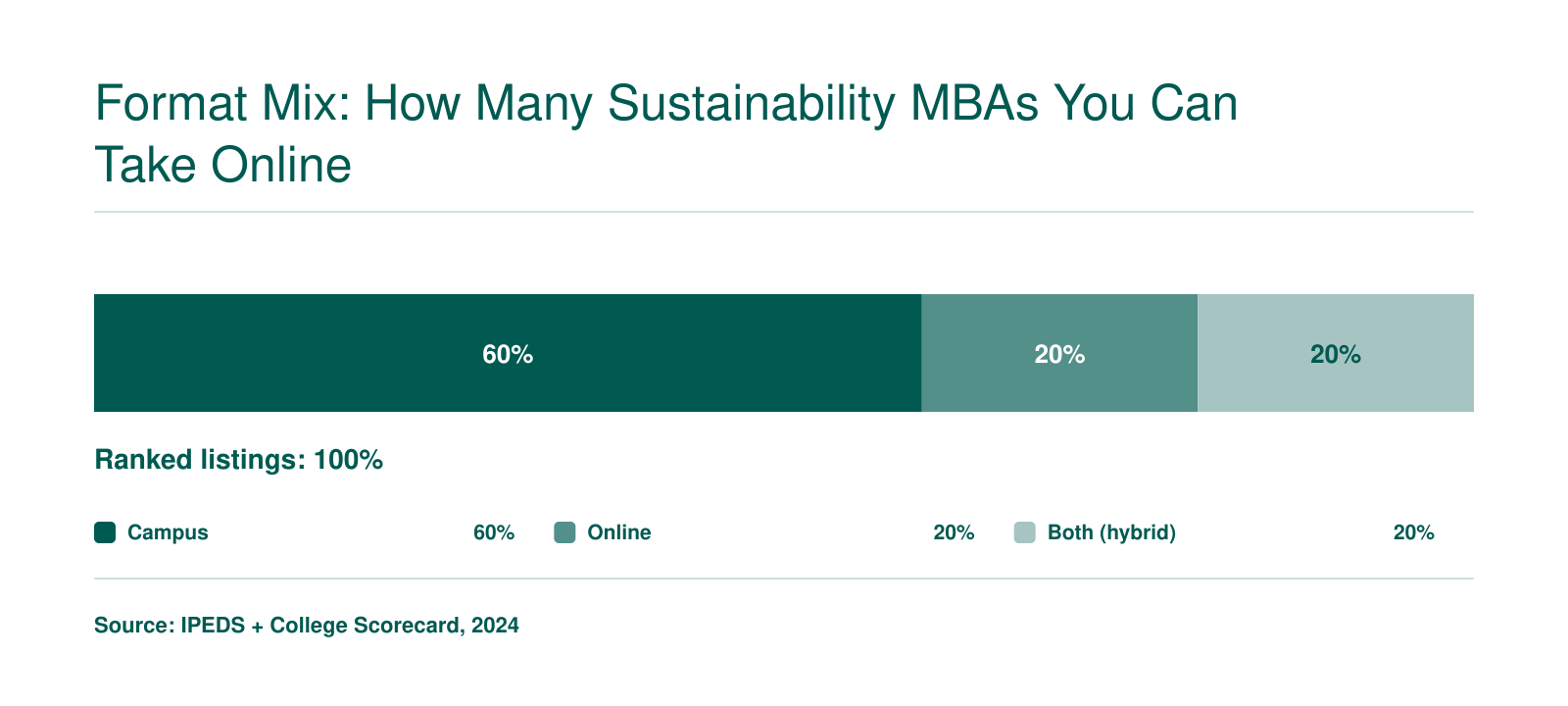
Format Mix: How Many Sustainability MBAs You Can Take Online
Most of the sustainability MBAs ranked here are delivered on campus, with a smaller share offered fully online or in a hybrid format that combines both. An online sustainability MBA from a regionally and AACSB-accredited school carries the same degree title as its campus version, so check accreditation before you check format. The trade-off is access: campus programs often offer more in-person contact with sustainability centers, treks, and recruiters.
Your Sustainability MBA Application Checklist
Requirements differ sharply between a full-time program like Yale SOM and a hybrid one like Bard. Confirm every detail on the school's own admissions page before you apply.
- Bachelor's degreeEvery program expects a bachelor's degree from an accredited institution. Bard sets a 3.0 GPA benchmark. Applicants below it may need to submit a test score or take an alternative skills assessment.
- GMAT/GRE policyYale SOM requires the GMAT or GRE, offers no waiver, and accepts scores up to five years old. Bard requires no exam. Michigan Ross Online and Duke Fuqua handle waivers case by case. Arizona Eller Online lists a waiver for 2026-27, but it may be time-limited. Duke's guidance has been inconsistent, so check its current instructions.
- Work experienceFull-time programs generally favor applicants with several years of professional experience. Online and executive formats often expect more. Each school sets its own expectations, so compare them before applying.
- DeadlinesYale SOM rounds close September 15, 2026, January 6, 2027, and April 7, 2027. Bard accepts applications December 1, February 1, and May 1 on a rolling basis. Arizona Eller Online's remaining 2026-27 deadlines are December 18 and February 15. Michigan Ross and Duke have not confirmed 2026-27 dates.
- Essays, resume, recommendationsExpect essays that show a genuine commitment to sustainability, a resume that highlights relevant results, and recommenders who can speak to your leadership.
Sustainability programs by state
Quick Answers on Green and Sustainability MBAs
Labels vary from school to school, so the details below matter more than the program name. Check each school's current policies before you apply.
Is a green MBA the same thing as a sustainability MBA?
Can you get into a top sustainability MBA without taking the GMAT?
Do employers take online sustainability MBA degrees seriously?
Compare Sustainability programs on the data that matters
Explore more MBA specializations or browse every graduate field.
All MBA programs