Most Affordable MBA in Sustainability Programs
Compare 30+ accredited most affordable MBA in Sustainability programs at 20+ schools, with graduate earnings, cost, debt, and completion data from IPEDS and the U.S. College Scorecard.

Sustainability MBAs, including MBA in Sustainability Programs With No GMAT or GRE Required, often arrive with private-school sticker prices, yet effective net price across the programs ranked here runs from roughly $13,000 to $23,000 a year, a spread wide enough to double your final bill depending on where you enroll.
That gap is the tension: fully online degrees at public universities, including Accelerated MBA in Sustainability Programs, can cost a fraction of a prestige dual-degree program, and the cheaper option is sometimes the better value. The ranking orders programs by net price and financial aid, so affordability drives the order.
Sticker tuition rarely matches what graduates actually pay.
Key Points
- Prescott College builds sustainability into every MBA course, not a two-course concentration.
- Green skills hiring rose 7.7% from 2024 to 2025, outpacing supply.
- Compare median earnings to median federal debt to judge loan payoff speed.
10 Most Affordable Sustainability MBA Programs for 2027
Price and flexibility shaped this list: each entry appears because it offers a credible sustainability-focused MBA at a cost that works for graduate students, not because of a brand name. We looked at net price after aid, total program cost where published, and delivery options that let working professionals keep earning while they study.
University of California-Berkeley
#1Berkeley, CA · ~$16,000/yr (est.)
Best for: Climate-focused leaders wanting business rigor
UC Berkeley offers a distinctive five-semester concurrent degree that pairs the Haas MBA with a Master of Climate Solutions from Rausser College. The program integrates business core courses with climate data science, carbon accounting, and lifecycle analysis, and includes two summer internships plus a capstone with real organizations. Graduates work across business, government, and nonprofit sectors.
- 5-semester concurrent MBA and Master of Climate Solutions
- Two summer internships built into the program
- Capstone pairs students with business, government, or nonprofit organizations
- Coursework covers carbon accounting, lifecycle analysis, and climate data science
- First year of MBA core at Haas, then climate coursework at Rausser
- Statement of purpose required on climate-solutions interest
Westfield State University
#2Westfield, MA · $5,000 – $10,000/yr (est.)
Best for: Budget-conscious online learners
Westfield State University's online MBA offers a Global Sustainability for Business concentration through an embedded 12-credit certificate, paired with the Business Leadership Certificate. The 30-credit degree can be completed in three semesters with multiple start dates and no entrance exam, making it accessible for working adults. The sustainability track covers organizational change, reporting, responsible leadership, and green urban planning.
- 30-credit online MBA completed in three semesters
- Earn the Business Leadership Certificate plus Global Sustainability for Business certificate
- Sustainability certificate covers reporting, responsible leadership, and green cities
- No GMAT/GRE required; 2.8 GPA minimum
- 8-week and 15-week sessions, multiple start dates
- MBA Boot Camp covers missing prerequisites
University of South Dakota
#3Vermillion, SD · ~$7,000/yr (est.)
Best for: Working professionals needing flexible format
The University of South Dakota offers an AACSB-accredited MBA with a Sustainability specialization that can be completed in as little as 12 months. Students choose from face-to-face, hybrid, or fully online formats with the same faculty teaching all courses. The program includes nine specializations and is WICHE WRGP eligible, offering in-state tuition rates for qualifying residents.
- 12-month completion possible, full-time or part-time
- Nine specializations including Sustainability
- Face-to-face, hybrid, or fully online formats
- 2.7 GPA minimum; no entrance exam required
- WICHE WRGP eligible for in-state tuition rates
- Accelerated B.B.A./M.B.A. option available
- Same faculty across all delivery formats
Southern Oregon University
#4Ashland, OR · ~$18,000/yr (est.)
Southern Oregon University's online MBA with a Corporate Sustainability concentration requires 45 quarter credits and can be finished in as few as 16 months. The program includes 33 core credits plus 12 concentration credits, with 7-week terms and multiple start dates. Tuition is $430 per credit, and the university holds a STARS gold sustainability rating.
- 45 quarter credits, 13 courses, fully online
- 16-month completion with 7-week terms
- $19,350 total program tuition; $430 per credit
- 33 core credits plus 12 concentration credits, including capstone
- 3.0 GPA preferred; provisional admission with 2.75 GPA and work experience
- STARS gold sustainability rating
- Up to 16 transfer quarter credits accepted
- No penalty for taking a term off
Colorado State University-Fort Collins
#5Fort Collins, CO · ~$14,000/yr (est.)
Colorado State University's 16-month Impact MBA is a STEM-designated program focused on sustainable business, combining economic, social, and environmental initiatives. The program ranks No. 4 on the Better World MBA list and includes a fellowship capstone with organizations. Students can add graduate certificates in Carbon Management or Entrepreneurship and Innovation, and a dual degree with the Master of Finance is available.
Prescott College
#6Prescott, AZ · ~$19,000/yr (est.)
Prescott College delivers a 100% online, asynchronous MBA in Sustainability Leadership built on a triple bottom line framework. The program has no application fee and no GRE or GMAT requirement, with small, highly connected classes and experiential learning. Coursework can be applied directly in the student's own community, and career paths include sustainability director and corporate social responsibility officer.
- 100% online asynchronous MBA in Sustainability Leadership
- Triple bottom line curriculum: economic, environmental, social
- No GRE or GMAT; no application fee
- Small, highly connected classes
- Experiential learning; coursework applied in your community
- Career paths include sustainability director and CSR officer
University of Minnesota-Twin Cities
#7Minneapolis, MN · ~$22,000/yr (est.)
The University of Minnesota's Carlson School of Management offers a full-time or part-time MBA with a Sustainable ESG Management specialization, co-sponsored by the Humphrey School of Public Affairs and the Institute on the Environment. Students blend sustainability science with supply chain, financial reporting, and organizational change, working on real-world projects with companies. Part-time students can study in-person, online, or via HyFlex, and class discussions benefit from 5-6 years of average work experience.
Unity Environmental University
#8New Gloucester, ME · ~$10,000/yr (est.)
Unity Environmental University's Sustainable MBA is a 100% online, 36-credit program that can be completed in 14 months while working full-time. The curriculum integrates sustainability into every course, preparing graduates for green entrepreneurship and environmental management. With five annual start dates and small online classes, the program offers flexibility and personalized faculty guidance.
- 100% online Sustainable MBA, 36 total credits
- $650 per credit; total program cost $23,400
- 14-month completion time while working full-time
- Five annual start dates
- 3.0 minimum GPA required
- Sustainability integrated into every course
- Small online class sizes
University of Michigan
#9Ann Arbor, MI · $29,000 – $58,000/yr (est.)
The University of Michigan's Erb Institute offers a three-year dual-degree program leading to both an MBA and a Master of Science in sustainability and environmental management. The 77-credit curriculum includes two distinct summer internships, real-world research projects, and nine concentration options such as renewable energy and corporate responsibility. Admission requires separate applications to both schools.
- 3-year dual MBA and Master of Science degree
- 77 total credit hours; thesis required
- Two distinct summer internships
- Nine concentration options including renewable energy and corporate responsibility
- Real-world research projects
- Partnership with School for Environment and Sustainability
Michigan State University
#10East Lansing, MI · $22,000 – $42,000/yr (est.)
Michigan State University offers an MBA with a concentration in Corporate Social Responsibility and Sustainability, focusing on the triple bottom line and preparing graduates for roles in ESG coordination and sustainability analytics. The curriculum covers green supply chain management, stakeholder management, ethics, and environmental disclosure. The concentration is one of seven available within the MBA.
- Concentration in Corporate Social Responsibility & Sustainability
- Focus on triple bottom line performance
- Prepares for ESG coordination and sustainability analytics roles
- Covers green supply chain and environmental disclosure
- Seven concentration options overall
Cost & outcomes by school
Federal data for the highest-earning Sustainability programs, independent of the ranking above. Earnings are this field's master's graduates four years after completing, where the Scorecard reports them.
| School | Earnings | Tuition / yr | Debt | Grads/yr | Format |
|---|---|---|---|---|---|
| University of Redlands CA | $128,897 | $25,172 | — | — | Hybrid |
| University of South Dakota SD | — | $7,118 | — | 3 | Online |
| University of Nebraska at Omaha NE | — | $8,305 | — | — | Campus |
| Westfield State University MA | — | $8,676 | — | — | Online |
| Unity Environmental University ME | — | $9,750 | — | 28 | Online |
| California State Polytechnic University-Humboldt CA | — | $9,921 | — | — | Campus |
| University of Maine ME | — | $10,662 | — | — | Online |
| University of North Carolina at Chapel Hill NC | — | $12,751 | — | — | Campus |
| The University of Arizona Global Campus AZ | — | $12,930 | — | — | Online |
| The Evergreen State College WA | — | $13,458 | — | — | Campus |
| University of California-Berkeley CA | — | $15,866 | $41,000 | 71 | Campus |
| University of Colorado Boulder CO | — | $16,634 | — | — | Campus |
Sources: U.S. Department of Education. Tuition and graduates: IPEDS. Earnings and debt: College Scorecard, this field's master's graduates; a dash means no figure is reported.
Real Sustainability Curriculum or a Two-Course Add-On? How to Vet Each Program
Prescott College's MBA in Sustainability Leadership integrates sustainability across the entire curriculum, while Westfield State's MBA offers a Global Sustainability for Business concentration that fits within a general management degree.
Dedicated vs. Add-On
A dedicated sustainability MBA (Prescott College, Unity Environmental University) weaves climate, ESG, and responsible management into every course. A general MBA with a concentration (Southern Oregon's Corporate Sustainability, Michigan State's CSR & Sustainability, Minnesota's 12 to 13 credit ESG specialization) layers a short set of electives onto a traditional core shared by many Best MBA Programs.
The Fast Vetting Test
Count required sustainability credits: if it is under 12, it is an add-on, not a full specialization. Look for a capstone or applied project with real organizations; several programs on this list require one, including Southern Oregon and Colorado State.
Accreditation: AACSB, ACBSP, and Regional
AACSB is the most widely recognized business school accreditor, with 1,093 accredited institutions as of October 2026.1 ACBSP also accredits business programs but is more instruction-focused; regional accreditation covers the whole university.2 Online MBAs can be AACSB accredited because the review covers the school, not the delivery format; the same is true for Online Master's in Sustainability programs. University of South Dakota highlights AACSB accreditation, which some employers in consulting and finance prefer. Check current status in the AACSB and ACBSP directories before applying3; losses at South Dakota State and SUNY New Paltz show that status can change1.
Related Articles
Formats and Credit Policies That Shrink Your Final Bill
Format choice is the single biggest lever on your final bill, and most of the affordable master's in sustainability programs are built for online study. You can finish entirely online at schools like Southern Oregon, Prescott, Unity Environmental, and Catawba, all of which run asynchronous coursework with no campus visits. Hybrid options sit between: Minnesota's Carlson School offers in-person, online, and HyFlex pacing, while Bard's low-residency model requires a four-day weekend in New York City every month, a real travel cost worth budgeting.
Pace Against Fees
Part-time pacing lets you keep a full salary and spread tuition across fiscal years, which eases cash flow and may stretch employer reimbursement over more cycles. The tradeoff: more terms can mean more per-term fees, so compare the all-in cost, not just per-credit price.
Credits and Hidden Costs
Transfer-credit caps trim your bill directly. Excelsior accepts up to 15 transfer credits toward its 30-credit degree; Southern Oregon takes up to 16 quarter credits. Business undergrads considering sustainability master's programs should ask about foundation-course waivers. Watch for out-of-state online surcharges, though several schools charge flat online tuition regardless of residency, and confirm whether any listed residencies are mandatory.
LinkedIn Economic Graph's most recent Global Green Skills Report found that from 2024 to 2025, the share of hiring involving green skills rose 7.7%, while the share of workers with those skills grew only 4.3%. Employer demand is growing nearly twice as fast as the talent supply.
Scholarships, Employer Tuition Benefits, and Military Discounts
The net price figures in the ranking matter more than sticker tuition, because they reflect what students actually paid after grants and scholarships. Keep in mind those are institution-wide averages across all programs, not a quote for the sustainability MBA specifically. Your own bill depends on the aid you qualify for and the credits you bring in.
Scholarships and Assistantships
Several schools here flag funding on their own pages. Colorado State notes scholarships and fellowship capstones tied to its Impact MBA, and most business schools reserve merit awards for strong applicants. Ask each program's admissions office directly which graduate assistantships or departmental scholarships apply to the sustainability track.
Employer and Military Benefits
Under IRS Section 127, an employer can provide up to $5,250 per calendar year in tax-free educational assistance, a limit that can also cover qualified student loan payments.1 Unused amounts do not carry forward, and anything above $5,250 is generally taxable.2 Pitch the degree as an ESG, reporting, or compliance skills investment to make the case. Veterans should ask each school about Yellow Ribbon participation and military tuition rates before enrolling.
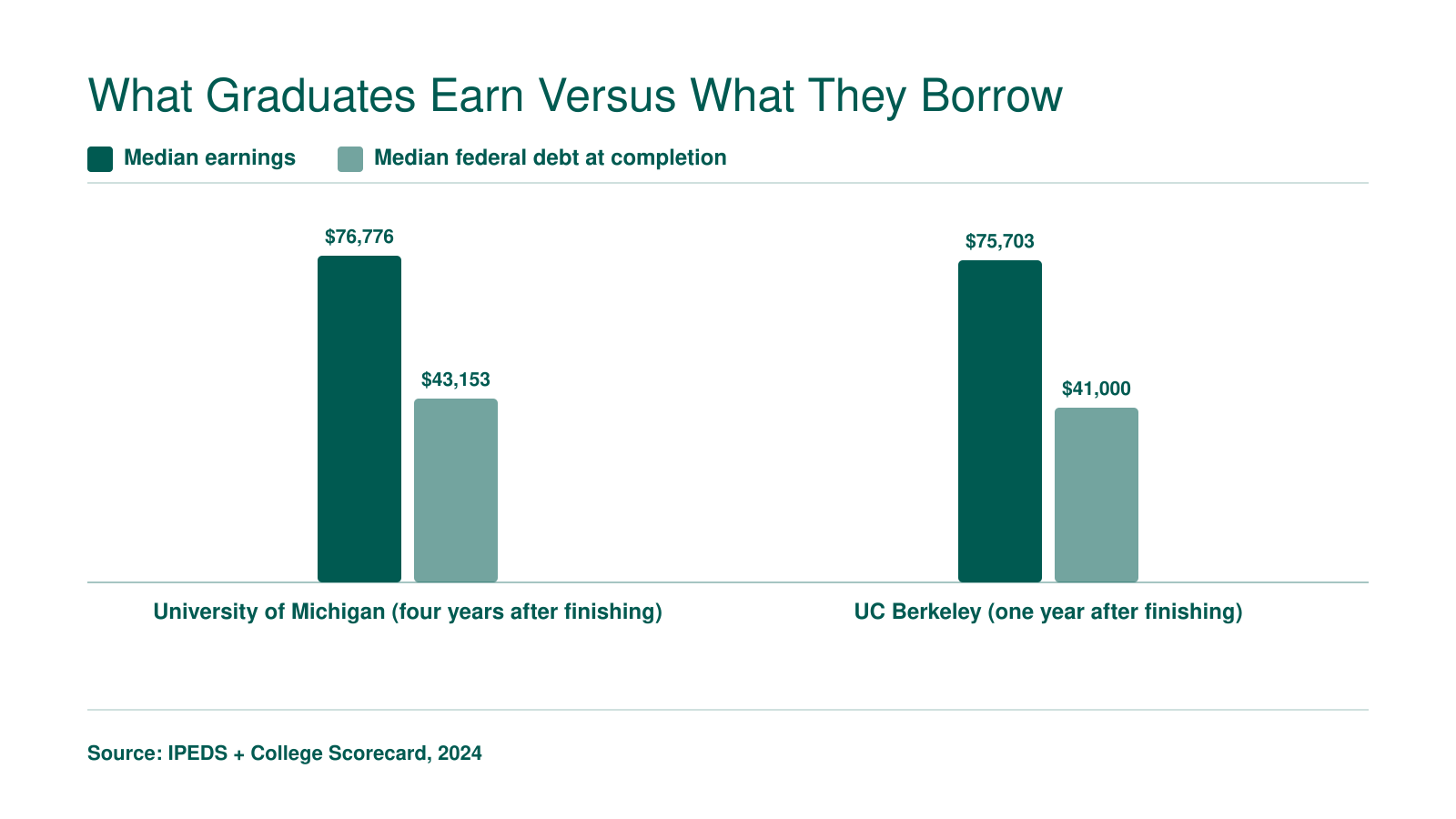
What Graduates Earn Versus What They Borrow
For programs where both figures are published, the gap between median earnings and median federal debt is the clearest signal of whether the degree pays for itself quickly. A larger gap means more of each paycheck stays with the graduate, not the lender.
Sustainability programs by state
Quick Answers on Cost, Value, and Credentials
These are the questions prospective students ask before committing to a sustainability MBA. The answers stick to what the data shows on cost, curriculum, and debt.
Is an MBA in sustainability worth it?
What is the difference between a sustainability MBA and a green MBA?
How much does a sustainability MBA cost?
Compare Sustainability programs on the data that matters
Explore more MBA specializations or browse every graduate field.
All MBA programs