Best Online Master's in Sustainability Programs
Compare 130+ accredited online Sustainability programs, with graduate earnings, cost, debt, and completion data from IPEDS and the U.S. College Scorecard.

A sustainability master's from a campus program and one delivered fully online can share a faculty roster and a diploma, yet differ by thousands of dollars. Among the programs here, total tuition runs from about $14,500 at the University of Florida to $30,450 at the University of Oklahoma.
The real question is which fully online programs justify that spend, with no campus residency. Hybrid programs are excluded.
Graduate earnings and net price, not name recognition, separate strong value from expensive branding in a field where employers care more about applied skills.
Key Points
- In 2027, rankings weigh graduate earnings, net price, and quality over prestige.
- Mandatory technology and online fees can meaningfully raise final cost.
- University of Oklahoma's live lectures run Tuesday through Thursday in 2027.
Top 10 Best Fully Online Master's in Sustainability Programs
These are fully online master's programs, not hybrid offerings. We rank them by a mixed quality composite that blends graduate earnings, net price, and baseline institutional quality rather than prestige. Net price figures are institution-wide averages after grant aid.
University of Florida
#1Gainesville, FL · ~$13,000/yr (est.)
Best for: Mid-career environmental professionals seeking fully online ecology
The University of Florida's fully online MS in Interdisciplinary Ecology, offered through the School of Natural Resources and Environment, combines ecological science with policy, economics, and data analysis in a 30-credit curriculum. Out-of-state graduate tuition is $28,659, and the institution-wide net price after aid averages $6,541. The school is regionally accredited by SACSCOC.
- 30 credit hours
- 5 concentration options
- Fully online, same faculty as on campus
- Thesis or capstone option
- Courses in sustainability science, policy, economics, and justice
- Data science and statistics electives
- State Employee Tuition Waiver accepted
Florida State University
#2Tallahassee, FL · ~$11,000/yr (est.)
Best for: Entrepreneurs balancing profit with social impact
Florida State University's online MS in Entrepreneurship with a major in Social and Sustainable Enterprises focuses on enterprises that balance profit with social and environmental impact. Out-of-state graduate tuition is $18,786, and the institution-wide net price after aid averages $11,297. The program is fully online with synchronous and asynchronous options.
- 30 credit hours
- No entrance exam required
- Fully online option available
- Synchronous and asynchronous options
- Triple bottom line: people, planet, profit
- 2 letters of recommendation required
- $30 application fee
University of Illinois Urbana-Champaign
#3Champaign, IL · ~$19,000/yr (est.)
Best for: Natural resource managers needing evening online classes
The University of Illinois Urbana-Champaign's online MS in Natural Resources and Environmental Sciences (non-thesis) is a 32-credit program with evening online classes and a capstone. Out-of-state graduate tuition is $35,124, and the institution-wide net price after aid averages $14,355. The GRE is not required.
- 32 credit hours
- No GRE required
- Fully online, evening classes
- 3.0 GPA minimum
- 3 letters of recommendation required
- Capstone required
- Core courses at 400 and 500 level
Virginia Polytechnic Institute and State University
#4Blacksburg, VA · ~$19,000/yr (est.)
Virginia Tech's online Master of Natural Resources offers concentrations in Sustainability and Sustainable Development and Global Sustainability. Out-of-state graduate tuition is $37,764, and the institution-wide net price after aid averages $24,953. The program prepares sustainability leaders with a low student-to-instructor ratio.
- Apply by 2027-01-01
- Military benefits accepted
- Five core courses
- Interdisciplinary program
- Careers in natural resource management
- Low student-to-instructor ratio
- Graduate certificates available
- 30 credit hours
- No thesis or capstone required
- Fully online option available
- Low student-to-instructor ratio
- Preparing sustainability leaders for over a decade
Stony Brook University
#5Stony Brook, NY · ~$14,000/yr (est.)
Stony Brook University's MS in Technological Systems Management with a Resilience and Sustainability concentration is a 30-credit fully online program built for mid-career professionals and new graduates. Out-of-state graduate tuition is $32,741, and the institution-wide net price after aid averages $18,784. Students complete a faculty-supervised master's project.
- 30 credit hours
- 10 total courses
- Fully online option available
- Capstone required
- Five required courses shared across concentrations
- Focus on energy and environmental systems
- Quantitative and analytic skills emphasized
- Master's project supervised by faculty
Indiana University-Bloomington
#6Bloomington, IN · $12,000 – $33,000/yr (est.)
Indiana University Bloomington's online Master of Environmental Sustainability offers concentrations in Municipal and Industrial Sustainability and Sustainable Environmental Policy and Planning. Out-of-state graduate tuition is $41,891, and the institution-wide net price after aid averages $16,264. The 36-credit program is fully online and self-paced.
- 36 credit hours
- Test optional
- Fully online option available
- Capstone required
- 3 letters of recommendation required
- $70 application fee
- Core curriculum built with employers
- 21 credit hours of core courses
- 9 credit hours in concentration
- 3 credit hours of electives
- No entrance exam required
- Fully online option available
- Self-paced degree program
- Personal statement required
Purdue University
#7West Lafayette, IN · ~$10,000/yr (est.)
Purdue University's online MS in Sustainable Engineering is a 30-credit, 24-month program designed for working engineers, with core study in life cycle assessment and global sustainability engineering. Out-of-state graduate tuition is $28,794, and the institution-wide net price after aid averages $14,600. The fully online program draws on multiple engineering disciplines.
- 30 credit hours
- 24-month program
- $1,139 per credit
- Fully online option available
- Core focus on life cycle assessment
- Coursework in project management and leadership
- Customize studies with various specialties
- Careers: sustainability engineer, chief sustainability officer
University of Oklahoma – Hudson College of Public Health
#8Norman, OK · ~$9,000/yr (est.)
The University of Oklahoma's online MS in Sustainability: Energy and Materials Management is an 18-month, 30-credit cohort-based program delivered through the Gallogly College of Engineering. Out-of-state graduate tuition is $27,377, and the institution-wide net price after aid averages $15,300. Live evening lectures keep the fully online program connected.
- 30 credit hours
- 18-month program
- $1,015 per credit
- Fully online option available
- Synchronous online classes
- Cohort-based structure
- 3.0 GPA minimum
- Live evening lectures Tuesday through Thursday
University of Vermont
#9Burlington, VT · $14,000 – $34,000/yr (est.)
The University of Vermont's online MPS in Leadership for Sustainability, offered through the Rubenstein School of Environment and Natural Resources, integrates ecological and social processes for sustainability leadership. Out-of-state graduate tuition is $45,502, and the institution-wide net price after aid averages $19,343. A fully online option is available.
- Fully online option available
- Distance learning master's program
- Faculty dedicated to applied research
- 130 graduate students, 30+ faculty
- Annual graduate research symposium
- Assistantships and fellowships available
University of Connecticut
#10Storrs, CT · ~$23,000/yr (est.)
The University of Connecticut's fully online Master of Energy and Environmental Management is a 30-credit asynchronous program with a 3-credit internship or practicum. Out-of-state graduate tuition is $43,712, and the institution-wide net price after aid averages $25,097. Students may earn concurrent graduate certificates.
- 30 credit hours
- Fully online option available
- Asynchronous online classes
- 27 credits of coursework
- 3-credit internship or practicum
- Only 9 required credits
- Concurrent graduate certificates available
- Certificate credits may transfer
Cost & outcomes by school
Federal data for the highest-earning Sustainability programs, independent of the ranking above. Earnings are this field's master's graduates four years after completing, where the Scorecard reports them.
| School | Earnings | Tuition / yr | Debt | Grads/yr | Format |
|---|---|---|---|---|---|
| University of Redlands CA | $128,897 | $25,172 | — | — | Hybrid |
| Columbia Southern University AL | — | $3,936 | — | — | Online |
| Texas A&M University-Central Texas TX | — | $6,242 | — | — | Online |
| Catawba College NC | — | $7,188 | — | — | Online |
| Tarleton State University TX | — | $7,527 | — | — | Hybrid |
| Missouri State University MO | — | $8,204 | — | — | Online |
| University of Alabama at Birmingham AL | — | $8,640 | — | — | Online |
| Troy University AL | — | $8,550 | — | — | Online |
| University of North Carolina at Greensboro NC | — | $8,614 | — | — | Online |
| South Dakota School of Mines and Technology SD | — | $8,500 | — | — | Hybrid |
| Lamar University TX | — | $8,642 | — | — | Hybrid |
| University of Wyoming WY | — | $8,422 | — | — | Hybrid |
Sources: U.S. Department of Education. Tuition and graduates: IPEDS. Earnings and debt: College Scorecard, this field's master's graduates; a dash means no figure is reported.
Cost, debt & payoff
Median earnings of this field's master's graduates (4 yrs after completing) vs. their median federal loan debt · U.S. College Scorecard
Across these programs the median graduate earns about $70,670 and finishes with roughly $38,500 in debt — a ratio that clears a common rule of thumb (keep debt below first-year salary). Tuition and debt vary widely school to school, so check the per-school figures in the table above before you shortlist.
What Top Graduates Earn After an Online Sustainability Master's
Cost & Value: Per-Credit Tuition vs. Total Program Price
For an affordable master's in sustainability, a low per-credit rate tells you almost nothing about what you will actually pay. The number that matters is total price: the rate multiplied by required credits, plus any mandatory technology or online fees. Two programs with similar sticker rates can finish thousands apart once credit loads and fees are added.
Do the Math
- Wisconsin-Madison: $750 per credit over 34 credits works out to $25,500, with no separate course, technology, or segregated fees. The same rate applies whether you live in-state or out.
- Oklahoma: $1,015 per credit across 30 credits reaches $30,450. The program page lists no standalone online fee, though books are extra.
- American: $2,163 per credit over 30 credits totals $64,890, and a per-credit digital courseware charge applies on top of tuition.1
Wisconsin-Madison's flat rate is the clearest case of online pricing that ignores residency. For sustainability master's programs at traditional publics, the in-state versus out-of-state gap can still apply, so confirm which rate your enrollment triggers.
Weigh Price Against Debt
Where a program reports typical graduate debt and estimated monthly payments, use those figures to pressure-test the sticker price. A higher total cost can still pencil out if median debt and payments stay manageable.
One practical move: ask about employer tuition assistance and the per-course billing timeline before you enroll. Spreading payments by course changes your cash flow considerably.
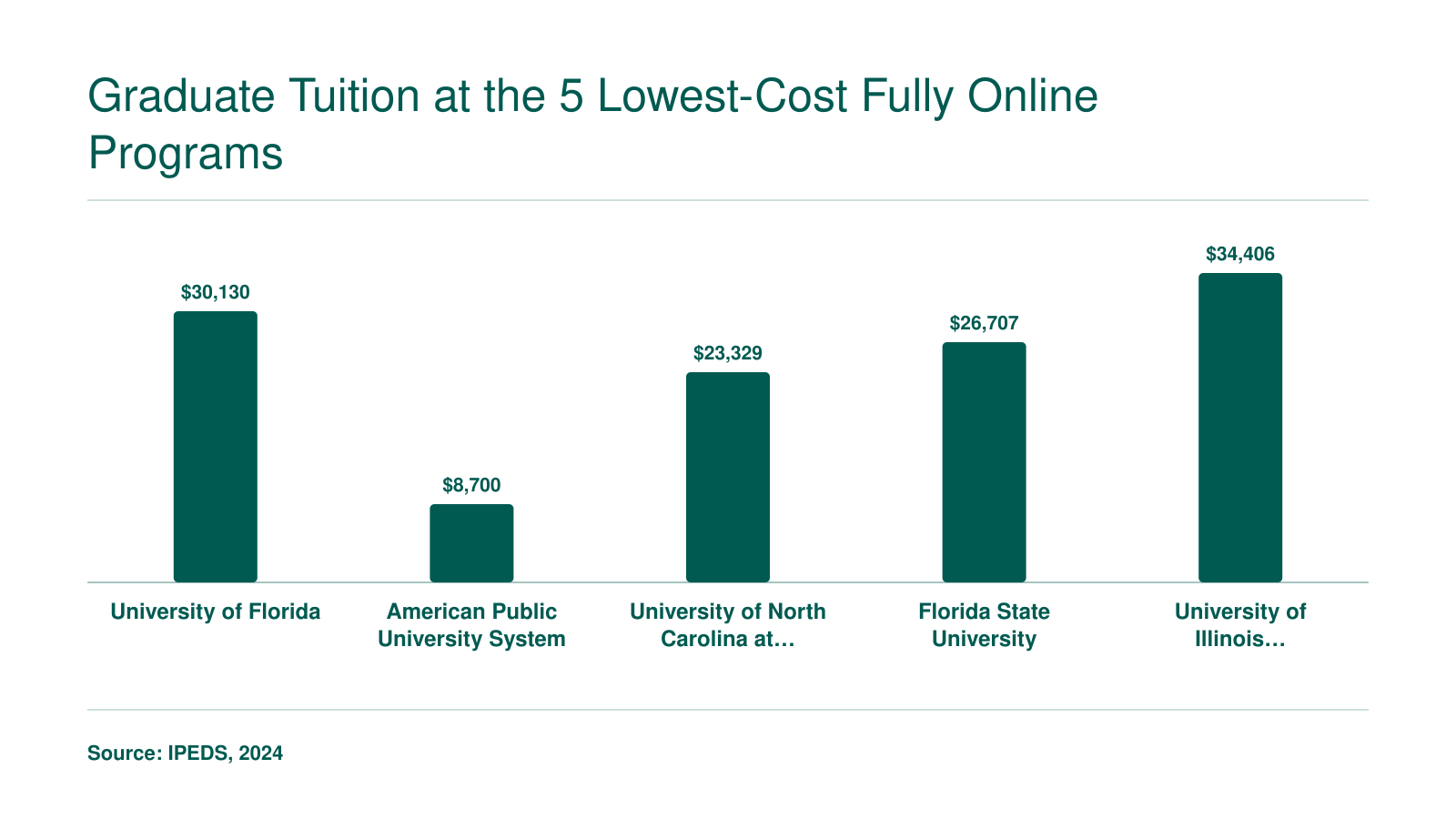
Graduate Tuition at the 5 Lowest-Cost Fully Online Programs
The figures below are annual graduate tuition and fees for out-of-state students as reported to IPEDS. Actual cost depends on course load and any additional fees.
Truly 100% Online? Asynchronous Classes and Hidden Residencies
The University of Oklahoma schedules live lectures Tuesday through Thursday from 7 to 9 p.m. Central, one night per class; "online" and "on your own schedule" are two different promises. Learn the vocabulary before you apply: asynchronous means recorded lectures and no fixed login time; synchronous means live sessions you must attend; residency or immersion means days spent on campus.
Which programs ask for live or in-person time
Arizona State, Colorado State, Northeastern, Florida, and Indiana deliver coursework fully online and asynchronously.1 George Washington is asynchronous but adds live sessions, typically in the evening. UNC Greensboro mixes synchronous and asynchronous classes. Harvard Extension School is the clear outlier: most fall and spring courses meet once weekly for two hours, and a campus residency is required, satisfied either as a single weekend or a three-week summer course tied to the thesis proposal or capstone. Colorado State lists optional short residencies, and Indiana lets students take some coursework on campus if they want it.2
Budget the hours honestly
Few programs publish weekly workload. Oklahoma is the exception, estimating 10 to 20 hours per week. Treat that as a working baseline.
If a program runs live sessions, confirm the time zone in writing. A 7 p.m. Central class is a 5 p.m. workday conflict on the West Coast.
Related Articles
STEM-Designated Online Sustainability Master's Programs
As more sustainability work shifts toward data, STEM designation has become a dividing line between programs that train analysts and sustainability MBA programs that train managers. The distinction turns on one technical detail that degree titles obscure.
What STEM Designation Actually Means
A program's STEM status is set by its Classification of Instructional Programs (CIP) code, not by the words "sustainability" or "environmental" in its name.1 When a program's CIP code appears on the DHS STEM Designated Degree Program List, F-1 graduates qualify for a 24-month STEM OPT extension on top of standard Optional Practical Training. DHS draws most qualifying fields from CIP series 14 (engineering), 26 (biological sciences), 27 (mathematics and statistics), and 40 (physical sciences), and eligibility can be set at the two-, four-, or six-digit level.1
How to Verify It, and Why It Matters Online
Do not take a title's word for it. Check the program page for the exact CIP code, then confirm that code sits on the current DHS list.2 Fields like Environmental/Natural Resource Economics (03.0204) were added only after formal review of 133 nominations.3
Fully online programs generally cannot sponsor F-1 visas, so for most applicants STEM status functions as credential signaling, pointing toward quantitative paths such as energy analytics and carbon accounting rather than visa benefit.
Admissions Checklist for Online Sustainability Master's Programs
Most applications include a transcript, statement, letters, and résumé.
- Bachelor's degree and GPAAn accredited bachelor's degree is standard. Minimum GPAs are often 3.0; Grand Canyon lists 2.8.
- Test scoresGRE policies vary. USC, Goucher, and Frostburg do not require it; American encourages but does not require it.
- Résumé and recommendationsExpect a statement of purpose, letters of recommendation, and a résumé.
- PrerequisitesSome programs ask for quantitative or science preparation, such as college algebra at Oklahoma or lab-science and quantitative courses at Frostburg.
- Work experienceNot universally required. American lists no minimum; Arizona State notes three years and gives it priority.
- Transfer credit and timingTransfer caps vary, Oklahoma allows 9 credits and Grand Canyon 12. USC has fall, spring, and summer starts; Frostburg has no deadline; SMU uses rolling admission.
Sustainability programs by state
Frequently Asked Questions About Online Sustainability Master's Degrees
How long does an online master's in sustainability take?
What is the difference between sustainability management and environmental sustainability?
What can you do with an online master's in sustainability?
Is an online master's in sustainability worth it?
Compare Sustainability programs on the data that matters
Explore more Science & Engineering specializations or browse every graduate field.
All Science & Engineering programs