Best Master's in Sustainability Programs in South Dakota
Compare 3 accredited Sustainability programs in South Dakota, with graduate earnings, cost, debt, and completion data from IPEDS and the U.S. College Scorecard.
South Dakota's agro-energy economy makes sustainability training unusually concrete: grazing lands, mine reclamation, Missouri River management, and wind buildout all demand people who read systems, budgets, and policy together. Yet only a handful of the state's public universities offer a sustainability-focused master's degree, so the practical choice is narrow but meaningful. Fully online delivery, master's in sustainability no GRE admissions, and per-credit costs that vary by hundreds of dollars separate the options more than prestige does. Graduates enter a market where earnings and licensure hinge on whether the degree reads as management or engineering.
Key Points
- University of South Dakota's sustainability master's costs $415.95 per resident credit.
- Black Hills State offers its sustainability master's fully online.
- No state license is required for general sustainability work in South Dakota.
Best Master's in Sustainability Programs in South Dakota Ranked
South Dakota's sustainability master's options are compact but distinctive. One path is a broad sustainability degree, another is a fully online sustainability master's, and a third embeds sustainability inside a civil and environmental engineering program. All three are offered by public universities accredited by the Higher Learning Commission.
University of South Dakota
#1Vermillion, SD · ~$7,000/yr (est.)
Best for: Interdisciplinary learners seeking hands-on community research
The University of South Dakota in Vermillion offers a graduate sustainability program with thesis and non-thesis tracks and an online option. Students work on community-based research and projects along the Missouri River, and the university is the only school in the region with both undergraduate and graduate sustainability degrees. The focus is on the three pillars of sustainability: environmental, social, and economic. USD is accredited by the Higher Learning Commission.
- Thesis and non-thesis tracks
- Fully online option available
- Three concentration options
- Community-based research projects
- Work directly on the Missouri River
- Campus as a sustainability learning laboratory
- Faculty mentorship and one-on-one attention
- WICHE-region students may pay in-state rates
Black Hills State University
#2Spearfish, SD · ~$9,000/yr (est.)
Best for: Working professionals needing a fully online degree
Black Hills State University offers a fully online Master of Science in Sustainability, designed to be completed in about two years. The 33-credit program pairs sustainability theory with social and economic systems, and it ends with an applied capstone. BHSU is accredited by the Higher Learning Commission.
- Fully online degree
- 33 total credit hours
- Designed to finish in about two years
- Capstone project required
- 3.0 minimum undergraduate GPA
- GRE considered for applicants with 2.5 to 2.75 GPA
- Interdisciplinary sustainability theory foundation
- Explores natural, social, and economic systems
South Dakota School of Mines and Technology
#3Rapid City, SD · ~$9,000/yr (est.)
Best for: Engineers targeting sustainable infrastructure careers
South Dakota School of Mines and Technology in Rapid City offers a Civil and Environmental Engineering master's with a Sustainable Engineering Specialization that can be completed on campus or online. The program spans environmental, water resources, geotechnical, materials, and structural engineering, with both thesis and non-thesis tracks. South Dakota Mines is accredited by the Higher Learning Commission.
- Sustainable Engineering Specialization
- On campus or fully online
- 30 credit hours
- Thesis and non-thesis tracks
- 3.0 minimum undergraduate GPA
- Three letters of recommendation
- Environmental, water resources, geotechnical, materials, and structural emphases
- Research areas include AI for drinking water and bioplastics
Cost & outcomes by school
Federal data for the highest-earning Sustainability programs, independent of the ranking above. Earnings are this field's master's graduates four years after completing, where the Scorecard reports them.
| School | Earnings | Tuition / yr | Debt | Grads/yr | Format |
|---|---|---|---|---|---|
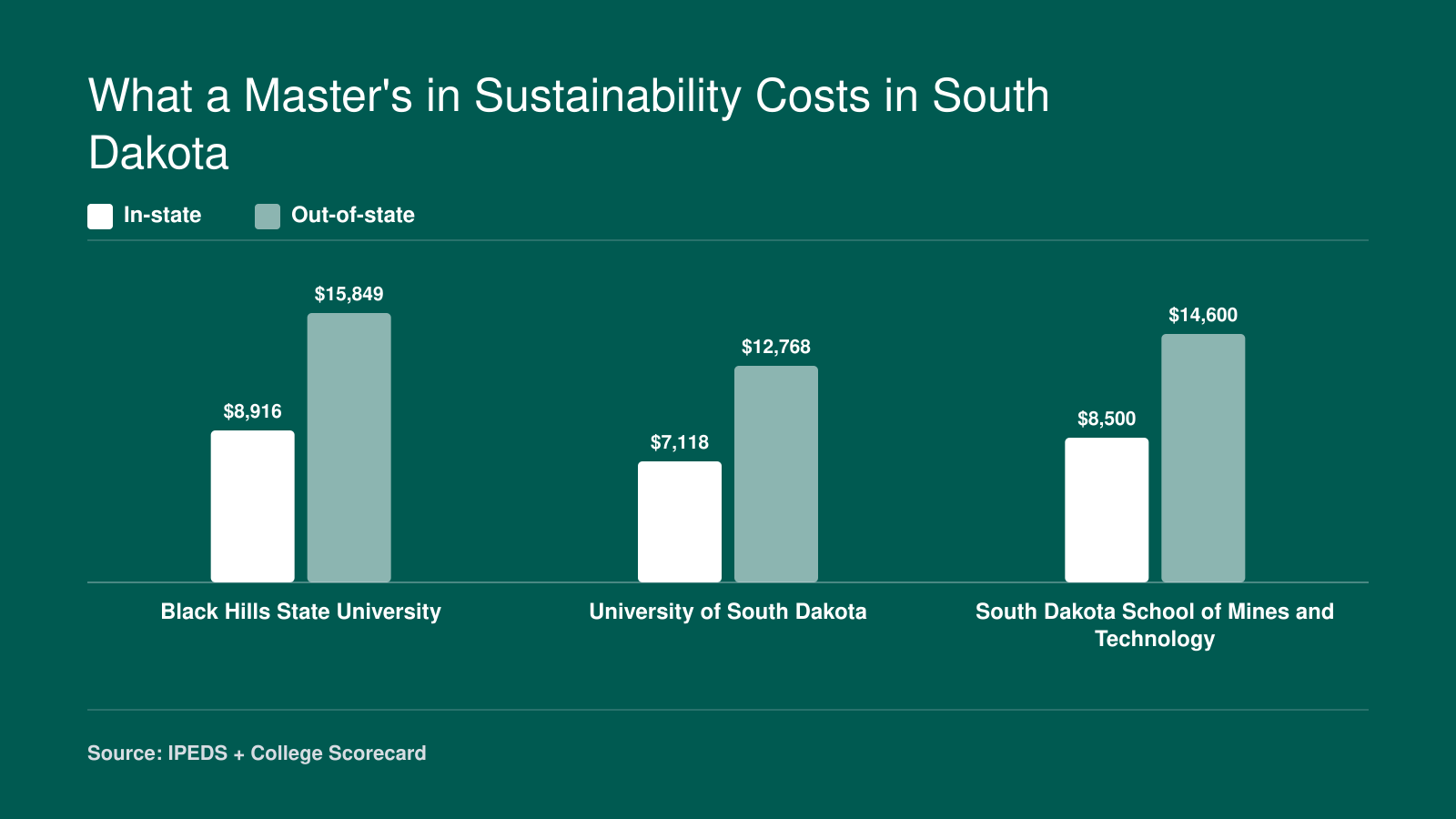
| South Dakota School of Mines and Technology SD | — | $8,500 | — | — | Hybrid |
| University of South Dakota SD | — | $7,118 | — | 3 | Hybrid |
| Black Hills State University SD | — | $8,916 | — | 5 | Online |
Sources: U.S. Department of Education. Tuition and graduates: IPEDS. Earnings and debt: College Scorecard, this field's master's graduates; a dash means no figure is reported.
Online and Hybrid Master's in Sustainability Options in South Dakota
Yes, among Master's Programs in South Dakota, the University of South Dakota offers its M.S. in Sustainability online as well as on campus in Vermillion, and its 2026 catalog lists no required campus residency. Black Hills State University delivers its M.S. in Sustainability entirely online, so you can enroll without relocating.
- University of South Dakota: Campus and online master's in sustainability. The degree includes a 2 to 4 credit seminar, and the non-thesis route adds a 1 to 6 credit internship or advisor-approved elective. The catalog does not say either must be completed in Vermillion, though USD notes that supervised field study outside South Dakota may carry restrictions. Out-of-state online students should keep that in mind.
- Black Hills State University: Fully online with no routine campus attendance. A third-party program listing describes it as part-time and online1, but BHSU's own pages do not spell out a part-time policy, so confirm pacing with the graduate office.
- South Dakota School of Mines and Technology: The sustainable engineering specialization is available on campus or online.
The program pages for USD and BHSU do not specify whether online courses use live, scheduled sessions or self-paced modules. If you work full time, ask admissions about required login times and realistic part-time completion length before you apply.
Which South Dakota Sustainability Master's Programs Waive or Make the GRE Optional
Admissions expectations differ by program and can change between catalog years. The table below reflects published GRE, GPA, and application requirements for each sustainability master's option in South Dakota as of the 2026 catalog or most recent admissions guidance.
| Program | GRE Policy | Minimum GPA | Other Requirements |
|---|---|---|---|
| Black Hills State University M.S. Sustainability | GRE score report required if GPA is below 2.75; otherwise no GRE requirement stated. | 2.5 on a 4.0 scale | One letter of recommendation; paper-based TOEFL 550 minimum for international applicants; no statement-of-purpose requirement stated. |
| South Dakota School of Mines and Technology sustainable engineering master's specialization | GRE not required for non-thesis campus and distance applicants; waived for current South Dakota Mines students and graduates; research/thesis applicants follow program-specific requirements. | Typically above 3.0 on a 4.0 scale, but criteria may not be strict thresholds. | Statement of research interests required for non-thesis applicants; recommendations not required for non-thesis campus and distance applicants; minimum TOEFL iBT 79 and IELTS 6.5. |
| University of South Dakota M.S. Sustainability | No published policy | Not stated | Completed application, $36 application fee, and official transcripts; additional program-specific materials not stated; English proficiency minimums not stated. |
Related Articles
What a Master's in Sustainability Costs in South Dakota
Per-credit charges show the granular picture: University of South Dakota's M.S. Sustainability lists $415.95 per resident credit, while South Dakota Mines graduate engineering is $519 per credit for residents and $895 for nonresidents. Assistantships reduce costs sharply, with USD graduate assistants paying $247.50 per credit and South Dakota Mines assistants paying $52 per credit after a full tuition waiver. Net price averages are institution-wide and may not match graduate costs: Black Hills State University $15,911, University of South Dakota $19,858, and South Dakota School of Mines and Technology $20,183 after aid.
Curriculum and Career Outcomes for Sustainability Master's Graduates
USD's M.S. in Sustainability totals 30 credits on both the thesis pathway (6 to 9 thesis credits) and the non-thesis pathway, which uses an internship or advisor-approved elective instead of a thesis. Students take four core courses (SUST 501, 706, 707, 715), and at least half of all credits must be at the 700 level or above. The environmental, social, and economic pillars let students tailor electives.
BHSU's online M.S. in Sustainability is 33 credits, finishable in two years, with seven core courses and a 6-credit capstone instead of a thesis. Its catalog entries disagree on elective credits (6 in 2026, 9 in 2025-2026), so confirm with the program.
Mines Is a Different Kind of Degree
South Dakota Mines has no standalone sustainability master's. Sustainable Engineering is a specialization inside the Civil & Environmental Engineering M.S., so the diploma carries an engineering title. It runs 30 credits, either a thesis option (6 thesis credits plus 24 of coursework, with an oral defense) or a non-thesis option. USD and BHSU are interdisciplinary sustainability master's programs.
Career Paths
Program-level earnings and employment figures are not reported for these programs, so none are shown here. Realistic South Dakota paths include:
- Sustainability coordinator
- Environmental compliance
- Energy and agriculture resource management
- Public-sector planning
South Dakota Licensure and Certification for Sustainability Professionals
Frequently Asked Questions About Master's in Sustainability in South Dakota
Can I complete a sustainability master's in South Dakota part time?
When are application deadlines and start dates for South Dakota sustainability master's programs?
Can international students enroll in a sustainability master's in South Dakota?
Is South Dakota Mines' sustainable engineering specialization the same as a sustainability master's?
Compare Sustainability programs on the data that matters
Explore more Science & Engineering specializations or browse every graduate field.
All Science & Engineering programs