Best Master's in Sustainability Programs
Compare 410+ accredited Sustainability programs at 320+ schools, with graduate earnings, cost, debt, and completion data from IPEDS and the U.S. College Scorecard.

Green skills demand grew 8% over two years while supply grew 4%, so the question is which sustainability master's converts that shortage into a well-paid climate, ESG, or policy job without excessive debt.
The ranked programs include online, campus, and hybrid sustainability and environmental management master's degrees chosen for the strongest outcome and cost profiles. Institution-wide net price after aid runs from $6,128 at Princeton to $40,815 at Georgetown, a spread that reshapes return on investment.
Each section, ranking, cost and ROI, online versus campus, careers, admissions, and accreditation, weighs that tradeoff. Most programs still do not publish program-level earnings, so net price and debt become the first screen.
Key Points
- Net price runs from $6,128 at Princeton to $40,815 at Georgetown.
- Program-level earnings and debt data are not yet published for most of these degrees.
- Everglades University and Indiana University let you earn the degree online, on campus, or both.
10 Master's in Sustainability Programs for 2027
Choosing a sustainability master's degree means weighing delivery format, culminating experience, and total cost against the careers you want after graduation. The programs below include campus, online, and hybrid options, each profiled for the structure, concentrations, and requirements that set it apart. Use the details to narrow down which program fits your schedule and goals.
Harvard University
#1Cambridge, MA · $55,000 – $60,000/yr (est.)
Best for: Working adults needing hybrid online flexibility
Harvard Extension School's sustainability master's is built for working professionals who need a part-time, mostly online path. Students take 11 of 12 courses online and complete one short campus residency, with a thesis or capstone at the end. The degree spans climate strategy, environmental policy, sustainable finance, and leadership, and graduates move into corporate sustainability, consulting, government, and nonprofit roles.
- $3,580 per course tuition
- Complete in anywhere between 2 and 5 years
- 12 total courses, including prerequisite courses
- Thesis or capstone option
- 11 of 12 courses online with one short campus residency
- 80% of students work full time
- No environmental science background required
- Stackable graduate certificates available
Princeton University
#2Princeton, NJ · ~$66,000/yr (est.)
Best for: Engineers targeting resilient infrastructure research
Princeton's graduate program in civil and environmental engineering offers a Sustainable, Resilient Cities and Infrastructure Systems track within six research areas. The campus-based degree is research-driven and pairs students with doctoral and M.Eng. peers. It suits engineers and planners who want to shape infrastructure through climate, water, energy, and environmental change.
- Sustainable, Resilient Cities and Infrastructure Systems track
- One of six research areas
- Research-driven campus program
- Three graduate degrees: Ph.D., M.S.E., and M.Eng.
Columbia University in the City of New York
#3New York, NY · ~$58,000/yr (est.)
Best for: Professionals pivoting into corporate sustainability
Columbia's Master of Science in Sustainability Management blends hard science with management fundamentals for careers in business, government, and nonprofits. The campus program offers full- and part-time options with evening classes, so working students can keep their jobs. Students draw on more than 200 environmental courses and join a network of over 3,000 sustainability professionals.
- Full-time and part-time options
- Evening classes fit around a full-time job
- Over 200 environmental classes offered
- Partnership with Columbia Climate School
- Alumni network of more than 3,000 professionals
- Management plus sustainability science coursework
University of California-Berkeley
#4Berkeley, CA · ~$16,000/yr (est.)
UC Berkeley's Master of Climate Solutions is a one-year, in-person program for professionals with at least three years of work experience. The curriculum integrates climate science, economics, policy, and management, with a required yearlong capstone project. Graduates target roles such as climate policy analyst, ESG manager, and sustainability consultant.
- One-year, in-person program
- Requires at least three years of work experience
- Yearlong capstone with partner organizations
- Concurrent MBA/MCS degree option
- Cross-disciplinary faculty from three departments
- Equity and climate justice at the core
- Partial and full scholarships available
Yale University
#5New Haven, CT · ~$50,000/yr (est.)
Yale's Master of Environmental Management is a two-year, 48-credit campus degree with nine concentration options. Students in the Climate Change Science and Solutions concentration take 18 credits of specialty coursework and complete a capstone plus a required summer experience. The program draws on more than 100 YSE courses and access to offerings across Yale.
- Climate Change Science and Solutions concentration
- Two-year, 48-credit campus program
- 18 credits in the specialization
- Capstone plus required summer experience
- More than 100 YSE courses to choose from
- Access to courses across Yale
- Option to add a second specialization
California Polytechnic State University-San Luis Obispo
#6San Luis Obispo, CA · ~$14,000/yr (est.)
Cal Poly San Luis Obispo's M.S. in Environmental Sciences and Management combines natural science, research methods, and environmental policy with five emphasis areas. Students choose a thesis or professional project, work with a faculty advisor before admission, and can do field project work at Swanton Pacific Ranch. Small fall cohorts and an open undergraduate major policy make it flexible for career changers into consulting, resource management, and policy.
- Sustainability emphasis among five options
- 45-unit curriculum, 27 units at the 500 level
- Thesis or professional project option
- Fall cohort start
- Open to any undergraduate major
- Project work at Swanton Pacific Ranch
- Test optional with 3.0 GPA minimum
University of Pennsylvania
#7Philadelphia, PA · ~$48,000/yr (est.)
Penn's Master of Environmental Studies offers an Environmental Sustainability concentration within a 12-course, campus-based degree. Evening classes allow full-time work, and students take courses across Wharton, Penn Law, and other schools. Internships, fieldwork, and a capstone that addresses real community challenges prepare graduates for sustainability leadership.
- Environmental Sustainability concentration
- 12-course degree over two to four years
- Evening classes from 5:15 to 8:15 p.m.
- Courses available across Wharton, Penn Law, and other schools
- Internships and fieldwork opportunities
- Capstone addresses energy grid decarbonization
- Dual degree options in business, law, and public health
University of Wisconsin-Madison
#8Madison, WI · ~$12,000/yr (est.)
UW-Madison's Environmental Remediation & Management M.S. is a 4+1 accelerated program that can be completed in one additional year after a bachelor's degree. The 30-credit curriculum, designed with industry experts, focuses on soil and groundwater contamination and includes project management training. It fits students aiming for project management and business development roles in environmental cleanup.
- 4+1 accelerated master's program
- 30 credits designed with industry experts
- $1,100 per credit, $33,000 total tuition
- Focus on soil and groundwater remediation
- Requires GRE and prerequisite coursework
- No thesis or capstone required
University of Michigan
#9Ann Arbor, MI · $29,000 – $58,000/yr (est.)
Michigan's Master of Science in Environment and Sustainability is a two-year, 42-credit campus program with seven specializations, including Sustainable Systems and Environmental Justice. Students build interdisciplinary knowledge across natural science, social science, and policy, and can pursue dual degrees or an accelerated track. It suits learners who want a customizable degree centered on sustainability and justice.
- Seven specializations, including Sustainable Systems
- 42-credit, two-year campus program
- Interdisciplinary natural science, social science, and policy work
- Dual degree and accelerated track options
- Four graduate certificate programs
- Customizable around individual interests
Cost & outcomes by school
Federal data for the highest-earning Sustainability programs, independent of the ranking above. Earnings are this field's master's graduates four years after completing, where the Scorecard reports them.
| School | Earnings | Tuition / yr | Debt | Grads/yr | Format |
|---|---|---|---|---|---|
| University of Redlands CA | $128,897 | $25,172 | — | — | Hybrid |
| Columbia University in the City of New York NY | $123,641 | $57,973 | $61,500 | 273 | Campus |
| Columbia Southern University AL | — | $3,936 | — | — | Online |
| Texas A&M University-Kingsville TX | — | $6,157 | — | — | Campus |
| Texas A&M University-Central Texas TX | — | $6,242 | — | — | Online |
| Florida Atlantic University FL | — | $6,693 | — | — | Campus |
| Georgia Southern University GA | — | $6,646 | — | — | Campus |
| Sitting Bull College ND | — | $6,710 | — | — | Campus |
| Sul Ross State University TX | — | $6,661 | — | — | Campus |
| University of Nevada-Reno NV | — | $7,032 | — | — | Campus |
| Youngstown State University OH | — | $6,848 | — | — | Campus |
| Arkansas State University AR | — | $7,322 | — | — | Campus |
Sources: U.S. Department of Education. Tuition and graduates: IPEDS. Earnings and debt: College Scorecard, this field's master's graduates; a dash means no figure is reported.
Cost, debt & payoff
Median earnings of this field's master's graduates (4 yrs after completing) vs. their median federal loan debt · U.S. College Scorecard
Across these programs the median graduate earns about $70,670 and finishes with roughly $38,500 in debt — a ratio that clears a common rule of thumb (keep debt below first-year salary). Tuition and debt vary widely school to school, so check the per-school figures in the table above before you shortlist.
Most Affordable Sustainability Master's Programs
Net price is the institution-wide average amount students pay after grants and scholarships, while sticker tuition is the published rate before aid. For budgeting, use net price as a starting point, then confirm your program's per-credit charges and mandatory fees because individual aid and credit load can shift the final cost. The schools below show the lowest net-price sustainability programs in this ranking; none of the schools below publishes a single online rate that removes the out-of-state tuition gap, and Florida State's online program still lists separate in-state and out-of-state tuition.
| School | Program | Format | Graduate tuition (in-state) | Graduate tuition (out-of-state) | Net price (after aid) |
|---|---|---|---|---|---|
| Princeton University | Master of Science in Engineering, Sustainable, Resilient Cities and Infrastructure Systems | Campus | $65,936 | $65,936 | $6,128 |
| University of Florida | Master of Integrated Sustainable Development | Campus | $12,737 | $30,130 | $6,541 |
| Florida State University | Master of Science in Entrepreneurship with a major in Social and Sustainable Enterprises | Online | $10,553 | $26,707 | $11,297 |
What Students Actually Pay: Net Price Across All Ranked Schools
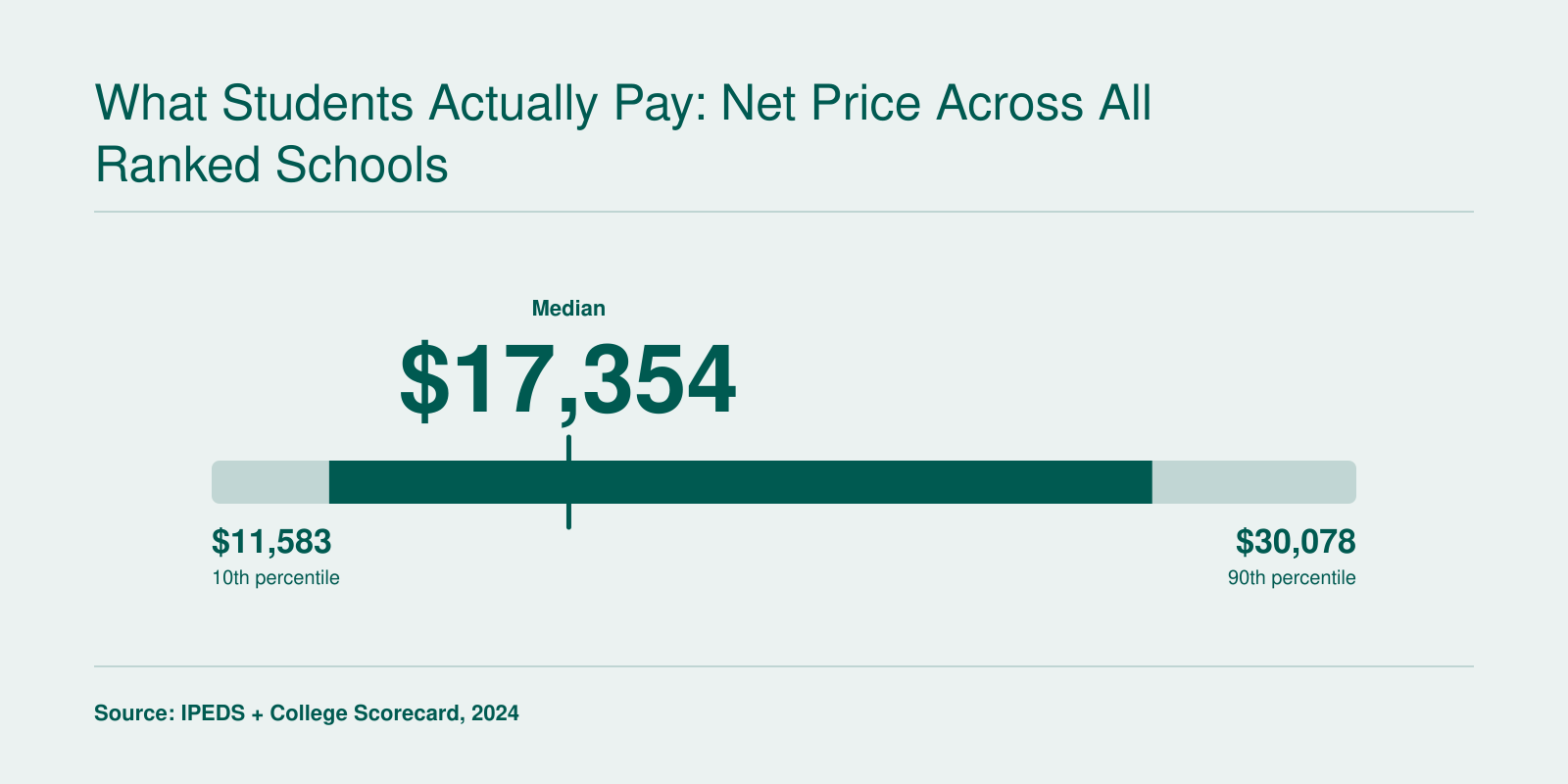
Net price runs from $6,128 at the low end (Princeton) to $40,815 at the high end (Georgetown), with a typical school landing near $17,354. Public universities cluster at the lower end, between $6,541 and $17,354, while private schools cover the whole spread, from a few that rival public pricing to those above $30,000. Net price is an institution-wide average after grants and aid. It is approximate and not a quote for any individual student, so your own cost depends on your aid package, program length, and residency.
Are Sustainability Master's Programs Worth It? Earnings, Debt, and ROI
Will a master's in sustainability pay off, or will the loan payments outrun the salary bump? The honest answer for this field is that the most precise outcome measures are not yet available. Federal reporting has not published program-level earnings, debt, or employment results for the sustainability degrees ranked here. That gap is common for newer, smaller Science & Engineering Master's Programs, and it means you should treat any precise "graduates earn X" claim with caution.
What the Institution-Level Numbers Show
What we can compare is a school-wide return ratio: a university's median earnings 10 years after enrollment divided by its median debt at graduation. It reflects the whole institution, not the sustainability program specifically. Still, it is a useful signal of whether a school's graduates generally earn well relative to what they borrow.
- Princeton University: ratio of about 10.7, with median debt of $10,320
- Johns Hopkins University: about 8.5, with median debt of $10,250
- Brown University: about 8.2, with median debt of $11,428
- Rice University: about 8.2, with median debt of $11,000
- Yale University: about 7.7, with median debt of $12,975
- Duke University: about 7.5, with median debt of $13,000
Cornell, Harvard, UC Berkeley, and Penn follow closely, with ratios between roughly 7.1 and 7.4 and median debt between $13,000 and $15,716.
Why These Debt Figures Understate Your Risk
These debt medians are institution-wide and skew low because many students at these schools receive generous aid. Master's students usually borrow more. Cornell's one-year environmental and sustainability Public Policy program, for example, lists total tuition of $62,588 before living costs. If you finance most of that, your repayment picture looks very different from a $10,000 to $15,000 school median.
How to Judge ROI Without Program Data
Until program-level outcomes are published, build your own estimate of a positive psychology master's total cost:
- Price the full degree: Multiply credits or courses by the per-unit rate, then add fees and living costs for the program length.
- Check program length: One-year options at Berkeley, Brown, and Cornell cut both tuition and lost income compared with two-year degrees at Yale and Duke.
- Ask for placement data: Request employment rates and starting salaries for recent graduates directly from the program.
- Factor in employer support: Part-time and online formats, like those at Johns Hopkins and Harvard Extension, let you keep earning and may qualify for tuition reimbursement.
A strong school-wide ratio is encouraging, but the best value is the program you can finish with manageable debt.
Related Articles
Online vs. Campus Sustainability Master's Programs
Format changes how you study more than what you earn at the end. Several programs here, including Everglades University and Indiana University, let you earn the same degree online, on campus, or through a mix of both. Use the comparison below to match the format to your schedule, budget, and need for hands-on experience.
| Factor | Online | Campus |
|---|---|---|
| Schedule | Ranges from fully asynchronous (Indiana University, University of Wisconsin–Madison) to a mix of live and asynchronous sessions (Teachers College, Columbia University) | Set class meetings on campus, so your calendar is built around the program |
| Residencies or campus visits | Varies: none at Wisconsin–Madison or USC; one required course at Harvard (a weekend or a three-week summer option); two optional but recommended summer weeks at Teachers College | In person throughout, with no travel add-ons beyond relocating or commuting |
| Typical completion time | Oklahoma as little as 18 months; Indiana as little as two years; Wisconsin–Madison 24 to 36 months at 1 to 2 courses per term; Harvard 2 to 5 years | Indiana's one-year in-person option and Everglades at about 12 months show how quickly full-time study can move |
| Labs and fieldwork | Coursework and capstone work are delivered remotely; ask each program how projects and applied work are arranged | Direct access to campus facilities and local field partners, where the school offers them |
| Networking | Virtual cohorts, plus optional residencies that add face-to-face contact | Daily contact with classmates, faculty, and local employers, which helps internship searches |
| Cost | Many online programs charge a flat per-credit rate and spare you relocation and commuting; compare tuition and fees on each program page | Tuition plus living costs near campus, which can change the true price |
| Same degree both ways | Everglades online uses the same core courses, faculty, and capstone requirements as its campus program | Indiana lets students choose a one-year in-person path or mix online and on-campus classes |
| Best suited for | Working professionals who need flexibility and want to keep their income | Career changers who need internships, on-site networking, and structured full-time immersion |
According to LinkedIn's Global Green Skills Report, demand for green hires grew 8% over the two years ending in 2025, while the supply of workers with green skills grew just 4%. In other words, employers want qualified sustainability talent roughly twice as fast as the workforce can provide it.
Specializations and Career Paths in Sustainability
A policy concentration and a corporate sustainability concentration can carry the same degree title and lead to entirely different offices. One prepares you for agency, NGO, and multilateral work where the output is regulation and advocacy; the other prepares you for reporting, disclosure, and operations work inside a company. Choosing between them matters more than choosing between two schools with similar rankings.
Matching Concentrations to Job Titles
The specializations available across the programs here map onto a short list of real roles:
- Management and ESG tracks: Columbia's Master of Science in Sustainability Management pairs business coursework with sustainability science, the standard preparation for sustainability manager and ESG analyst roles. American University's sustainability management graduates skew heavily toward the private sector, with government and nonprofit employers taking smaller shares; the program reported an average salary of $90,667 for its graduates in 2019.
- Policy tracks: Cornell's Master of Science in Environmental and Sustainability Policy and Yale's Master of Environmental Management (with a climate change science and solutions specialization) point toward climate policy analyst and regulatory affairs work.
- Energy and infrastructure tracks: Princeton's sustainable, resilient cities and infrastructure systems concentration and Berkeley's Master of Climate Solutions lean toward energy program manager, decarbonization planning, and utility-side roles. Penn's capstone work on energy grid decarbonization sits in the same territory.
- Technical and remediation tracks: Wisconsin's environmental remediation and management degree and Cal Poly's environmental sciences and management program, specialized environmental science master's programs, prepare graduates for site assessment, compliance, and consulting work.
Programs With Documented Placement Pipelines
A few programs publish enough to verify. Stanford's Doerr School reported 216 summer 2026 internship placements from 916 applicants, spread across 175 organizations, 35 industries, and 10 countries. The Middlebury Institute's environmental policy and management program lists UNICEF and the U.S. Government Accountability Office among internship hosts, reports more than 80 employers of recent interns and over 40 employers of recent graduates, and cites a 93% employment or continuing education rate along with a 96% internship rate for 2019 to 2021.2 NYU's sustainability and global energy practice degree runs credit-bearing consulting practicums with the UN Foundation and the U.S. State Department.
What to Ask Before You Deposit
Most programs publish nothing comparable. Columbia advertises alumni at Google, Patagonia, and Nike; Harvard Extension reports that 97% of recent graduates recommend the program. Neither is a placement rate. Ask admissions directly for a list of internship hosts from the last two cohorts and the employers of recent graduates. If they cannot produce one, treat the career claims on the website as marketing.
Admission Requirements: Do You Need a Science or Business Background?
Short answer: usually not. Most programs here accept any undergraduate field. Check each school's current requirements before you apply.
- Bachelor's degreeAn accredited bachelor's is the baseline. Arizona State, Michigan Tech, UW-Madison, and American University's Kogod School accept any field or discipline. Harvard Extension asks for a four-year accredited degree or a foreign equivalent.
- Application materialsExpect a statement of purpose, recommendation letters, and a resume at most schools. Confirm the exact list on each program's page.
- GPAMinimums vary. Arizona State sets 3.25 for its MS and MA in Sustainability and 3.00 for Sustainability Solutions. UW-Madison and Michigan Tech typically look for 3.0, and UW-Madison may consider lower GPAs for provisional admission. Johns Hopkins SAIS lists no minimum. Texas State's sources conflict (2.75 versus 3.0), so verify.
- GRENo program here requires it. Kogod makes it optional, though applicants who skip it submit a waiver essay on quantitative readiness. Scores may help with funding.
- Prerequisites and experienceJohns Hopkins SAIS requires micro- and macroeconomics, which its free Economics Basics course can satisfy with a B- or higher. Arizona State's MA recommends one semester of calculus. Harvard Extension requires two graduate courses completed first. The sources reviewed don't list work experience as a requirement.
As of October 8, 2026, the Science Based Targets initiative counted 12,121 companies with validated emissions-reduction targets, plus another 2,839 holding net-zero targets. Every one of those commitments needs people who can measure emissions, rebuild supply chains, and report progress, which is exactly the work sustainability master's graduates are trained to do.
Sustainability programs by state
Frequently Asked Questions About Sustainability Master's Programs
These answers draw on published program requirements from the schools ranked here. Credit loads, timelines, and part-time definitions vary by program, so confirm details with each admissions office before you apply.
What is the best master's degree in sustainability?
How long does a master's in sustainability take?
Is an MBA in sustainability better than an MS in sustainability management?
Can I get a sustainability job without a master's?
Compare Sustainability programs on the data that matters
Explore more Science & Engineering specializations or browse every graduate field.
All Science & Engineering programs