Best Master's in Sustainability Programs in Maine
Compare 4 accredited Sustainability programs in Maine, with graduate earnings, cost, debt, and completion data from IPEDS and the U.S. College Scorecard.
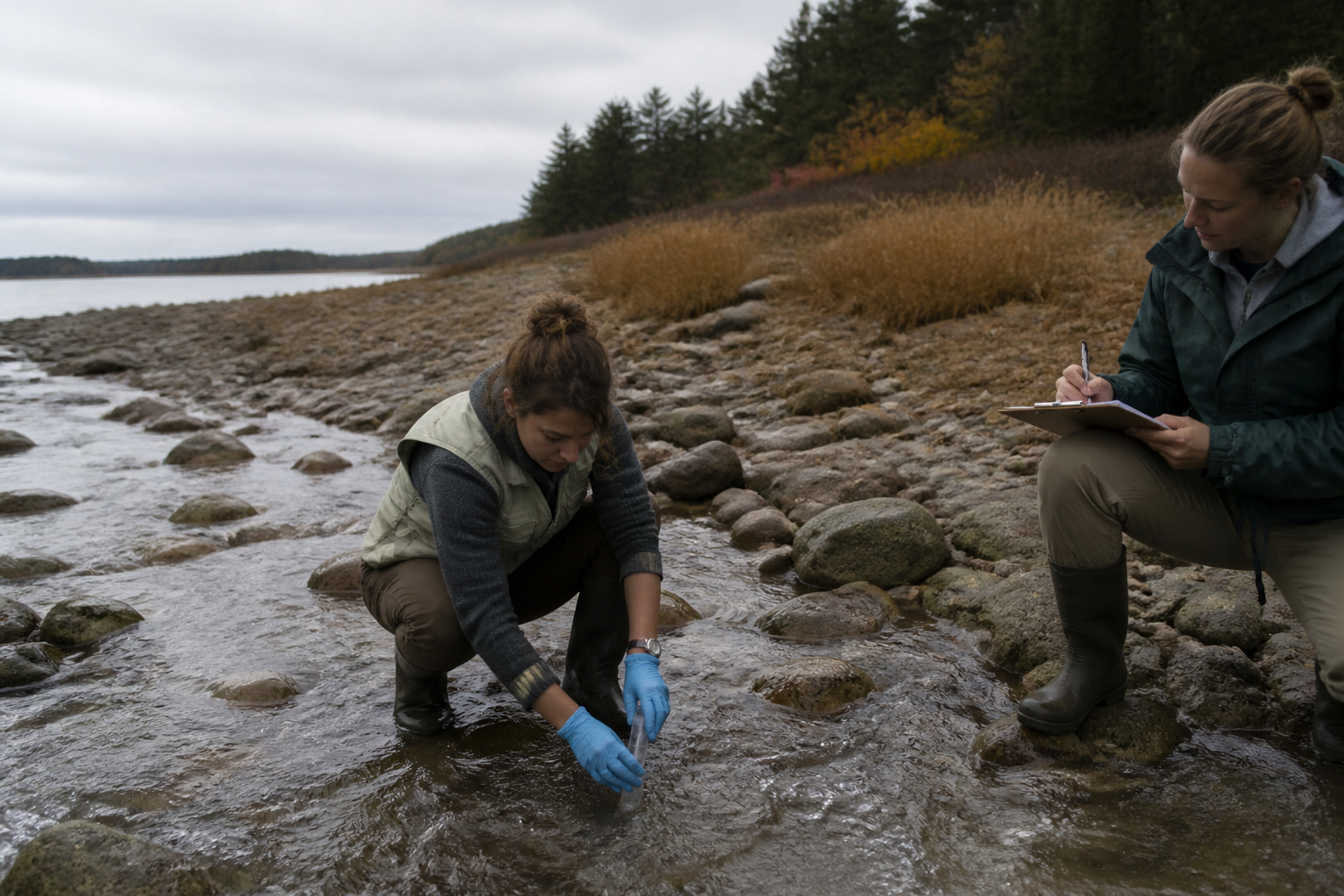
A master's in sustainability in Maine is a graduate degree built around the state's own resource economy: a 3,400-mile tidal coastline, the largest working forest in the Northeast, active fisheries, and a state climate plan with legally set emissions targets. That gives students local material for capstones and internships.
The field here is small. Only a handful of Maine schools offer a sustainability master's, so every option can be compared side by side.
The tension is practical: tuition ranges widely, and sustainability roles in Maine rarely require a license, so the degree's price matters more than its label.
Key Points
- All ranked 2027 Maine sustainability programs below are online.
- Most programs below do not require GRE scores for 2027 admission.
- Maine's public universities show the widest in-state versus out-of-state tuition gaps.
Best Master's in Sustainability Programs in Maine for 2027
Maine's sustainability master's options sit at the intersection of business, climate science, and public policy. The four programs below are all delivered online, so working students can stay in their jobs while building credentials for corporate sustainability, municipal planning, and climate-focused leadership roles. Each profile lists graduate tuition and fees, regional accreditation, and the university's overall graduation rate.
University of New England
#1Biddeford, ME · ~$40,000/yr (est.)
Best for: Working professionals seeking climate-focused business leadership
University of New England offers a Master of Science in Climate Change Leadership with a Sustainable Business concentration, delivered fully online with live sessions early in the program and asynchronous coursework later. The 30-credit program covers climate science, environmental economics, sustainable operations, and change leadership, ending with a faculty-guided capstone. The university is regionally accredited by the New England Commission of Higher Education (NECHE), and its overall graduation rate is 68.3%.
- 30 credit, 5-semester fully online program.
- $710 per credit, $21,300 total program tuition.
- No GRE or entrance exam required.
- Three concentration options, Sustainable Business focus.
- Synchronous and asynchronous course formats.
- Capstone project required.
- NECHE accredited institution.
- Apply by 2026-12-21.
University of Maine
#2Orono, ME · ~$11,000/yr (est.)
Best for: Maine residents wanting flexible online MBA
The University of Maine's MaineMBA in Sustainability combines core business training with a focus on financial, environmental, and social performance. The 33-credit STEM-designated degree is fully online and draws electives from the Graduate School of Business, the University of Southern Maine's Muskie School of Public Service, and the University of Maine School of Law. The university is regionally accredited by NECHE and holds AACSB business accreditation; its overall graduation rate is 54.9%.
- 33 credit, 11 course fully online MBA.
- Sustainability concentration with seven options.
- STEM-designated business degree.
- AACSB accredited business school.
- Electives from Maine School of Law and Muskie School.
- Self-paced non-credit foundation courses available.
- 81% promoted within four months.
- Prerequisite courses required.
University of Southern Maine
#3Portland, ME · $10,000 – $27,000/yr (est.)
Best for: Public policy professionals pivoting to planning
The University of Southern Maine offers an online Master of Policy, Planning, and Management with a Planning and Sustainability concentration. The 36-credit program blends policy analysis, planning, and management skills with hands-on projects through the Catherine Cutler Institute, internships, and opportunities to publish research. USM is regionally accredited by NECHE as part of the University of Maine System, and the university's overall graduation rate is 40.3%.
- 36 credit, fully online, full-time or part-time.
- Planning and Sustainability concentration.
- No GRE required.
- Rolling admissions, three start dates per year.
- Hands-on work with Catherine Cutler Institute.
- Internships in town management or food policy.
- 150+ graduate assistantships with stipend.
- One-on-one career advising.
Unity Environmental University
#4New Gloucester, ME · ~$10,000/yr (est.)
Unity Environmental University's Sustainable Master of Business Administration (SMBA) is designed for working professionals who want to lead change in business. The 36-credit online program can be completed in as little as one year, with five start dates and asynchronous 8-week terms. The university is regionally accredited by NECHE, and its overall graduation rate is 28.7%.
- 36 credit, 12-month fully online program.
- Asynchronous 8-week terms, five start dates per year.
- Locked tuition rate through 2030.
- No entrance exam or application fee.
- Military tuition rate $535 per credit.
- Capstone project required.
- 88% job placement rate.
- NECHE accredited.
Cost & outcomes by school
Federal data for the highest-earning Sustainability programs, independent of the ranking above. Earnings are this field's master's graduates four years after completing, where the Scorecard reports them.
| School | Earnings | Tuition / yr | Debt | Grads/yr | Format |
|---|---|---|---|---|---|
| University of Southern Maine ME | — | $9,918 | — | — | Online |
| University of Maine ME | — | $10,662 | — | — | Online |
| Unity Environmental University ME | — | $9,750 | — | 28 | Online |
| University of New England ME | — | $40,235 | — | — | Online |
Sources: U.S. Department of Education. Tuition and graduates: IPEDS. Earnings and debt: College Scorecard, this field's master's graduates; a dash means no figure is reported.
Online and Hybrid Master's in Sustainability Options in Maine
Every sustainability-focused master's from the schools ranked here is built to run online, which makes online master's programs in Maine a practical option for working professionals who can't relocate or step away from a job.
Fully Online Formats Dominate
The University of Maine delivers its Master of Business Administration in Sustainability fully online, with a 33-credit structure of eight core courses and three concentration electives drawn from the UMaine MBA concentrations. Core business classes are taken through the university, and the program expects most students to work full-time while enrolled. The University of Southern Maine offers its Policy, Planning, and Management master's with a Planning and Sustainability concentration online, spanning 36 credits with multiple start dates a year. Unity Environmental University runs its Sustainable MBA (including a Climate-Ready Business concentration) online in asynchronous, eight-week terms. The University of New England's Master of Science in Climate Change Leadership pairs synchronous and asynchronous options across a five-semester schedule.
Confirm In-Person Requirements
Published details on required residencies or field weekends for these master's programs are thin, so verify directly with each admissions office before assuming a course is entirely remote. The University of New England states no campus travel is required for its online track.
A Practical Tip on Tuition
Online enrollment does not guarantee a single price. Public programs at the University of Maine and the University of Southern Maine can charge out-of-state students more, so confirm which rate applies to you before applying.
Which Maine Sustainability Master's Programs Waive or Make the GRE Optional?
The admissions pages reviewed lean strongly test optional. Most of the programs below do not require the GRE or state that GRE scores are not considered, and the official pages reviewed do not list a specific prerequisite course sequence for these programs.
| School | GRE Policy | Minimum GPA | Prerequisites | Deadline / Start Term |
|---|---|---|---|---|
| University of Maine: Ecology and Environmental Sciences MS | Not required | Typically greater than 3.0 undergraduate GPA | Not published | Rolling admissions; fall applicants receive decision by March 31. Fall typical; other semesters possible. |
| University of Maine: Plant, Soil, and Environmental Sciences MS | Not required | Not published | Not published | Rolling basis; no official deadline for priority consideration. Start varies with faculty support. |
| University of Maine: Earth and Climate Sciences | GRE not considered | No formal minimum GPA requirement | Not published | January 15 for teaching assistantships or university fellowships; otherwise year round. Fall decisions generally in February and early March. |
| University of Maine: Biological Sciences MS | GRE scores not accepted | Not published | Not published | Rolling basis; deadline depends on posted lab openings; international applicants advised at least six months ahead. Fall, spring, or summer start. |
| University of New England: Master of Climate Change Leadership | No GRE; test free | No published minimum; holistic review | Not published | December 21, 2026; start term not published |
Related Articles
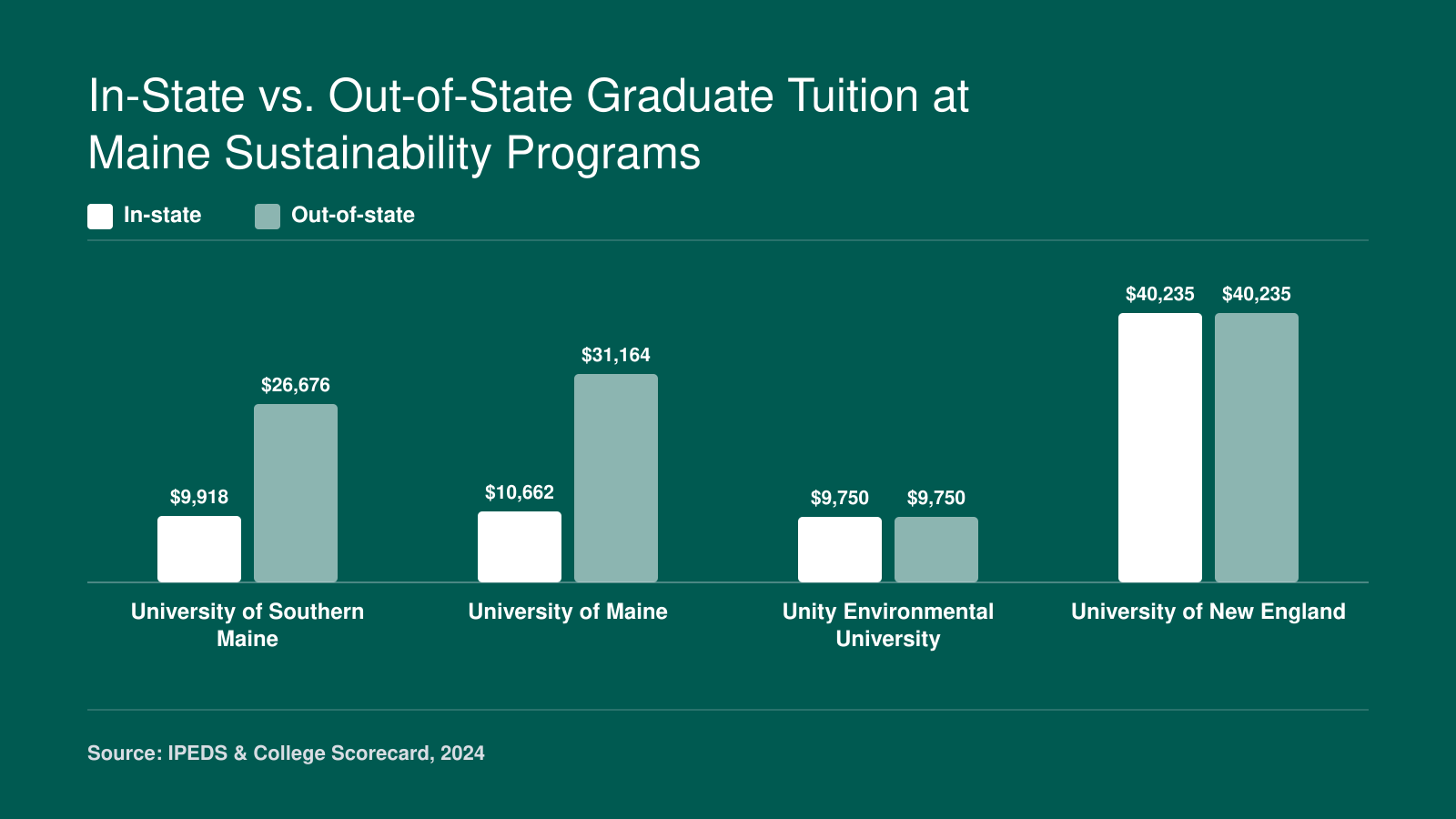
In-State vs. Out-of-State Graduate Tuition at Maine Sustainability Programs
Published graduate tuition and fees show the widest residency gaps at Maine's public universities. Some private programs here list the same rate for every student. The figures below are sticker prices, not final cost; net price after aid is an institution-wide average, not a guaranteed quote.
What a Master's in Sustainability Costs in Maine, and Which Certifications Matter
Sustainability work in Maine is still governed by voluntary credentials rather than state licensure, which puts most of the decision weight on what a Master's in Sustainability costs.
Build the Per-Credit Math First
University of Maine's MaineMBA in Sustainability runs 33 credits (eight core courses plus three concentration electives) at $425 per credit for Maine and Canadian residents, $742 under the New England regional rate, and $1,229 for nonresidents. University of New England lists $710 per credit across 30 credits, roughly $21,300 in program tuition. Unity Environmental University's sustainable MBA is 36 credits at a locked rate, with a $535 military rate. University of Southern Maine's online community planning and sustainable development option is 12 credits1, one option to weigh against a full Online Master's in Sustainability. Mandatory program fees are not uniformly published, so request a current fee schedule before treating tuition as the full price.
Funding Routes Students Actually Use
- Assistantships: UMaine's ecology and environmental sciences program rarely admits students without funding; 12-month stipends start at $22,667 for thesis master's students and carry a tuition waiver and health insurance, through research assistantships, teaching assistantships, or fellowships. USM advertises more than 150 graduate assistantships with stipends.
- Regional tuition: The New England Regional Student Program rate applies if your program and residency qualify.
- Scholarships: UMaine and USM both award institutional aid.
Credentials That Carry Weight
Maine issues no state license for sustainability professionals. Maine DEP runs a self-guided Environmental Leader program for organizations, and its permits and certifications portal charges a $2 transaction fee. Employers more often recognize LEED and ISSP credentials; confirm current exam and renewal costs with each issuing body. Treat institution-wide net price figures as approximate context.
Sustainability Master's Degree Jobs in Maine and What Graduates Earn
Where sustainability graduates work
Maine's clean-energy and efficiency sector is the clearest near-term employer for sustainability graduates.2 Efficiency Maine has posted roles such as a 2026 Program Specialist supporting energy-conservation work1, and the Governor's Energy Office and Maine Department of Energy Resources connect policy, efficiency, clean energy, and workforce development. Maine Won't Wait climate plan implementation also drives hiring in transportation electrification, heat pumps, weatherization, and renewables. State agencies including the Maine Department of Environmental Protection also hire sustainability graduates for policy and compliance work. Municipalities are building climate-resilience capacity, with 243 communities enrolled in the Community Resilience Partnership and roles like sustainability coordinator, planner, and grant manager. Forestry, marine resources, and working-lands conservation add another layer of demand tied to carbon accounting and natural-resource management.
Is the investment worth it?
For earnings context, the available program-level median earnings figure in the program data here is $42,592 one year after finishing for Unity Environmental University's Online MBA in Sustainability. That is a useful benchmark for an entry to mid-level sustainability role, not a guaranteed salary. Given Maine's push toward 30,000 clean-energy jobs by 2030 and low in-state tuition at several affordable master's in sustainability programs here, the degree can be worth it for candidates targeting energy efficiency, municipal resilience, or natural-resource management, especially if they check employer-specific salary data before enrolling.
Compare Sustainability programs on the data that matters
Explore more Science & Engineering specializations or browse every graduate field.
All Science & Engineering programs