Master's Programs in Maine
Every master's program reported by a school in Maine: 170+ programs at 14 graduate schools, with the online options, costs and outcomes behind each one.

For a 30-credit in-state master's, the University of Maine and the University of Southern Maine list tuition of roughly $15,000 to $21,500 before fees in 2026-27. Private options such as the University of New England and Husson University usually cost more, and many students hold jobs while studying online or part-time.
The real tension is not public versus private but whether the credential leads to licensure or a salary step that justifies the price. Some Maine master's degrees pay for themselves quickly in healthcare, engineering, or counseling; others offer flexibility without a clear earnings boost.
Key Points
- In-state 30-credit degrees at UMaine and USM run roughly $15,000 to $21,500 before fees.
- UMaine's 2026-27 assistantship minimum stipend is $21,000 for master's students.
- Maine's LCPC license requires 60 graduate semester hours and a 900-hour practicum and internship.
Popular degrees in Maine
Master's programs in Maine by field
Business & Management
- Healthcare Administration7 programs
- Management7 programs
- Analytics6 programs
- General Business5 programs
- Healthcare Management4 programs
- Accounting3 programs
- Organizational Leadership3 programs
- Project Management3 programs
Education & Teaching
- Educational Leadership6 programs
- Special Education6 programs
- Curriculum & Instruction3 programs
- Teaching3 programs
- Secondary Education3 programs
- Reading & Literacy3 programs
- Art Education3 programs
- Music Education2 programs
Nursing
- Nursing Education or Nurse Educator5 programs
- Psychiatric Mental Health Nurse Practitioner4 programs
- Family Nurse Practitioner (FNP)4 programs
- Nurse Administrator3 programs
- Adult Gerontology Acute Care Nurse Practitioner3 programs
- Nurse Executive Leader2 programs
- RN to MSN2 programs
- Adult Gerontology Primary Care Nurse Practitioner1 program
Social Work & Social Sciences
- Social Work7 programs
- Social Work Advanced Standing3 programs
Healthcare
- Public Health3 programs
- Health Administration3 programs
- Nutrition2 programs
- Speech Pathology1 program
- Health Informatics1 program
Science & Engineering
- Sustainability or Environmental Management4 programs
- Environmental Science2 programs
Computers & IT
- Information Security & Assurance2 programs
- Data Analytics2 programs
- Cybersecurity2 programs
Psychology
- Counseling Psychology1 program
- Applied Psychology1 program
- Applied Behavior Analysis1 program
- School Psychology1 program
- Clinical Psychology1 program
- Educational Psychology or School Psychology1 program
Communications & Media
- Communication3 programs
- Communication Disorders1 program
- Speech Pathology1 program
Criminal Justice & Law
- Public Policy3 programs
- Homeland Security1 program
Arts & Design
- Creative Writing3 programs
- Fine Arts1 program
Counseling
- Clinical Mental Health Counseling2 programs
- School Counseling2 programs
How Much Does a Master's Degree Cost in Maine? Tuition Compared
What will a 30-credit master's degree in Maine actually cost? At the public campuses, the 2026-27 tuition schedules from the University of Maine and the University of Southern Maine put an in-state degree at roughly $15,000 to $21,500 before fees. Out-of-state students pay far more unless they enroll online or qualify for a regional rate.
Public Tuition Per Credit, 2026-27
- UMaine (Orono): $596 per credit for Maine residents, $1,043 for NEBHE-eligible students, and $1,817 for out-of-state students.
- USM, in-state: $494 to $554 per credit, depending on the program's tuition level (levels 1 to 3).
- USM, out-of-state: $1,494 to $1,674 per credit by level. NEBHE rates run $840 to $970 and apply only to eligible programs.
As a rough total, a 30-credit degree at UMaine costs about $17,900 for residents and $54,500 for non-residents. A 36-credit degree runs about $21,500 and $65,400. At USM, 30 credits cost roughly $14,800 to $16,600 in-state and $44,800 to $50,200 out-of-state.
Where Online Rates Change the Math
Online pricing is the one place out-of-state students can come out ahead. UMaine's online graduate rates are $607 per credit for education, $651 for most other fields, and $780 for business and engineering. Its schedule does not show separate in-state and out-of-state online rates. USM charges $548 per credit for students in fully online programs, regardless of residency. A non-resident taking 30 online credits at USM pays about $16,400, against $44,800 or more on campus. Online rates apply only to programs delivered fully online, so confirm how your program is classified.
Why Private Schools Price Differently
Public campuses get state appropriations that hold down resident tuition, while out-of-state rates come closer to the full cost of instruction. Private institutions such as the University of New England, Husson University, Thomas College, and Saint Joseph's College of Maine receive no such subsidy and set one rate for everyone. Their 2026-27 graduate schedules were not available for this comparison, so we are not quoting figures. Check each school's current bursar schedule, and expect many private programs to cost more per credit than in-state public tuition. Some may undercut out-of-state public rates.
Fees the Per-Credit Rate Leaves Out
USM adds a mandatory fee of $107 per credit, covering comprehensive and technology charges. That is about $3,200 on a 30-credit degree and $3,850 on 36. Confirm whether it applies to your online program. UMaine's schedule lists no single graduate fee for all students, but Engineering and Nursing carry additional fees that vary with credit load. Program-specific charges, such as clinical or lab fees, can also apply. Add them to any tuition estimate before you compare schools.
Online, Hybrid, and On-Campus Master's Formats in Maine
Maine's graduate schools split into four working formats. These facts cover only the programs I could verify; confirm current delivery details with each school. I could not verify 2026 format details for UMaine Online, UNE Online, or Thomas, so check those catalogs directly.
Fully Online
The University of Southern Maine runs several master's programs entirely online, including Adult and Higher Education (MS). Saint Joseph's College of Maine offers an Online MBA in Leadership. The University of Maine at Farmington is launching a fully online Master of Education in Spring 2026, designed for part-time study over about two years.
Hybrid With Low-Residency Weekends
UMF's Educational Leadership (MSEd) is roughly 70% online, with in-person weekend or summer intensives. Husson's Clinical Mental Health Counseling (MS) offers a live online pathway, but it is still hybrid in practice, because students come to the Bangor campus for two residencies, the first lasting three days.
Part-Time and Evening Study
Every graduate program in USM's College of Education can be taken part-time or full-time. USM's Public Health (MPH) is HyFlex, meaning you can attend in person or by livestream. It takes two years full-time or three to four part-time.
Accelerated Formats
USM's Digital Marketing Analytics (MS) and Educational Leadership (MSEd) are both offered in accelerated online formats. USM's Literacy Education (MSEd) also uses seven-week courses. I found no verified accelerated master's at UMaine, UNE, Saint Joseph's, Thomas, or UMF.
Online Coursework Still Means In-Person Hours
Clinical fields are the exception to "fully online." USM's Family Nurse Practitioner (MSN) is mainly hybrid, with most courses meeting face-to-face once a week, plus clinical practicums in several areas. Husson's counseling program adds a 100-hour practicum and a 900-hour internship on top of its residencies. Budget for travel, unpaid placement time, and schedule flexibility with your employer.
Planning Your Timeline
- Part-time: Plan on two to four years. USM Literacy Education takes about four, FNP three to four, and UMF's leadership degree two to three.
- Full-time: Two years is typical. USM Literacy Education and the MPH both fit that window.
Transfer credits and course load can shorten or stretch these timelines, as Husson notes for its counseling program.
Admissions Requirements and GRE Policies at Maine Graduate Schools
Maine's graduate schools set many rules program by program, so treat these as typical starting points and confirm details on your program's page.
- Accredited bachelor's degreeUniversity of Maine (UMaine), University of Southern Maine (USM), and University of New England (UNE) all require a bachelor's degree. UMaine and USM expect it from an accredited institution. UNE requires it before you matriculate.
- Minimum GPAUMaine and UNE both point to a 3.0. UMaine programs may differ. UNE weighs your last 60 credits and does not forgive retakes. USM has no single university-wide minimum, so programs set their own.
- GRE statusUSM says GRE and GMAT scores do not influence admission. UMaine's Graduate School does not require them, but individual programs may. UNE publishes no university-wide rule, so ask the program.
- Prerequisites, recommendations, and experienceSTEM, nursing, and engineering programs usually list their own prerequisite courses. Expect to submit letters of recommendation and a statement of purpose. MBA and education programs often want a resume or professional experience.
- International applicantsUMaine lists a TOEFL minimum of 80. USM lists TOEFL 79, IELTS 6.5, PTE 60, or Duolingo 105, though programs may ask for more. UNE requires proof of English fluency but states no numeric minimums. UNE requires a WES ICAP course-by-course credential evaluation. For a UMaine I-20, plan on about six weeks of processing plus financial documents. The Fall 2026 deadline for those documents was July 15, so confirm the date for your term. USM online students do not receive an I-20.
- DeadlinesDeadlines are set by program, not university-wide. UMaine's general fall financial-aid date is January 15. Rolling programs there ask you to apply at least two months before the semester. Some USM programs admit once a year. USM charges a $50 application fee.
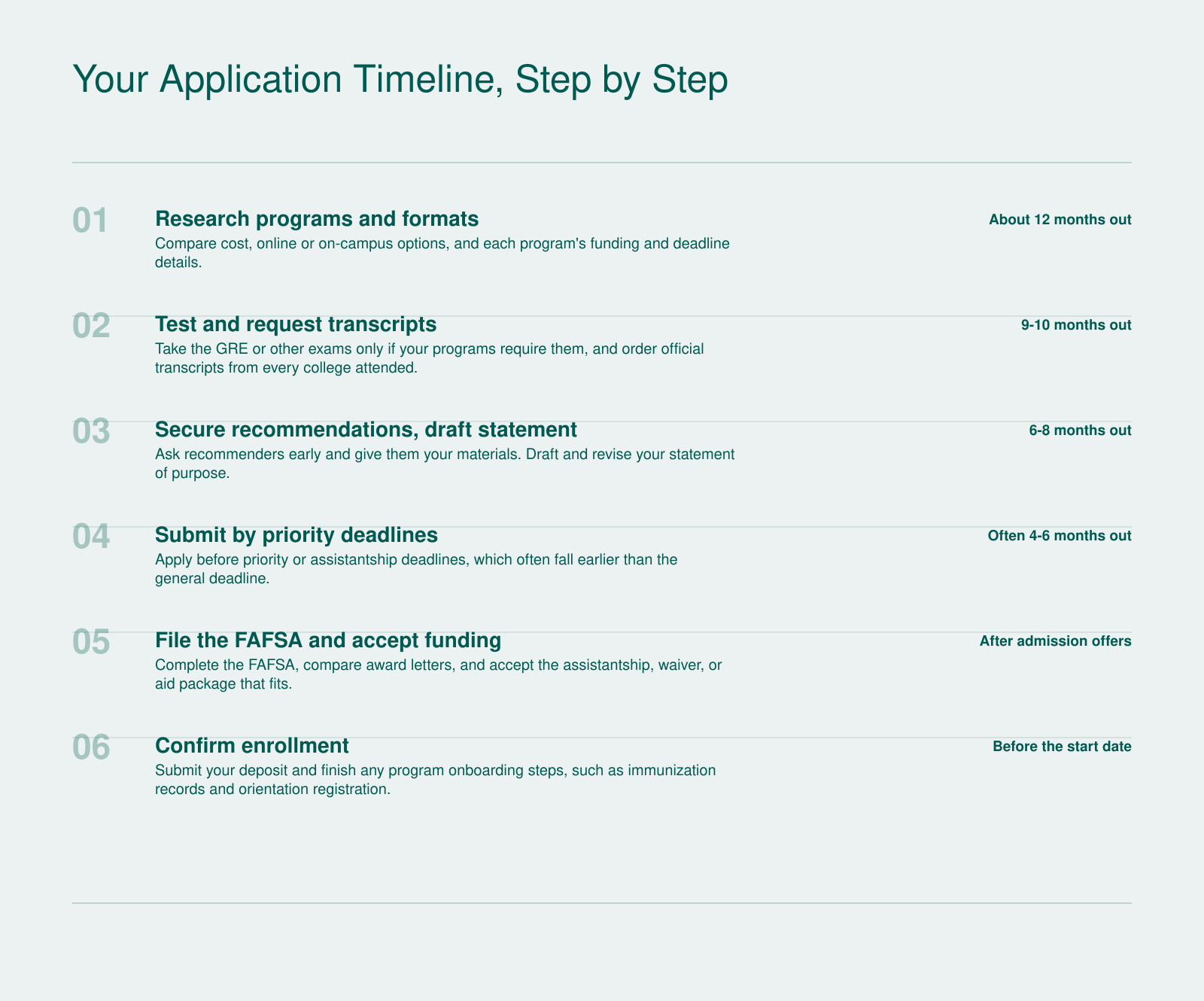
Your Application Timeline, Step by Step
Work backward from your start date. Assistantship consideration often requires applying earlier than the general deadline, so treat the priority date as your real deadline if you want funding.
Paying for It: Assistantships, Tuition Waivers, and Scholarships in Maine
At the University of Maine, the 2026-27 graduate assistantship minimum stipend is $21,000 for master's students and $23,500 for doctoral students on a 9-month, 20-hour-per-week appointment. That base package is prorated for shorter terms or fewer hours.
How UMaine Assistantships Work
For a standard 9-month assistantship, UMaine requires tuition coverage for 9 credits in fall, 9 in spring, and 6 in summer. Assistants pay the resident tuition rate: $596 per credit for 2026-27, even if they would otherwise pay the nonresident rate of $1,817 per credit. The university also requires a 65% contribution toward the medical premium when enrolled, 50% for one dependent, and 50% for dental. Waivers generally exclude audit courses, late drops, and student activity or technology fees, so budget for those separately. Research-based M.S. programs, especially in fields like ecology and environmental sciences, are among the most likely to fund students, though stipends vary widely by lab and funding source. Ecology and Environmental Sciences lists 12-month minimums of $22,667 for master's and $26,667 for doctoral, but these are not directly comparable to the 9-month university-wide minimums.
Institutional Scholarships and Maine-Specific Aid
Beyond assistantships, check each school's financial aid office. At the University of Southern Maine, donor-funded scholarships include one per year for a mental health or psychiatric social work graduate student in MSW programs, subject to available funds. The University of New England's 2026 graduate scholarship amounts were not available in the sources reviewed, so contact UNE directly. For Maine-specific aid, the Maine Community Foundation considers academic performance, financial need, extracurriculars, and work experience, and does not consider citizenship or immigration status.1 Awards are paid to the college and can cover tuition, room and board, books, materials, and fees.2 A FAFSA may be required, but a waiver exists for students unable to submit one because of visa or immigration status.1
Employer Aid and Federal Loans
Do not assume employer tuition reimbursement without verifying it. The reviewed sources did not document current tuition assistance terms at major Maine employers such as Bath Iron Works or regional health systems. Ask your human resources office directly. Federal Direct Unsubsidized Loans and Grad PLUS Loans remain options, but current 2026 loan limits were not available in the sources reviewed; check StudentAid.gov for the latest caps before borrowing. Exhaust assistantships and employer aid first.
A funded assistantship can change the cost picture of a Maine master's more than choosing a cheaper school, so compare your net cost after funding, not the sticker price.
Licensure and Accreditation: What to Check Before You Enroll
Institutional accreditation and programmatic accreditation are two different things, and a Maine master's program can carry one without the other. Institutional accreditation is what makes a school eligible for federal financial aid and makes your credits transferable. Programmatic accreditation is what a state licensing board, and often an employer, actually looks for when you apply to practice.
The institutional layer
Maine's graduate schools are accredited by the New England Commission of Higher Education (NECHE). The University of Maine System holds a unified NECHE accreditation granted in July 2020 that covers the University of Maine and the University of Southern Maine, among other campuses; USM was reviewed as part of that system and met the commission's requirements in 2022. Husson University is separately NECHE-accredited.1 If a school you are considering cannot point you to an institutional accreditor, stop there.
The program layer
The accreditor you need depends entirely on the field:
- Counseling: CACREP. Husson's Clinical Mental Health Counseling and School Counseling graduate programs hold it.1
- Social work: CSWE, the standard credential for an MSW anywhere in the country, including online MSW programs.
- Nursing: CCNE or ACEN. Husson's master's and post-graduate APRN certificate programs are CCNE-accredited.1
- Engineering: ABET, which is applied far more consistently at the bachelor's level than the master's. USM's BS electrical and mechanical engineering degrees are ABET-accredited, and its industrial engineering program expects to seek accreditation with first graduates in 2027.
- Education: state approval through the Maine Department of Education, as Husson holds for school counseling and teacher education, plus national accreditation in some cases. USM's College of Education is nationally accredited for both initial and advanced educator preparation.
Out-of-state online programs
An online master's run from another state is not automatically acceptable to a Maine licensing board. Before you pay a deposit, read the program's state authorization and professional licensure disclosure, which must state whether the curriculum meets Maine's requirements. Then verify independently: CACREP, CSWE, CCNE, ACEN, ABET and NECHE all publish searchable directories of accredited programs. A two-minute search beats a recruiter's assurance.
Licensure in Maine: The Counseling Example
Engineering and Ecology Master's Programs in Maine
Graduate engineering in Maine is a narrow field, and the real question for most applicants is not which program to pick but whether the specialty they want exists in state at all. The answer shapes everything else: funding, research access, and whether you relocate.
Mechanical engineering at the graduate level
The University of Maine in Orono is the state's land grant research university and the usual destination for graduate mechanical engineering study. Research master's degrees in this field conventionally split into a thesis track, where you join a faculty member's funded project and write original research, and a coursework or non-thesis track aimed at practicing engineers who want depth without a lab commitment. Credit totals, track availability, active research areas, and whether assistantship support is offered in a given admissions cycle vary year to year, so verify the current structure with the department before you build an application around it. Treat any funding figure you read secondhand as provisional until the graduate coordinator confirms it.
Maine Maritime Academy is not an engineering graduate option
Maine Maritime Academy in Castine is a serious engineering school, but at the undergraduate level. Its Marine Systems Engineering program runs on four-year and five-year tracks, with the longer route adding eligibility for a U.S. Coast Guard third assistant engineer license. Its graduate offerings sit on the management side: a Master of Science in international logistics management, alongside maritime management study. If you are looking for a graduate marine or mechanical engineering degree there, it is not available.
Ecology, environmental, and marine sciences
For students weighing sustainability master's programs, Maine's coastline, working forests, and fisheries make environmental research a genuine state strength, and UMaine houses graduate work in ecology and marine sciences as well as environmental science master's programs. As with engineering, confirm program structure and funding directly with the unit.
Both paths are research-driven degrees where funded seats go to applicants an advisor already wants. Email faculty months before the deadline, read their recent work, and ask plainly whether they expect to support a new master's student.
Career Outcomes and Salary Expectations for Maine Master's Graduates
What do master's graduates in Maine actually earn, and does it justify the debt? The answer depends more on your field than your school, and the federal data is thinner than most students expect.
Where the Highest Salaries Are
Advanced nursing offers the clearest payoff. May 2025 state wage data put the median Nurse Practitioner wage in Maine at $130,260 (about $62.62 an hour). The middle half of earners made between $120,830 and $141,440. Mechanical engineers in the state earned a median of $102,430, ranging from roughly $78,440 at the 10th percentile to $137,280 at the 90th.1
Program-level data points the same way. On College Scorecard, Husson University's 88 master's completers in registered nursing show median earnings of $101,209.2 Its 194 general MBA graduates show $50,789.2 Median debt is not reported for either program, so the payback math stays incomplete.
Education, social work, and counseling pay less, even though these jobs remain needed across the state. In these fields, a master's often raises pay on a salary schedule or qualifies you for licensure. It rarely produces engineering or nurse practitioner salaries. Maine-specific wage figures for school counselors were not available.
Weigh Debt Against Earnings
Salary alone is a misleading scoreboard. A useful rule of thumb is to keep total borrowing at or below your expected first-year salary. A public program with modest debt and solid earnings can pay for itself faster than a private program whose graduates earn more but borrowed far more. In lower-paying fields like social work and education, choosing affordable MSW programs and keeping debt low matters even more. Public Service Loan Forgiveness may also factor in if you work for a qualifying employer.
Know the Data Limits
College Scorecard suppresses figures for small programs to protect privacy, so many Maine master's programs show no earnings or debt at all. One example is Husson's clinical, counseling and applied psychology master's, which had 21 graduates.2 Institution-wide numbers, such as the debt figures on the University of Maine's page, don't isolate specific master's fields.3 A blank entry means unreported, not zero. Ask the program directly for recent graduates' outcomes.
Finding the Best Value: How to Weigh Cost, Format, and Payoff
Sticker price is the least useful number in a graduate search. A program that looks expensive can cost little once an assistantship covers tuition, and a cheap one can be a poor deal if it doesn't qualify you for the license your career requires. Pull the earlier sections together into four questions:
- Net cost after funding: Subtract assistantships, waivers, scholarships, and employer aid from tuition and fees.
- Format fit: Can you finish without giving up the income you're living on?
- Accreditation and licensure: Does the program meet the requirements of the Maine board or national accreditor your field depends on?
- Earnings relative to debt: Will typical graduate earnings comfortably cover what you borrow?
Three Maine Student Profiles
A Maine resident working full-time usually gets the best value from an online or hybrid program in the University of Maine System. In-state public rates keep tuition down, and keeping a full salary often matters more than any discount. Check whether your employer offers tuition assistance before you borrow.
A research-focused student, in a field like ecology or engineering, should aim for a funded thesis M.S. at UMaine. Research and teaching assistantships commonly bundle a tuition waiver with a stipend, so the real cost can approach zero. The tradeoff is a full-time, on-campus commitment and a narrower window to apply.
A career changer heading into a health profession faces the highest bills and the strictest rules. Clinical programs at UNE or Husson can lead directly to licensed, well-paid work, but tuition is private-school pricing and assistantships are rare. Here, accreditation status and licensure pass rates should weigh as heavily as cost, and borrowing should be measured against realistic starting pay in that occupation.
Are There Affordable Master's Programs in Maine?
Yes. Public in-state tuition across the University of Maine System is the most reliable route to a lower bill, and online options extend those rates to working students around the state. Add a graduate assistantship and a public program can become one of the least expensive ways to earn a master's in New England. Private programs can still be worth it, but mainly when they lead to a credential or salary that public options don't.
Your Next Step
Before you submit any application, ask each program for two documents: a total cost sheet listing tuition, fees, and expected funding for the full degree, and a written licensure disclosure confirming whether the program meets requirements in Maine and any state where you might work. Programs that can't provide both clearly deserve a harder look.
Graduate schools in Maine with the most master's programs
| School | City | Type | Master's programs | Online | Grad tuition / yr |
|---|---|---|---|---|---|
| University of Maine | Orono | Public | 42 | 27 | $10,662 |
| University of Southern Maine | Portland | Public | 36 | 31 | $9,918 |
| University of New England | Biddeford | Private nonprofit | 21 | 19 | $40,235 |
| Saint Joseph's College of Maine | Standish | Private nonprofit | 16 | 16 | $9,738 |
| Husson University | Bangor | Private nonprofit | 14 | 9 | $19,832 |
| Thomas College | Waterville | Private nonprofit | 11 | 9 | $31,824 |
| Beal University | Bangor | Private for-profit | 10 | 10 | — |
| University of Maine at Farmington | Farmington | Public | 9 | 8 | $11,874 |
| University of Maine at Presque Isle | Presque Isle | Public | 5 | 5 | $14,100 |
| Unity Environmental University | New Gloucester | Private nonprofit | 5 | 5 | $9,750 |
| University of Maine at Augusta | Augusta | Public | 4 | 4 | $8,892 |
| Maine College of Art & Design | Portland | Private nonprofit | 3 | 1 | $42,647 |
| University of Maine at Fort Kent | Fort Kent | Public | 1 | 1 | $6,000 |
| Maine Maritime Academy | Castine | Public | 1 | 1 | $15,335 |
Program counts are the verified master's listings in our directory; tuition is the school-wide average for a full-time graduate student (IPEDS).
Questions About Master's Programs in Maine
These answers summarize the main points from the sections above. Policies change by program and by year, so confirm details with the graduate office at each school before you apply.
Is the GRE required for master's programs in Maine?
Which universities in Maine offer online master's programs?
Can international students work on campus or get assistantships while earning a master's in Maine?
Can I use NEBHE Tuition Break or in-state rates for an online master's in Maine if I live elsewhere in New England?
Compare programs nationwide
Many Maine residents study online. Every ranked list above has an online lens, or browse every field.
Online master's programs Browse all fields