Master's Programs in Nebraska
Every master's program reported by a school in Nebraska: 340+ programs at 20 graduate schools, with the online options, costs and outcomes behind each one.

Nebraska's public universities often charge less per graduate credit than many neighboring states, which makes the state a quiet bargain for a 30 to 36 credit master's, including online master's degrees. The harder questions come after the sticker price: how much of a program you can finish online, whether an assistantship is realistic, and whether the degree lifts your pay enough to justify the time away from work.
The answers vary sharply by campus and department, and a license requirement can narrow your options further. In Nebraska, a program's accreditation and in-state supervised-hours rules often decide a career outcome more than the school's name does.
Key Points
- Some University of Nebraska online programs charge one rate to everyone, erasing the out-of-state premium.
- Nebraska counselor and social work licenses require 3,000 supervised hours and a degree from an accredited program.
- Compare net price after assistantships, not sticker price, when weighing Nebraska graduate schools in 2026.
Popular degrees in Nebraska
Master's programs in Nebraska by field
Business & Management
- Organizational Leadership10 programs
- Healthcare Administration9 programs
- Accounting9 programs
- Finance8 programs
- Management7 programs
- Marketing7 programs
- General Business6 programs
- Analytics6 programs
Education & Teaching
- Curriculum & Instruction15 programs
- Special Education12 programs
- Teaching10 programs
- Elementary Education7 programs
- STEM Education or Science Education or Mathematics Education6 programs
- Educational Leadership5 programs
- Early Childhood Education5 programs
- Secondary Education5 programs
Nursing
- Nursing Education or Nurse Educator7 programs
- Nurse Administrator5 programs
- Nurse Executive Leader3 programs
- Nurse Executive Leadership3 programs
- Family Nurse Practitioner (FNP)2 programs
- Adult Gerontology Acute Care Nurse Practitioner2 programs
- Psychiatric Mental Health Nurse Practitioner2 programs
- Health/Nursing Informatics2 programs
Healthcare
- Public Health7 programs
- Health Administration5 programs
- Health Informatics4 programs
- Speech Pathology4 programs
- Exercise Science3 programs
- Nutrition1 program
Counseling
- School Counseling11 programs
- Clinical Mental Health Counseling6 programs
- Marriage and Family Therapy or Marriage and Family Counseling2 programs
Social Work & Social Sciences
- Social Work7 programs
- Sociology6 programs
- Political Science, Government2 programs
- Social Work Advanced Standing2 programs
- Human Services1 program
Communications & Media
- Speech Pathology5 programs
- Communication4 programs
- Public Relations3 programs
- Communication Disorders2 programs
- Journalism1 program
- Media Communication1 program
- Health Communication1 program
Psychology
- Educational Psychology or School Psychology4 programs
- Industrial Organizational Psychology2 programs
- Applied Behavior Analysis2 programs
- General Psychology1 program
- School Psychology1 program
- Political Psychology1 program
- Counseling Psychology1 program
Science & Engineering
- Geography6 programs
- Sustainability or Environmental Management2 programs
- Environmental Science1 program
Arts & Design
- Creative Writing6 programs
- Fine Arts1 program
Computers & IT
- Cybersecurity3 programs
- Data Analytics2 programs
- Machine Learning1 program
Religion & Theology
- Divinity1 program
- Christian Leadership1 program
- Youth and Family Ministry1 program
- Theology1 program
Criminal Justice & Law
- Legal Studies1 program
- Master of Laws1 program
What a Master's Degree in Nebraska Costs: Tuition at UNL, UNO, UNK, UNMC, Wayne State and Creighton
Rates below are 2025-26 per-credit-hour tuition, before mandatory fees, which each campus bills separately. Some University of Nebraska online programs charge one rate to everyone, which can erase the out-of-state premium: UNL's online business and engineering management programs run $710 per credit hour, against a nonresident on-campus range that reaches $1,192. Current figures for UNK, UNMC, Wayne State and Creighton, and confirmation of Midwest Student Exchange Program eligibility for graduate students, were not available for this table, so check each bursar's page before budgeting. Creighton is private and charges one rate regardless of residency.
| School | Resident Tuition per Credit Hour | Nonresident Tuition per Credit Hour | Online Rate | Est. Tuition for 36 Credits |
|---|---|---|---|---|
| University of Nebraska-Lincoln (on campus, by academic unit) | $383.00 to $531.00 | $479.00 to $1,192.00 | Varies by program | $13,788 to $19,116 resident; $17,244 to $42,912 nonresident (36 credits x per-credit rate) |
| University of Nebraska-Lincoln College of Business (online) | N/A | N/A | $710.00 per credit hour | $25,560 (36 credits x $710) |
| University of Nebraska-Lincoln Master of Engineering Management (online) | N/A | N/A | $710.00 per credit hour | $25,560 (36 credits x $710) |
| University of Nebraska-Lincoln Doctor of Plant Health (online doctorate, shown for comparison) | $383.00 | $479.00 | Resident $383.00; nonresident $479.00 | $13,788 resident; $17,244 nonresident (36 credits x per-credit rate) |
| University of Nebraska Omaha (on campus, by academic unit) | $383.00 to $531.00 | $922.00 to $1,444.00 | Varies by program | $13,788 to $19,116 resident; $33,192 to $51,984 nonresident (36 credits x per-credit rate) |
| University of Nebraska Omaha MBA (online) | $442.00 | $1,025.00 | Resident $442.00; nonresident $1,025.00; Omaha Urban Rate $663.00; international $1,025.00 | Published estimate for the 33-credit MBA: resident $17,319.75; nonresident $36,558.75; Omaha Urban Rate $24,612.75; international $37,158.75 |
Online, Hybrid and Campus-Based Master's Formats in Nebraska
The appeal of an online master's is flexibility, but the label can hide in-person and live-session requirements that matter to a working professional. In Nebraska, the details differ a lot by school and program, so read the fine print before you apply.
What the Sources Confirm
UNO is the clearest case. Its Online at UNO graduate offerings span fully online, hybrid and in-person options, and the online programs can generally be completed entirely asynchronously. Examples:
- MS in Criminology and Criminal Justice: a 36-credit program with a 100% online option and a hybrid online/on-campus version.
- MS in Cybersecurity: 33 credits, offered fully online, hybrid or in person.
- Secondary education graduate coursework: for 2026, the hybrid format meets four times on campus, while the online format meets four times over Zoom, with asynchronous work in between.
At UNK, the M.A.Ed. in Curriculum and Instruction is one of UNK's online M.Ed. programs; it is completely online and includes asynchronous courses. It is built for PK-12 teachers and requires a teaching certificate. UNK reports more than 40 graduate programs in online, in-person or blended formats. Bellevue University offers more than 80 online degree options across levels, through Anytime Online (no set class times, no live attendance) and Connected Campus (live virtual sessions at scheduled times).1
For UNL, Wayne State, Creighton, Chadron State and Peru State, the sources I reviewed do not establish which master's programs are fully online, hybrid, evening or part-time. Check those schools' program pages directly.
Programs That Look Online but Aren't Fully Remote
Clinical fields are where "online" misleads. Bellevue's online master's in clinical mental health counseling is 60 credits and delivered 100% online, yet it requires a 100-hour practicum, 600 hours of clinical internship under a licensed counselor, and two residencies.2 The first comes after MCC 500, the second after MCC 670 and before Internship I. The source does not say whether those residencies are on a physical campus. Ask before you enroll. Nursing and educational leadership programs commonly add placements or live sessions too, so confirm each one.
Part-Time Pacing
Most working students take one or two courses per term. For a 36-credit degree at three credits per course, that means about two years at two courses each fall, spring and summer term, or closer to four years at one course per term. UNK's published cost estimate for its online M.A.Ed. assumes two-year completion. Longer programs, such as a 60-credit counseling degree, take proportionally more time, and clinical hours can lengthen the timeline.
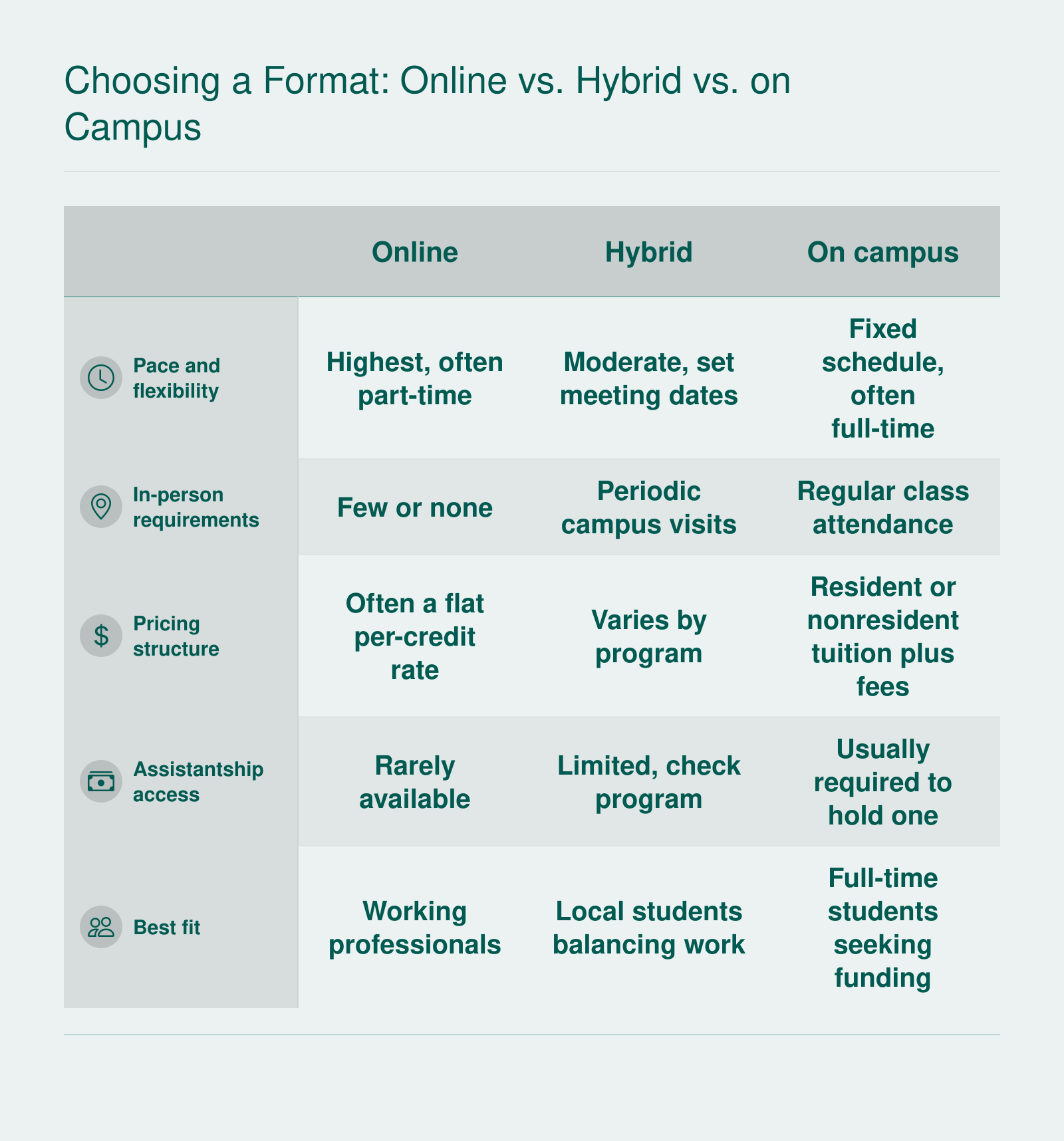
Choosing a Format: Online vs. Hybrid vs. on Campus
The right format depends on your work schedule, budget and funding plans. Format also affects whether you can hold a graduate assistantship, since those positions generally require on-campus enrollment. Confirm pricing and in-person requirements with each program, because they vary by school and degree.
Nebraska Graduate School Admissions: GPA, GRE and What Programs Really Ask For
Graduate admission in Nebraska runs on two layers. The university's graduate college sets a floor: a bachelor's degree from an institution with regional accreditation, official transcripts, and a grade point average benchmark. The individual department then sets the real bar, which is usually higher and often includes prerequisites, a statement of purpose, references, and sometimes an interview or portfolio. Meeting the floor gets your file read. It does not get you admitted.
The GPA baseline
At the University of Nebraska at Omaha, general graduate admission expects a 3.0 on a 4.0 scale, with applicants around 2.7 considered for provisional admission, meaning you start under conditions you have to clear in your first terms. The University of Nebraska-Lincoln treats 3.0 as the competitive norm rather than a hard cutoff; it reviews files holistically and does not reject applicants on grade point average alone, and some colleges, including engineering, state no universal minimum.1 The University of Nebraska at Kearney publishes no university-wide floor, so the program page is your only reliable source there.
Does Nebraska require the GRE?
Mostly no. Neither UNL nor UNO imposes a university-wide entrance exam requirement, and UNL lists the GRE as optional across nearly all engineering graduate programs with no minimum score, a policy that mirrors broader No-GRE master's programs.2 Testing survives at the department level: some research-heavy science programs and certain business tracks still ask for the GRE or GMAT, and UNO maintains institutional codes for both exams (6420 for the GRE, VWNW357 for the GMAT) precisely because some of its programs still collect scores. Waiver language varies program by program rather than campus-wide, so treat "test optional" as a claim you verify on the specific program page, not an assumption.
International applicants
Non-native English speakers must document proficiency. UNL and UNK both work from a 79 TOEFL iBT, 550 paper-based TOEFL, and 6.5 IELTS baseline, with Duolingo accepted at 120 at UNL and 110 at UNK; UNO lists 80 on the TOEFL iBT and 53 on the PTE. General-training IELTS is not accepted at UNL, scores expire after two years, and departments may demand higher. Thresholds shift for tests taken on or after January 21, 2026, so check the date rules before you sit the exam. UNL exempts applicants holding a bachelor's or higher from an English-instruction institution. UNK requires an official credential evaluation of all non-U.S. transcripts; UNL may require one at your expense if it cannot verify your documents.
Your Nebraska Application Checklist and Deadline Timing
Nebraska deadlines are set mostly by program, not by university, so confirm dates with your department before you plan your calendar.
- Bachelor's degree and official transcriptsEvery program expects a completed bachelor's degree and official transcripts. UNO requires a NACES course-by-course evaluation of international credentials beginning August 1, 2026.
- Minimum GPAThe GPA floor is set by each program, so check the department page rather than assuming a university-wide number.
- Test scores or a waiverGRE or GMAT requirements and waivers vary by program. International applicants to Creighton should plan for English proficiency scores of TOEFL 90, IELTS 6.5 or Duolingo 110.
- Recommendation letters, statement of purpose and resumeMost programs ask for all three, but the number of letters and the essay prompts differ. Give recommenders several weeks of notice.
- Application feeUNL and UNO charge $50 for degree-seeking applicants. UNL charges $25 to current UNL students. UNO charges $25 for certificate and non-degree applicants and for current UNO students. Fee waivers exist, including for UNO military applicants and UNL Pell and McNair participants. UNK and Creighton fee amounts were not confirmed, so check their application pages.
- Deadline windowsUNL's fall funding priority is January 15 (financial support deadline: January 7), with a March 1 fall deadline, September 1 for spring and February 1 for summer. Many UNL programs admit on a rolling basis. UNK's fall deadline is August 10 and its spring deadline is December 15. Summer is rolling. Creighton's final fall deadline is July 15, 2026.
- International deadlinesUNK sets June 15 for fall, November 15 for spring and March 15 for summer. UNL and UNO have no single date, so start about six months ahead to allow for credential evaluation and visas.
Paying for It: Assistantships, Tuition Remission and Scholarships
The tradeoff in funding a Nebraska master's is simple: assistantships and fellowships cut your bill the most but demand work hours and early planning, while loans and employer aid are easier to get but leave you paying more. Most students end up combining sources.
How Assistantships Work at UNL
UNL's 2025-26 guidelines tie eligibility to appointment size: at least 0.33 FTE but no more than 0.49 FTE, or roughly 13 to 19.6 hours a week. The minimum stipend is $7,725 per semester, or $15,450 for the year. Tuition remission covers up to 12 credit hours per semester. The policy does not establish that mandatory fees are waived, so confirm that with your department.
Assistants at 33% or above are auto-enrolled in UNL health insurance for graduate assistants. The employing department pays 79% of the premium and the assistant pays 21%. You can waive with equivalent coverage, but the Fall 2026 deadline was September 12, 2026, and an untimely waiver leaves the premium charge non-refundable. Current published stipend, remission and insurance terms for UNO and UNK were not available to us, so check those directly with each graduate office.
Named Fellowships
UNL's Graduate Studies office nominates students for several awards:
- Presidential Fellowship: $24,000 for advanced doctoral and MFA students, including tuition, fees and a health insurance portion.
- Fling Fellowship: $20,000 for advanced master's students (within one year of graduating) and doctoral students, with the same inclusions.
- Dean's Fellowship: $5,500 for advanced master's and doctoral students.
- Neu Fellowship: $4,000 for full-time students (prorated if part-time) connected to LGBTQA+ causes, organizations or research.
The McCulley Fellowship ($5,000) is for doctoral students, and Buffett Institute Graduate Scholars (up to $25,000, four doctoral students a year)1 is also doctoral-only. We did not find published Creighton merit aid figures, so ask its admissions office.
Employer Aid and Federal Loans
If you work in Omaha or Lincoln and plan to study online, employer tuition assistance may be your best source. Ask HR about annual caps and any requirement to stay after you finish.
For loans first disbursed between July 1, 2026 and June 30, 2027, federal student loan interest rates on Direct Unsubsidized loans are fixed at 8.07%. Direct Grad PLUS loans are fixed at 9.07%, with an origination fee of 4.228% (as of 2020) for loans first disbursed after October 1, 2020. Federal rules for loans first disbursed on or after July 1, 2026 have changed, so check studentaid.gov for how they affect graduate borrowing before you count on PLUS.
Ask About Funding When You Apply
Do not wait for an admission letter to raise money. Email the department or graduate director while you apply and ask what assistantships exist, when the priority deadline falls, and whether remission is included. Assistantship offers often follow priority deadlines, so a late complete application can mean admission without funding.
Nebraska Licensure at a Glance
Master's Programs That Lead to Professional Licensure in Nebraska
If your career goal requires a license, the accreditation on a program matters more than the school's reputation. Nebraska ties several credentials to specific accrediting bodies, and a degree from an unaccredited program can leave you ineligible to sit for an exam or apply for licensure. Here is what to confirm before you enroll.
Counseling, Social Work and School Roles
For clinical mental health counseling, look for CACREP accreditation. Chadron State College's MAE in Clinical Mental Health Counseling program1 and the University of Nebraska at Kearney's program are both CACREP-accredited (UNK's accreditation runs through October 2032).2 Nebraska's LPC/LMHP path generally requires 60 graduate credits, the CPCE exam, and passage of the NCE or NCMHCE, plus post-degree supervised hours.13
Social work follows a separate track. Nebraska treats counseling and social work as distinct, and master's-level social work credentialing runs through the ASWB examination, with Advanced Generalist, Master, or Clinical options depending on the credential sought.3 The relevant program accreditor for an MSW is CSWE, so verify a program is among CSWE-accredited MSW programs before committing.
School counseling and educational administration lead to Nebraska Department of Education endorsements rather than a health-profession license. These programs are typically reviewed under CAEP and require state approval, so the CACREP or CSWE label you'd check for counseling or social work does not apply the same way here.
Health Professions
Speech-language pathology licensure hinges on ASHA CAA accreditation. The University of Nebraska-Lincoln's MS, UNK's MSEd, and the University of Nebraska-Omaha program are ASHA CAA-accredited, with UNL receiving a continued accreditation decision in early 2026.6
Nurse practitioner tracks sit under the Advanced Practice Registered Nurse credential, which requires a master's or doctoral nursing degree and national certification; CCNE is the accreditor to look for,7 and Nebraska grants prescriptive authority at licensure.5 Physician assistant programs, offered at institutions such as UNMC and Creighton, must hold ARC-PA accreditation, and graduates sit for the PANCE.4 Nebraska's PA licensure carries a $150 application fee and a $110 renewal.4
A Warning for Out-of-State Online Students
Before paying a deposit for an online program from outside Nebraska, check the program's state authorization and professional licensure disclosure. A Nebraska degree does not automatically meet another state's licensure rules, and programs are required to tell you whether their curriculum satisfies the requirements where you live.
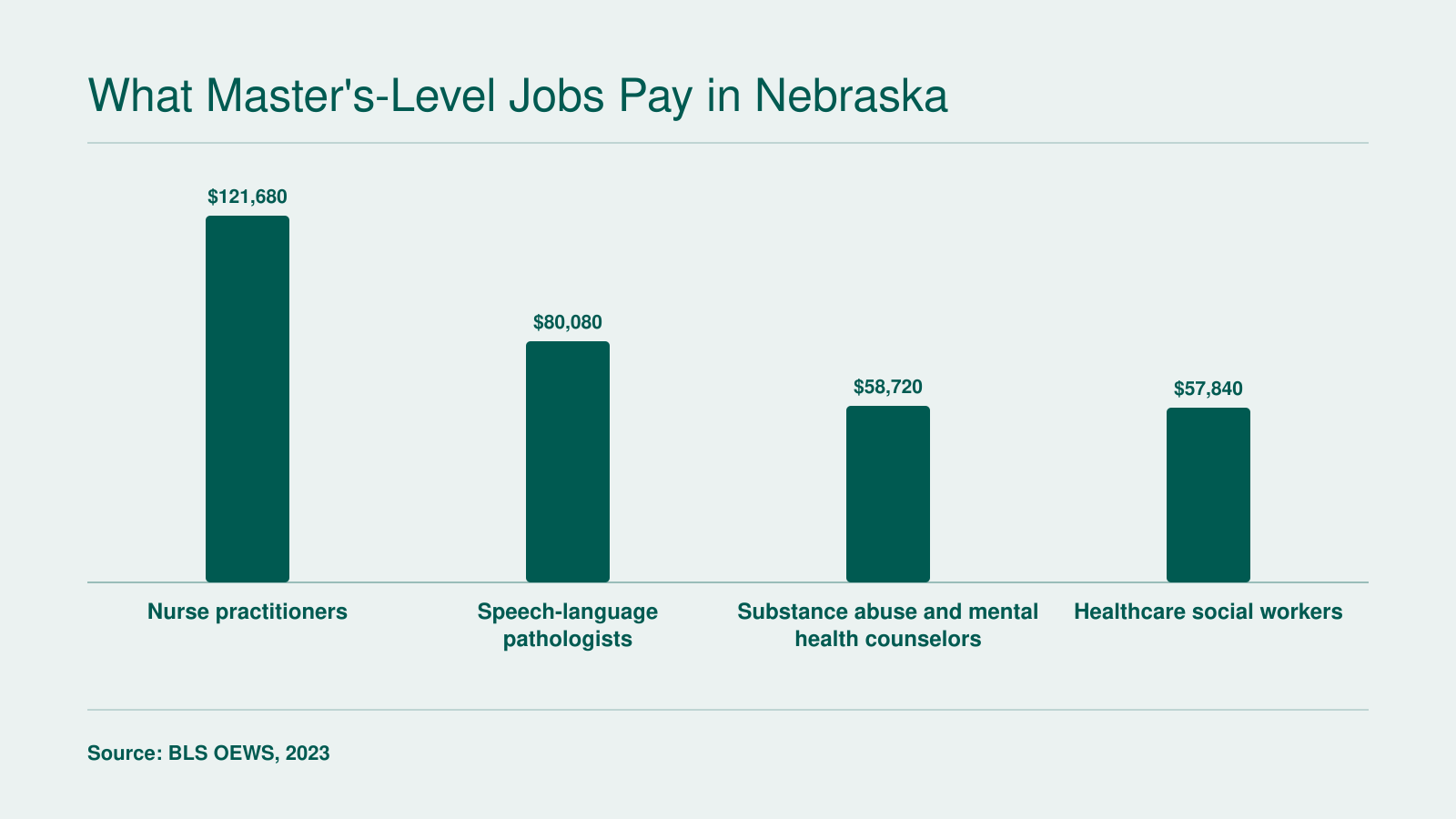
What Master's-Level Jobs Pay in Nebraska
These are Nebraska median annual wages from the Bureau of Labor Statistics OEWS survey for May 2023, the latest state-level figures confirmed for these occupations. Newer OEWS releases exist, so treat the numbers as a baseline rather than today's pay. For context, the national median for speech-language pathologists was $97,870 in May 2025, though that figure comes from a different year than the Nebraska bar.
How to Compare Nebraska Graduate Schools on Value, Not Just Price
Start with total cost after assistantships and tuition remission, not the published sticker price. A $12,000 master's with a graduate assistantship may beat a $9,000 program with no funding, because net price and time to degree change the real cost. Compare programs on five factors: total cost after funding, format fit for your schedule, accreditation for your licensure goal, time to degree, and local employer ties in Omaha, Lincoln, and Kearney. Those last three matter more than the school's name.
Campus Fit and Employer Ties
UNL is the state's research flagship, strongest for funded, doctoral-bound master's work and employer pipelines into state government, agriculture, and engineering in Lincoln. UNO is the urban campus, built around working professionals in Omaha, with evening, hybrid, and online courses that fit full-time jobs. UNK serves regional Nebraska and online learners, often with lower tuition and a smaller, more flexible footprint, and its graduates feed Kearney's education, business, and health employers. UNMC is the health professions campus, where licensure and clinical placement dominate the value calculation for MSN programs.
Wayne State's value position is its lower tuition and rural-focused professional programs. Creighton's is its private-school cost but strong health, law, and business licensure outcomes, with Omaha employer ties. Neither is automatically the better value. The right choice depends on whether the program holds the specific accreditation your licensure board requires. Check accreditation before comparing price. If a program lacks the required accreditor for nursing, counseling, or education, the cheaper degree can become expensive through retakes or license denials.
Run a Simple Payback Estimate
Take total program cost after aid and divide by the expected annual salary gain from the salary card above. If a program costs $20,000 and raises your earnings by $5,000 a year, payback is four years. If payback exceeds the time you plan to stay in the field, the degree may still be worth it for licensure or career switching, but you should know the tradeoff. Factor in time to degree too: a 36-credit program taken part-time can take four years and delay the earnings bump.
A bigger name is not automatically a better value. Compare net cost, licensure readiness, and employer alignment to find the program that actually pays off.
The Master's Degree Earnings Premium in Nebraska
Nebraska workers with a graduate or professional degree earn a median of
Graduate schools in Nebraska with the most master's programs
| School | City | Type | Master's programs | Online | Grad tuition / yr |
|---|---|---|---|---|---|
| University of Nebraska at Omaha | Omaha | Public | 61 | 20 | $8,305 |
| University of Nebraska-Lincoln | Lincoln | Public | 42 | 15 | $8,434 |
| University of Nebraska at Kearney | Kearney | Public | 33 | 29 | $8,106 |
| Concordia University-Nebraska | Seward | Private nonprofit | 28 | 25 | $8,100 |
| Wayne State College | Wayne | Public | 28 | 28 | $5,784 |
| Creighton University | Omaha | Private nonprofit | 26 | 17 | $20,056 |
| Bellevue University | Bellevue | Private nonprofit | 24 | 22 | $12,630 |
| Nebraska Methodist College | Omaha | Private nonprofit | 16 | 16 | $14,552 |
| Chadron State College | Chadron | Public | 15 | 8 | $5,883 |
| University of Nebraska Medical Center | Omaha | Public | 14 | 9 | $12,006 |
| Nebraska Wesleyan University | Lincoln | Private nonprofit | 12 | 12 | $10,350 |
| Doane University | Crete | Private nonprofit | 10 | 7 | $10,173 |
| Clarkson College | Omaha | Private nonprofit | 8 | 8 | $13,320 |
| College of Saint Mary | Omaha | Private nonprofit | 8 | 6 | $22,155 |
| Bryan College of Health Sciences | Lincoln | Private nonprofit | 4 | 4 | $32,804 |
Program counts are the verified master's listings in our directory; tuition is the school-wide average for a full-time graduate student (IPEDS).
Frequently Asked Questions About Nebraska Master's Programs
These answers cover the questions applicants ask most often once they start comparing Nebraska graduate schools. Policies change, so confirm details with the program and graduate college before you apply.
Do Nebraska master's programs require the GRE?
Can out-of-state students pay in-state rates for an online master's in Nebraska?
Are Nebraska master's programs a good option for international students?
Can I hold a graduate assistantship while enrolled part-time or online?
Compare programs nationwide
Many Nebraska residents study online. Every ranked list above has an online lens, or browse every field.
Online master's programs Browse all fields