Master's Programs in Delaware
Every master's program reported by a school in Delaware: 220+ programs at 5 graduate schools, with the online options, costs and outcomes behind each one.

For students looking to find the best master's programs, Delaware is a small state with a surprisingly wide spread of graduate options, and the right choice depends on what you want: a research university, a mission-driven HBCU, or a schedule. The University of Delaware is the flagship. Delaware State University is the state's historically Black public university. Wilmington University is a private institution built around working adults. Their prices, formats and admissions habits differ sharply.
The master's programs by degree and field lists on this page already show what exists. What they cannot show is what a degree costs after fees, how it is delivered, how selective it is, how it gets funded, which licenses it supports, and what graduates earn.
In Delaware, the biggest earnings gaps sit between fields, not between brand names.
Key Points
- University of Delaware business master's completers report median earnings of $135,799, the top published Delaware figure.
- Most Delaware graduate programs no longer require the GRE or GMAT, so check each department.
- F-1 students generally cannot finish a Delaware master's fully online, so confirm format before applying.
Popular degrees in Delaware
Master's programs in Delaware by field
Business & Management
- Accounting12 programs
- Finance12 programs
- Healthcare Administration or Healthcare Management9 programs
- Human Resource Management or HR Management6 programs
- Analytics6 programs
- General Business5 programs
- Healthcare Management5 programs
- Marketing5 programs
Education & Teaching
- Special Education6 programs
- Music Education3 programs
- School Counseling or Educational Counseling3 programs
- Educational Leadership2 programs
- Educational Technology or Instructional Design2 programs
- Teaching2 programs
- Elementary Education2 programs
- Secondary Education2 programs
Nursing
- RN to MSN5 programs
- Family Nurse Practitioner (FNP)4 programs
- Psychiatric Mental Health Nurse Practitioner4 programs
- Nursing Education or Nurse Educator3 programs
- MSN/MBA1 program
- Public Health1 program
- Nurse Executive Leader1 program
- Family Nurse Practitioner1 program
Healthcare
- Nutrition5 programs
- Health Administration3 programs
- Health Education3 programs
- Public Health2 programs
- Exercise Science1 program
- Health Informatics1 program
- Speech Pathology1 program
Communications & Media
- Communication6 programs
- Public Relations4 programs
- Speech Pathology2 programs
- Communication Disorders1 program
- Strategic Communication1 program
- Media Communication1 program
Science & Engineering
- Environmental Science7 programs
- Sustainability or Environmental Management4 programs
Social Work & Social Sciences
- Sociology3 programs
- Social Work2 programs
- Human Services2 programs
- Social Work Advanced Standing2 programs
- Political Science, Government1 program
Computers & IT
- Cybersecurity4 programs
- Information Security & Assurance3 programs
- Machine Learning1 program
- Data Analytics1 program
Psychology
- Clinical Psychology3 programs
- Counseling Psychology3 programs
- School Psychology1 program
- Educational Psychology or School Psychology1 program
- Social Psychology1 program
Counseling
- School Counseling4 programs
- Clinical Mental Health Counseling2 programs
Criminal Justice & Law
- Public Policy2 programs
- Homeland Security1 program
Arts & Design
- Fine Arts1 program
What Master's Programs in Delaware Actually Cost
How much does a master's in Delaware actually cost once per-credit rates, residency rules and mandatory fees are included? The answer depends less on the school's name than on how it bills and which fees ride along with tuition.
Billing Basis and Sticker Rates
- Wilmington University charges per credit at the academic level of the program. The 2025-2026 standard graduate rate is $551 per credit hour for domestic students regardless of residency.1 International students pay $606 per credit hour.1 A 30-credit master's costs $16,530 at the standard rate, or $18,180 for international students.1 At 36 credits, those figures rise to $19,836 and $21,816.1 Registration fee: $25 per semester.2
- Goldey-Beacom College also bills per credit, but uses one rate for all students: $671 per credit hour in 2025-263, with no mandatory fees listed.4 A 30-credit program is $20,130; 36 credits is $24,156.3
- Delaware State University reports graduate tuition as an academic-year cost rather than a per-credit rate. In 2025-26, the tuition component is $8,694 in state and $17,190 out of state, plus $420 in mandatory fees.5 Because no per-credit figure is published, multiply only after confirming the program's required credits and duration.
- University of Delaware lists a per-credit graduate rate of $1,149 for 2026-2027, regardless of residency.
Where the Cheapest Rate Is
Among the schools with clearly published per-credit graduate rates, Wilmington University has the lowest verified standard rate at $551 per credit hour.1 That makes a typical 30-credit master's around $16,530 before registration fees, several thousand lower than the same 30 credits at Goldey-Beacom.1 The trade-off is not hidden, but it matters: the international rate is $606 per credit1, and some programs can carry their own differential pricing, so specialized MBA programs, MSN programs, or online master's programs may not use the standard $551 figure.
Fees That Sticker Tuition Hides
At Goldey-Beacom, the $671 rate3 is unusually clean because the school lists no mandatory fees.4 Wilmington adds a small $25 registration fee each semester.2 Delaware State adds $420 per academic year beyond tuition.5 Before comparing one program to another, add these fees and any program-specific charges to the tuition total. When a program publishes both a generic graduate rate and a differential online or professional rate, use the higher, program-specific figure for your planning.
Online, Hybrid and Part-Time Master's Options in Delaware
Yes, you can complete a master's degree entirely online in Delaware, and several programs are built for working adults who never set foot on campus. Others carry on-site requirements that no amount of asynchronous coursework can replace, so the format matters as much as the field.
Fully Online Tracks
The University of Delaware runs an online M.S. in Business Analytics and Information Management that is 100% asynchronous, 30 credits, finished in roughly 12 to 24 months depending on how you pace it; a hybrid version is also listed. UD's M.Ed. programs in Literacy, Teacher Leadership, and Educational Technology are fully online, with most coursework delivered asynchronously and courses running 5, 7, or 14 weeks. UD also advertises online master's options in nursing and engineering, though program-level delivery details are thinner there.
Wilmington University's M.S. in Health Sciences is available 100% online, with 33 credits delivered in eight-week terms and completable in as little as a year.2 Its M.S. in Administration of Justice offers online, hybrid, and classroom formats across concentrations in Criminal Behavior, Homeland Security, and Leadership and Administration.3 We could not verify a current list of fully online master's programs at Delaware State University from available sources, so confirm DSU's offerings directly with the Graduate College before counting on a remote option there.
Scheduling That Fits a Job
The accelerated, short-term model is the headline convenience: UD's M.Ed. courses compress into 5-, 7-, or 14-week blocks, and Wilmington's Health Sciences classes start every eight weeks. These shorter terms let you stack fewer courses at a time while still moving steadily, and both the UD M.Ed. and the business analytics degree are typically completed part-time over about two years.
Where You Still Have to Show Up
Licensure-track and clinical programs are the exceptions. Wilmington's M.S. in Clinical Mental Health Counseling is a hybrid, 60-credit program that includes a full year of clinical training; its Digital-Hybrid Cohort requires mandatory synchronous Zoom sessions plus some in-person activities at the New Castle or Brandywine locations.1 Counseling, nursing, and teaching degrees commonly embed practicums, internships, or supervised placements you cannot do from a laptop.
If you live out of state, verify the program is authorized in your state through NC-SARA before enrolling, especially for any degree tied to professional licensure where approval requirements vary.
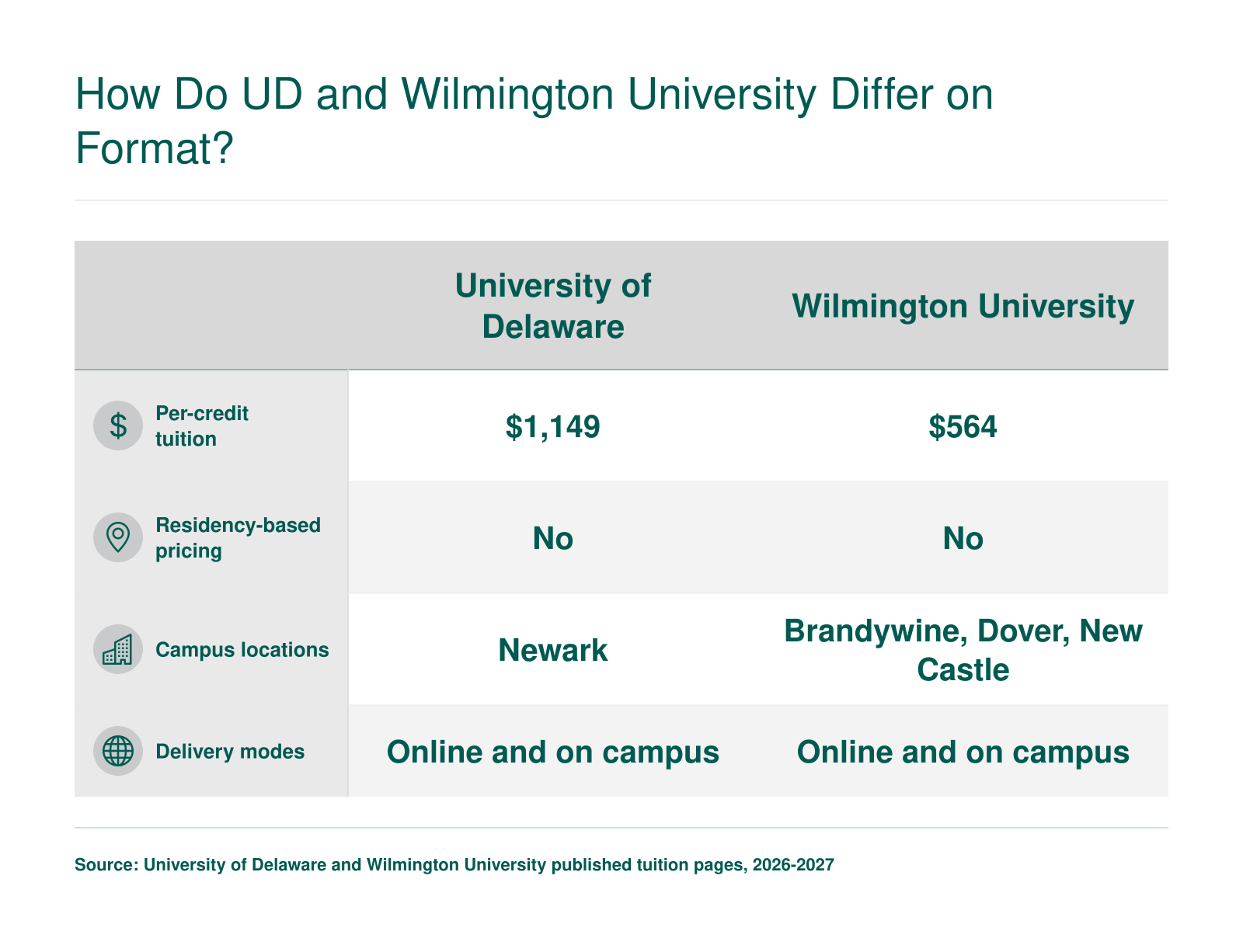
How Do UD and Wilmington University Differ on Format?
The University of Delaware and Wilmington University publish enough 2026-2027 detail to compare directly. Delaware State University's published calendar shows a conventional fall semester, but its graduate sites, online tuition and evening scheduling are not documented, so it is left out of the grid. In general, UD's semester structure suits a full-time student who can be on the Newark campus. Wilmington's multiple sites and online option suit a working adult, though class schedules vary by program, so confirm them before applying.
Admissions Requirements and GRE Policies at Delaware Graduate Schools
The test-optional wave that reshaped undergraduate admissions has moved firmly into graduate study, and Delaware's schools, many with No-GRE master's programs, have largely followed.
Is the GRE or GMAT required?
For most applicants, the short answer is no. The University of Delaware Graduate College does not require GRE or GMAT scores; applicants may submit them optionally, but the decision rests with each program. That program-by-program control matters, because a handful of competitive or research-heavy tracks at UD still weigh scores heavily even when they are technically optional, while others ignore them entirely. Goldey-Beacom College does not require GRE or GMAT scores for its graduate admissions.1 When a program page says "optional," treat that as an opportunity: a strong score can strengthen a thin file, but a weak one you are not obligated to send.
GPA, deadlines and start terms
A 3.0 undergraduate GPA on a 4.0 scale is the common baseline at the University of Delaware, and that figure is typical across Delaware graduate schools. Programs frequently admit below it with strong professional experience or conditional terms, so read the minimum as a guideline rather than a wall.
Deadline models vary by school:
- University of Delaware: Applications are accepted year-round and reviewed on a rolling basis, with a Fall deadline of August 1 (June 1 for international applicants) and a Spring deadline of January 1 (November 1 for international applicants). Fall and spring starts are both available.
- Rolling vs. fixed dates: Rolling review rewards early applicants, since funding and cohort seats fill as decisions go out. Where a firm priority date applies, submitting ahead of it protects your assistantship and scholarship eligibility.
What else programs ask for
Beyond any scores, expect to assemble a standard set of materials: official transcripts from every institution attended, two or three recommendation letters, a statement of purpose that explains your goals, and a current resume or CV. Field-specific requirements add to that list. Nursing programs generally require an active RN license and sometimes clinical hours; many education tracks, including M.Ed. programs, ask for a teaching certificate or classroom experience; business analytics and similar quantitative programs may expect prerequisite coursework in statistics or calculus.
Verify on the program page
Requirements vary widely within a single university, so a policy that holds for one department will not reliably apply to another. Before you build your application, confirm the GPA floor, test policy, deadlines and supplemental items on the specific program's own page. The general admissions site tells you the institution's defaults; the program page tells you what actually decides your case.
Funding Your Delaware Master's Degree
At the University of Delaware, the College of Education and Human Development guarantees qualifying doctoral students a minimum stipend of $27,000 for nine months and full tuition, but it prioritizes Ph.D. students and offers few master's tuition scholarships. That gap shapes how master's students should plan.
Assistantships at UD and DSU
UD funding is department-based. Full-time students may receive a tuition scholarship plus a stipend for working as a research, teaching or graduate assistant, usually around 20 hours a week. Departments choose recipients on qualifications, and the offer letter spells out the duration and terms. Support is concentrated in research-oriented, full-time programs. In engineering and the sciences, funded students are often doctoral, so a professional or part-time master's student should expect to pay most of the bill.
Delaware State University offers a limited number of graduate research and teaching assistantships each year, generally covering partial tuition plus a stipend. Its named scholarships include Inspire, GAP, Partial Tuition and Full Tuition. Current award sizes and eligible programs vary, so confirm them with the department.
Employer and State Help
Many working students are better served by employer tuition assistance than by an assistantship. Large Delaware employers such as ChristianaCare and the state's financial services firms may have education benefits, but policies differ by role and tenure, so get the details in writing from HR. For teachers comparing M.Ed. programs and for healthcare workers, ask each school about TEACH Grants (which carry a service obligation) and check the Delaware Higher Education Office for state awards. Part-time students in affordable online master's programs may qualify only for a partial award.
Federal Aid After July 1, 2026
File the FAFSA, which opens October 1. Then plan around the federal loan changes that took effect July 1, 2026. Grad PLUS is closed to new borrowers. New graduate borrowers are limited to Direct Unsubsidized loans, capped at $20,500 per year and $100,000 in aggregate (higher caps apply to professional degrees). A pricey program that once could be covered by Grad PLUS may now leave a gap, to be filled by savings, employer money, scholarships or private loans, which typically carry fewer protections.
One Tactic: Ask Before You Apply
Contact the department and your employer before you submit anything. Assistantship and fellowship deadlines often come before admission deadlines. UD's civil engineering fellowship consideration, for example, runs October 1 for spring and February 1 for fall. Ask the graduate coordinator whether master's students receive funding, how many, and when decisions are made. Then ask HR what an employer will cover.
Accreditation and Licensure: Which Delaware Degrees Lead Where
Accreditation determines which Delaware master's degrees can open a license, and the strongest signal is program-level specialized accreditation rather than institutional approval alone.
Institutional Accreditation Comes First
The University of Delaware, Delaware State University, and Wilmington University hold institutional accreditation from the Middle States Commission on Higher Education. That baseline matters because students need it for federal financial aid, credit transfer, and employer recognition. Specialized accreditation is a second layer, not a substitute, and it applies to specific programs or departments.
Where Programmatic Accreditation Is Clear
- Social work: Delaware State University's Master of Social Work is accredited by the Council on Social Work Education and is one of the CSWE-accredited MSW programs. The program has held accreditation since 1986, is offered in Dover, Wilmington, and Georgetown, and has had an online option since 2018; its next CSWE review is June 2028.1
- Nursing: The University of Delaware School of Nursing and Wilmington University's College of Health Professions appear in the CCNE directory.2 That listing does not specify every covered master's track or its exact current status, so confirm your specific NP or nursing program directly.
- Education: The University of Delaware's teacher preparation center and Delaware State University's Professional Education Unit were listed in CAEP's 2024 reporting.3 That reporting is not a 2026 decision, and it does not prove that every education master's qualifies completers for Delaware licensure.
No AACSB or ACBSP accreditation was established for master's business programs at these schools, and no CACREP-accredited counseling master's was identified.
Licensure Is a Separate Step
A degree alone is never the license. Teaching, school leadership, advanced practice nursing, clinical social work, and professional counseling all require additional state approval. CAEP inclusion does not guarantee Delaware educator certification; CCNE listing alone does not guarantee advanced practice nursing eligibility, which depends on the Delaware Board of Nursing, APRN category, and national certification. Delaware State's CSWE-accredited MSW does not by itself satisfy every Delaware LCSW requirement, such as field hours and exam conditions. For professional counseling, no CACREP-based pathway to Delaware licensure is established from these schools in the available research.
Online and Out-of-State Students Should Verify Home-State Rules
Before enrolling, check each program's professional licensure disclosure page if you plan to practice outside Delaware. These disclosures list which states a program meets requirements for, but you should still confirm with your home licensing board. That step matters most for online nursing, education, social work, and counseling tracks, where home-state rules often differ.
Delaware Licensure Snapshot
Career Outcomes and Earnings for Delaware Master's Graduates
University of Delaware general MBA completers report median earnings of $135,799, the highest field-level figure among Delaware institutions with published data. Wilmington University's business administration master's cohort from 2017-2019 reports a median of $95,899, about 7 percent below the national master's median for the same field.1 Delaware State University business administration completers report $64,689 five years after completion.2
Not every figure is apples-to-apples. University of Delaware computer and information sciences data from 2020 shows $88,641, and its registered nursing figure is $75,052, but both are described as salary after graduation rather than strictly master's completers. Delaware State University business administration completers report $64,689 five years after completion, though the credential level is not explicitly limited to master's degrees.2 Delaware State registered nursing reports a median of $84,512 across 66 graduates with the same caveat.2 Delaware State teacher education reports $50,397 across its M.Ed. programs.2 Wilmington's business figure for 2018-2020 graduates is $77,356.1
Where Delaware's Employers Create Demand
Earnings connect directly to who hires in Delaware. Wilmington's banking and credit card operations, including JPMorgan Chase, Bank of America, Capital One, Barclays, M&T, WSFS, and PNC, generate demand for finance, analytics, and business roles, including master's in finance candidates.3 Healthcare and education together account for roughly 129,897 jobs with mean annual wages of $70,890, making them the largest destination for nursing and education master's completers.4 Life sciences, chemicals, advanced manufacturing, state government, and public school districts absorb additional graduate talent.3
Field Usually Outweighs School Name
Across available data, field drives more variation than institution. Delaware State's nursing median ($84,512) exceeds its business median ($64,689) and teacher education median ($50,397).2 For context, University of Delaware's institution-wide average across its master's programs is $82,826, but that mixes fields and uses an average, not a median. A bigger name does not automatically mean higher earnings in every program.
How to Check Your Own Program
College Scorecard covers only federally aided graduates with reported earnings; students without federal aid or reported wages are not included.2 To check a specific program, open College Scorecard, select field of study and credential level, and set the state to Delaware. Compare the earnings interval and cohort size listed with each figure, because one-year, four-year, five-year, and ten-year measures are not equivalent.
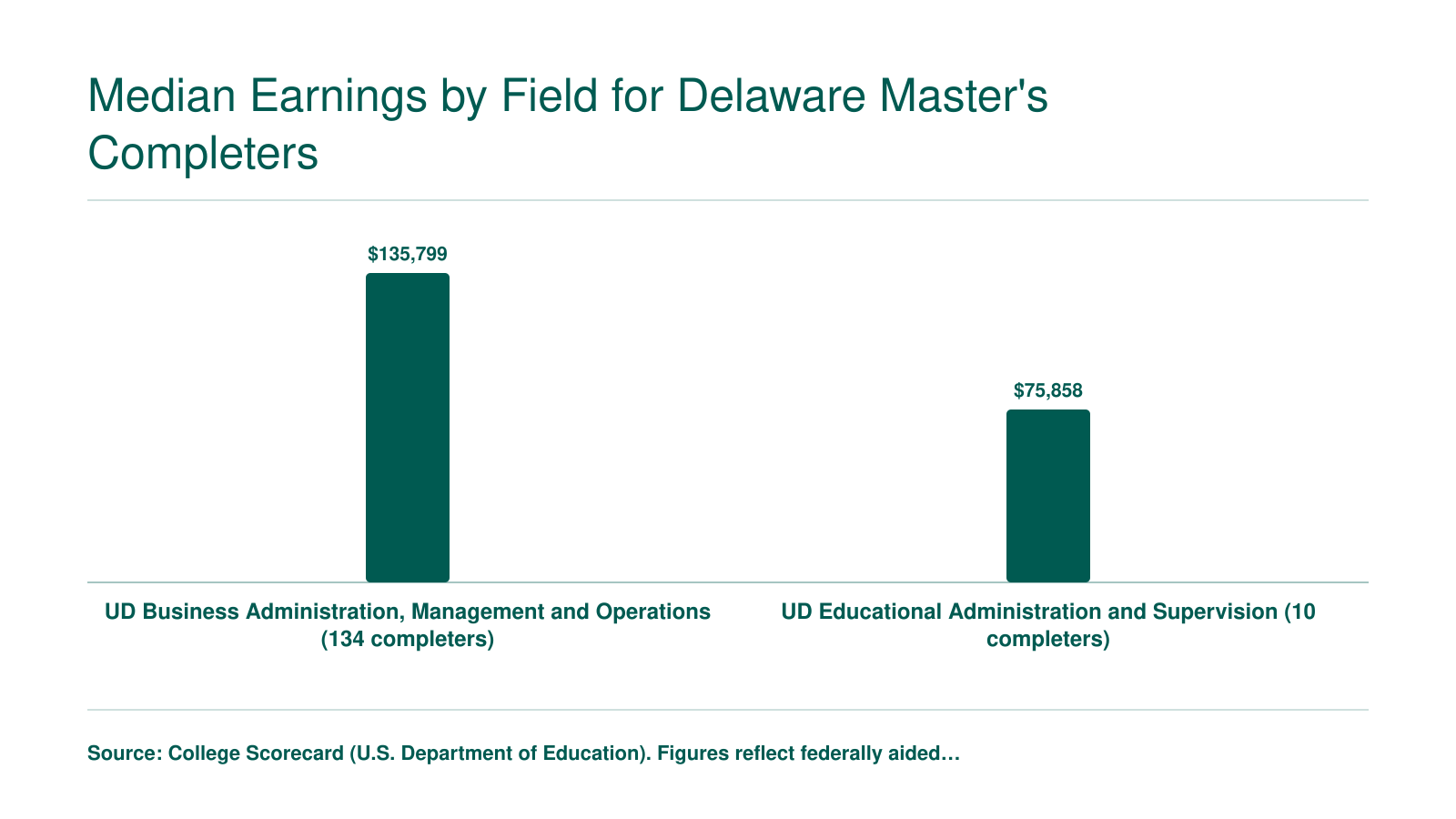
Median Earnings by Field for Delaware Master's Completers
Only two Delaware field-level figures share the same measurement point in the federal data, so this chart compares them at 4 years after completion and does not mix in 1-year or program-average numbers. The educational administration figure rests on just 10 completers, so read it as a rough signal rather than a benchmark. Delaware State University lists several master's fields, but field-specific earnings are not reported for them.
What International Students Should Know Before Applying in Delaware
Can you study for a Delaware master's degree entirely online on an F-1 visa? Generally no. F-1 status requires enrollment at a school certified by the Student and Exchange Visitor Program (SEVP), and federal rules sharply limit how much of a course load can be online. Delaware State University states that it does not issue I-20s for online-only programs.1 Wilmington University runs a separate online international checklist, so confirm directly whether a specific hybrid or online program can support F-1 status before you pay an application fee.3
English Proficiency and Credential Evaluation
UD and DSU both set a TOEFL minimum of 550 paper-based or 79 internet-based. DSU also accepts a 6.5 IELTS, an English Language Institute certificate,1 and conditional admission when proficiency is the only gap.2 UD grants waivers only in strict circumstances, requested by the graduate program. Some UD programs ask for more: the College of Earth, Ocean and Environment recommends 600/100. Wilmington requires proof of English proficiency, but the material reviewed gives no numeric minimum, so check its current packet.3 The sources list TOEFL and IELTS, so ask each school whether Duolingo is accepted.
Credential rules differ:
- DSU: An evaluation from WES, ECE, or GCE, sent directly to the school at least 60 days before enrollment.1
- Wilmington: A course-by-course evaluation from a NACES member, sent directly.3
- UD: Transcripts are required, and individual programs may add their own rules.
OPT, STEM Extension and Proof of Funds
F-1 graduates can usually work in their field through Optional Practical Training (OPT) for up to 12 months. Graduates in STEM-designated fields can apply for a 24-month extension. The sources reviewed do not confirm which Delaware master's programs qualify, so ask the program for its CIP code and check it against the federal STEM list.
To receive an I-20, you must document funding. UD asks for tuition for 18 graduate credits plus fees, health insurance, and living costs, with an affidavit for family or sponsor money. Wilmington adds $3,000 per dependent.4 DSU routes financial documents through its Office of International Affairs. Confirm current dollar figures with each school.
Delaware's location between Philadelphia and Baltimore also puts internships and employers within reach of campus, which matters when you are building a post-graduation work plan.
Graduate schools in Delaware with the most master's programs
| School | City | Type | Master's programs | Online | Grad tuition / yr |
|---|---|---|---|---|---|
| University of Delaware | Newark | Public | 82 | 28 | $20,304 |
| Wilmington University | New Castle | Private nonprofit | 62 | 60 | $9,726 |
| Delaware State University | Dover | Public | 29 | 28 | $9,114 |
| Strayer University-Delaware | Wilmington | Private for-profit | 25 | 25 | $15,135 |
| Goldey-Beacom College | Wilmington | Private nonprofit | 22 | 11 | $10,980 |
Program counts are the verified master's listings in our directory; tuition is the school-wide average for a full-time graduate student (IPEDS).
Frequently Asked Questions About Master's Programs in Delaware
These answers cover the questions applicants ask most often. Policies change and often vary by program, so confirm details with the department you plan to apply to.
How much does a master's program cost in Delaware?
Is the GRE required for master's programs in Delaware?
Can Delaware residents get in-state rates for a graduate program in a field Delaware doesn't offer, such as through the SREB Academic Common Market?
Does Delaware offer accelerated bachelor's-to-master's (4+1) pathways for current undergraduates?
Will credits from one Delaware graduate program transfer to another?
Compare programs nationwide
Many Delaware residents study online. Every ranked list above has an online lens, or browse every field.
Online master's programs Browse all fields