Best Master's in Finance Programs
Compare 340+ accredited Finance programs at 290+ schools, with graduate earnings, cost, debt, and completion data from IPEDS and the U.S. College Scorecard.

A master's in finance does not need a famous name to pay off, and the price spread shows why. Total program tuition runs from $15,338 at Florida State to $74,618 at Notre Dame, and both feed graduates into investment management and corporate finance.
The practical question is which programs deliver strong pay without excessive cost. Federal College Scorecard figures on net price and debt, rather than reputation surveys, point repeatedly toward public universities such as Florida, Maryland, and Baruch.
One caveat: program-level earnings for finance are not yet published, so cost and STEM status carry more weight than usual.
Key Points
- Vanderbilt Owen's 2026 MSF budget totals $110,431, the only complete one-year figure we found.
- Federal data does not yet publish program-level earnings, so cost and format drive our rankings.
- In GMAC's 2025 survey, 52% of U.S. Master of Finance programs reported application declines.
The 10 Best Master's in Finance Schools 2027
These 10 finance master's programs stand out for verifiable outcomes, from graduate earnings to net price and debt. The list spans fully online, hybrid, and campus options at public and private universities, so you can compare format and cost before applying. Each entry highlights the school's strongest metric so the ranking stays grounded in what students actually experience.
Harvard University
#1Cambridge, MA · $55,000 – $60,000/yr (est.)
Best for: Working professionals needing hybrid flexibility
Harvard's finance master's is built for working professionals who need a serious finance education without leaving their jobs. The hybrid format combines 11 online courses with a short Cambridge residency, and admission is performance-based, letting you earn your way in through foundational courses. Graduates report a median salary of $111,894 one year after completion, with alumni at firms like Bain Capital and Bank of America.
- Complete in anywhere between 2 and 5 years
- 12 total courses: 11 online plus a short on-campus residency
- Performance-based admissions: pass foundational courses to qualify
- Stackable certificates in corporate finance, data analytics, or real estate
- 80% of students work full time while enrolled
- Tuition $3,580 per course
CUNY Bernard M Baruch College
#2New York, NY · $11,000 – $21,000/yr (est.)
Best for: Budget-conscious New York finance career starters
Baruch's Zicklin School offers a Manhattan-based MS in Finance with resident graduate tuition around $7,500 and a net price near $3,000 after aid, making it a rare affordable option in the New York finance market. Fully online and part-time paths are available, and the STEM-designated curriculum aligns with CFA and FRM exams. Graduates report a median salary of $121,670 four years after completion.
- 30 total credit hours, full-time and part-time options
- Fully online option available
- STEM-designated degree with 24-month OPT
- 2 concentration options
- Prepares for CFA and FRM exams
- Graduate internships in finance
University of Florida
#3Gainesville, FL · ~$13,000/yr (est.)
Best for: Current UF undergraduates combining degrees
The Hough MS in Finance at the University of Florida is built largely for current UF undergraduates through a combination pathway that lets them start graduate work before finishing the bachelor's. Students manage a real portfolio, work in the Capital Markets Lab with Bloomberg terminals, and choose among corporate finance, financial markets, or investments tracks. Graduates earn a median of $116,367 one year after completion, and the curriculum carries CFA University Affiliation.
- 32 total credit hours
- 3 concentration options
- No entrance exam required
- 98% job placement rate
- Capital Markets Lab with Bloomberg terminals and Capital IQ
- 16 grad credits before bachelor's through combination pathway
- Internship after junior year
University of Maryland-College Park
#4College Park, MD · ~$18,000/yr (est.)
Maryland's Smith School offers a focused Master of Finance with a Corporate Finance concentration that emphasizes valuation, M&A, and AI-driven modeling. Students work on applied projects with firms like Capital One, Deloitte, and Google, and selected students help manage the Smith Global Equity Fund. The 30-credit program reports a median salary of $68,027 one year after completion.
- 30 total credit hours
- Complete in 2 or 3 semesters
- Corporate Finance concentration: M&A, valuation, risk
- Projects with Capital One, Deloitte, and Google
- Selected students manage Smith's Global Equity Fund
- AI woven through the curriculum
- Open to non-business backgrounds
- First round deadline Oct. 15
Florida State University
#5Tallahassee, FL · ~$11,000/yr (est.)
Florida State's MSF gives students hands-on training in a trading room with Bloomberg terminals and FactSet, plus a student-managed fund worth over $11 million. The program offers Corporate Finance and Investment Management and Real Estate tracks, and it is STEM-designated with a summer start. Graduates earn a median of $62,034 one year after completion, and assistantships can include tuition waivers.
- 32 total credit hours, three semesters
- Corporate finance and investment management focus
- Trading room with Bloomberg terminals and FactSet
- CFA and CAIA aligned curriculum
- STEM-designated degree
- $15,338 total program tuition
- Assistantships include tuition waiver
- Real estate concentration
- Careers: real estate analysts, lenders, asset managers
- Test optional: no entrance exam required
- Student-managed fund over $11 million
- Internship can replace in-person course
Columbia University in the City of New York
#6New York, NY · ~$58,000/yr (est.)
Columbia's MS in Financial Economics packs four semesters of PhD- and MBA-level finance coursework into a small, STEM-eligible program. Students work through financial economics, econometrics, machine learning, and data science for careers in sell-side, buy-side, and fintech. The program sits in New York City, with dedicated career management support.
- Four full-time semesters
- PhD and MBA courses at Columbia Business School
- STEM eligible degree
- Machine learning and data science in curriculum
- Small program with dedicated Career Management Center
- Located in New York City
Georgetown University
#7Washington, DC · $60,000 – $65,000/yr (est.)
Georgetown's Master of Science in Finance blends online coursework with in-person residencies in Washington, D.C. and abroad. Students complete a global consulting project and choose between a 21-month part-time track or a 10-month accelerated full-time track. Graduates report a median salary of $110,674 one year after completion.
- 32 total credit hours
- 21-month part-time or 10-month accelerated full-time track
- Three in-person residencies in Washington, D.C. and abroad
- Weekly MSFLive case discussions
- Global consulting project
- 3.0 GPA required to graduate
- Accelerated pathway for Georgetown undergraduates
University of Pennsylvania
#8Philadelphia, PA · ~$48,000/yr (est.)
Penn's MS in Quantitative Finance is a submatriculation track open to Penn undergraduates that leads into a dedicated fifth year of advanced study. The curriculum covers investment management, derivatives, data science for finance, and applied research, with electives in machine learning and risk. Graduates report a median salary of $216,287 one year after completion, the highest published in this list.
- Submatriculation for Penn undergraduates
- Apply during junior year
- Ten graduate course units total
- Core: investment management, derivatives, fixed income, data science
- Electives in machine learning, statistics, real estate analytics
- No transfer or study abroad credit accepted
University of Notre Dame
#9Notre Dame, IN · ~$65,000/yr (est.)
Notre Dame's M.S. in Finance is a STEM-designated, 38-credit program with a quant-heavy curriculum in modeling, valuation, and forecasting. The small cohort of about 48 students learns from Wall Street-seasoned professors across banking, consulting, and private wealth. Program reporting shows every 2025 graduate had a job offer within six months, with an average base salary near $88,765.
- 38 total credit hours
- STEM-designated degree
- Cohort of about 48 students
- Curriculum covers modeling, valuation, forecasting
- Scholarships available regardless of citizenship
- $74,618 total program tuition
Ohio State University
#10Columbus, OH · ~$14,000/yr (est.)
Ohio State's Specialized Master in Business - Finance is a two-semester, STEM-designated program with applied training in Bloomberg, Capital IQ, and Crystal Ball. Students complete a capstone and practicum, and domestic students entering autumn 2026 can finish the final semester online. Graduates report a median salary of $102,531 five years after completion.
- Two-semester program, starts fall
- STEM-designated curriculum
- Capstone and practicum required
- Training in Bloomberg, Capital IQ, and Crystal Ball
- Domestic students can complete final semester online
- OPT work permission up to three years
Cost & outcomes by school
Federal data for the highest-earning Finance programs, independent of the ranking above. Earnings are this field's master's graduates four years after completing, where the Scorecard reports them.
| School | Earnings | Tuition / yr | Debt | Grads/yr | Format |
|---|---|---|---|---|---|
| University of Pennsylvania PA | $316,195 | $47,844 | $41,000 | 2 | Campus |
| Sul Ross State University TX | — | $6,661 | — | — | Campus |
| Worcester State University MA | — | $6,813 | — | — | Campus |
| University of South Dakota SD | — | $7,118 | — | — | Hybrid |
| Wichita State University KS | — | $7,986 | — | — | Hybrid |
| New Mexico Highlands University NM | — | $8,016 | — | — | Hybrid |
| University of North Carolina at Charlotte NC | — | $8,037 | — | — | Campus |
| Abraham Lincoln University CA | — | $8,160 | — | — | Online |
| California State University-Los Angeles CA | — | $8,688 | — | — | Campus |
| Concordia University-Saint Paul MN | — | $8,550 | — | — | Online |
| Columbia College MO | — | $8,477 | — | — | Online |
| The University of Texas Rio Grande Valley TX | — | $8,589 | — | — | Online |
Sources: U.S. Department of Education. Tuition and graduates: IPEDS. Earnings and debt: College Scorecard, this field's master's graduates; a dash means no figure is reported.
Cost, debt & payoff
Median earnings of this field's master's graduates (4 yrs after completing) vs. their median federal loan debt · U.S. College Scorecard
Across these programs the median graduate earns about $113,855 and finishes with roughly $39,725 in debt — a ratio that clears a common rule of thumb (keep debt below first-year salary). Tuition and debt vary widely school to school, so check the per-school figures in the table above before you shortlist.
How We Rank Finance Schools: Outcomes Over Prestige
Our ranking of master's in finance programs compares what graduates actually get for their money: what they earn after finishing, how much they borrow, and what the school costs once aid is applied. Every figure comes from the U.S. Department of Education's College Scorecard, which reports results for specific programs, not just whole universities.
What We Measure
- Earnings: Median earnings for graduates of the finance master's program after completion.
- Debt: Median federal loan debt held by program completers.
- Net price: The average cost of attendance after grants and scholarships.
- Completions: How many students finish the program, which signals its scale and how much weight its outcome data can bear.
Why Outcomes Beat Reputation
Many well-known lists, including best MBA schools rankings, lean on peer surveys, where deans and administrators rate other schools, along with brand recognition. Those measures capture reputation, which changes slowly and tends to favor older, wealthier institutions. They do not tell you whether an MBA in Finance (or any degree costing tens of thousands of dollars) will pay you back. Earnings and debt data answer that question directly. Sometimes a lesser-known public university delivers stronger earnings relative to debt than a famous name, and we would rather show you that than repeat a prestige pecking order.
What the Data Cannot Tell You
Federal outcome data has real limits, and you should read our ranking with them in mind.
- Medians only: You see the midpoint, not the range. Half of graduates earned more, and half earned less.
- Federal aid recipients only: Students who paid out of pocket, had employer sponsorship, or studied as international students (who generally cannot receive federal aid) are not counted. That matters in finance, where international enrollment is often high.
- Missing earnings: Smaller programs may have no published earnings because the graduate count is too low to report. A blank is not a bad result.
- School-wide figures: Net price is an institution-wide average after aid, shaped largely by undergraduate aid patterns, so graduate students may pay more. Graduation rates likewise describe the whole university, not the finance program itself.
Salary Outcomes: Where Finance Graduates Earn the Most
Employment reports from MIT Sloan and Princeton's Master in Finance programs show strong placement: MIT's Class of 2025 posted a 97.1% offer rate within six months, with 85% entering finance roles primarily in quantitative research, trading, and investment banking, while Princeton reports 100% full-time and internship placement for 2026. The earnings figures below are program-level median salaries for the cohort indicated in each row, paired with median debt at completion and the associated 10-year monthly payment so you can weigh payoff against cost.
| Institution | Median earnings (window) | Median debt at completion | 10-year monthly payment |
|---|---|---|---|
| University of Pennsylvania | $384,547 (5 years) | $41,000 | $466 |
| Boston College | $182,242 (5 years) | $41,000 | $466 |
| University of Wisconsin-Madison | $180,896 (5 years) | N/A | N/A |
| Washington University in St Louis | $165,087 (4 years) | N/A | N/A |
| Georgetown University | $149,302 (5 years) | $74,347 | $846 |
| CUNY Bernard M Baruch College | $148,843 (5 years) | N/A | N/A |
| Bentley University | $143,094 (5 years) | $20,500 | $233 |
| Harvard University | $142,601 (5 years) | $28,268 | $322 |
| University of Florida | $142,122 (5 years) | N/A | N/A |
| University of Southern California | $135,370 (5 years) | N/A | N/A |
Master's in Finance Costs: Tuition, Net Price, and Total Attendance by School
Published program stickers for a master's in finance vary sharply: Purdue's in-state total is about $26,136 while Boston University's nine-month track has a published total cost of attendance of $100,260, and USC Marshall's 36-credit program totals $94,872. Those figures are sticker totals before grants, assistantships, or any aid; the institution-wide average net price is what students actually paid after all grant aid, and for the schools ranked here it ranges from about $3,000 at CUNY Baruch to roughly $17,300 at Ohio State. Net price is an average across all students at the university, not a guarantee for any individual finance student, so compare it with the per-credit and total program figures below.
| School | Residency / Audience | Per-Credit Tuition | Total Program Cost | Total Cost of Attendance |
|---|---|---|---|---|
| Boston University Questrom (9-Month Track) | All students | N/A | $74,272 | $100,260 |
| Boston University Questrom (16-Month Track) | All students | N/A | $88,089 | N/A |
| Purdue University | Indiana residents | $726 | $26,136 | N/A |
| Purdue University | Out-of-state students | $1,028 | $37,008 | N/A |
| Purdue University | International students | $1,400 | N/A | N/A |
| Middle Tennessee State University Online | In-state | $772 | $23,476 | N/A |
| Middle Tennessee State University Online | Out-of-state | $1,871 | N/A | N/A |
| George Mason University | Virginia, D.C., and Maryland residents | $1,025 | N/A | N/A |
| George Mason University | Out-of-state and international students | $1,400 | N/A | N/A |
| USC Marshall | All students | $2,541 | $94,872 | N/A |
| American Public University System Online | All students | $470 | $16,805 | N/A |
| University of Oklahoma Online | All students | $1,015 | $32,480 | N/A |
| George Washington University | All students | N/A | $111,500 | N/A |
| Purdue Global Online | All students | $485 | N/A | N/A |
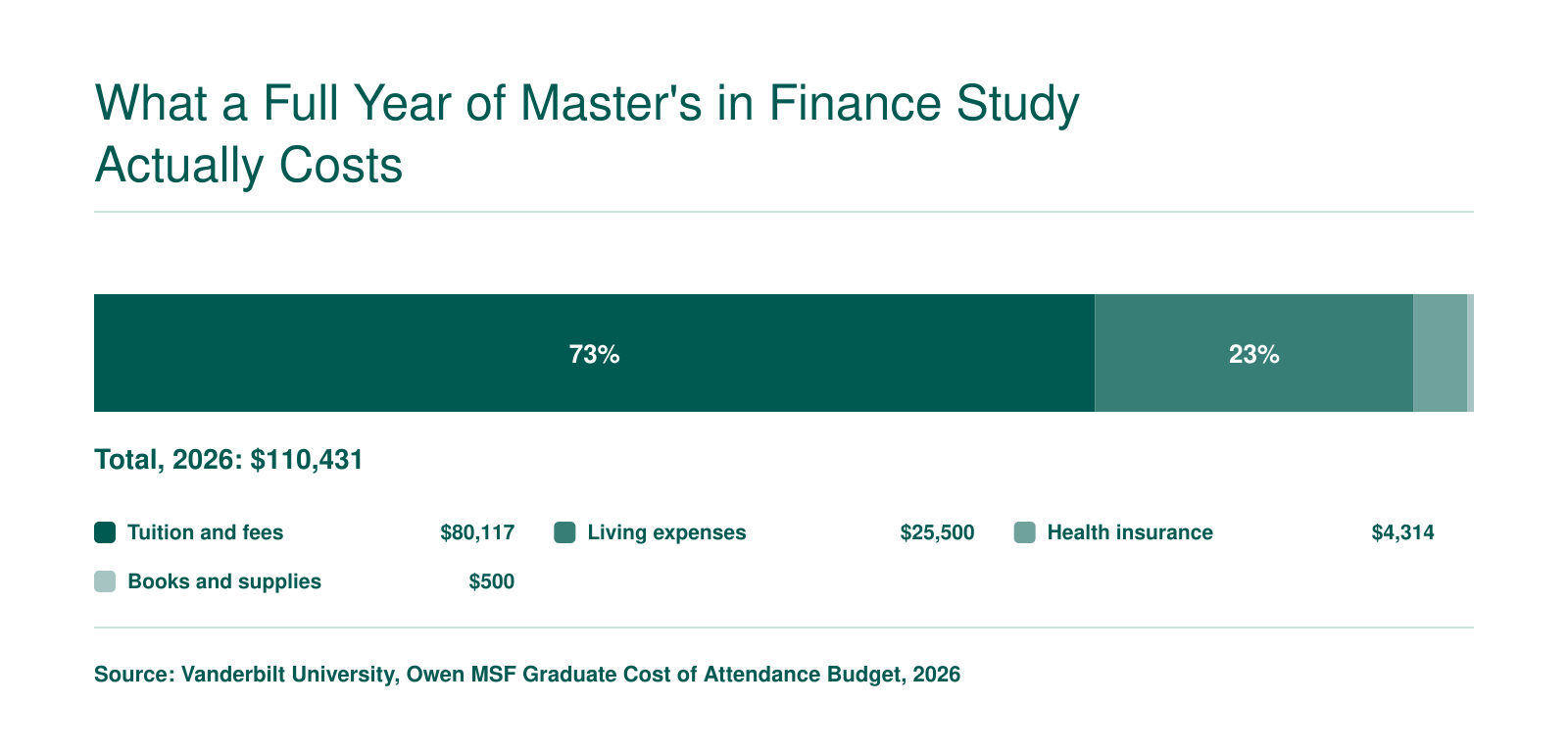
What a Full Year of Master's in Finance Study Actually Costs
Vanderbilt Owen's MSF budget for 2026 is the only complete official one-year figure we found. It totals $110,431, and the sheet notes that it rests on a projected 2026 increase, so actual amounts may vary slightly. Living expenses add roughly 32% on top of tuition and fees alone, and about 38% once health insurance and books are included. Housing and food are combined in a single living expenses line, and transportation and personal costs are not itemized separately. MIT Sloan and WashU Olin publish tuition and fees but no comparable full budget.
Related Articles
STEM-Designated Master's in Finance Programs and What They Mean for OPT
A STEM-designated master's in finance is a program the university has classified under a federal instructional category that appears on the Department of Homeland Security's list of STEM fields. The label has nothing to do with how mathematical the coursework feels day to day. It is a code on paper, and that code is what determines whether an international graduate on an F-1 visa can stay and work in the United States for one year or three.
Quantitative finance, financial engineering, financial mathematics, and econometrics or quantitative economics designations are the ones that typically carry STEM eligibility. Arizona State's W. P. Carey Master of Science in Finance, for instance, is STEM-eligible under a general finance code (52.1301)8 rather than a quant-specific one, which shows that a STEM classification does not always come from the category you would expect.
The Work-Authorization Math
Standard post-completion Optional Practical Training gives any eligible F-1 graduate 12 months of work authorization. A STEM-designated degree allows a 24-month extension on top of that, for up to 36 months total. That extra time is the entire point for most international students: three years spanning three H-1B lottery cycles instead of one, which materially improves the odds that an employer's sponsorship attempt eventually lands.
The extension comes with conditions. Your employer must be enrolled in E-Verify and have a valid federal employer identification number2, must sign Form I-983 documenting a training plan, and must report early termination to your designated school official (within 48 hours, per common university guidance)4. The job has to be paid, at least 20 hours per week, and directly related to the qualifying degree1. You must stay under 90 days of unemployment3 and file validation reports every six months4. As of August 1, 2026, a $250 processing fee applies to OPT and STEM OPT filings3. The qualifying degree can also be an earlier STEM degree conferred within the past 10 years, not only the one you just finished3.
Verify the Code, Not the Brochure
Several well-known programs carry the designation. Northeastern's MS in Quantitative Finance5, Vanderbilt's nine-month MS in Finance6, and George Mason's MS in Finance7 are all STEM-designated. Coastal Carolina has proposed an MS in Finance under a financial analytics code9, though as a 2026 proposal its status is not settled.
Here is the part applicants skip: classification codes are program-specific and can change without any update to the marketing page. Before you commit a deposit, confirm the code printed on your I-20 against the current DHS STEM Designated Degree Program List. An admissions page that says "STEM-designated" is a claim. The I-20 is the document immigration officers actually read.
Admissions: GMAT/GRE, Work Experience, and Application Deadlines
Requirements for the 2026–27 cycle vary more than most applicants expect. Testing rules in particular range from mandatory to not accepted for consideration at all. Confirm every detail on the program's own page before you apply.
- Degree, coursework, and GPAA bachelor's degree is the baseline, and Boston University Questrom specifies a four-year degree. Quantitative preparation matters. USC Marshall requires BUAD 306 and BUAD 308 for non-Marshall majors and a 3.0 cumulative GPA. Illinois Institute of Technology also lists a 3.0 minimum. Golden Gate University considers bachelor's degrees from regionally accredited U.S. schools or foreign equivalents.
- GMAT/GRE policyChicago Booth and Georgetown McDonough's online program require a GMAT or GRE and show no preference between them. Illinois Gies, BU Questrom, and Emory Goizueta make scores optional. USC Marshall, IIT, and Golden Gate do not require them. Houston Bauer's online program waives scores only for qualifying UH undergraduates with a 3.6 GPA, and a waiver does not guarantee admission.
- Work experience and formatReliable average-experience figures are not published for most programs here. USC Marshall is a pre-experience route, open even to juniors and seniors. Online formats such as Georgetown and Houston are structured differently and are not directly comparable to residential programs. Career switchers should check each program's stated prerequisites.
- Deadlines and roundsDates for this cycle include Chicago Booth (October 1, now passed), Emory (October 14), BU Questrom (October 20), and USC Marshall (November 1). Complete round schedules are not confirmed for every program, so verify later-round dates directly.
- International applicants and materialsIIT notes English proficiency requirements where applicable, and minimum TOEFL, IELTS, or Duolingo scores differ by school. Expect a resume and, at some programs, a statement of purpose.
What Employers Expect to Pay Master's in Finance Hires
GMAC does not report a separate U.S. median for master's in finance hires. The closest benchmark is its figure for non-MBA business master's hires, a category that includes finance.
Master's in Finance vs. MBA in Finance vs. European Mif
The real decision is whether to buy technical depth at the start of a career or a broader leadership credential after management experience. The three formats serve very different moments, and the cheaper or shorter option is not automatically the better financial decision once opportunity cost and visa runway are included.
U.S. Master's in Finance: a pre-experience specialist degree
A U.S. master's in sustainability no GRE is usually a 9 to 18 month degree aimed at recent graduates.1 Work experience is rarely required, and students often land in analyst roles in corporate finance, investment banking, risk, or fintech. Cohorts skew toward students in their early 20s. Program length varies widely: UT Austin's track is 10 months, MIT Sloan's runs 12 to 18 months, and some options reach 24 months. Many leading U.S. MSFs are STEM-designated, which can let F-1 students combine 12 months of OPT with a 24-month STEM extension for up to 36 months of post-study work, subject to immigration and employment requirements. Reported starting salaries are not directly comparable across schools, but several U.S. programs in the guide publish ranges from roughly $110,000 to $160,000. Total cost can be far lower than an MBA, with examples from about $48,000 to $122,000 before living expenses.1
MBA with a finance concentration: a two-year leadership investment
A full-time MBA typically lasts about two years and expects 3 to 6 years of work experience. Students are usually in their late 20s or early 30s. The finance concentration is one track inside a broader master's in management degree, not a specialist finance credential. The financial tradeoff is steep: annual tuition alone may be $80,000 to $84,000, and total program cost can run from $310,000 to $420,000, before forgone salary. That lost income is the largest hidden expense. STEM OPT is not automatic for every MBA; non-STEM F-1 students generally have 12 months of OPT, while STEM-designated MBA tracks may reach 36 months. The MBA suits mid-career professionals who want to move into leadership, corporate development, or senior finance roles, not entry-level analysts.
European MiF: short, international, and visa-sensitive
European pre-experience Masters in Finance such as LSE, HEC Paris, and London Business School are generally 10 to 12 months. LSE's MSc Finance is 10 months. Tuition is quoted in euros or pounds and often separates home and overseas rates, so direct cost comparisons are difficult. Post-study work depends on the country. Under the UK Graduate Route, eligible international graduates can stay and work without sponsorship, and those applying before January 2027 can get two years; from January 2027 the taught master's grant drops to 18 months. The route does not require a job offer but it is not permanent, and graduates must switch to a Skilled Worker or other route to stay longer. EU countries have no single post-study visa, and rules differ by member state.
Which path fits you
Choose a U.S. MSF if you want specialist finance training right after undergrad and value up to 36 months of U.S. STEM OPT. Choose an MBA with a finance concentration if you have several years of experience, can absorb two years of tuition plus lost salary, and want a leadership pivot. Choose a European MiF if you want a short, finance-intensive course in London or continental Europe and can move quickly between visa systems. None is universally better: the right choice depends on when you need the credential and where you want to work afterward.
Demand for U.S. Demand for U.S. master's in finance programs is more uneven than the field's popularity suggests. In GMAC's 2025 Application Trends Survey, 44% of U.S. Master of Finance programs reported application growth, while 52% reported declines. The median program received just 131 applications, so admissions competition varies widely from school to school.
Finance programs by state
Master's in Finance FAQs
These answers draw on the school-reported outcomes and program details behind the rankings above. Where data is limited or varies by program, we say so, and you should confirm current figures with each school before applying.
Which master's in finance programs have the highest starting salaries?
Do I need work experience for a master's in finance program?
Are online master's in finance degrees worth it?
Can I get into a master's in finance without a finance or economics undergraduate degree?
Does a master's in finance help prepare for the CFA exams?
Compare Finance programs on the data that matters
Explore more Business & Management specializations or browse every graduate field.
All Business & Management programs