Best Master's in Finance Programs in Florida
Compare 24 accredited Finance programs in Florida at 19 schools, with graduate earnings, cost, debt, and completion data from IPEDS and the U.S. College Scorecard.

A Florida resident can finish a master's in finance at a public university for roughly $12,700 in graduate tuition; the same credential at the University of Miami lists about $46,870. Format widens the spread further, with campus cohorts, synchronous evening hybrids, and fully asynchronous online tracks all in play.
The tension is that employers in Miami and Tampa screen for CFA progress, Bloomberg certification, and internship record, none of which track neatly with what you paid to earn the degree.
Key Points
- FIU lists about $30,000 total tuition for Florida residents, a useful budgeting benchmark.
- Florida International, Florida Atlantic, and Nova Southeastern each offer a fully online master's in finance.
- CFA and CFP are national credentials; Florida securities work requires FINRA exams, not a state degree.
Best Master's in Finance Schools in Florida: The Top 10 Rankings
What separates the top tier of Florida's finance master's programs in 2026 is a mix of strong institution-wide graduation rates, accessible public-school tuition, and flexible delivery that lets working students finish in about a year. Cards below show whether each program meets on campus, online, or both, along with concentrations, and the school's overall graduation rate is the share of all students it graduates, not the finance program's own completion rate. Check each program's page for current tuition, since per-credit and flat-rate pricing differ widely.
University of Florida
#1Gainesville, FL · ~$13,000/yr (est.)
Best for: Current UF undergraduates fast-tracking graduate study
The University of Florida's Hough MS in Finance is built largely for current UF undergraduates through a combination pathway, with 16 graduate credits earned before the bachelor's degree. Hands-on work includes an Asset Allocation Project managing a real portfolio and a Capital Markets Lab with Bloomberg terminals and Capital IQ. The university graduates 91% of its students overall, and in-state tuition is low for a flagship public school.
- 32 total credit hours with three concentration options
- Concentrations in corporate finance, markets and institutions, or investments
- Asset Allocation Project managing a real portfolio
- Capital Markets Lab with Bloomberg terminals and Capital IQ
- Internship after the junior year in the combination pathway
- Campus-based, with prerequisite courses required
- Careers in investment banking, corporate finance, and asset management
Florida State University
#2Tallahassee, FL · ~$11,000/yr (est.)
Best for: Real estate finance specialists
Florida State's Master of Science in Finance is a 32-credit, three-semester cohort program with a STEM designation and a student-managed investment fund of more than $11 million. Students work in a trading room with Bloomberg terminals and FactSet, and can choose between a Corporate Finance and Investment Management track and a Real Estate track. The program admits once a year in summer, and assistantships that include a tuition waiver are available. Florida State graduates 86% of its students overall.
- 32 credits over three semesters, cohort-based
- Covers equity valuation, fixed income, derivatives, crypto, and fintech
- Student-managed investment fund worth more than $11 million
- Bloomberg terminals and FactSet workstations
- STEM-designated degree
- Starts each summer; GMAT and GRE are optional
- Real estate concentration within the same 32-credit MSF
- Careers as real estate analysts, lenders, and asset managers
- Internship can replace an in-person summer course
- Three letters of recommendation and prerequisite courses required
Florida International University
#3Miami, FL · ~$11,000/yr (est.)
Best for: Working professionals wanting online flexibility
Florida International University's Master of Science in Finance is a 12-month, cohort-based program that can be completed in person at the MMC Campus and FIU Brickell or fully online, with Spring and Fall starts. It is a CFA Institute University Affiliation Program and prepares students for Level I of the CFA exam. Tuition is about $30,000 for Florida residents and $33,600 for non-residents. The university graduates 74% of its students overall.
- 12-month cohort program on weekday evenings and Saturdays
- Campus classes at MMC Campus and FIU Brickell
- Fully online option available
- Bloomberg Certified, with access to the Bloomberg Lab
- Dedicated career services and interview coaching
- Fully online, completed in 12 months
- Covers fintech, Python coding, and big data
- Spring and fall starts
- CFA Level I exam preparation
- Campus-based concentration at the Modesto Maidique Campus
- Fall and spring starts
- Tuesday and Thursday evening or Friday evening and Saturday classes
- Campus-based concentration; three concentration options in total
- Classes at Modesto Maidique Campus and the Brickell facility
- Fall (August) and spring (January) starts
University of South Florida
#4Tampa, FL · ~$10,000/yr (est.)
The University of South Florida in Tampa offers an MS in Financial Analytics that blends analysis, investments, and planning in a STEM-designated, hybrid format. Full-time students often finish its 30 credits in three semesters, while part-timers can spread the work out. The university graduates 77% of its students overall.
- 30 credit hours, often finished in three semesters
- Financial Analysis concentration among four options
- Mix of on-campus and online coursework
- STEM-designated, with OPT of up to 36 months for eligible international students
- Full-time and part-time options
- GMAT or GRE waiver with a 3.5 GPA
- Prepares for CFA, CFP, and CFM credentials
University of Miami
#5Coral Gables, FL · ~$47,000/yr (est.)
The University of Miami's Master of Science in Finance is a STEM-designated, one-year program that lets students tailor study through course clusters such as Financial Analytics, Fintech, Corporate Finance, and Wealth Management. A Bridge to MSF helps students without a finance background, and an online version is available. The school sits in a major international banking hub and graduates 84% of its students overall.
- One-year program, full-time or part-time
- Nine concentration options through customizable course clusters
- Bridge to MSF for students without a finance background
- Fall and spring starts
- Located near more than 60 international banks
- 16-month online format with 33 credit hours
- Starts in fall, spring, or summer
- Test optional, with one letter of recommendation
- Cohort-based, with a personal statement of up to 600 words
- Curriculum integrates modeling and data analytics
Florida Atlantic University
#6Boca Raton, FL · $7,000 – $18,000/yr (est.)
Florida Atlantic University in Boca Raton runs a 16-month MSF with Monday and Wednesday evening classes in eight-week terms. Students can attend in person or live online, which suits working professionals across South Florida. A Bloomberg-equipped trading room and a finance boot camp round out the program. The university graduates 63% of its students overall.
- 16-month program with fall and spring starts
- Evening classes Monday and Wednesday in eight-week terms
- Attend in person or through synchronous online sessions
- Trading room that replicates real trading
- Bloomberg Certification included
- Finance boot camp for incoming students
- Careers in investment banking and hedge funds
The University of Tampa
#7Tampa, FL · ~$13,000/yr (est.)
The University of Tampa's Master of Science in Finance offers a Financial Analysis track that follows the CFA curriculum and a Quantitative Analysis track focused on data analytics. Classes meet during the day, at night, or on weekends, full time or part time, and the Sykes College of Business has a Bloomberg-equipped trading center. The university graduates 64% of its students overall.
- Two tracks: Financial Analysis and Quantitative Analysis
- STEM-approved program
- Full-time and part-time options
- Day, night, and weekend classes
- 16 hours of electives, including fintech and machine learning for finance
- GMAT waivers available
- Bloomberg real-time trading center
Nova Southeastern University
#8Fort Lauderdale, FL · ~$25,000/yr (est.)
Nova Southeastern University's M.S. in Finance combines core finance with math, statistics, data science, and AI in a STEM-designated program. It takes as little as 18 months, with weeknight classes in Fort Lauderdale/Davie or asynchronous online study. Alumni and employer partners can access tuition discounts. The university graduates 63% of its students overall.
- 18-month program, 30 to 42 credits
- Weeknight classes at the Fort Lauderdale/Davie campus or online asynchronously
- Six electives chosen to fit career goals
- STEM-designated, with up to three years of OPT for eligible international students
- 20% alumni tuition discount
- Up to 20% employer tuition discount
Millennia Atlantic University
#9Doral, FL · ~$13,000/yr (est.)
Millennia Atlantic University in Doral offers a Master of Science in Global Finance focused on cross-border decision-making. The 36-credit program usually takes 18 to 24 months and covers portfolio management, international markets, currency exposure, and mergers and acquisitions. It suits working professionals who want an international finance emphasis on a campus in Miami-Dade County.
- 36 credit hours, usually 18 to 24 months
- Courses on mergers and acquisitions and currency exchange exposure
- Covers International Financial Reporting Standards
- Capstone on a real global financial issue
- Internship option with 135 supervised hours
- Classes held on campus in Doral
- Some courses offered online in Spanish
Embry-Riddle Aeronautical University-Daytona Beach
#10Daytona Beach, FL · ~$23,000/yr (est.)
Embry-Riddle's Master of Science in Aviation Finance, in the O'Maley College of Business in Daytona Beach, is a specialized pick for students who want to apply finance in airlines and aerospace. It takes 33 credits and includes an optional ISTAT University certificate. The university graduates 67% of its students overall.
- 33 total credit hours
- Aviation management courses plus Managerial Finance and Investments
- Four open electives to customize study
- ISTAT University certificate available within the degree
- In person at the Daytona Beach campus
- Roles such as flight revenue analyst and international pricing analyst
Cost & outcomes by school
Federal data for the highest-earning Finance programs, independent of the ranking above. Earnings are this field's master's graduates four years after completing, where the Scorecard reports them.
| School | Earnings | Tuition / yr | Debt | Grads/yr | Format |
|---|---|---|---|---|---|
| University of Florida FL | $173,875 | $12,737 | — | 49 | Campus |
| University of Miami FL | $112,491 | $46,870 | — | 44 | Campus |
| Florida International University FL | $109,647 | $11,334 | $30,705 | 77 | Campus |
| Florida State University FL | $101,223 | $10,553 | $27,096 | 38 | Campus |
| Florida Atlantic University FL | $99,143 | $6,693 | — | 20 | Hybrid |
| The University of Tampa FL | $82,637 | $13,240 | — | — | Campus |
| Herzing University-Orlando FL | — | $9,370 | — | — | Online |
| Herzing University-Tampa FL | — | $9,190 | — | — | Online |
| DeVry University-Florida FL | — | $9,832 | — | — | Online |
| Embry-Riddle Aeronautical University-Worldwide FL | — | $10,057 | — | — | Campus |
| Saint Leo University FL | — | $12,870 | — | — | Online |
| Schiller International University FL | — | $14,400 | — | — | Campus |
Sources: U.S. Department of Education. Tuition and graduates: IPEDS. Earnings and debt: College Scorecard, this field's master's graduates; a dash means no figure is reported.
Cost, debt & payoff
Median earnings of this field's master's graduates (4 yrs after completing) vs. their median federal loan debt · U.S. College Scorecard
Across these programs the median graduate earns about $109,647 and finishes with roughly $30,705 in debt — a ratio that clears a common rule of thumb (keep debt below first-year salary). Tuition and debt vary widely school to school, so check the per-school figures in the table above before you shortlist.
How We Rank Florida Master's in Finance Programs
Federal data now lets applicants compare master's in finance programs on outcomes rather than reputation, and that is the lens we use here.
We look at four things:
- Graduate tuition: the published price of the degree itself.
- Net price: the average cost after grant aid, as the federal government reports it.
- Graduation rate: the share of students who finish at the institution.
- Earnings and debt: College Scorecard figures for the specific program, where they are published.
Two caveats matter. Net price is a school-wide average, not a quote for your situation, and graduation rates cover the whole institution, not the finance program alone.
Program-level earnings matter more than a famous name because they show what graduates of that degree actually make. Many Master's Programs in Florida have no published figure, usually because cohorts are too small to report without identifying individuals. When a number is missing, we leave it out rather than guess.
Online and Hybrid Master's in Finance Options in Florida
Across Business & Management Master's Programs, several schools ranked here deliver the degree online or in a hybrid format, so you can keep working while you study. Florida International, Florida Atlantic, and Nova Southeastern each offer a fully online option, while Florida State runs its first required course fully virtual and asynchronous. The rest, including the University of Florida, are built around on-campus attendance; the University of Miami's MS in Finance is delivered online.
As with MBA in Florida options, delivery styles differ in ways that matter for a full-time schedule:
- Florida Atlantic: Synchronous live-virtual classes on weeknights, so you attend in real time alongside the cohort.
- Nova Southeastern: Asynchronous online coursework you complete on your own pace, which suits unpredictable work hours.
- Florida International: A fully online option delivered on evenings and Saturdays over a 12-month cohort.
Florida International lists the same program total for its online and in-person tracks, so remote study does not add cost. If you want flexibility, an asynchronous program like Nova's fits full-time workers best; a live-virtual format keeps cohort networking intact. Confirm current residency and pacing details directly with each school.
Related Articles
GMAT and GRE Policies at Ranked Florida Master's in Finance Schools
FIU sets a GMAT minimum of 500 (or an equivalent GRE score), yet it also admits applicants with four years of finance-related work experience or a qualifying business degree with a 3.0 GPA. Policies vary widely across the schools here, so verify each on its current admissions page.
- Test required, with exceptions: The University of Tampa asks for the GMAT or GRE but offers waivers, without publishing criteria in what we reviewed. The University of Miami requires a score for its standard program, with case-by-case waivers through a BusinessCAS opt-out and a one-page summary. Its online master's programs list scores as optional.
- Optional or waivable: FAU waives scores for a business degree with a 3.0 upper-division GPA plus four years of industry experience, for an FAU finance, economics, or accounting degree at that GPA, or for an advanced degree. USF's listing cites a 3.5 GPA waiver and a CFA Level I waiver. FSU's listing shows test optional.
- No clear published policy: UF, Nova Southeastern, Millennia Atlantic, and Embry-Riddle. We could not confirm a policy, so we won't guess.
Expect a bachelor's degree, a GPA near 3.0, and sometimes prerequisite coursework such as calculus, statistics, accounting, or finance. If you are exploring master's programs with no GRE required, a strong GMAT or GRE can still strengthen a modest GPA.
A school's brand tells you little about what you'll earn or owe. Program-level earnings and debt show whether a master's in finance actually pays off.
Cost of a Master's in Finance in Florida: Tuition Comparison
The table runs from lowest to highest average net price. Where schools publish a total program cost (per-credit rate times required credits), that figure is the better budgeting number: FIU lists about $30,000 for Florida residents and $33,600 for non-residents, and FAU lists 30 credits at $1,000 each, or $30,000. Net price is a school-wide average after aid, so treat it as approximate, and note that Florida residents save substantially at the public universities, while private schools charge one rate to everyone.
| School | Graduate in-state tuition (per year) | Graduate out-of-state tuition (per year) | Average net price (approx.) | Format |
|---|---|---|---|---|
| University of Florida | $12,737 | $30,130 | $6,541 | On campus |
| Florida Atlantic University | $6,693 | $18,482 | $8,752 | In person or live remote |
| Florida International University | $11,334 | $24,439 | $9,288 | In person or fully online |
| University of South Florida | $10,428 | $21,126 | $9,812 | Hybrid |
| Florida State University | $10,553 | $26,707 | $11,297 | On campus |
| Embry-Riddle Aeronautical University-Worldwide | $10,057 | $10,057 | $18,725 | On campus |
| Herzing University-Orlando | $9,370 | $9,370 | $19,850 | Online |
| Herzing University-Tampa | $9,190 | $9,190 | $20,421 | Online |
| Saint Leo University | $12,870 | $12,870 | $21,293 | Online |
| Millennia Atlantic University | $13,256 | $13,256 | $26,879 | On campus |
Florida Certification and Licensing Paths for MSF Graduates
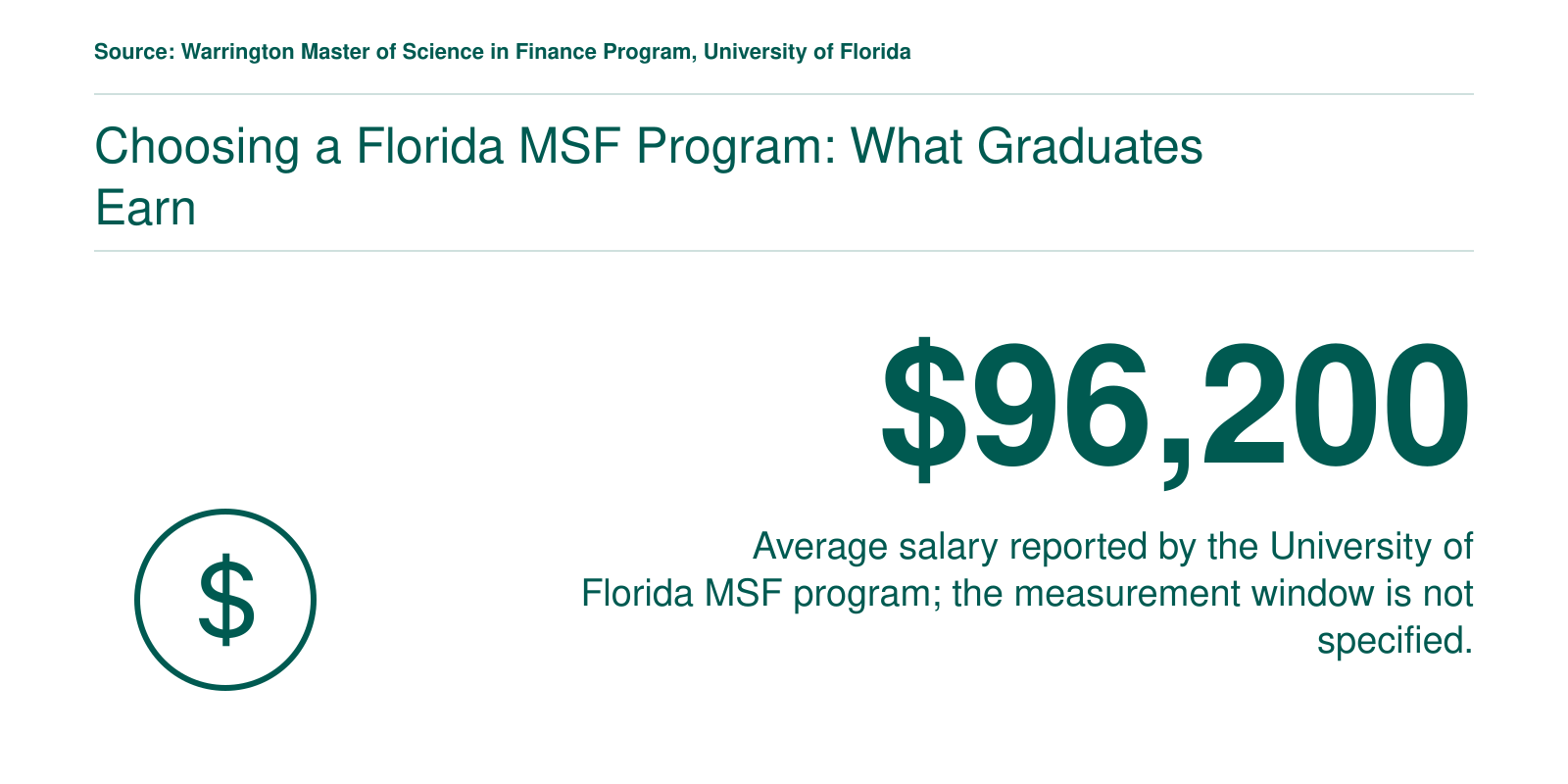
Choosing a Florida MSF Program: What Graduates Earn
Federal program-level earnings and median program debt are not yet published for the finance programs ranked here, so we do not chart them side by side. The one program-reported figure is from the University of Florida, which also cites a 98% job placement rate, though neither number comes with a stated timeframe. Treat both as school-reported claims, and compare them against each program's total cost before judging value.
Frequently Asked Questions About Florida Master's in Finance Programs
Which Florida MSF program is best for investment banking?
Is a master's in finance worth it in Florida?
Are Florida MSF programs STEM-designated, and what does that mean for international students' OPT?
How competitive is admission to Florida MSF programs?
Compare Finance programs on the data that matters
Explore more Business & Management specializations or browse every graduate field.
All Business & Management programs