Master's Programs in Nevada
Every master's program reported by a school in Nevada: 150+ programs at 5 graduate schools, with the online options, costs and outcomes behind each one.

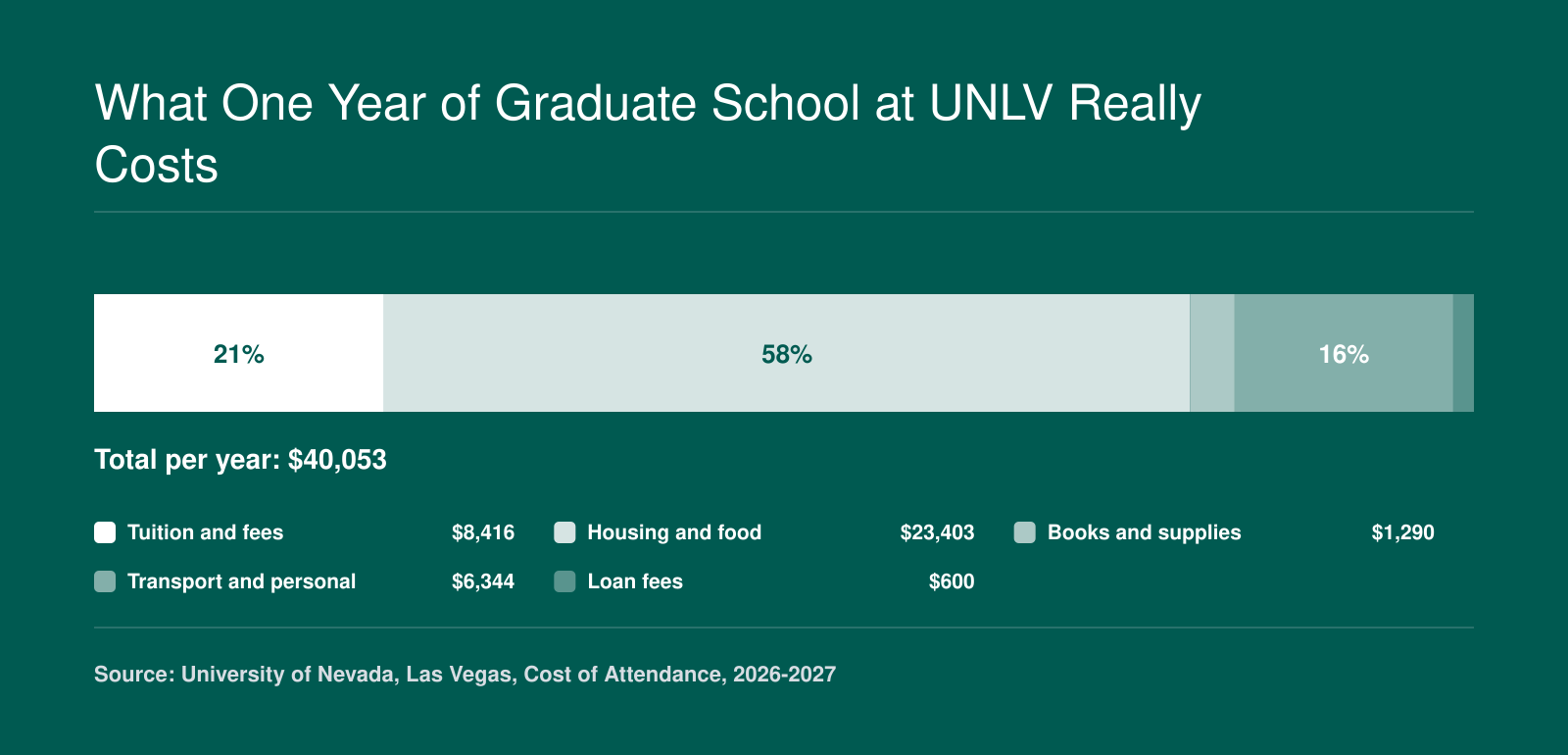
What is the total cost of a master's degree in Nevada once rent is counted? Most students choose among three public universities, UNLV, UNR and Nevada State University, plus a few private schools concentrated in health fields. UNLV's 2026-2027 budget for a resident living off campus reaches $40,053, and housing and food exceed tuition and fees.
Format and funding move that figure more than sticker price does. Online tracks and assistantships can lower it, while counseling psychology, nursing and social work carry accreditation requirements that a cheaper program may not meet. In Nevada, the field you pick shapes your return more than the degree itself.
Key Points
- UNLV's 2026-2027 budget for a resident living off campus totals $40,053.
- Housing and food cost more than tuition and fees at UNLV.
- Counselor licensure in Nevada requires 60 semester hours, and CACREP-accredited degrees satisfy the education rule.
Popular degrees in Nevada
Master's programs in Nevada by field
Business & Management
- Accounting4 programs
- Management Information Systems4 programs
- Finance4 programs
- Public Administration3 programs
- Healthcare Management3 programs
- Information Technology Management3 programs
- Healthcare Administration3 programs
- MBA/MD or MD/MBA or MBA/Medical Doctor or Medical Doctor/MBA2 programs
Education & Teaching
- Special Education5 programs
- Curriculum & Instruction5 programs
- Teaching3 programs
- Higher Education or Adult Education3 programs
- STEM Education or Science Education or Mathematics Education3 programs
- Educational Leadership2 programs
- Music Education2 programs
- Secondary Education2 programs
Healthcare
- Speech Pathology4 programs
- Nutrition3 programs
- Health Education3 programs
- Public Health2 programs
- Health Administration2 programs
- Health Informatics1 program
- Exercise Science1 program
Nursing
- Family Nurse Practitioner (FNP)4 programs
- Psychiatric Mental Health Nurse Practitioner2 programs
- Nursing Education or Nurse Educator2 programs
- Nurse Administrator2 programs
- Clinical Nurse Leader1 program
- Direct Entry MSN (MENP) or (DEMSN)1 program
- Pediatric Nurse Practitioner1 program
- Adult Gerontology Acute Care Nurse Practitioner1 program
Communications & Media
- Journalism4 programs
- Communication4 programs
- Communication Disorders2 programs
- Speech Pathology2 programs
- Public Relations1 program
Social Work & Social Sciences
- Social Work5 programs
- Political Science, Government2 programs
- Social Work Advanced Standing2 programs
- Sociology1 program
Arts & Design
- Creative Writing6 programs
- Fine Arts2 programs
Counseling
- School Counseling3 programs
- Marriage and Family Therapy or Marriage and Family Counseling2 programs
- Clinical Mental Health Counseling2 programs
Science & Engineering
- Geography3 programs
- Environmental Science1 program
- Sustainability or Environmental Management1 program
Psychology
- Educational Psychology or School Psychology2 programs
- Applied Behavior Analysis1 program
- Social Psychology1 program
Computers & IT
- Cybersecurity2 programs
- Data Analytics2 programs
Criminal Justice & Law
- Public Policy1 program
- Master of Laws1 program
Masters Programs in Nevada Tuition: UNLV, UNR, Nevada State and Private Schools Compared
The cheapest Nevada master's route is not always the one that fits your field, but the price gaps are wide enough that you should know them before you apply. Among the schools with published 2026-2027 rates, Nevada State University's tuition and fees are the lowest-cost option per credit for residents, and the University of Nevada, Reno (UNR) costs somewhat more. For nonresidents, the gap at both schools is large.
Nevada State University
Nevada State's graduate schedule lists about $330.25 per credit in mandatory charges for Nevada residents, plus a $150 building fee each Fall and Spring term for loads above 3 credits.1 At 9 credits per semester, its costs page estimates about $3,123 per term, or roughly $6,245 per year.2 Those figures do not reconcile exactly with the per-credit rates, and the school does not explain the difference, so treat them as estimates.
Nonresidents taking 7 or more credits pay full-time tuition of $8,384.50 per semester on top of registration fees. That tuition alone is well above a resident's entire semester bill. Online and hybrid courses add a $25 per-credit distance education fee, and summer adds a small per-credit surcharge.1
University of Nevada, Reno
UNR lists resident graduate tuition of $383.25 per credit and nonresident tuition of $421.75 per credit, with full-time nonresident tuition of $10,094.50 per term. Mandatory student fees run $730.50 per term, and the optional health insurance charge is $1,431. A resident at 9 credits per semester should expect roughly $4,200 per term, or about $8,400 per year, before insurance and college-specific fees. UNR's published schedule does not break out the resident registration fee separately, so confirm the total with the bursar.
Program differentials apply on top of base rates. UNR lists an additional $250 for the online MAcc, $100 for engineering, and $50 for community health sciences.
UNLV and Private Schools
We could not confirm UNLV's 2026-2027 graduate rates, mandatory fees or online differentials, so we are not quoting a number. Check the UNLV bursar's graduate schedule directly. The same applies to Touro University Nevada and Roseman University of Health Sciences. Private schools usually price by program or total degree rather than by NSHE-style per-credit rates, so ask each for a full-program cost.
Where Standard Rates Don't Apply
MBA programs, nursing, health sciences and many online degrees are often self-supporting. They may carry flat or differential rates that differ from standard graduate tuition. These published figures also exclude one-time and college-specific fees, housing and living costs. Use them to compare schools, then request a program-specific estimate before you decide.
What One Year of Graduate School at UNLV Really Costs
UNLV's official 2026-2027 budget for a Nevada resident living off campus in single occupancy totals $40,053, based on 9 credits. Housing and food alone come to more than the tuition and fees. Living costs differ between Las Vegas and Reno, so UNR's budget will not match, and UNLV's mandatory health-insurance fee (estimated at $4,350) is not included in this total.
Online Masters Programs in Nevada: Online, Hybrid, Campus, Part-Time and Accelerated Options
Yes, you can earn a master's degree from a Nevada public university without relocating. The state's institutions run a mix of fully online, hybrid and campus-based tracks, and the format you choose affects both your price and your timeline more than most applicants expect.
Fully online options
The University of Nevada, Reno's online arm offers an MS in Instructional Technology and Learning Design, a No-GRE master's program, that runs 100% online across 32 credits, takes roughly two years, requires no entrance exam and starts three times a year. It lists tuition at $383.25 per credit, or about $12,264 before student fees. Reno's online Online MPH is a 45-credit program listed at $730 per credit, roughly $32,850 before additional charges. Note that the $383.25 rate is Reno's base graduate figure for 2026-2027, and online programs often carry their own pricing, so the flat-rate-regardless-of-residency question is one to confirm in writing with each program rather than assume.
Nevada State University's MSN in Nursing Leadership is fully online and asynchronous: 36 credits, designed for completion in about 12 months, with estimated costs under roughly $13,500 for in-state and Western Regional Graduate Program students and a higher published figure for out-of-state students.1 Additional fees and materials apply.
Hybrid and campus-based tracks
Hybrid means online coursework paired with something you must do in person. UNLV's MS in Applied Economics and Data is a 36-credit hybrid program built around roughly 18 months of full-time study, with instruction based on the Las Vegas campus and some classes delivered online. UNLV's MS in Cybersecurity offers evening, hybrid and fully online formats across 36 credits; it can be finished in about 18 months, though prerequisite coursework commonly stretches that closer to two years depending on your background. The MS in Management Information Systems also runs evening courses in hybrid and online formats.
Clinical and licensure fields are where in-person requirements cluster. Nursing, counseling, social work (MSW programs), school psychology and the health professions generally need supervised practicum or clinical hours, and those are arranged at approved sites even when lectures are online. Reno's CCNE-accredited MSN is described in places as hybrid with limited campus visits and elsewhere as fully online, which is exactly the kind of detail to pin down with an admissions advisor before you apply.
Part-time, 4+1 and accelerated paths
Evening scheduling at UNLV is deliberately aimed at people holding full-time jobs, and most Nevada master's degrees allow part-time enrollment, which typically pushes a two-year program to three or four. On the other end, some Nevada State and Nevada System institutions offer combined bachelor's-to-master's (4+1) tracks that let undergraduates count a block of graduate credits toward both degrees, and 1 year online msn programs like the Nevada State MSN compress a full degree into a single year.1
One caveat for out-of-state applicants
If you live outside Nevada, confirm the program can enroll students in your state, and for licensure-track degrees, confirm the curriculum meets your state board's requirements. Authorization status changes, and a program that cannot place you in a clinical site near home is not a workable option.
Admission Requirements for UNLV and UNR Master's Programs
Both Graduate Colleges set a baseline, and each department layers its own requirements on top. Meeting the minimums does not guarantee admission, so check your program's page before you apply.
- Accredited bachelor's degreeUNLV expects a degree from a regionally accredited U.S. institution or an approved international equivalent; UNR accepts a bachelor's or equivalent and reviews three-year degrees case by case.
- Minimum GPABoth schools list a 2.75 cumulative GPA; UNLV also accepts a 3.00 over your last 60 semester credits, and some departments, such as UNR Computer Science and Engineering or UNLV Geoscience, ask for 3.0.
- TranscriptsSubmit records from every postsecondary institution you attended; UNR may review unofficial copies first, and international applicants may need credential evaluations or certified translations.
- Statement of purpose and resumeMost departments require both, though the Graduate Colleges do not apply them universally, so confirm with your program.
- Letters of recommendationThe number is set by the department: UNR commonly asks for two, while programs such as UNR Chemistry, UNR Political Science and UNLV Geoscience ask for three.
- English proficiency (international applicants)UNR lists a TOEFL iBT minimum of 79 and UNLV lists 80, with IELTS 7.0 and PTE 65 also shown for UNLV; some departments set their own bar, such as IELTS 6.5 in UNR Civil and Environmental Engineering. Native speakers and certain exempt groups are excused.
- Program-specific prerequisitesExpect coursework requirements such as 18 undergraduate units in your intended major at UNR or 18 upper-division math or statistics credits at UNLV Mathematical Sciences.
- Licenses, portfolios and interviewsSome programs add requirements like an active RN license for MSN tracks, a portfolio, or an interview, and tests such as the GRE or GMAT vary by department.
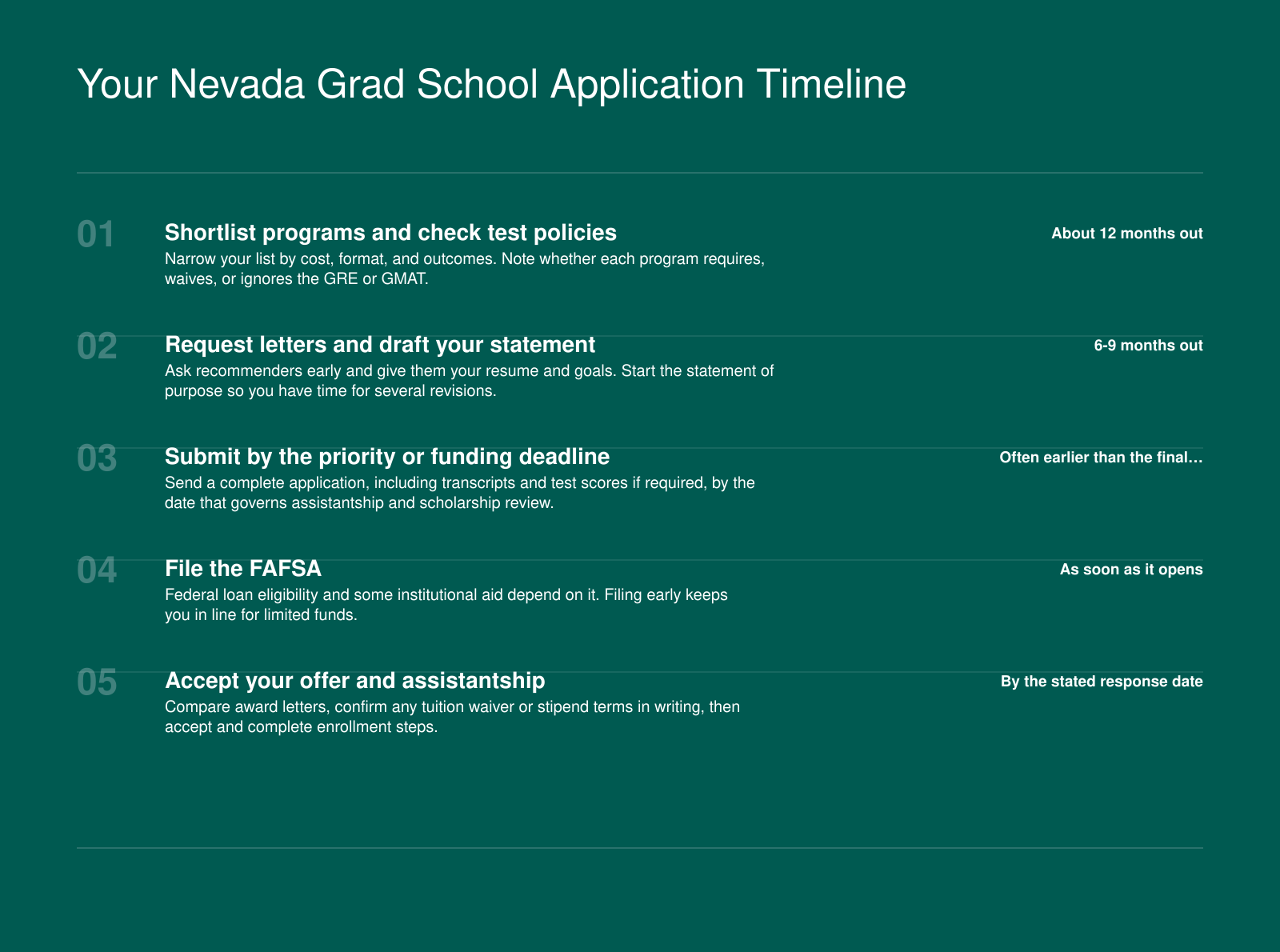
Your Nevada Grad School Application Timeline
Work backward from the earliest funding deadline, not the final admission date. Exact dates vary by program, so confirm each one on the department's own admissions page.
Do Nevada Master's Programs Require the GRE or GMAT? Waivers and Deadlines
The Lee Business School MBA at UNLV asks for a GMAT or GRE score, with a target of at least the 33.3rd percentile. UNLV has no university-wide rule, though, so the answer changes by department. Most UNR master's programs list no GRE or GMAT requirement, and the UNR MBA does not require either exam.
Where Exams Still Matter
The UNLV hospitality administration master's does not require a test, though a score can help an applicant with a lower GPA. The dual programs are stricter. The HOA-MBA requires a GMAT or GRE, with a waiver possible in specific cases. The HOA-MIS requires a score, and the exam must be within five years. Take the test at least five to six weeks before the deadline.
How MBA Waivers Work
At Lee, a waiver is decided case by case, and asking does not guarantee approval. You submit a form and make a case built on academic background, professional experience, career achievements, and leadership. The committee reviews holistically and usually responds in one to two weeks. If it says no, you must send an official score. UNR skips the exam but asks for two years of professional experience and, for applicants who need it, a Duolingo score of at least 115.
Deadlines
UNLV graduate programs list assistantship dates of March 1 for fall and November 1 for spring, but a department may set an earlier one. Lee MBA final dates are August 1 for domestic fall applicants and December 1 for spring, with a November 15 spring priority date. International applicants face earlier cutoffs, such as May 1 for fall. Hospitality applicants should file the assistantship application with the admission application.
The UNR MBA accepts applications year-round, but materials are due by March 15 for fall and October 15 for spring. For Spring 2027, the deadline moved to December 1, 2026. UNR assistantships are awarded by program, not by the Graduate School, so no single date applies.
Deadlines are set at the department level, not by the graduate college. Check each program's own page before you plan, and ask about spring starts if fall timing doesn't work.
Paying for Your Degree: Assistantships, Scholarships, and Federal Loans
Graduate Assistantships at UNLV and UNR
An assistantship is the most valuable funding a Nevada master's student can land, because it attacks tuition and living costs at the same time. Packages are not uniform, though, so read each offer line by line.
At UNR, a full-time state-funded assistantship means roughly 20 hours of work per week. In return, the university waives tuition fees on up to nine graduate credits per term, covers the mandatory graduate health insurance fee, and pays a monthly stipend. UNR's handbooks do not publish a single stipend figure. Pay varies by department, appointment level, funding source and discipline. Out-of-state assistants get a major break: nonresident tuition is waived while the appointment is active, so you pay resident rates. Health coverage is part of full-time appointments for students enrolled in at least six credits. Those on 10- or 15-hour appointments pay part of the premium themselves.
UNLV awards assistantships program by program, and the university does not post one campus-wide stipend. One concrete example among fully funded MFA programs: UNLV's Fall 2026 MFA in Art call offers every accepted student a tuition waiver, health insurance and $21,000 for nine months. The waiver covers tuition but not fees, and it requires nine credits each fall and spring plus three in summer. Treat that package as one department's offer, not a university standard.
Scholarships and Fellowships
Beyond assistantships, funding comes from graduate college scholarships and departmental fellowships. We could not find a complete, current list of 2026 awards with amounts and deadlines. Nevada-specific workforce or health-profession funding may exist in some fields but is not well documented. Ask your program director directly what students typically receive. Apply early, since departmental money often goes to admitted students first.
Federal Loans After July 1, 2026
Federal borrowing changed significantly this year. Graduate students have not been eligible for subsidized loans, so interest accrues from disbursement. For 2025-26, the annual Direct Unsubsidized limit was $20,500.1 Grad PLUS let students borrow up to the full cost of attendance minus other aid.
Under the 2025 federal law, Grad PLUS is generally eliminated for graduate borrowers for loans covering instruction on or after July 1, 2026.2 Direct Unsubsidized loans remain. Federal sources describe the new annual ceilings by borrower category, with higher amounts (up to $50,000) tied to professional-degree status.3 New aggregate caps fall between $100,000 and $200,000, depending on category.2 Students who borrowed for their current program before the cutoff may fall under transition rules. Confirm your status with your school's financial aid office before counting on any figure.
The practical takeaway: if a program's full cost of attendance exceeds what you can borrow federally, the gap now comes from savings, private loans or funding.
Employer Tuition Assistance
For working professionals in Las Vegas and Reno, employer tuition benefits are a realistic route, especially in part-time and online programs built around a job. Check your HR policy for annual caps, approved-field rules and any service commitment after you finish. Pair that benefit with a lower-cost public program, and you may need little or no debt at all.
Accredited Masters Programs in Nevada: Programmatic Accreditation and Licensure by Field
UNLV’s 2026 graduate catalog identifies programmatic accreditation for several licensure-track master’s programs, including CACREP for counseling, CCNE for nursing, CSWE for social work, NAAB for architecture, CEPH for public health, and ABET for health physics. That second layer sits on top of institutional accreditation: Nevada’s public universities are institutionally accredited by the Northwest Commission on Colleges and Universities (NWCCU). Institutional accreditation is about the whole university; programmatic accreditation is about whether a specific degree meets the standards of a profession and its licensing board.
Licensure-track map by field
- Nursing: CCNE-accredited M.S.N. at UNLV; licensure is handled by the Nevada State Board of Nursing.1
- Counseling: UNLV’s Clinical Mental Health Counseling M.S. and School Counseling M.Ed. hold CACREP accreditation; the Nevada Board of Examiners for Marriage and Family Therapists and Clinical Professional Counselors handles licensure.2
- Social work: UNLV’s M.S.W. holds CSWE accreditation; the Nevada Board of Examiners for Social Workers is the licensing body.3
- Education: Educator licensure runs through the Nevada Department of Education.5 Confirm whether your specific M.Ed. program holds CAEP or state-approved status before enrolling, a step expected in accredited M.Ed. programs.
- Architecture: UNLV’s M.Arch. holds NAAB accreditation; the Nevada State Board of Architecture, Interior Design and Residential Design governs licensure.4
- Engineering: The Nevada State Board of Professional Engineers and Land Surveyors manages PE licensure.4 ABET accreditation is relevant, but a master’s is not required for PE licensure in Nevada. UNLV’s Health Physics M.S. Environmental Option also holds ABET accreditation.
- Public health: UNLV’s M.P.H. holds CEPH accreditation, placing it among CEPH-accredited MPH programs; CEPH matters for employers and fellowships even though most public health roles do not require a separate Nevada license.
Where the master’s is required
Licensure requirements vary by field. Nursing advanced practice, counseling, and social work generally require a master’s or higher as part of the credential path. Architecture requires a professional degree; an NAAB-accredited M.Arch. is one route, though equivalent education may be accepted in some cases. Engineering is the notable exception: Nevada PE licensure does not require a master’s, so a graduate degree is optional for the license itself even if it helps with career advancement. Teaching licensure usually does not require a master’s initially, but a graduate degree can support salary advancement and endorsements.
Before you enroll, verify directly
Accreditation status can change, and catalog listings may not reflect the entire calendar year. Check the accreditor’s own directory for current status rather than relying only on a program’s marketing materials. The available evidence here is strongest for UNLV; for the University of Nevada, Reno and Nevada State University, program-level accreditation should be confirmed with the accreditor and the relevant Nevada board before you commit.
Nevada Licensure for Counselors
Masters Degree Salary in Nevada: What Graduates Earn and Owe
A graduate degree carries a measurable earnings premium in Nevada, but the size of that premium depends far more on your field than on the state average. Census American Community Survey figures for 2020-2024 put median earnings for Nevada adults 25 and older holding a graduate or professional degree at $83,858, against $62,137 for those whose highest credential is a bachelor's. That gap of $21,721, roughly 35 percent, covers every graduate and professional credential (including law and medicine) and every working adult in that age range, so treat it as a directional benchmark rather than a forecast for your specific program.
Program-Level Numbers Tell a Sharper Story
Federal College Scorecard data reported at the program level is more useful, though coverage is patchy and not every Nevada master's field has published figures yet. At the University of Nevada, Reno, the numbers that are available spread widely:
- Business administration: median earnings of $118,430 against median debt of $30,115, from a cohort of 128 completers.
- Registered nursing: median earnings of $123,539 with median debt of $41,000, from a much smaller group of 24 completers.
- Public health: median earnings of $93,116 with median debt of $41,000.
- Student counseling and personnel services: median earnings of $67,781 against median debt of $40,423, a debt burden of about 60 percent.
Comparable program-level earnings for UNLV master's degrees are not yet published, so prospective students there should ask admissions staff directly for placement and salary data by department.
Use the Debt-to-Earnings Ratio as Your Value Test
The single most useful number is debt divided by first-year earnings. The Reno general MBA cohort sits near 25 percent, which is comfortable; the counseling cohort's 60 percent is the kind of ratio that squeezes a budget for years. A rough rule: if projected debt approaches or exceeds your expected first-year salary, the program needs to justify itself on something other than arithmetic.
Funded assistantships rewrite that equation entirely. A tuition waiver plus a stipend can move a program from a 60 percent debt burden to near zero, which matters most in exactly the fields where earnings are modest (education, counseling, social work, including affordable MSW programs). Chase funding hardest where the salary ceiling is lowest.
No State Income Tax Lifts Take-Home Pay
Nevada levies no personal income tax, so a Nevada salary converts to more take-home pay than the same gross figure in California, Oregon, or Arizona. When you compare job offers across state lines, run the net numbers, not the headline ones.
The Master's Pay Bump for Nevada Teachers
Clark County School District's licensed salary schedule shows what a master's can add at the very start of a teaching career.
Graduate schools in Nevada with the most master's programs
| School | City | Type | Master's programs | Online | Grad tuition / yr |
|---|---|---|---|---|---|
| University of Nevada-Las Vegas | Las Vegas | Public | 71 | 21 | $7,413 |
| University of Nevada-Reno | Reno | Public | 69 | 17 | $7,032 |
| Nevada State University | Henderson | Public | 5 | 2 | $5,444 |
| Touro University Nevada | Henderson | Private nonprofit | 5 | 5 | $52,976 |
| Roseman University of Health Sciences | Henderson | Private nonprofit | 2 | 2 | $29,400 |
Program counts are the verified master's listings in our directory; tuition is the school-wide average for a full-time graduate student (IPEDS).
Frequently Asked Questions About Master's Programs in Nevada
These answers condense the cost, format, residency and accreditation points covered above. Tuition varies by program and changes each year, so confirm figures with the school before you apply.
What is the cheapest master's program in Nevada?
Are there fully online master's programs in Nevada?
Can out-of-state students qualify for Nevada resident graduate tuition?
Is a master's from Nevada State University or a private Nevada school accredited the same way as UNLV or UNR?
Compare programs nationwide
Many Nevada residents study online. Every ranked list above has an online lens, or browse every field.
Online master's programs Browse all fields