Master's Programs in Michigan
Every master's program reported by a school in Michigan: 870+ programs at 40+ graduate schools, with the online options, costs and outcomes behind each one.

A master's degree at a Michigan public university can cost a fraction of what a comparable private program charges, and the gap between public campuses is wide too. Per-credit rates vary by school, by program, and by residency status, and no single page lines them up side by side.
School websites tend to leave out the numbers that matter most: what the total cost of a master's degree is, which options are truly Online Master's Programs, which programs still require the GRE, how much funding is realistic, and whether the program meets licensure rules.
Michigan's strongest outcomes often depend on the field and the license, not the school's name.
Key Points
- MSU's online education M.A. costs a flat $933 per credit hour.
- Assistantships mostly go to doctoral and research students, not master's students.
- Michigan social work licensure requires a CSWE-accredited MSW, so check program accreditation first.
Popular degrees in Michigan
Master's programs in Michigan by field
Business & Management
- Healthcare Administration33 programs
- Accounting29 programs
- Finance28 programs
- Management27 programs
- Analytics26 programs
- Marketing26 programs
- Healthcare Management18 programs
- Public Administration18 programs
Education & Teaching
- Teaching20 programs
- Music Education12 programs
- Educational Leadership10 programs
- Special Education9 programs
- Curriculum & Instruction5 programs
- Secondary Education5 programs
- STEM Education or Science Education or Mathematics Education5 programs
- Reading & Literacy4 programs
Nursing
- Family Nurse Practitioner (FNP)15 programs
- Psychiatric Mental Health Nurse Practitioner11 programs
- Nursing Education or Nurse Educator10 programs
- Adult Gerontology Primary Care Nurse Practitioner6 programs
- Nurse Administrator5 programs
- Public Health4 programs
- Pediatric Nurse Practitioner4 programs
- Nurse Executive Leadership4 programs
Social Work & Social Sciences
- Social Work35 programs
- Social Work Advanced Standing23 programs
- Sociology6 programs
- Political Science, Government4 programs
- Human Services2 programs
Healthcare
- Health Administration19 programs
- Public Health12 programs
- Nutrition10 programs
- Speech Pathology10 programs
- Exercise Science7 programs
- Health Education7 programs
- Health Informatics4 programs
- Clinical Research Management1 program
Psychology
- Educational Psychology or School Psychology9 programs
- Counseling Psychology9 programs
- Applied Behavior Analysis7 programs
- Industrial Organizational Psychology6 programs
- Clinical Psychology5 programs
- General Psychology4 programs
- School Psychology3 programs
- Developmental Psychology2 programs
Computers & IT
- Cybersecurity17 programs
- Data Analytics13 programs
- Information Security & Assurance10 programs
- Machine Learning6 programs
Communications & Media
- Speech Pathology12 programs
- Communication8 programs
- Communication Disorders6 programs
- Strategic Communication2 programs
- Advertising2 programs
- Media Communication1 program
- Technical Communication1 program
- Political Communication1 program
Counseling
- Clinical Mental Health Counseling15 programs
- School Counseling10 programs
- Addiction Counseling3 programs
- Christian Counseling3 programs
- Marriage and Family Therapy or Marriage and Family Counseling2 programs
Religion & Theology
- Divinity7 programs
- Christian Ministry5 programs
- Theology5 programs
- Urban Ministry4 programs
- Christian Leadership3 programs
- Youth and Family Ministry2 programs
Science & Engineering
- Environmental Science10 programs
- Sustainability or Environmental Management8 programs
- Geography4 programs
Arts & Design
- Creative Writing14 programs
- Fine Arts6 programs
- Interior Design1 program
Criminal Justice & Law
- Master of Laws4 programs
- Legal Studies2 programs
- Cybercrime2 programs
- Public Policy2 programs
- Homeland Security1 program
What a Master's Degree in Michigan Really Costs
Public vs. private, resident vs. nonresident: those two splits drive most of the price difference you'll see in Michigan graduate programs. Before you compare schools, it helps to understand how they actually set the number.
How Michigan Public Universities Price Graduate Study
Most state universities bill graduate work in one of two ways: per-credit or a flat full-time rate. Wayne State, for example, charges a published nonresident graduate rate of $1,136.03 per credit for 2025-26, layered with a $387.41 registration fee and a $66.95 per-credit student-services charge.1 The University of Michigan treats 9 credits as full-time and lists full-term tuition figures of roughly $11,285 to $19,208 for 2025-26, with the exact amount varying by school, residency, and pre-candidate or candidate status.2 Western Michigan's third-party-compiled annual graduate tuition runs about $20,964 for residents and $30,961 for nonresidents in 2025-26.3
Residency matters enormously, and so does program-differential pricing. Business, engineering, and nursing degrees frequently carry higher per-credit rates than a general humanities master's at the same university, so always check the rate for your specific program rather than the school's headline figure.
Sticker Price Is Not Total Cost
A typical 30 to 36 credit master's spans a wide range. At a regional public school paying resident rates, tuition alone might land in the low-to-mid $20,000s across the program; at a flagship or at nonresident rates, it can climb well past $40,000. But tuition is only part of the bill. Mandatory fees, health insurance for full-time students, books, and living costs stack on top. Wayne State's 2025-26 estimates put total cost of attendance around $25,684 for a resident living at home,4 while Western Michigan's published annual budget reaches about $32,740 once housing, food, transportation, and other expenses are included. Ann Arbor and East Lansing carry some of the state's higher living costs, which inflate the real total even when tuition looks comparable.
Where Private Schools Fit
Private institutions such as University of Detroit Mercy and Lawrence Technological University charge a single rate regardless of residency, which can make them competitive for out-of-state students who'd otherwise pay nonresident public tuition. The figure that ultimately matters is net price: sticker tuition minus the assistantships, fellowships, and grants you actually receive. A higher-priced program that funds you generously can cost less out of pocket than a cheaper one that offers nothing. Every figure here reflects the 2025-26 academic year; confirm current rates with each school before you budget.
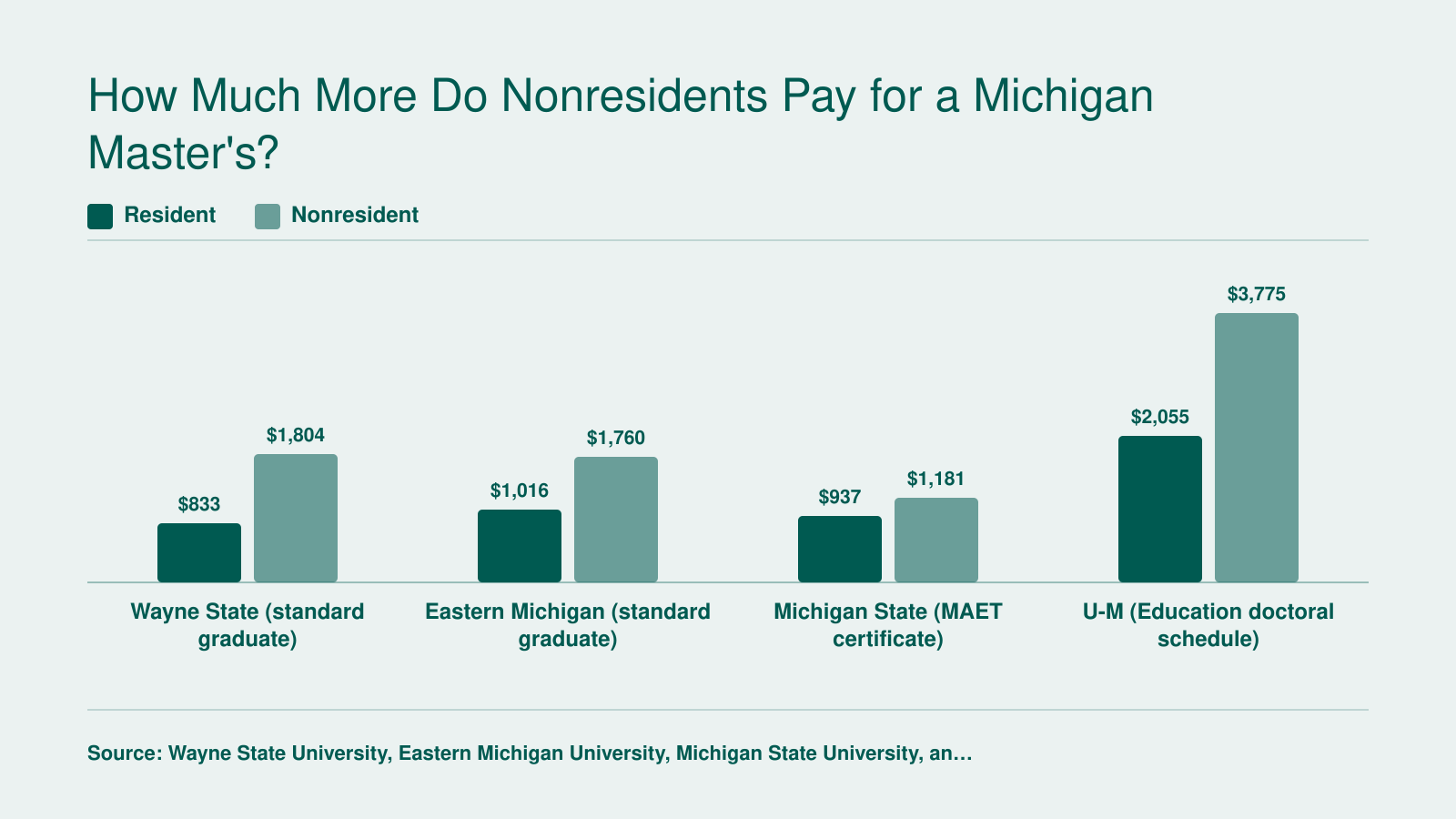
How Much More Do Nonresidents Pay for a Michigan Master's?
These are published 2025-26 graduate tuition rates per credit hour, resident and nonresident, from each university's own tuition pages. Michigan schools rarely publish one standard graduate rate, so the Michigan State and University of Michigan bars reflect a single program schedule (the MAET certificate and the School of Education doctoral rate), not a campus-wide master's rate. Mandatory fees are extra. Central Michigan ($829) and Grand Valley State (about $826 to $904 depending on the program) publish one per-credit figure without separate residency amounts, so they are not charted. Michigan State's online M.A. in Education charges a flat $933 per credit regardless of residency. The nonresident premium is about $1,720 per credit (roughly 84%) on the University of Michigan schedule shown. It is about $971 at Wayne State and $744 at Eastern Michigan. Check your own program's rate before budgeting.
Online Master's Programs in Michigan: Fully Online, Hybrid, and On-Campus
Online master's programs in Michigan have shifted from an occasional convenience to a standard delivery route, but the word "online" still hides real differences in schedule, location, and price.
The three formats Michigan schools actually use
Fully online generally means every required course can be completed remotely. University of Michigan-Ann Arbor defines "100% online" as all degree courses accessible online with no on-campus requirement, though some courses are asynchronous and others meet at set times.1 Michigan State University reserves "online" for programs that are totally online and uses "hybrid" when at least 50% of required courses are online; hybrid students may still have scheduled in-person contact for classes, exams, labs, or other experiences.2 Grand Valley State University offers "low-residency" options that require just one visit per session,3 a tighter version of the weekend or cohort model. Traditional on-campus programs remain fully in person. When a school says hybrid, ask whether the in-person piece is an occasional weekend, a set residency, or a clinical placement tied to licensure.
What online students actually pay
Tuition rules vary by school and program. Wayne State University's 2026-27 regulations state that students in completely online graduate programs pay Michigan resident rates, including out-of-state students.4 Eligible programs include the Master of Library and Information Science, the M.Ed. in Learning Design and Technology, the M.B.A., the M.S. in Criminal Justice, and the M.A. in Sports Administration.4 By contrast, MSU's online M.A. in Education charges the same per-credit tuition for all students regardless of residency; the 2025-26 rate is $933 per credit for 30 required credits.5 Other MSU online and hybrid master's programs may carry separate per-credit rates, such as $965 per credit for the Hybrid Online M.S. Forestry Plan B in Summer 2026.6 Not every university publishes a single flat e-tuition rate, so check the program fee schedule before assuming out-of-state status disappears.
State authorization and the placement catch
Out-of-state online students should confirm state authorization. University of Michigan and Michigan State University participate in NC-SARA8; MSU has been a member since September 11, 2015.7 This lets institutions enroll residents of other member states under home-state authorization. But SARA does not override state laws or guarantee the same tuition, and MSU notes it must still comply with requirements in participating and non-participating SARA states.7 Licensure-track programs can add another layer: online MSN programs, counseling master's, or online MSW programs may accept online coursework but still require in-person clinical or practicum placements in or near the student's state, and some programs may not admit residents of every state for that reason. University of Michigan does not publish a single flat online tuition rate for all graduate programs, so confirm whether your program uses resident, nonresident, or a separate distance rate.8
Where to Find Online and Hybrid Graduate Options Across Michigan
Michigan State University charges $933.00 per credit hour for its online M.A. in Education in fall 2025 and spring 2026, with the same rate for every student regardless of residency. That flat-rate approach is one of several pricing models students will encounter when comparing online and hybrid graduate study in Michigan.
Flat Online Tuition Regardless of Residency
- MSU: The online M.A. in Education is billed per credit hour at $933.00 for all students. This is a fully online program, and the listed rate applies to fall and spring terms.
- Wayne State: The Online Master of Science in Community Health carries the same tuition for Michigan residents and out-of-state students.
- GVSU: Grand Valley State's master's tuition is charged per credit hour by academic program, with published rates from $859 to $940 and no separate residency-based rate. The 2026-2027 cost reference does not name a specific fully online master's program, but the per-credit range applies across graduate programs.
Where Residency Still Changes the Price
- UMich: The Health Infrastructures & Learning Systems (HILS) Online M.S. uses separate Michigan-resident and nonresident rates. Full-time enrollment of 9 or more credits per full term is $14,916 for residents and $30,076 for nonresidents, plus $241.19 in mandatory fees.
Fully Online Formats at Specific Campuses
- UM-Dearborn: The Early Childhood Education M.A. is listed as available only in a fully online format. The catalog excerpt does not state a separate online tuition rate, so prospective students should confirm the current per-credit cost directly with the program.
The named programs above are fully online. For students who need hybrid or weekend delivery, the sources do not list those formats for these specific programs, so direct confirmation with the graduate school is the safest step.
Admissions, GRE Waivers, and Application Timelines at Michigan Graduate Schools
Standardized tests have shifted from gatekeeper to optional extra at many Michigan graduate schools, but the move toward master's programs with no GRE required is happening program by program rather than campus by campus.
Where the GRE Still Matters
Wayne State University's Graduate School is test-optional for 2026 and requires no GRE or GMAT at the university level, yet departments can add their own rules.1 The M.P.A. treats the GRE as optional for admission but requires it for assistantship or fellowship consideration.2 The M.S. in Computer Engineering recommends it if your undergraduate degree is from a non-ABET-accredited school. At Michigan State, the M.A. in Education requires no GRE, though scores can be submitted as supporting material.3
Business programs show how waivers work. Wayne State's Mike Ilitch School of Business doesn't require the GMAT or GRE to apply, and most of its business master's programs waive the GMAT automatically for applicants who meet criteria such as a 2.5+ GPA or at least three years of professional experience with growing responsibility.4 The M.S. in Finance is stricter, asking for an acceptable GRE, LSAT, or MCAT score or a 3.3 GPA from an AACSB-accredited business program.4 Generally, quantitative and research-heavy programs at selective schools are the likeliest to still expect scores, so check each program page every cycle.
How Rackham and Departments Split the Work
At the University of Michigan, Rackham Graduate School oversees many master's and doctoral programs, but departments largely set their own requirements and make admissions decisions. That is why a single "UMich master's acceptance rate" is misleading: selectivity varies sharply by program, and no published program-level figures allow a reliable comparison. Ask the department for recent applicant and admit numbers.
Typical Requirements
- GPA: Wayne State's minimum is 2.75 for master's applicants.1 Programs can set higher bars, such as 3.2 for the M.A. in Communication.5 MSU's M.A. in Education looks for 3.0, with flexibility for applicants who show promise through supplemental materials.3
- Written materials: Expect a statement of purpose and, at most programs, letters of recommendation.
- Experience: MBA and MPA programs often weigh professional experience, and at Ilitch it can substitute for a test score.4
Deadlines and Time to Degree
Funded, research-oriented programs commonly set fall priority deadlines between December and February because assistantships are awarded early. Many professional and online programs review applications on a rolling basis with later cutoffs. Wayne State's Graduate School lists June 1 for fall,6 the M.P.A. July 1,2 and Ilitch August 1.4 MSU's M.A. in Education targets early August for fall, early December for spring, and mid-April for summer.3 Most full-time students finish in 1.5 to 2 years; part-time students usually take longer.
Funding Your Michigan Master's: Assistantships, Fellowships, and Residency Rules
The single largest discount on a Michigan master's degree is an assistantship, and most master's students will never receive one. Funded appointments exist at every major public university in the state, but they are concentrated in doctoral programs and research-heavy departments. Budget as if you are paying the sticker price, then treat any award as a windfall.
How Assistantships Reduce Tuition
Graduate student instructor and research assistant appointments typically combine a stipend, a tuition benefit, and in many cases health coverage. The tuition piece is rarely all-or-nothing. At the University of Michigan, the credit-hour waiver scales with the size of the appointment: an appointment fraction of at least 23.7 percent carries a full tuition waiver, while smaller appointments cover proportionally less (roughly 64 percent at a 18.7 percent fraction, 54 percent at 13.7 percent, and 44 percent at 8.7 percent). Appointees normally enroll in at least six credits during fall and winter, with a five-credit minimum available when a faculty advisor approves it in writing.1
Wayne State structures its benefit as a tuition scholarship rather than a percentage waiver, covering up to 10 graduate credits in each of fall and winter and up to 2 credits in spring/summer during the term of appointment.2 For 2026-27, research assistants, research associates, graduate assistants, and graduate research assistants are also eligible to have the nonresident portion of tuition waived.3 Western Michigan takes a different approach again: graduate appointees receive a charge privilege for tuition and related fees, which defers payment rather than eliminating it, and installment payments are still required.
At several Michigan universities, graduate employees are unionized, and contract minimums set the floor for stipends. Verify current rates with the hiring department, since terms change with each bargaining cycle. Professional master's programs, including the best MBA programs, the best MPH programs, and MSW tracks, generally fund students through merit scholarships and loans rather than appointments.
Residency, Loans, and Regional Discounts
Michigan residency for tuition purposes generally turns on establishing domicile roughly a year before enrollment, and moving to the state primarily to attend school usually does not qualify you in year one. The rules are university-specific. Wayne State allows eligible salaried employees with at least half-time appointments to apply for residency after six months of continuous Michigan residency,3 and extends resident-equivalent rates to qualifying students from Fulton, Lucas, Ottawa, and Williams counties in Ohio and from Ontario, Canada.4 Western Michigan permits any student to file a residency application for a term with on-campus coursework.
Beyond that, most graduate students rely on federal Direct Unsubsidized loans, Grad PLUS borrowing, and employer tuition assistance. If a school advertises Midwest Student Exchange Program pricing, confirm directly that it applies to your specific master's program before counting on it.
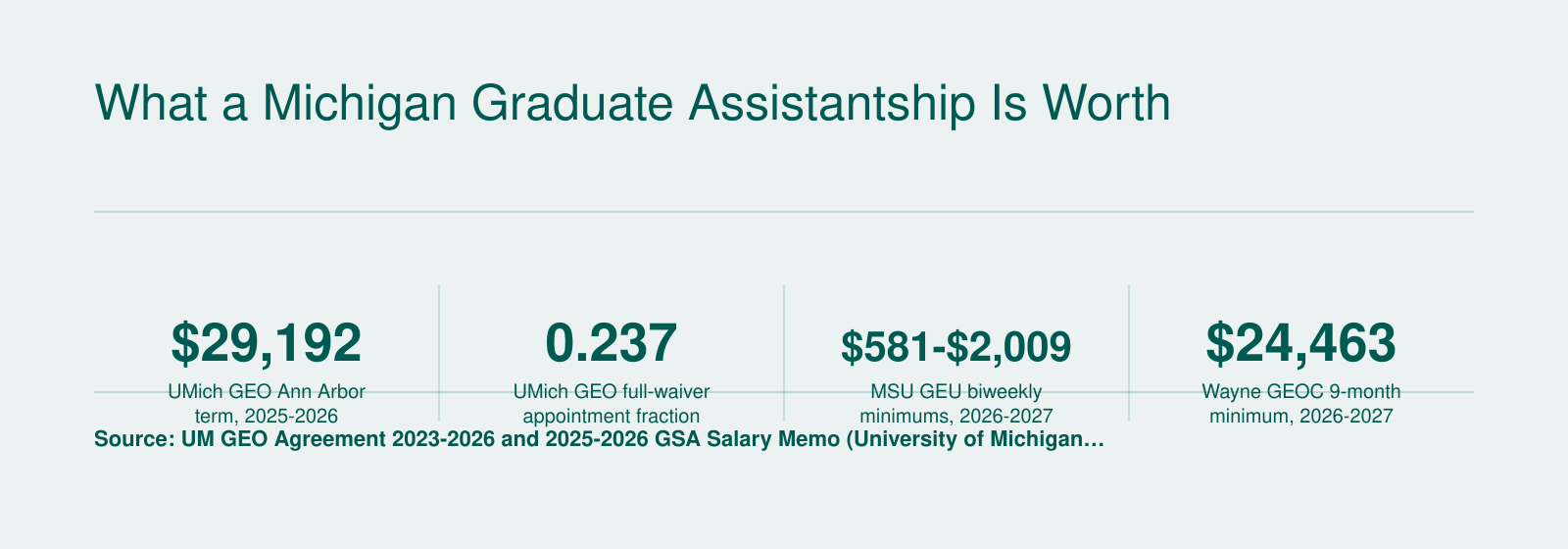
What a Michigan Graduate Assistantship Is Worth
Minimums come from the current union contracts at the University of Michigan (GEO), Michigan State (GEU), and Wayne State (GEOC). The U-M figures are per four-month term and come from the 2023-2026 agreement plus the 2025-2026 salary memo. Negotiations on a new U-M agreement are ongoing, and the old terms remain in effect for now. The excerpts reviewed do not spell out health-coverage terms, so confirm those with each union or HR office.
Accredited Graduate Programs in Michigan: Accreditation and Licensure Checks
Institutional accreditation tells you a school is legitimate. Programmatic accreditation tells you whether a specific degree will actually qualify you for a license. Confusing the two is one of the costliest mistakes a master's applicant can make.
Two Layers of Accreditation
Michigan colleges are generally accredited at the institutional level by the Higher Learning Commission (HLC). That status is what makes a school eligible for federal student aid and gives its credits broad recognition. Programmatic accreditation is separate. A field-specific body awards it to an individual program, and licensing boards and employers in regulated professions look at it directly. A school can hold HLC accreditation while one master's track lacks the credential your license depends on.
Accreditors to Verify by Field
- Nursing: CCNE or ACEN for APRN master's programs. Nurse-midwifery uses ACME, and nurse anesthesia uses COA. In-state nursing programs also need Michigan Board of Nursing approval.1
- Social work: CSWE. Michigan's limited LMSW license, issued by LARA, requires a degree from a CSWE-accredited MSW program.2
- Counseling: CACREP is the standard credential for LPC-track programs such as clinical mental health counseling programs.1 Confirm with LARA what your specific path requires before enrolling.
- Education: CAEP is the main national accreditor. Michigan requires educator preparation providers to hold national accreditation and State Board of Education approval for specific grade bands and endorsements.3
- Business and engineering: AACSB for business and ABET for engineering. These work more as quality signals for employers than as licensing gates.
How to Verify a Program
Do not rely on a school's marketing page. Search the accreditor's own directory for the exact program and degree level, and confirm the status is full accreditation, not "candidacy." Candidacy means a program is working toward accreditation without a guarantee of getting it, and graduates may not qualify for licensure. Also check that the accreditation covers the format you plan to use.
If You're Studying Online From Outside Michigan
Licensure is set by the state where you will practice, not the state where your school sits. Find the school's professional licensure disclosure page, which states whether the program meets requirements in each state, then confirm with your home state's board. Within Michigan, oversight is split: LARA handles nursing, social work, and counseling,12 while the Michigan Department of Education handles educator certification.4
Licensure Authority in Michigan
Career Outcomes and Salary Data for Michigan Master's Graduates
The question behind every tuition payment is whether the degree pays for itself, and in Michigan the answer depends heavily on the field. Some master's degrees translate directly into higher wages; others pay off more slowly, or mainly through licensure and salary-schedule bumps rather than a dramatic jump in base pay.
What the Wage Data Shows
For master's-level occupations, state wage data gives the clearest picture available right now. Michigan's May 2025 figures from the federal Bureau of Labor Statistics show Nurse Practitioners earning a median of about $131,450 a year (roughly $63.20 an hour) across an estimated 8,290 jobs statewide. Nurse practitioner roles typically require a master's, and nearly all current NPs hold one. Nurse anesthetists, a smaller field of about 2,300 Michigan jobs, post a median near $247,010, with the middle half earning between roughly $220,840 and $299,120.2 These are among the highest-paying master's-level paths in the state.
Treat these as wages for people working in the occupation, not as earnings of recent graduates. They tell you what the field pays, not what a specific program's completers earn.
How to Frame Return on Investment
A simple way to weigh any Michigan program: compare its total cost against the typical salary lift in the field you are entering. A clinical nursing master's that moves you toward NP licensure, where median pay runs well into six figures, clears its cost quickly. Business master's degrees such as an MBA in Finance and computer science master's degrees also tend to carry meaningful wage premiums, though outcomes vary widely by employer and region.
Education master's degrees such as Curriculum & Instruction and social work master's degrees work differently. Their payoff often comes through a step on a district salary schedule or through the licensure a role legally requires, not through a large open-market salary jump. That does not make them poor investments, but it does mean you should check the specific pay scale or license your target job depends on before enrolling.
The Limits of the Numbers
No single figure captures a program's value. The federal College Scorecard reports program-level median earnings for completers, but only for graduates who received federal financial aid, so it misses anyone who paid out of pocket or used an employer benefit. Program-by-program earnings for Michigan master's completers in nursing, business, education, and computer science were not available for this writeup, so we have not listed them here.
Early-career earnings also understate long-run value. Most master's degrees compound over a decade, meaning the first-year paycheck is the floor, not the ceiling.
A Master's-Level Paycheck in Michigan
Nurse practitioners in Michigan earn a median of
Graduate schools in Michigan with the most master's programs
| School | City | Type | Master's programs | Online | Grad tuition / yr |
|---|---|---|---|---|---|
| Michigan State University | East Lansing | Public | 75 | 33 | $21,772 |
| Wayne State University | Detroit | Public | 75 | 22 | $17,960 |
| University of Michigan | Ann Arbor | Public | 49 | 13 | $28,886 |
| Western Michigan University | Kalamazoo | Public | 47 | 16 | $20,103 |
| Oakland University | Rochester Hills | Public | 42 | 22 | $21,960 |
| Eastern Michigan University | Ypsilanti | Public | 40 | 21 | $17,968 |
| Central Michigan University | Mount Pleasant | Public | 37 | 18 | $17,187 |
| Grand Valley State University | Allendale | Public | 36 | 22 | $20,030 |
| University of Michigan-Flint | Flint | Public | 36 | 35 | $14,473 |
| Andrews University | Berrien Springs | Private nonprofit | 35 | 14 | $29,156 |
| Calvin University | Grand Rapids | Private nonprofit | 30 | 21 | $11,113 |
| University of Detroit Mercy | Detroit | Private nonprofit | 29 | 10 | $22,544 |
| Ferris State University | Big Rapids | Public | 28 | 27 | $9,538 |
| Spring Arbor University | Spring Arbor | Private nonprofit | 27 | 25 | $8,364 |
| Davenport University | Grand Rapids | Private nonprofit | 26 | 25 | $20,098 |
Program counts are the verified master's listings in our directory; tuition is the school-wide average for a full-time graduate student (IPEDS).
Common Questions About Michigan Master's Programs
These are the questions prospective students ask most often when comparing graduate options in the state. Answers reflect typical patterns, so confirm specifics with the program you are considering.
How long does it take to complete a master's program in Michigan?
How do I find the strongest Michigan master's program in my field?
Can I complete a Michigan master's fully online if I live out of state?
Is a master's from a regional Michigan university worth less than one from UMich or MSU?
Compare programs nationwide
Many Michigan residents study online. Every ranked list above has an online lens, or browse every field.
Online master's programs Browse all fields