Best Adult-Gerontology Primary Care Nurse Practitioner (AG-PCNP) MSN Programs in Michigan
Compare 6 accredited Adult Gerontology Primary Care Nurse Practitioner programs in Michigan at 5 schools, with graduate earnings, cost, debt, and completion data from IPEDS and the U.S. College Scorecard.
How much do Michigan's ranked AG-PCNP master's programs actually charge in-state, and how do format and clinical demands change the math compared with other nurse practitioner programs in Michigan?
In-state graduate tuition and fees run from $14,704 at University of Michigan-Flint to $34,014 at Spring Arbor University, a range tracked in the Most Affordable Adult-Gerontology Primary Care Nurse Practitioner MSN Programs list. That spread overlaps with sharp differences in campus days, placement support, and program length across the ranked options. For a working RN, a lower sticker price with a schedule conflict can cost more in missed shifts than a higher-tuition hybrid.
Key Points
- Graduates of unaccredited MSN programs cannot sit for AANP or ANCC adult-gerontology primary care exams.
- Spring Arbor University pairs asynchronous online coursework with one four-day campus residency.
- Michigan certification is added to an active RN license through LARA, in a set order.
Best Adult-Gerontology Primary Care NP Master's Programs in Michigan, Ranked
Schools earn their place here on what a Michigan nurse actually pays and what graduates walk away with. Each card shows in-state and out-of-state graduate tuition alongside the school's graduation rate, which covers the whole institution rather than only the nurse practitioner track. Net price figures are approximate institution-wide averages, not program quotes, so confirm costs with each nursing school before you apply.
University of Michigan
#1Ann Arbor, MI · $29,000 – $58,000/yr (est.)
Best for: Nurses wanting school-arranged clinical placements
The University of Michigan pairs the strongest school graduation rate on this list with centrally managed clinical placement, so students are not left to find their own preceptors. It offers the AG-PCNP track on a two- or three-year timeline, with a hybrid version that brings students to campus three days per term. Scorecard data show a median debt among the lowest-risk in this group relative to earnings growth, and nursing master's graduates here reach about $110,000 four years after finishing.
- CCNE accredited
- Finish in two or three years
- Six concentration options within the MSN
- Clinical site placement with expert preceptors
- Faculty mentorship programs
- Hybrid format with three campus days per term
- 50 total credit hours
- Fall start
- Multiple program length options
- Campus skill building and testing
Michigan State University
#2East Lansing, MI · $22,000 – $42,000/yr (est.)
Best for: Working RNs needing limited campus time
Michigan State University offers a hybrid AG-PCNP MSN with just 15 on-campus days, which suits working nurses who live far from East Lansing. Clinical rotations are vetted and arranged through statewide partnerships, and the focus on frail older adults fits long-term care and sub-acute rehab careers. The program reports a 100% first-time certification pass rate and strong one-year employment. Its institutional graduation rate is the second highest on this list.
- CCNE accredited
- Hybrid with only 15 on-campus days
- Full-time and part-time options
- Synchronous and asynchronous options
- Vetted clinical rotations arranged statewide
- Program reports 100% first-time certification pass rate
- MSN, DNP and post-graduate options
Oakland University
#3Rochester Hills, MI · ~$22,000/yr (est.)
Best for: Nurses preferring in-person campus study
Oakland University delivers its AG-PCNP track on campus in Rochester Hills, with experienced nurse practitioner faculty and a faculty interview as part of competitive admission. Graduates are prepared for ANCC or AANP certification. Among the six schools, nursing master's graduates here report the second-highest median earnings one year out, at roughly $108,500, on lower in-state tuition than the top two.
- CCNE accredited
- Campus-based delivery
- Prepares for ANCC or AANP certification
- Faculty interview required for admission
- Post-Master's Certificate option
- Ties to the Michigan Council of Nurse Practitioners
Spring Arbor University
#4Spring Arbor, MI · ~$8,000/yr (est.)
Spring Arbor University runs a fully online, asynchronous AG-PCNP with a single four-day campus residency. Courses follow a seven-week format with one course at a time, and there are multiple starts each year. It is the most flexible entry point for nurses who need to keep working, and it offers both a BSN-to-MSN and an RN-to-MSN route. Tuition is private-school pricing, so compare the per-credit rates carefully.
- CCNE accredited
- 47 credit hours, as few as two years and five months
- $810 per credit
- 500 clinical hours
- Six start dates per year
- 3.0 GPA minimum
- Military benefits accepted
- 82 credit hours for RNs without a BSN
- $499 per credit
- As few as four years
- Four start dates per year
- 500 clinical hours
- Dedicated student success coach
University of Michigan-Flint
#5Flint, MI · $14,000 – $21,000/yr (est.)
The University of Michigan-Flint offers an online BSN-to-DNP pathway with an MSN exit and an AG-PCNP concentration, with minimal campus visits. Its school graduation rate is the lowest on this list, but nursing master's graduates report the highest median earnings one year out, at about $118,000. The program has the highest GPA floor here and a modest application fee.
- CCNE accredited
- 55 total credit hours
- Online with minimal campus visits
- Full-time and part-time options
- 3.2 GPA minimum and three recommendations
- Two start dates per year
- Scholarships available
Eastern Michigan University
#6Ypsilanti, MI · $15,000 – $20,000/yr (est.)
Eastern Michigan University offers an online primary care nurse practitioner MSN with an Adult-Gerontology concentration and a heavier clinical load than most peers. It requires a minimum of 750 clinical hours across six consecutive semesters. In-state and out-of-state graduate rates are close, which helps nonresidents. Nursing master's graduates report the lowest debt in the group, and earnings rise substantially by year four.
- CCNE accredited
- Two years over six consecutive semesters
- Minimum of 750 clinical hours
- Three start dates per year
- Scholarships and loans available
- Separate Family Nurse Practitioner track at the same school
- 49 to 52 credit hours
- Online format
- Pathway to a Doctor of Nursing Practice
Cost & outcomes by school
Federal data for the highest-earning Adult Gerontology Primary Care Nurse Practitioner programs, independent of the ranking above. Earnings are this field's master's graduates four years after completing, where the Scorecard reports them.
| School | Earnings | Tuition / yr | Debt | Grads/yr | Format |
|---|---|---|---|---|---|
| Spring Arbor University MI | $120,740 | $8,364 | $53,555 | 222 | Online |
| Michigan State University MI | $118,130 | $21,772 | $48,355 | 43 | Campus |
| Eastern Michigan University MI | $117,970 | $17,968 | $39,156 | 18 | Online |
| Oakland University MI | $117,829 | $21,960 | $44,928 | 60 | Campus |
| University of Michigan MI | $109,684 | $28,886 | $51,923 | 115 | Online |
Sources: U.S. Department of Education. Tuition and graduates: IPEDS. Earnings and debt: College Scorecard, this field's master's graduates; a dash means no figure is reported.
Cost, debt & payoff
Median earnings of this field's master's graduates (4 yrs after completing) vs. their median federal loan debt · U.S. College Scorecard
Across these programs the median graduate earns about $118,050 and finishes with roughly $50,139 in debt — a ratio that clears a common rule of thumb (keep debt below first-year salary). Tuition and debt vary widely school to school, so check the per-school figures in the table above before you shortlist.
CCNE Accreditation and AANP/ANCC Exam Results for Michigan AG-PCNP Master's Programs
A program's reputation means little at the certification stage if its accreditation or exam outcomes are unclear: graduates of unaccredited MSN programs cannot sit for the AANP or ANCC adult-gerontology primary care certification exams.
CCNE accreditation is consistently reported among the Michigan AG-PCNP programs here. Spring Arbor University, Michigan State University, Oakland University, University of Michigan Ann Arbor, and University of Michigan-Flint all hold CCNE accreditation, with no probation or unusual review flags in available school pages.
Published first-time adult gerontology primary care NP certification pass rates are uneven. Michigan State reports 100% for all NP concentrations in 2024, but does not separate the AG-PCNP track or specify first-time status. Spring Arbor reports 100% without a year, test-taker count, or first-time-only designation. U-M Ann Arbor describes AGPCNP graduate pass rates as "extremely high" but publishes no figure. Oakland and U-M-Flint do not publish a first-time AG-PCNP rate, so ask admissions for the most recent first-time AANP or ANCC number.
Online and Hybrid AG-PCNP Master's Options in Michigan: How Often You'll Be on Campus
Delivery format usually comes down to how many campus trips your current RN schedule can absorb. The programs here fall into three main patterns.
- Primarily online: Spring Arbor University uses asynchronous online coursework and requires one four-day campus residency in year two. University of Michigan-Flint lists an online format with minimal campus visits, and Eastern Michigan University lists online delivery, a pattern seen in the Best Online Adult-Gerontology Primary Care Nurse Practitioner MSN Programs.
- Hybrid: University of Michigan's Digital Education option includes on-campus sessions each term (up to three days, beginning with N503), and its separate hybrid modality is about two-thirds face-to-face. Michigan State University combines online, on-campus, and clinical work, with 15 on-campus days total (4-5 per semester).
- Campus-based: Oakland University's program meets primarily on campus.
Whichever format you choose, clinical rotations always happen in person at a precepted site. The program pages reviewed here do not state out-of-state authorization limits, so confirm your eligibility with the school before applying to Master's Programs in Michigan.
Related Articles
AG-PCNP Clinical Hours, Placement Support, and Program Length by School
Clinical hours and who secures your preceptor shape an AG-PCNP program as much as its credit count does, and they can vary across Accelerated Adult-Gerontology Primary Care Nurse Practitioner MSN Programs. The national minimum is 500 direct patient-care hours, so every figure below should be read against that floor.
- University of Michigan (Ann Arbor): 49 credits and 504 clinical hours reported. Full-time takes 2 years, part-time 3. The official placement policy is unclear; distance students reportedly arrange preceptors near home.
- Michigan State University: 54 credits (24 core, 30 specialty) and 630 clinical hours. The school vets and arranges all rotations through statewide partners. Full-time takes 2 years, part-time 3.
- University of Michigan-Flint: 55 credits, with full-time and part-time plans and two starts a year. Hours, placement policy and typical length were not found in its official pages.
University of Michigan in Ann Arbor has the fewest credits and hours, and ties MSU on a 2-year full-time path, so it is the shortest option. MSU offers the strongest placement support, since students never source their own sites. For Oakland, Spring Arbor and Eastern Michigan, confirm hours and preceptor policy with the program before applying, the same due diligence applies to Best Adult-Gerontology Acute Care Nurse Practitioner MSN Programs in Michigan.
What You Need to Apply to a Michigan AG-PCNP MSN
Requirements differ by school, so confirm current terms on each admissions page before you plan your timeline.
- RN licenseMichigan State requires an unrestricted RN license. University of Michigan requires an unencumbered one and proof of a valid RN license in your clinical state before the first term. Eastern Michigan accepts applicants who are eligible for a Michigan license. Out-of-state nurses admitted to Michigan State may start provisionally but need a U.S. or Michigan license before clinicals.
- Degree and GPAA BSN is the norm, and Eastern Michigan also accepts a bridge route. GPA minimums run from 2.7 at Eastern Michigan (or 3.0 over the last half of the degree) to 3.0 at Michigan State and University of Michigan.
- Experience and prerequisitesNeither Michigan State nor University of Michigan sets a minimum amount of RN experience. Recent Michigan State admits average about 4.5 years. Michigan State also requires a 3-credit statistics course taken within five years.
- MaterialsUniversity of Michigan and Eastern Michigan use NursingCAS, and University of Michigan requires no GRE. Michigan State asks for three recommendation letters. Check each school's page for statement, resume, and interview details.
- Deadlines and start termsMichigan State admits for fall, with an early deadline of December 1 and a final deadline of April 1. University of Michigan's Fall 2026 cycle ran from a December 1 priority date to a March 1 final deadline, so verify the next cycle's dates. Eastern Michigan lists a winter start with rolling review.
Early-Career Earnings for Michigan AG-PCNP Graduates
The highest program-level figure here belongs to University of Michigan-Flint.
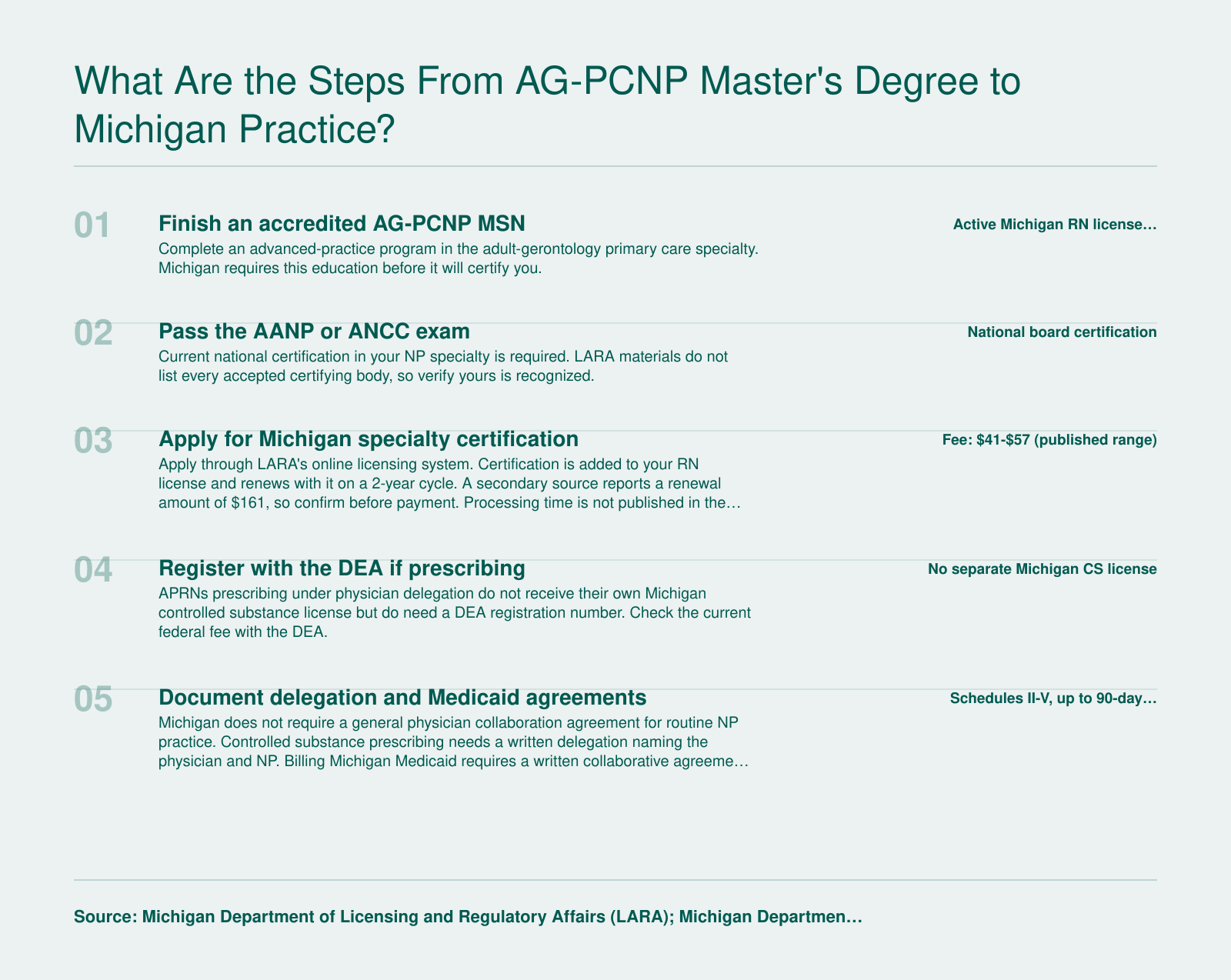
What Are the Steps From AG-PCNP Master's Degree to Michigan Practice?
Michigan adds NP specialty certification to an active RN license through the Michigan Board of Nursing (LARA). Order matters because each credential depends on the one before it. Confirm every fee and form in LARA's current licensing system before paying.
Compare Adult Gerontology Primary Care Nurse Practitioner programs on the data that matters
Explore more Nursing specializations or browse every graduate field.
All Nursing programs