Most Affordable Adult-Gerontology Primary Care Nurse Practitioner (AG-PCNP) MSN Programs
Compare 140+ accredited most affordable Adult Gerontology Primary Care Nurse Practitioner programs at 120+ schools, with graduate earnings, cost, debt, and completion data from IPEDS and the U.S. College Scorecard.

An AG-PCNP credential shouldn't cost six figures in debt, yet the price spread between programs is wide enough to decide whether it does. Published in-state graduate tuition among the schools ranked here runs from $6,693 at Florida Atlantic University to $14,476 at UCLA.
Every program listed is an MSN in adult-gerontology primary care. Adult-gerontology acute care nurse practitioner (AG-ACNP) MSN programs and post-master's certificates are excluded.
Tuition is only the opening number. Preceptor placement, fees, format requirements and accreditation status often determine what a low-cost program really costs by graduation.
Key Points
- Florida Atlantic University lists the lowest in-state tuition at $5,467.
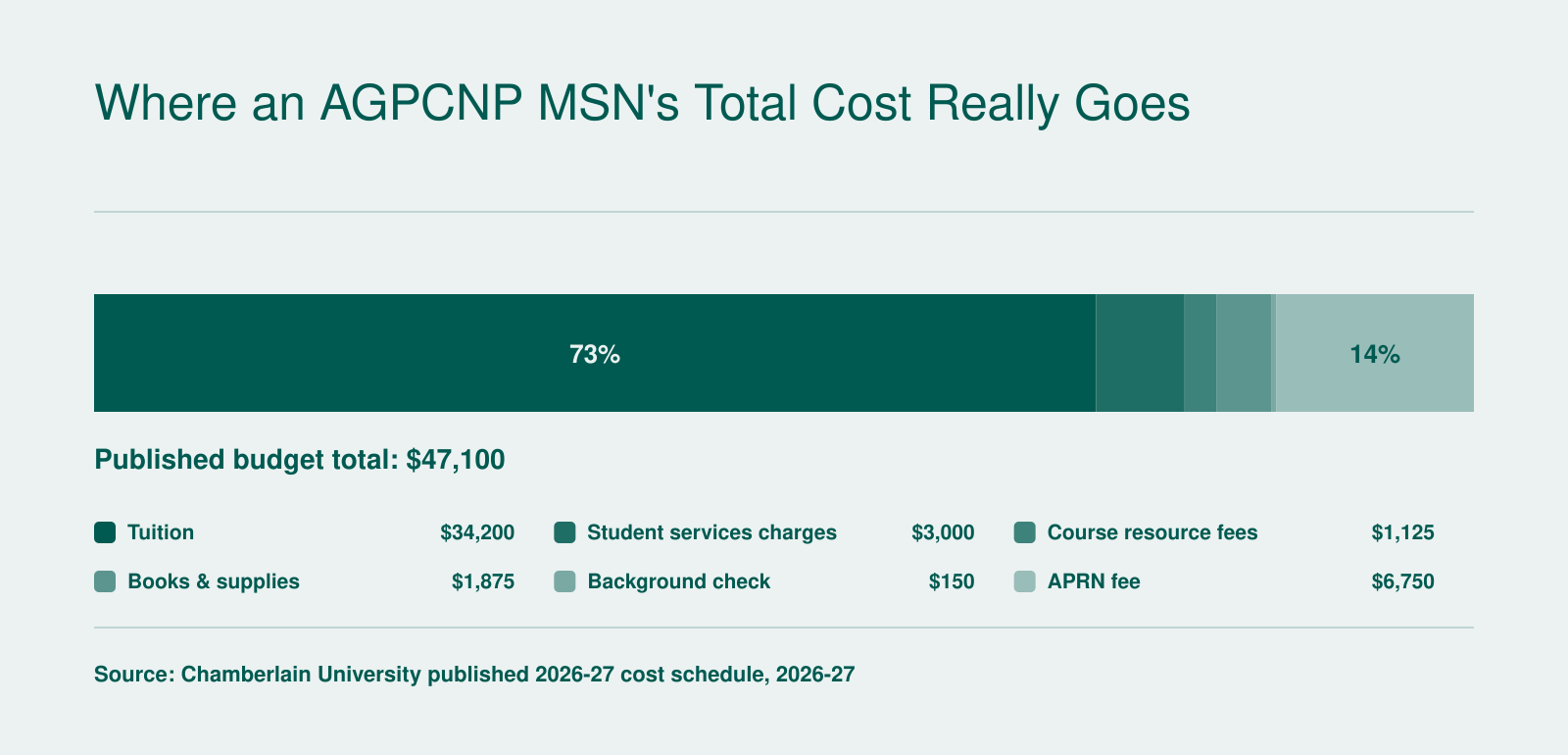
- Chamberlain's 2026-27 budget adds $12,900 beyond its $34,200 tuition line.
- Penn arranges preceptor sites in Pennsylvania, New Jersey, and Delaware.
10 Most Affordable AG-PCNP MSN Programs for 2027
Florida Atlantic University publishes the lowest in-state graduate tuition on this list at $5,467. These 10 programs include online, hybrid, and campus options, so you can compare total price and the format that fits your schedule.
CUNY Hunter College
#1New York, NY · ~$11,000/yr (est.)
Best for: High financial-need students seeking city value
CUNY Hunter College's AGPCNP MS prepares you for comprehensive primary care with adults and older adults in New York community settings. The program blends advanced pathophysiology, pharmacology, and health assessment with sequential clinical practicums and 630 supervised clinical hours. Its daytime and evening class options give working students flexibility.
- 42 total credit hours
- 630 supervised clinical hours
- Prepares for New York State NP certification
- National board certification by ANCC or AANPCB
- 12-week summer session with 210 clinical hours
- Daytime and evening course options
- Sequential clinical practicum courses
- Campus-based program
California State University-Long Beach
#2Long Beach, CA · $9,000 – $19,000/yr (est.)
Best for: Second-career RNs wanting California public affordability
California State University-Long Beach offers a CCNE-accredited MSN concentration in Adult-Gerontology Primary Care with specialty theory and clinical courses focused on primary care management of aging populations. Students choose a thesis, directed project, or comprehensive exam, and California residents pay materially lower tuition and fees than nonresidents.
- CCNE accredited
- 30 to 48 units required
- 3.0 GPA minimum
- Prerequisite courses in statistics, pathophysiology, and physical assessment
- Thesis, directed project, or comprehensive exam option
- California RN license required
- Core courses include advanced pathophysiology, pharmacology, and health assessment
- Specialty courses in Adult-Gerontology Primary Care
College of Staten Island CUNY
#3Staten Island, NY · $10,000 – $15,000/yr (est.)
Best for: Clinically experienced nurses needing evening hybrid classes
College of Staten Island offers a 42-credit, ACEN-accredited Adult Gerontology Primary Care Nurse Practitioner MS with 750 supervised clinical hours across three semesters. Most courses meet one evening a week with some online components and summer and winter sessions, which is well suited to nurses who need to continue working.
- ACEN accredited
- 42 total credit hours
- 750 clinical hours over three semesters
- 3.0 GPA minimum
- Two letters of recommendation required
- One year of clinical experience required
- Courses meet one evening weekly
- Summer and winter sessions offered
Florida International University
#4Miami, FL · ~$11,000/yr (est.)
Florida International University's predominantly online AGPCNP MSN covers disease prevention, health promotion, and management of acute and chronic conditions over six semesters and 45 credits. Students can arrange clinical placements outside South Florida, adding geographic flexibility.
- CCNE accredited
- 6-semester program
- 45 total credit hours
- Predominantly online format
- Fall start
- Clinicals allowed outside local areas
- Option to add Nurse Educator Certificate
- Prepares for national NP certification
Florida Atlantic University
#5Boca Raton, FL · $7,000 – $18,000/yr (est.)
Florida Atlantic University's Adult Gerontological Primary Care Nurse Practitioner concentration is a hybrid online and on-campus program with 52 credits and 780 clinical hours, designed for part-time study over eight semesters. Clinical placements are arranged in South Florida, and no prior clinical experience is required for admission, reducing the entry threshold.
- CCNE accredited
- 52 total credit hours
- 780 clinical hours
- Part-time study over eight semesters
- No entrance exam required
- Hybrid online and on-campus format
- Clinical sites arranged in South Florida
- Prepares for ANCC or AANP certification
University of South Florida
#6Tampa, FL · ~$10,000/yr (est.)
University of South Florida's campus-based AGPCNP MSN requires 57 credits and a comprehensive exam, with coursework spanning research, health policy, leadership, and primary care management. A separate 74-credit occupational health nursing subspecialty adds a workplace and public health lens for those interested in that path.
- CCNE accredited
- 57 total credit hours
- Comprehensive exam required
- Prepares for ANCC or AANPCB certification
- Curriculum includes research, health policy, leadership, and consultation
- 74 total credit hours
- Occupational Health Nursing concentration
- Prepares for ANCC and AANPCB certification
- Combines nursing and public health courses
- Grant funding may cover costs
- Personalized program plan provided
- Campus-based delivery
University of California-Los Angeles
#7Los Angeles, CA · ~$14,000/yr (est.)
UCLA's two-year MSN Adult-Gerontology Primary Care focus sits within the occupational and environmental health nursing area, emphasizing total worker health and primary ambulatory care for adults. It is a strong fit for nurses who want primary care training with an occupational health and safety perspective.
- Occupational and Environmental Health concentration
- Two-year program
- Prepares for national certification exams
- Primary ambulatory care for adults
- Total worker health emphasis
- Includes industrial hygiene and safety content
- Two concentration options
San Diego State University
#8San Diego, CA · ~$10,000/yr (est.)
San Diego State University's MSN in Advanced Practice Nursing of Adults and the Elderly combines Adult Gerontology Primary Care Nurse Practitioner preparation with an Acute and Critical Care Clinical Nurse Specialist concentration. Students complete 768 clinical hours and can pursue national certification through ANCC, AANP, and AACN.
- CCNE accredited
- 768 clinical hours
- Dual AGPCNP and Acute/Critical Care CNS concentration
- Prepares for ANCC, AANP, and AACN certification
- Campus-based program
Purdue University Global
#9West Lafayette, IN · $10,000 – $15,000/yr (est.)
Purdue Global's online MSN AGPCNP track covers advanced physiology, pharmacology, health assessment, and adolescent, adult, women's health, and frail elderly care. ExcelTrack self-paced learning and credit for prior learning can help working nurses shorten the path and reduce cost.
- CCNE accredited
- 2.5 GPA minimum
- Prerequisite courses required
- Capstone or evidence-based project proposal required
- Prepares for ANCC or AANP certification
- ExcelTrack self-paced option
- Credit for prior learning accepted
- 60 to 90 quarter credit hours
Florida Agricultural and Mechanical University
#10Tallahassee, FL · ~$10,000/yr (est.)
Florida A&M University's fully online AGPCNP MSN is a 42-credit program with ACEN and SACSCOC accreditation and full-time or part-time tracks. It offers a flexible online route and an inclusive community, which may appeal to nurses seeking a historically Black university setting.
- ACEN and SACSCOC accredited
- 42 total credit hours
- Full-time and part-time options
- Online delivery format
- 5-semester full-time track
- 7-semester part-time track
- Financial aid available
Cost & outcomes by school
Federal data for the highest-earning Adult Gerontology Primary Care Nurse Practitioner programs, independent of the ranking above. Earnings are this field's master's graduates four years after completing, where the Scorecard reports them.
| School | Earnings | Tuition / yr | Debt | Grads/yr | Format |
|---|---|---|---|---|---|
| University of North Dakota ND | $244,209 | $13,677 | $51,250 | 130 | Online |
| San Diego State University CA | $165,564 | $10,252 | — | 31 | Campus |
| St. Joseph's University-New York NY | $153,908 | $23,278 | $43,045 | 26 | Campus |
| Molloy University NY | $148,040 | $27,520 | $45,750 | 104 | Campus |
| University of Akron OH | $146,142 | $10,125 | $41,000 | 59 | Campus |
| Fairleigh Dickinson University-Metropolitan Campus NJ | $145,105 | $19,068 | $40,432 | 57 | Hybrid |
| Fairleigh Dickinson University NJ | $145,105 | $25,628 | $40,432 | 8 | Online |
| CUNY Hunter College NY | $142,731 | $11,398 | $20,500 | 143 | Campus |
| Felician University NJ | $139,444 | $22,520 | $35,042 | 17 | Online |
| University of California-Los Angeles CA | $136,869 | $14,476 | $50,511 | 151 | Campus |
| West Coast University-Anaheim-Orange County CA | $136,520 | $16,178 | $35,570 | 591 | Online |
| Russell Sage College NY | $135,279 | $13,240 | $43,307 | 44 | Campus |
Sources: U.S. Department of Education. Tuition and graduates: IPEDS. Earnings and debt: College Scorecard, this field's master's graduates; a dash means no figure is reported.
Cost, debt & payoff
Median earnings of this field's master's graduates (4 yrs after completing) vs. their median federal loan debt · U.S. College Scorecard
Across these programs the median graduate earns about $121,815 and finishes with roughly $48,355 in debt — a ratio that clears a common rule of thumb (keep debt below first-year salary). Tuition and debt vary widely school to school, so check the per-school figures in the table above before you shortlist.
Our Scoring Approach: Net Price First, AGPCNP MSN Only
What will an AG-PCNP MSN actually cost you, and will you finish it? Those two questions drive everything below.
The starting point is federal data: graduate tuition and fees reported to IPEDS, average net price after grants and scholarships, and the institution's graduation rate. Where the College Scorecard publishes figures at the program level, median debt at graduation and median earnings after completion get factored in too.
Scope is deliberately narrow. Only master's-level adult-gerontology primary care tracks qualify. Acute care nurse practitioner programs, direct-entry DNPs, and post-master's certificates are left out so the cost figures compare like with like.
Two honest caveats. Net price is a school-wide average built largely on undergraduate aid patterns, not a quote for your situation. And graduation rates describe the whole institution, not the nursing track you would enroll in.
Where an AGPCNP MSN's Total Cost Really Goes
A published 2026-27 budget from Chamberlain University shows where an AGPCNP MSN's total cost can go beyond the headline tuition. In this example, the non-tuition charges add $12,900 on top of the $34,200 tuition line, a reminder to read the full cost sheet before comparing per-credit prices.
Preceptor Placement: The Cost Line Brochures Leave Out
Placement support is now one of the clearest dividing lines between adult gerontology primary care nurse practitioner programs, and it rarely shows up in a tuition table. Penn says faculty handle placement from site finding through onboarding, though mostly in Pennsylvania, New Jersey, and Delaware. Moravian also lists school-arranged placement, but a willing preceptor still doesn't guarantee approval. UT Arlington calls it collaborative: you look first, and the department steps in if you struggle. George Washington encourages students to find their own preceptor. Cincinnati expects a site secured by the end of week two.
Documented clinical hours range from roughly 504 hours at Cincinnati to 600 at George Washington, and hidden costs add up over that time. Budget for travel to sites, reduced work hours, and any paid placement service or preceptor stipend. We found no reliable typical fee for outside services. Saint Joseph's lists a $773 NP clinical fee per selected course, but that figure is program-specific.
Liability coverage also varies. Ask whether the school's policy covers you or whether you must buy your own. Student policies are often modest in price, but confirm the amount.
Before enrolling, ask admissions for the placement support policy in writing.
Related Articles
Fully Online, Hybrid, or On-Campus: Format Fine Print for Low-Cost AGPCNP Programs
Bradley University's online AGPCNP lists no required campus residencies, but other programs are less flexible. West Coast University's RN-to-MSN AGPCNP program requires two on-site intensives in California or Texas, depending on the enrolling campus. Spring Arbor University asks for one four-day residency in year three. Drexel University requires at least one four-day intensive plus on-campus or virtual sessions during clinical courses. For most schools, "online" means online coursework plus one or two campus trips.
Price those trips before you commit. Airfare, lodging, and unpaid days off for a four-day intensive can erase the advantage of a low per-credit rate.
State authorization is the next filter. Herzing University and Wilkes University's online MSN-AGNP program enroll only residents of authorized states, and Wilkes must also be authorized where your clinicals take place. Confirm your state is on the school's eligibility list before paying an application fee.
Entry routes vary as well. Bradley, Wilkes, and Walden accept associate-degree RNs through RN to MSN AG-PCNP routes, while UTA requires RN-to-BSN coursework before the MSN phase. Bridge routes add time, so ask each school for written full-time and part-time timelines.
Both national AGPCNP certification exams reported an 85% first-time pass rate for 2025 (AANPCB's A-GNP and ANCC's AGPCNP-BC). That means roughly 1 in 7 first-timers misses. A cheap program with weak exam results can cost more in retake fees and delayed NP earnings.
CCNE vs. ACEN: Accreditation Checks Before You Pay a Deposit
A low sticker price means little if the program's accreditation can't carry you to a certification exam. State boards of nursing and the national certifiers generally expect a degree from an accredited graduate nursing program, and federal aid depends on accreditation too. ANCC's AGPCNP page lists CCNE, ACEN, or CNEA as accepted accreditors, plus an active RN license and at least 500 faculty-supervised clinical hours. Confirm AANPCB's current wording on its own site.
How to verify
Search the school in the CCNE or ACEN directory rather than trusting a web page. Watch for "pre-accreditation," "candidate," or "probationary" labels, which are most likely on newer low-cost programs. Also check that the listing covers the MSN or certificate track, not just the institution.
Cal State Long Beach lists CCNE accreditation, while College of Staten Island and Florida A&M list ACEN. For the other schools here, get written confirmation.
Finally, ask each school for its AGPCNP-specific certification pass rate, not a blended NP figure.
Employer Tuition Benefits and Scholarships That Shrink the Bill
Employer tuition benefits can quietly erase thousands from an AGPCNP MSN before you borrow a dollar. Many universities work with hospital employers on partnership discounts, commonly 10% to 25%, but terms vary by program and employer. Hospital reimbursement often falls between roughly $3,000 and more than $10,000 per year, with many employers capping assistance at $5,250; HCA Healthcare, for example, uses a $5,250 annual cap. The first $5,250 in employer educational assistance is tax-free in 2026, and reimbursement usually requires an accredited program plus a B average or better. Federal and school aid can layer on top: Nurse Corps Scholarship (closed for 2026 but worth watching next cycle), HRSA Advanced Nursing Education-funded scholarships, and graduate nursing scholarships at individual schools. The practical move is to stack employer aid with in-state public tuition to drive the final cost lowest.
Adult Gerontology Primary Care Nurse Practitioner programs by state
Compare Adult Gerontology Primary Care Nurse Practitioner programs on the data that matters
Explore more Nursing specializations or browse every graduate field.
All Nursing programs