Best Psychiatric Mental Health NP Programs
Compare 300+ accredited Psychiatric Mental Health Nurse Practitioner programs at 230+ schools, with graduate earnings, cost, debt, and completion data from IPEDS and the U.S. College Scorecard.

A psychiatric mental health nurse practitioner (PMHNP) program is a graduate nursing track, typically 43 to 51 credits plus roughly 500 to 750 supervised clinical hours, that qualifies a registered nurse to diagnose psychiatric disorders, prescribe medication, and deliver psychotherapy.
On paper, the programs look alike, much like family nurse practitioner programs. Listed tuition among the schools ranked here runs from $9,992 (Purdue, in-state) to $66,523 (Duke).
The practical differences sit elsewhere. Villanova secures clinical placements for students, while Northeastern expects students to identify their own preceptors. Yale requires three four-day campus immersions on top of online coursework. Those logistics often decide whether a working RN finishes on schedule, just as they do in accredited online nurse practitioner programs.
Key Points
- ANCC certification requires a CCNE or ACEN accredited program.
- Texas Tech Health Sciences Center lists $7,153 in-state but $14,532 out-of-state.
- HRSA counts 7,127 mental health shortage areas as of September 2026.
The 10 Best PMHNP Schools of 2027, Ranked
This shortlist is built for working registered nurses who need an accredited path to prescriptive psychiatric care without pausing their careers. The schools below combine online or hybrid coursework with structured clinical training, with enough part-time and full-time options to fit different lives. Each entry flags the delivery model, clinical load, and admissions requirements most relevant to a PMHNP applicant.
Yale University
#1New Haven, CT · ~$50,000/yr (est.)
Best for: Working RNs needing hybrid prescribing pathway
The three-year curriculum prepares working registered nurses to diagnose mental health conditions, prescribe medications, and deliver psychotherapy across the lifespan. Its CCNE accreditation and simulated clinical training make it a strong choice for RNs who want a flexible path to advanced psychiatric practice without leaving their jobs.
- Hybrid MSN format with online asynchronous coursework
- Three-year program duration
- Three mandatory campus immersions
- Prepares for mental health diagnosis and medication prescription
- Simulated skill demonstrations and clinical training
- CCNE accredited
University of Pennsylvania
#2Philadelphia, PA · ~$48,000/yr (est.)
Best for: Full-time students pursuing neuroscience-informed practice
Penn's MSN Psychiatric Mental Health Nurse Practitioner program blends neuroscience with psychotherapy and psychopharmacology in a hybrid format. Full-time students finish in 14 months, while part-time students take three years, with in-person clinical placements arranged in top health systems. The combination of a fast full-time track and robust financial aid makes it especially attractive for motivated RNs planning to practice in underserved communities.
- Full-time completion in 14 months
- Part-time option takes three years
- Hybrid learning with online courses
- In-person clinical placements in top health systems
- BSN, 3.0 GPA, and RN license required
- College statistics prerequisite
- Total estimated cost roughly $103,526 to $105,814
- Financial aid and fellowships available
- CCNE accredited
Northeastern University
#3Boston, MA · ~$29,000/yr (est.)
Best for: Part-time learners needing discounted online coursework
Northeastern's PMHNP program through the Bouvé College of Health Sciences uses a hybrid format with online coursework and two on-campus clinical intensives. Students can study full-time or part-time, and online courses carry a discounted tuition rate. A one-year direct patient care requirement and no GRE option keep the program focused on working nurses who already bring clinical experience.
- Hybrid online and on-campus format
- Full-time or part-time study options
- Two on-campus clinical intensives
- One year of active direct patient care required
- GRE not required; 3.0 GPA minimum
- 43 credits for MS; 24 for CAGS
- Clinical placements within 100 miles
- CCNE accredited
Vanderbilt University
#4Nashville, TN · ~$58,000/yr (est.)
Vanderbilt's Psychiatric-Mental Health Nurse Practitioner (Lifespan) MSN uses a hybrid model with online classes and brief on-campus sessions. Full-time students complete it in 16 months, with a documented part-time plan and 560 clinical hours. Its lifespan focus, CCNE accreditation, and strong track record in graduate outcomes justify a place near the top of this list.
- Full-time completion in 16 months
- 560 supervised clinical hours
- Part-time study option available
- On-campus sessions last 3 to 5 days
- Lifespan psychiatric mental health focus
- Eligible for ANCC certification
- CCNE accredited
University of Virginia
#5Charlottesville, VA · ~$24,000/yr (est.)
UVA's MSN Psychiatric Mental Health Nurse Practitioner track combines online learning with monthly in-person classes and takes two years full-time or three years part-time. Students complete more than 500 clinical hours in Virginia-based facilities, with an emphasis on underserved and rural populations. The public-university tuition structure and no-GRE admissions make it a high-value option for in-state and out-of-state RNs alike.
- Hybrid with monthly in-person classes
- Two-year full-time, three-year part-time
- 500+ supervised clinical hours
- BSN, 3.0 GPA, and one year RN experience required
- No GRE required
- Focus on underserved and rural populations
- CCNE accredited
Duke University
#6Durham, NC · ~$67,000/yr (est.)
Duke's PMHNP MSN uses a trauma-informed hybrid curriculum with synchronous and asynchronous learning plus on-campus intensives. Rolling admissions, merit scholarships, and a network of more than 2,000 clinical partnerships give working nurses a flexible route to independent practice. The program's focus on tele-mental health and health equity aligns with current psychiatric workforce needs.
- Hybrid synchronous and asynchronous learning
- Rolling admissions
- On-campus intensives for hands-on training
- 2,000+ clinical partnerships nationwide
- Trauma-informed curriculum with tele-mental health focus
- Careers in emergency, inpatient, outpatient, and community settings
- Merit-based scholarships available
- CCNE accredited
University of North Carolina at Chapel Hill
#7Chapel Hill, NC · ~$13,000/yr (est.)
UNC Chapel Hill offers a distance-based MSN with a Psychiatric-Mental Health Nurse Practitioner specialty that emphasizes cultural sensitivity and evidence-based practice. Clinical experiences can be completed in local communities, which helps working nurses stay close to home. Its public-university net price and board certification preparation make it a practical choice for cost-conscious applicants.
- Online distance-based MSN format
- Lifespan psychiatric mental health focus
- Clinical experiences completed locally
- Psychopharmacology and psychotherapy curriculum
- Cultural sensitivity and evidence-based practice
- Prepares for board certification
- CCNE accredited
Boston College
#8Chestnut Hill, MA · ~$38,000/yr (est.)
Boston College's Master of Science, Nurse Practitioner Track includes a Psychiatric-Mental Health Nurse Practitioner concentration with clinical rotations at Boston-area institutions. Multiple pathways serve BSN, non-nursing bachelor's, MSN, and associate degree holders, with starts in fall, spring, and summer. Its Boston clinical network and flexible entry points give it strong appeal for nurses changing specialties or entering advanced practice.
- Campus-based Master of Science, Nurse Practitioner Track
- PMHNP concentration with emotional, cognitive, and social focus
- Clinical rotations at Boston-area institutions
- Direct entry pathway for non-nursing bachelor's
- Starts fall, spring, and summer
- 3.0 GPA minimum and two recommendations
- Financial aid and scholarships available
- CCNE accredited
Villanova University
#9Villanova, PA · $20,000 – $25,000/yr (est.)
Villanova's hybrid MSN in Psychiatric-Mental Health Nurse Practitioner pairs online core courses with in-person clinical experiences and requires 600 direct care hours. The school secures clinical placements in Pennsylvania, New Jersey, and Delaware, which reduces a major preceptorship burden for students. Its evidence-based therapy focus and tuition assistance options make it a practical mid-Atlantic option.
- Hybrid online core courses with in-person clinicals
- 47 total credit hours
- 600 direct clinical care hours
- Clinical placements secured by school in PA, NJ, and DE
- Evidence-based therapies: CBT, Family Systems, Solution-Focused
- Tuition scholarships and assistantships available
- CCNE accredited
Purdue University
#10West Lafayette, IN · ~$10,000/yr (est.)
Purdue's newer hybrid MS in Psychiatric/Mental Health Nurse Practitioner is available as a five-semester, 49-credit pathway with a 630-hour preceptorship. The curriculum emphasizes multidisciplinary study and prepares graduates for ANCC psychiatric/mental health NP certification. Its public-university tuition and part-time flexibility make it a sensible value pick for Indiana and Midwest RNs.
- Hybrid MS in Psychiatric/Mental Health Nurse Practitioner
- Five-semester, 49-credit pathway
- 630-hour preceptorship
- Multidisciplinary preceptorship emphasis
- Eligible for ANCC PMHNP certification
- Certificate track also available
- CCNE accredited
Cost & outcomes by school
Federal data for the highest-earning Psychiatric Mental Health Nurse Practitioner programs, independent of the ranking above. Earnings are this field's master's graduates four years after completing, where the Scorecard reports them.
| School | Earnings | Tuition / yr | Debt | Grads/yr | Format |
|---|---|---|---|---|---|
| University of North Dakota ND | $244,209 | $13,677 | $51,250 | 130 | Online |
| Mount Marty University SD | $221,221 | $16,499 | $88,791 | 6 | Online |
| Medical University of South Carolina SC | $187,865 | $17,574 | $103,353 | 74 | Hybrid |
| California State University-San Marcos CA | $148,800 | $9,606 | $60,000 | 31 | Hybrid |
| Arkansas State University AR | $146,230 | $7,322 | $61,500 | 76 | Online |
| University of Akron OH | $146,142 | $10,125 | $41,000 | 59 | Hybrid |
| Fairleigh Dickinson University-Metropolitan Campus NJ | $145,105 | $19,068 | $40,432 | 57 | Online |
| CUNY Hunter College NY | $142,731 | $11,398 | $20,500 | 143 | Campus |
| University of Nevada-Las Vegas NV | $141,227 | $7,413 | $34,991 | 62 | Hybrid |
| West Coast University-Anaheim-Orange County CA | $136,520 | $16,178 | $35,570 | 591 | Online |
| West Coast University-Texas TX | $136,520 | — | $35,570 | — | Online |
| Stony Brook University NY | $134,363 | $14,222 | $29,728 | 161 | Hybrid |
Sources: U.S. Department of Education. Tuition and graduates: IPEDS. Earnings and debt: College Scorecard, this field's master's graduates; a dash means no figure is reported.
Cost, debt & payoff
Median earnings of this field's master's graduates (4 yrs after completing) vs. their median federal loan debt · U.S. College Scorecard
Across these programs the median graduate earns about $120,723 and finishes with roughly $46,458 in debt — a ratio that clears a common rule of thumb (keep debt below first-year salary). Tuition and debt vary widely school to school, so check the per-school figures in the table above before you shortlist.
How This List Was Built: Accreditation, Cost, and Outcomes
Accreditation is the one requirement no PMHNP program can waive. To sit for the ANCC PMHNP-BC certification exam, you must graduate from a program accredited by either CCNE or ACEN. Both accreditors satisfy ANCC eligibility, and ANCC does not favor one over the other. A university's general reputation is not a substitute: confirm that the specific psychiatric-mental health track, not just the nursing school, holds current accreditation before you apply to nurse practitioner programs. Vanderbilt, for example, states that its MSN programs and Post-Master's Certificate PMHNP-lifespan programs are CCNE-accredited and meet the educational requirements for ANCC certification.
What We Weighed
Beyond accreditation, three factors shaped this list:
- Affordability: Net price and in-state and out-of-state tuition, since what you actually pay varies dramatically between public and private schools here.
- Institutional outcomes: Graduation rates, plus program-level earnings and debt where published.
- Format flexibility: Whether the program runs online, hybrid, or on campus, including accredited online PMHNP programs, and how well it fits working nurses.
A Note on Pass Rates
The national first-time ANCC PMHNP-BC pass rate was 82% in 2025. That figure aggregates candidates from every program and should not be read as any single school's result. Most schools do not publish their own pass rates. MCPHS University is an exception, reporting a 100% ANCC pass rate for 2024.
Lowest Net Price Among Our Ranked PMHNP Schools
Net price is an institution-wide average after grant and scholarship aid, so it is not a quote for the PMHNP program itself. The tuition figures below are published institution-wide rates from 2024 IPEDS data. Compare them alongside program format and state to see which schools carry the lowest published cost.
| School | State | Format | In-State Tuition | Out-of-State Tuition | Net Price |
|---|---|---|---|---|---|
| CUNY Hunter College | New York | Campus | $7,382 | $15,332 | $2,984 |
| Florida International University | Florida | Hybrid | $6,565 | $18,964 | $9,288 |
| California State University-San Marcos | California | Hybrid | $8,082 | $20,682 | $10,229 |
Psychiatric NP Program Tuition and Cost: What You'll Actually Pay
In-State vs. Out-of-State Tuition
Residency matters most at public schools. Among the programs we ranked, listed tuition runs from $7,153 in-state at Texas Tech University Health Sciences Center to $14,532 out-of-state. CUNY Hunter College lists $11,398 versus $20,828, and UNC Chapel Hill lists $12,751 versus $31,408. Florida International University and Cal State San Marcos show similar gaps. Private programs such as Yale ($49,500), Penn ($47,844), Vanderbilt ($57,868), and Duke ($66,523) charge one rate regardless of residency. Confirm whether a school quotes tuition per year or per credit, and add fees, travel to campus immersions, and clinical placement costs.
Debt and Earnings: What's Published
No program-level median debt at completion or typical 10-year monthly payment has been published for these PMHNP programs, so we can't give a debt-versus-earnings payoff for any single school. Program-level graduate earnings are also unavailable. We don't substitute institution-wide earnings figures, because they blend every graduate field at a school and say little about what a PMHNP earns. Until program data appears, compare total tuition against the salary range in your target state and ask each admissions office what recent graduates borrowed.
Three Ways to Lower Your Cost
- Employer tuition reimbursement: Many hospitals and health systems help RNs pay for graduate study, often in exchange for a work commitment. Ask HR before you apply.
- Loan repayment for shortage areas: The HRSA NURSE Corps and National Health Service Corps (NHSC) programs can repay education loans if you work in an eligible shortage-area facility after graduating. Check current eligibility rules for each.
- An in-state public program: The tuition gaps above show this is often the biggest single saving, especially compared with private options.
Related Articles
As of September 2026, HRSA designated 7,127 Mental Health Professional Shortage Areas across the country, home to more than 154 million people. HRSA estimates nearly 5,000 additional mental health practitioners are needed to lift those designations, a gap that keeps PMHNP demand strong.
PMHNP Admission Requirements and Schools That Skip the GRE
Requirements vary by school, so confirm details on each program's current admissions page. The patterns below are common across PMHNP programs, with specifics noted only where our research documented them.
- RN licenseExpect to need an active, unencumbered RN license. Clinical placements are tied to a state, so your license generally has to cover where you'll train. Vanderbilt accepts an unencumbered Georgia license or a multistate license.
- Degree and GPAA BSN from a CCNE- or ACEN-accredited program is the standard entry point. Johns Hopkins' PMHNP DNP also accepts an entry-level nursing master's. A 3.0 minimum GPA is common, though some schools set it higher.
- RN experienceMany programs ask for one to two years. Vanderbilt says competitive applicants have at least one year of full-time RN experience in psychiatric, behavioral health, or a similar setting. Other schools only prefer, rather than require, that background.
- GRE policyThe GRE is increasingly uncommon in PMHNP admissions and is often listed only "if applicable." Our research did not confirm GRE policies for Vanderbilt, Johns Hopkins, Rush, Duke, or Penn, so check each school directly before assuming a waiver.
- Application materialsPlan on transcripts, a personal statement, a resume or CV, letters of recommendation, and often an interview. Some programs also require prerequisites such as statistics, and occasionally anatomy and physiology, microbiology, or psychology.
MSN vs. DNP PMHNP: Matching the Degree to Your Goals
Both degrees qualify you to sit for the same PMHNP certification, so the choice comes down to your goals rather than your eligibility to practice. In purely clinical roles, pay is often similar between the two, especially early in your career. The DNP tends to pay off when you want senior clinical, administrative, or faculty appointments.
| Factor | MSN PMHNP | DNP PMHNP |
|---|---|---|
| Typical length | Shorter, and the faster route to prescribing | Longer, because of the added doctoral coursework and project |
| Clinical hours | 640 median supervised hours | 1,000 median supervised hours (DNP standard: 1,000 post-baccalaureate practice hours) |
| Final project | Varies by program; no doctoral-level project is typically required | DNP scholarly project |
| Cost implications | Generally lower total tuition and less time out of full-time work | Generally higher total cost from additional credits and time |
| Certification | Master's degree accepted for ANCC PMHNP-BC | DNP accepted for ANCC PMHNP-BC |
| Typical annual salary range (2026) | $130,000 to $160,000 | $135,000 to $185,000 |
| Reported enrollment trend (2026) | 1.0% | 9.8% |
| Best fit | Fastest path to practice and prescribing | Leadership, academia, and systems-level roles |
Accreditation and real clinical placement support matter more than sticker price: a cheaper PMHNP program that leaves you hunting for your own preceptors or ineligible for board certification is no bargain.
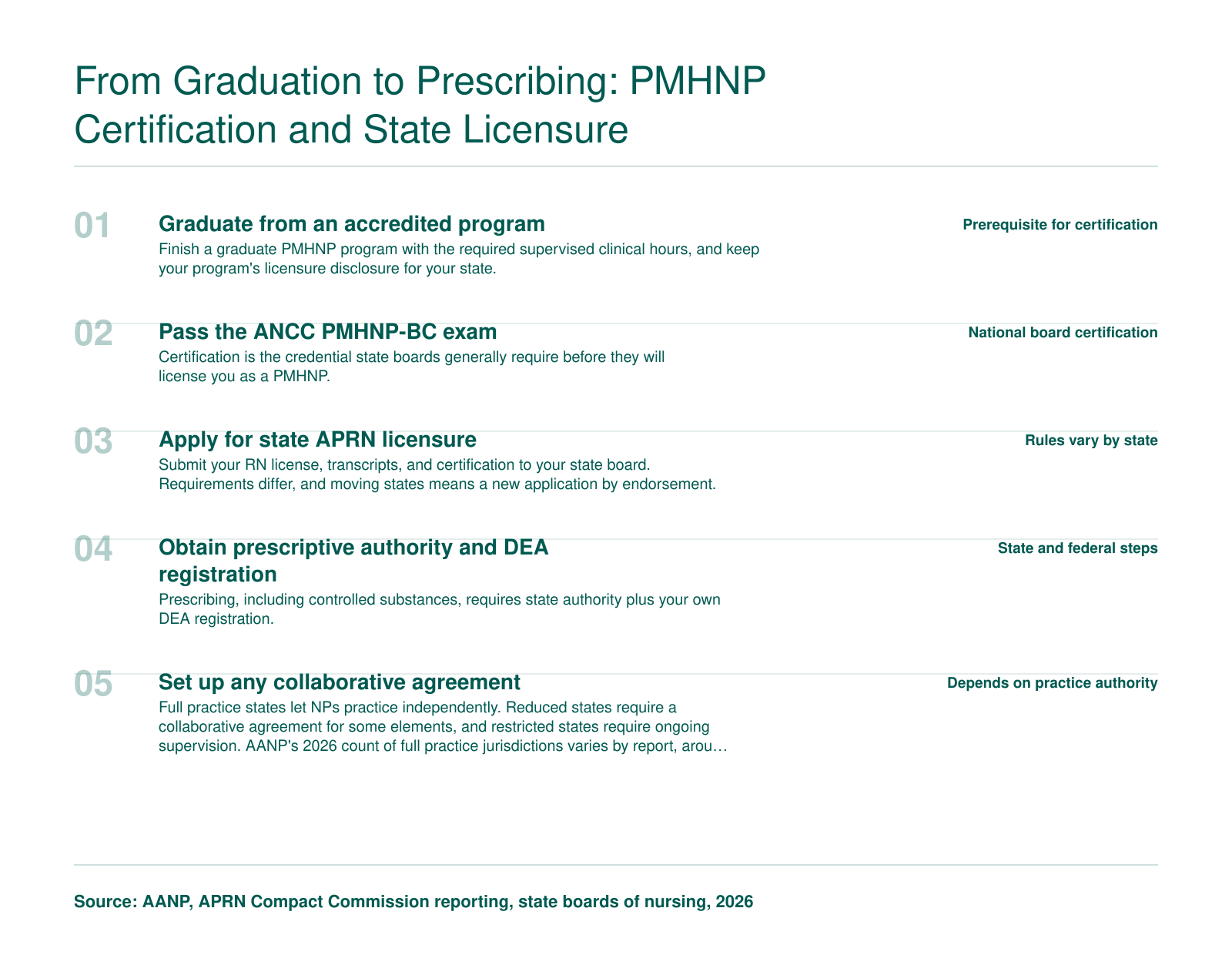
From Graduation to Prescribing: PMHNP Certification and State Licensure
Online students should confirm that their program is authorized in their home state and that its curriculum meets that state's APRN licensure requirements before enrolling. State authorization to enroll students does not guarantee licensure eligibility. The APRN Compact is not yet in effect: five of the seven states needed have enacted it (Delaware, North Dakota, South Dakota, Utah, Wyoming), so no multistate licenses are issued and you must still apply state by state.
Psychiatric Mental Health Nurse Practitioner programs by state
Quick Answers for Prospective PMHNP Students
These short answers cover the questions prospective students ask most often. Policies change by admissions cycle, so confirm details with each program before you apply.
What is the shortest PMHNP program available?
Do PMHNP schools still require the GRE?
How many supervised clinical hours does a psychiatric NP program require?
How much does a psychiatric NP program cost from start to finish?
What separates an MSN PMHNP from a DNP PMHNP?
Can you earn a PMHNP degree with zero campus visits?
When are PMHNP application deadlines and start terms?
Compare Psychiatric Mental Health Nurse Practitioner programs on the data that matters
Explore more Nursing specializations or browse every graduate field.
All Nursing programs