Most Affordable Psychiatric Mental Health Nurse Practitioner (PMHNP) MSN Programs
Compare 300+ accredited most affordable Psychiatric Mental Health Nurse Practitioner programs at 230+ schools, with graduate earnings, cost, debt, and completion data from IPEDS and the U.S. College Scorecard.

Does a low per-credit rate make a PMHNP degree cheap? Often not. Demand for psychiatric nurse practitioners is strong, but the degree also requires hundreds of supervised clinical hours (630 at CUNY Hunter College, 780 at Texas A&M University-Texarkana), and the costs around those hours rarely appear in a tuition table.
Average net price at the ranked schools runs from $2,984 at Hunter to $17,962 at Rasmussen University-Minnesota. That is a gap of nearly $15,000 for the same credential.
Residency rules and state authorization narrow the field further, so the cheapest seat is usually the one in your own state.
Key Points
- West Coast University's mandatory fees add thousands beyond advertised tuition.
- CCNE or ACEN accreditation is required before PMHNP licensure exams.
- Out-of-state enrollment limits can make some online PMHNP tracks unavailable.
The 10 Most Affordable PMHNP MSN Programs for 2027
The programs below earned their spots by keeping the after-aid price low while still showing evidence that students finish. Each card pairs the published residency-based tuition and net price with the delivery format and the school's overall graduation rate, so you can weigh cost against momentum to completion. Where a program publishes a per-credit rate or flat online tuition, that detail is included.
CUNY Hunter College
#1New York, NY · ~$11,000/yr (est.)
Best for: New York RNs needing low-cost graduate study
Hunter College's campus-based PMHNP MS requires 48 credits and 630 supervised clinical hours, with full-time and part-time study plans. In-state graduate tuition is about $7,382 and out-of-state $15,332, with an after-aid net price of $2,984; the program page also lists $470 per credit part-time or $5,545 per full-time semester, and out-of-state students must document New York residency. The school's overall graduation rate is 57%.
- 48-credit master's program
- 630 supervised clinical hours
- Prepares for New York State NP certification
- Covers neuroanatomy, psychopharmacology, and counseling
- Full-time and part-time study plans
- Admissions via NursingCAS
- National board certification ready
- Hunter-Bellevue School of Nursing
California State University-Long Beach
#2Long Beach, CA · $9,000 – $19,000/yr (est.)
Best for: California residents wanting affordable in-state tuition
Cal State Long Beach offers a campus-based MSN with a PMHNP concentration as one of six nurse practitioner specialty areas. The program requires 30 to 48 units and a 3.0 GPA, with CCNE accreditation and California Board of Registered Nursing approval. In-state graduate tuition is about $7,350 and out-of-state $19,950; the after-aid net price is $10,440, and the school's overall graduation rate is 69%.
- 30 to 48 units required
- 3.0 GPA minimum
- CCNE accredited
- Approved by California Board of Registered Nursing
- Requires active California RN license
- Statistics, pathophysiology, and physical assessment prerequisites
- Background check and drug screening required
- Malpractice insurance required for enrollment
Florida International University
#3Miami, FL · ~$11,000/yr (est.)
Best for: Florida nurses balancing work and study
Florida International University offers the PMHNP MSN in hybrid and campus formats; the hybrid track pairs online learning with on-campus sessions over 45 credits and six semesters. The program places students in community mental health centers, psychiatric clinics, and hospitals, and prepares graduates for national certification and state APRN licensure. In-state graduate tuition is about $6,565 and out-of-state $18,964; the after-aid net price is $9,288, and the school's overall graduation rate is 74%.
- Hybrid program format
- 45 credits required
- Six semesters length
- Fall term admission only
- March 1 application deadline
- NursingCAS application system
- Dual Nurse Educator option available
- Prepares for national certification
- 47 total credit hours
- 3.0 GPA minimum
- 3 letters of recommendation minimum
- 770 clinical hours
- Admissions interview required
- Florida RN license required
- BSN must be CCNE or ACEN accredited
- Minimum course grade of 85%
American Public University System
#4Charles Town, WV · $5,000 – $10,000/yr (est.)
American Public University System offers an MSN Nurse Practitioner with a PMHNP specialization, totaling 69 credits split between core and specialization courses. The online-friendly program requires one on-campus pre-clinical immersion weekend and holds CCNE accreditation, with Minnesota State Board of Nursing approval. Graduate tuition is a flat $8,400 regardless of residency, with an after-aid net price of $9,597 and a school-wide graduation rate of 57%.
- 69 total credit hours
- PMHNP specialization
- Fully online option available
- One-weekend on-campus pre-clinical immersion
- CCNE accredited
- Approved by Minnesota State Board of Nursing
- 3.0 GPA minimum
- GPA exception possible at 2.8 to 2.99
California State University-San Marcos
#5San Marcos, CA · ~$10,000/yr (est.)
Cal State San Marcos offers a part-time hybrid MSN with a PMHNP concentration designed for working RNs with a BSN. The 52-unit cohort-based program includes clinical placements and prepares students for ANCC certification and California NP licensure. In-state graduate tuition is about $8,082 and out-of-state $20,682; the after-aid net price is $10,229, and the school's overall graduation rate is 54.6%.
- Part-time hybrid program
- 52 units total
- Designed for working RNs
- Clinical placements included
- ANCC exam eligibility
- California NP certification
- Cohort-based learning
- Thesis or project required
Purdue University Global
#6West Lafayette, IN · $10,000 – $15,000/yr (est.)
Purdue Global's online MSN includes a PMHNP concentration with 60 to 90 quarter credit hours and required clinical practice sessions with preceptors. The program is CCNE accredited and offers an ExcelTrack option for pacing flexibility; students also need a BSN with a 2.5 GPA. Graduate tuition is about $10,101 in-state and $14,412 out-of-state; the after-aid net price is $7,770, and the school's overall graduation rate is 50%.
- Online MSN program
- 60 to 90 quarter credit hours
- Immersive learning experiences required
- Clinical practice sessions with preceptors
- Bachelor's degree in nursing required
- Minimum 2.5 GPA for admission
- CCNE accredited
- ExcelTrack option available
The University of Texas at Tyler
#7Tyler, TX · ~$8,000/yr (est.)
UT Tyler offers an online MSN in PMHNP with 49 credit hours, 750 clinical hours, and two- or three-year completion options. Texas residents benefit from a statutory graduate tuition rate of $50 per semester credit hour plus designated and nursing differential fees, and the published in-state graduate tuition is about $9,736; out-of-state is $25,494. The after-aid net price is $13,323, and the school's overall graduation rate is 54%.
- Online format with flexibility
- 49 credit hours required
- Two-year or three-year options
- 750 clinical hours included
- Prepares for PMHNP-BC exam
- CCNE-accredited curriculum
- 3.0 GPA minimum
- One year nursing experience
University of North Carolina at Chapel Hill
#8Chapel Hill, NC · ~$13,000/yr (est.)
UNC Chapel Hill offers a top-ranked online MSN with a PMHNP specialty, emphasizing psychiatric assessment, psychopharmacology, and evidence-based practice. The distance-based program lets students complete clinicals in their local communities and is CCNE accredited. In-state graduate tuition is about $8,994 and out-of-state $41,203; the after-aid net price is $11,655, and the school's overall graduation rate is 91%.
- Online distance-based format
- Prepares for board certification
- Lifespan psychiatric care focus
- Cultural sensitivity emphasis
- Clinicals in local communities
- CCNE accredited
- Ranked 4th nationally by U.S. News
- Individual and group therapy training
Rasmussen University-Minnesota
#9St. Cloud, MN · ~$7,000/yr (est.)
Rasmussen's online MSN-NP includes a PMHNP concentration and can be completed in about 27 months of full-time study, with an estimated tuition and fees cost of $50,680. The CCNE-accredited program combines virtual immersion with in-person practicums and requires no GRE. Graduate tuition is $11,490 regardless of residency; the after-aid net price is $17,962, and the school's overall graduation rate is 53.5%.
- Online program format
- 27-month completion time
- Estimated cost $50,680
- CCNE accredited
- No GRE requirement
- Requires BSN and RN license
- 3.0 GPA minimum
- Virtual immersion and in-person practicum
Texas A&M University-Texarkana
#10Texarkana, TX · ~$6,000/yr (est.)
Texas A&M University-Texarkana offers an MSN with Family Nurse Practitioner and PMHNP tracks; the PMHNP track requires 50 credit hours and combines online instruction with on-campus intensives in a simulation hospital. Students complete 780 clinical hours and can finish in as little as three years, with guaranteed clinical placement. In-state graduate tuition is about $8,349 and out-of-state $45,080; the after-aid net price is $12,997, and the school's overall graduation rate is 29.6%.
- Hybrid format with online instruction
- 50 total credit hours
- 780 clinical hours
- As little as three years
- Guaranteed clinical placement
- Simulation hospital includes ICU room
- Campus visits three times per semester
- CCNE accredited
Cost & outcomes by school
Federal data for the highest-earning Psychiatric Mental Health Nurse Practitioner programs, independent of the ranking above. Earnings are this field's master's graduates four years after completing, where the Scorecard reports them.
| School | Earnings | Tuition / yr | Debt | Grads/yr | Format |
|---|---|---|---|---|---|
| University of North Dakota ND | $244,209 | $13,677 | $51,250 | 130 | Online |
| Mount Marty University SD | $221,221 | $16,499 | $88,791 | 6 | Online |
| Medical University of South Carolina SC | $187,865 | $17,574 | $103,353 | 74 | Hybrid |
| California State University-San Marcos CA | $148,800 | $9,606 | $60,000 | 31 | Hybrid |
| Arkansas State University AR | $146,230 | $7,322 | $61,500 | 76 | Online |
| University of Akron OH | $146,142 | $10,125 | $41,000 | 59 | Hybrid |
| Fairleigh Dickinson University-Metropolitan Campus NJ | $145,105 | $19,068 | $40,432 | 57 | Online |
| CUNY Hunter College NY | $142,731 | $11,398 | $20,500 | 143 | Campus |
| University of Nevada-Las Vegas NV | $141,227 | $7,413 | $34,991 | 62 | Hybrid |
| West Coast University-Anaheim-Orange County CA | $136,520 | $16,178 | $35,570 | 591 | Online |
| West Coast University-Texas TX | $136,520 | — | $35,570 | — | Online |
| Stony Brook University NY | $134,363 | $14,222 | $29,728 | 161 | Hybrid |
Sources: U.S. Department of Education. Tuition and graduates: IPEDS. Earnings and debt: College Scorecard, this field's master's graduates; a dash means no figure is reported.
Cost, debt & payoff
Median earnings of this field's master's graduates (4 yrs after completing) vs. their median federal loan debt · U.S. College Scorecard
Across these programs the median graduate earns about $120,723 and finishes with roughly $46,458 in debt — a ratio that clears a common rule of thumb (keep debt below first-year salary). Tuition and debt vary widely school to school, so check the per-school figures in the table above before you shortlist.
Our Scoring Formula: Net Price and Aid First, Sticker Price Second
Net price, the average amount a student actually pays after grants and scholarships, carries the heaviest weight in this ranking of psychiatric mental health nurse practitioner programs. That figure matters more than sticker price because it reflects the true out-of-pocket cost for most students, not the published tuition rate. Scholarship and grant aid vary by student, so this figure is a starting point, not a personal quote.
A cost-only list can mislead. A program may advertise a low per-credit rate while fees, low completion rates, or weak clinical placement support push the real price higher. The formula therefore also considers graduate tuition rates and the school's completion record, so a bargain that rarely gets students across the finish line does not look as strong. A low completion rate can extend your time in school, adding living costs and delaying your first NP paycheck.
Two limits matter when reading the numbers. The net price figure averages across the whole institution, so it is approximate rather than a quote for your individual situation; graduation rates also cover the entire school, not just the PMHNP track. The tuition figures used here reflect graduate-level rates, not undergraduate prices that competitors sometimes mix in.
Where Your PMHNP Dollars Actually Go
A PMHNP sticker price is only part of the bill. West Coast University's 2026 cost of attendance shows how mandatory technology and clinical fees, supplies, and transportation add thousands beyond the listed tuition.
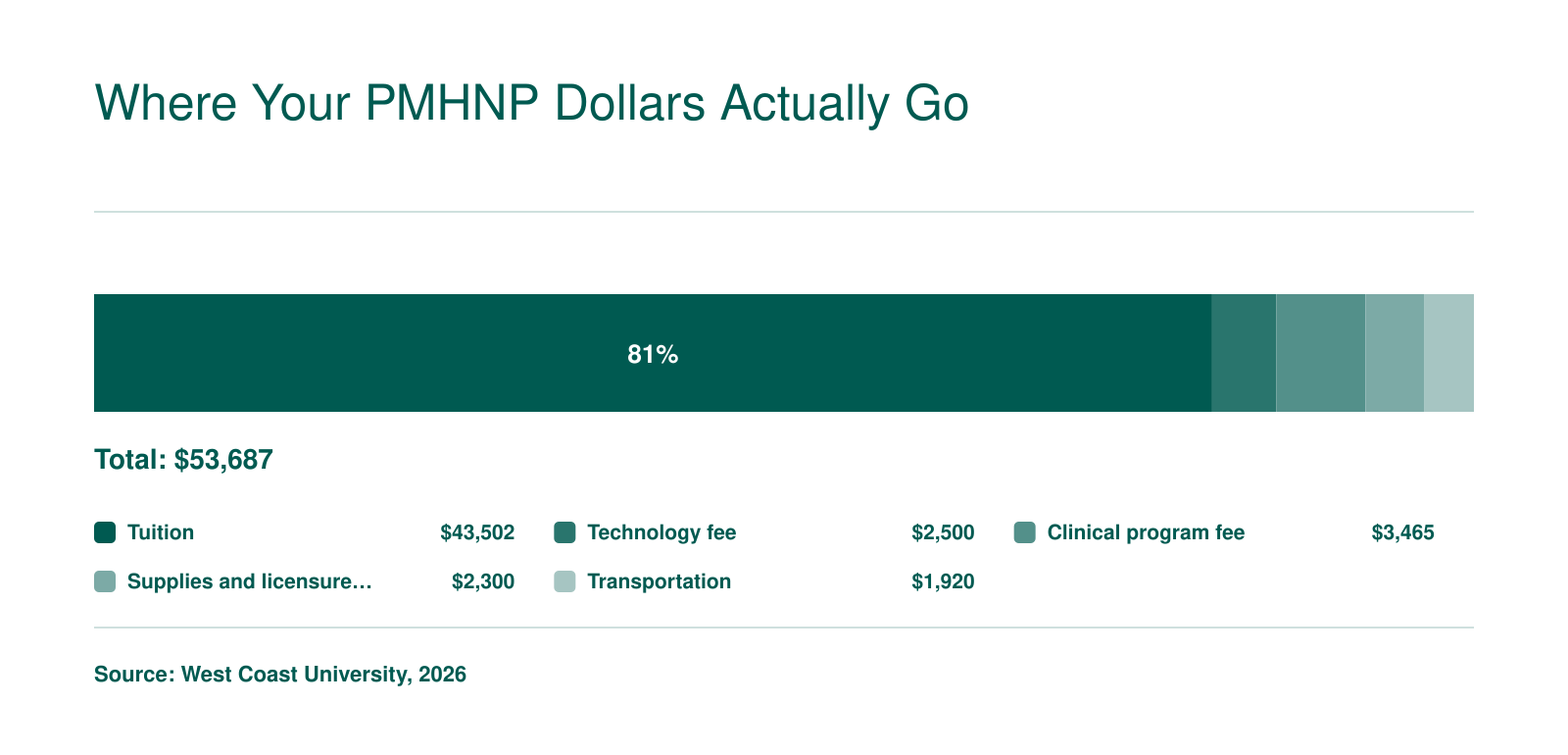
Fees and Clinical Expenses That Inflate a 'Cheap' PMHNP Degree
As online MSN programs have multiplied, the advertised per-credit rate has become a less reliable guide to what students actually pay. Fee structures differ widely across affordable nurse practitioner MSN programs, and the line items below are the ones most rankings skip.
Fees Beyond Tuition
Some schools add a per-credit distance-learning charge. George Mason's online MSN-FNP, for example, lists $850 per credit plus $35 per credit, which on 49 credits adds roughly $1,715. Simmons lists a higher $1,288 per credit but folds technology and support into tuition. Those are FNP examples, not PMHNP-specific, and we found no reliable program-wide norm for clinical-course or graduation fees, so ask each school directly.
Budget for certification too. The 2026 ANCC PMHNP-BC exam fee is $395 for non-members, with a $140 nonrefundable administrative fee that brings the total to about $535. Members pay less: APNA members total $360. Confirm current pricing with ANCC before you register.
Clinical Placement and Travel
If a school leaves placement to you, paid preceptor services fill the gap. Typical rates run $10 to $17.50 per clinical hour, or roughly $1,000 to $2,000 per rotation. MatchNP charges $12 to $15 per hour, takes a $500 deposit applied to your final invoice, and bills nothing if it finds no match. Some programs that arrange placements charge $500 to $1,500 or more per rotation, and background checks, drug screens, and travel come on top. Several rotations can turn a modest line item into a major expense.
A Simple Cost Formula
(Per-credit rate × total credits) + (all per-term fees × number of terms) + clinical and travel estimate + certification and graduation fees.
Before you apply, ask admissions for a full program cost sheet that itemizes every mandatory fee and states whether placement is included. It is the fastest way to compare programs fairly.
Related Articles
Online vs. Hybrid PMHNP Tracks: Campus Visits, Timelines, and Pacing
Fully online and hybrid PMHNP MSN tracks differ less in curriculum than in how much on-campus time a student must schedule before clinical rotations. The examples below show what that means for travel, synchronous class commitments, and pacing.
| Comparison point | Fully online PMHNP formats | Hybrid PMHNP formats |
|---|---|---|
| Campus intensive requirement | Xavier has no required campus immersion beyond local clinicals; Pittsburgh includes short on-campus immersion experiences; Rockhurst requires one three-day clinical immersion on campus. | Yale requires three mandatory in-person immersions on its campus; Frostburg State is roughly 90 to 95 percent online and does not list a separate multi-day immersion count. |
| Synchronous vs asynchronous coursework | Xavier uses asynchronous courses with no set meeting times, though practicum and scholarly project courses may add an instructor-chosen online synchronous session; Milwaukee School of Engineering mixes synchronous and asynchronous meetings. | Frostburg State combines synchronous and asynchronous formats for much of its online coursework; Yale's hybrid structure includes in-person immersions, so on-campus time is mandatory, while synchronous class details vary by course. |
| Typical full-time completion time | Many BSN-entry fully online PMHNP MSN tracks can be completed full time in about two years, with part-time paths often running three to four years. | Hybrid programs usually fall in a similar two-year full-time range, but campus intensives may require students to block out several specific days during the term. |
| Travel cost implications | Programs with no campus immersion, such as Xavier, avoid classroom travel and only require local clinical site travel; Rockhurst's one three-day immersion adds one round trip plus lodging. | Three Yale immersions mean three round trips and extra lodging nights, a larger travel line item than a single-visit online program; Frostburg's mostly online format keeps most work off campus, but students should budget for travel if the program schedules any in-person component. |
| Local clinical hours requirement | Clinical hours are completed in person at approved local sites even when all didactic coursework is online. | Clinical hours are also local and in person; campus immersions are in addition to those hours, not a substitute. |
Clinical Placement Support and Out-of-State Enrollment Limits
A low tuition bill can quietly transfer the hardest work in the degree onto you: finding a psychiatric preceptor willing to supervise hundreds of hours of direct patient care. That tradeoff is the single biggest hidden variable separating a cheap PMHNP program from a cheap one you can actually finish on schedule.
Three placement models, three very different workloads
Schools generally fall into one of three camps. Some secure and assign your clinical sites outright. Others assist, meaning a coordinator reviews, approves, and contracts with sites you help identify. The third group leaves preceptor recruitment largely to the student. Budget programs cluster toward the assisted and student-sourced end, because placement teams cost money. Texas State's online MSN is explicit that students contact sites themselves while a coordinator facilitates and approves arrangements; the university holds more than 1,000 clinical agreements but does not assign placements or guarantee one. Fresno State requires sites and preceptors to be approved and contracted, with preceptors generally holding an unencumbered California license unless practicing in a federal setting such as the VA.
Hours matter here because they define the scale of the search. NONPF describes a 500-hour minimum of supervised direct patient care per population focus, while the National Task Force standard cited for full-scope NP preparation is 750 direct patient care hours. Fresno State requires 540 total practicum hours with at least 500 direct, telehealth included. UNC Greensboro's post-graduate certificate requires 510 new hours and credits at least 300 prior NP hours.
State authorization can disqualify you before you apply
Online does not mean nationwide. Pittsburgh's online nurse practitioner programs require in-person clinicals in your residence state and are unavailable in Alabama, Alaska, Arizona, California, and Delaware. Arkansas State's online PMHNP is limited to Arkansas and Tennessee residents. UMass Amherst cannot currently accept PMHNP certificate students living in Alabama, Minnesota, New York, Oregon, or Washington. Felician admits from a defined list, and New York students must complete all clinical hours in New Jersey, with a New Jersey nursing license expected beforehand. Wilkes requires authorization and licensure in the clinical state, and moving mid-program can jeopardize continuation.
Ask admissions these three questions
- Who finds the preceptor: the school, a shared effort, or you alone?
- Is there a placement fee, and is it charged per term or per clinical course?
- What happens if no preceptor is found by the start date: deferral, leave of absence, or dismissal?
Psychiatric NP Earning Power in One Number
Accreditation Check: CCNE and ACEN Status for Ranked Programs
A regionally accredited university and a nursing program with its own specialty accreditation are not the same thing, and only the second one protects your path to licensure. Graduating from a CCNE- or ACEN-accredited program is generally required to sit for the ANCC PMHNP-BC certification exam, and most state boards of nursing require it for APRN licensure. Either accreditor works. What matters is that the master's program itself holds the status.
Status for Schools We Could Confirm
- Arkansas State University: MSN, Psychiatric Mental Health Nurse Practitioner. Accreditor: ACEN. Status: accredited. Next review year: confirm in the ACEN directory.
- Florida Southern College: MSN, Psychiatric Mental Health Nurse Practitioner. Accreditor: CCNE. Status: accredited. Next review year: confirm in the CCNE directory.
- Stony Brook University: PMHNP MSN. Accreditor: CCNE. Status: accredited. Next review year: confirm in the CCNE directory.
Scheduled review years were not available to us, so we have left them for you to look up rather than guess. We also could not verify accreditor or status for every other school mentioned on this page, so treat those as unconfirmed until you check.
Verify Before You Apply
Search the CCNE accredited programs directory by institution, state, or program (master's level), or use the ACEN program search. Newer PMHNP tracks are sometimes added to an existing accredited degree or are still under review, so confirm that the specific track is covered. If the directory is unclear, ask the admissions office for written confirmation.
Psychiatric Mental Health Nurse Practitioner programs by state
Quick Answers on PMHNP Cost, Length, and Clinical Support
Cost, time, and clinical logistics drive most PMHNP decisions. These quick answers focus on what the program data shows, including where the shortest tracks are and what working nurses should expect from rotations.
What is the cheapest PMHNP program online?
How much does a PMHNP program cost?
What is the shortest PMHNP program?
Are there 1 year PMHNP programs online?
Do affordable PMHNP programs include clinical placement support?
Is accreditation important for PMHNP programs?
Can you keep working as an RN while enrolled in a low-cost PMHNP program?
Compare Psychiatric Mental Health Nurse Practitioner programs on the data that matters
Explore more Nursing specializations or browse every graduate field.
All Nursing programs