Best Family Nurse Practitioner (FNP) Programs
Compare 460+ accredited Family Nurse Practitioner (FNP) programs at 400+ schools, with graduate earnings, cost, debt, and completion data from IPEDS and the U.S. College Scorecard.

The push to make the doctorate the standard entry credential for nurse practitioners has not retired the MSN, and the programs ranked here, across online, hybrid, and campus formats, still offer both routes to FNP certification.
Under that shared label, the differences are large. Required clinical hours run from 500 at George Mason to 786 at USC. Published graduate tuition runs from under $7,000 at Brigham Young to more than $72,000 at USC.
Placement may matter most. Northeastern expects students to find their own preceptors, while NYU arranges placements through faculty. That one policy can add months and thousands of dollars to a degree.
Key Points
- Published graduate tuition across the ranked FNP programs runs from roughly $6,700 upward.
- Out-of-state premiums at the five cheapest schools range from about $10,080 to $11,800.
- Only CCNE or ACEN accreditation qualifies you for AANPCB or ANCC certification, so verify it before applying.
10 Family Nurse Practitioner Programs in the U.S. for 2027
The programs below earned their place by clearing a federal data screen first: real net price after aid, institution-wide graduation rates, and early-career earnings among nursing master's completers, before brochure claims were considered. Each card shows delivery format, tuition, and average net price; net price is an institution-wide approximation, not a program-specific figure.
University of California-Los Angeles
#1Los Angeles, CA · ~$14,000/yr (est.)
Best for: California RNs pursuing doctoral-level FNP
UCLA's School of Nursing offers a Post BSN-DNP pathway for registered nurses aiming at doctoral-level advanced practice, with a Family Nurse Practitioner specialty among four options. The three-year program requires a California RN license, 3.0 GPA, and three recommendation letters, and its inaugural cohort began in Fall 2025. Clinical training draws on health-care systems in Los Angeles County, making it a strong option for nurses who want to stay in the region.
- CCNE accredited graduate nursing program
- Four NP specialty options, including Family Nurse Practitioner
- Three-year Post BSN-DNP pathway
- 3.0 minimum GPA and three recommendation letters
- California RN license required
- Inaugural cohort started Fall 2025
- Prerequisites include statistics, research, physical assessment, and human physiology
University of Michigan
#2Ann Arbor, MI · $29,000 – $58,000/yr (est.)
Best for: Working RNs needing hybrid flexibility
University of Michigan's School of Nursing pairs a hybrid primary care FNP track with an optional combined nurse-midwifery/FNP specialty, giving working RNs a path to advanced practice without relocating to Ann Arbor full time. The hybrid model keeps required campus time to three days per term, with both two-year and three-year plans available. Early-career median earnings for nursing master's completers one year out are about $91,800.
- MSN and DNP options available
- Hybrid online format with three on-campus days per term
- Two-year and three-year plans available
- Prepares for FNP certification
- Clinical experience and prerequisite coursework required
- Digital education option available
- Focus on primary care across the lifespan
- Combined nurse-midwifery and FNP track
- MSN degree level, hybrid delivery
- Prepares for dual nurse-midwifery and FNP certification
- Curriculum spans health sciences theory and clinical care
- Includes pregnancy and childbirth content
Vanderbilt University
#3Nashville, TN · ~$58,000/yr (est.)
Best for: Certification-focused candidates wanting geographic placement choice
Vanderbilt's School of Nursing offers both a four-semester FNP program and an extended dual nurse-midwifery/FNP route, both in a hybrid format built around online coursework and focused campus intensives. The FNP track emphasizes board readiness, reporting first-time certification pass rates about 10% above the national average. Students complete 600 or more clinical hours, with clinical placements in preferred geographic areas and special funding for rural and underserved community care.
- Hybrid online format with on-campus sessions
- Complete in four full-time semesters
- Over 600 clinical hours
- Part-time plans available
- 10% higher first-time board pass rate than national averages
- Clinical placements in preferred geographic areas
- Incorporates 2021 AACN Essentials
- Special funding options for rural and underserved care
- Dual nurse-midwifery and FNP specialty
- Eight full-time semesters
- Hybrid online and in-person format
- Over 1,400 clinical hours
- MSN degree level
- Prepares for dual certification
- Clinical placements arranged
- Funding opportunities available
University of Virginia
#4Charlottesville, VA · ~$24,000/yr (est.)
University of Virginia's FNP program is a hybrid program designed for working BSN-prepared nurses, with classes held on campus Thursdays and Fridays and full-time or part-time options. Admission requires a 3.0 GPA, one year of RN experience, and three recommendations, though no GRE is needed. The curriculum combines 23-24 core credits with 12 specialty and 11 practicum credits, leading to eligibility for ANCC or AANPBC certification.
- Hybrid format with on-campus classes Thursdays and Fridays
- Full-time two-year or part-time three-year plans
- 3.0 minimum GPA and one year RN experience required
- Three recommendation letters and $85 application fee
- No GRE required; alumni guaranteed admission
- 23-24 credit hours core plus 12 specialty and 11 practicum credits
- Eligible for ANCC or AANPBC certification exams
- January 5 application deadline; fall and spring starts
San Jose State University
#5San Jose, CA · ~$10,000/yr (est.)
San Jose State's MSN with FNP concentration uses a hybrid format, pairing online coursework with in-person Tuesday evening classes and clinical rotations. The full-time cohort model spans five semesters and admits only in the fall, with a small cohort that requires a BSN, a 3.0 GPA, and a California RN license. Clinical practicum courses prepare graduates for FNP certification.
- Hybrid format with online coursework and Tuesday evening classes
- Full-time cohort model spanning five semesters
- Fall admission only
- 3.0 GPA, BSN, and California RN license required
- Small cohort size
- Two years of nursing experience preferred
- Clinical practicum courses included
- Eligible for FNP certification
Northeastern University
#6Boston, MA · ~$29,000/yr (est.)
Northeastern's FNP MSN program combines online coursework with in-person clinical experience, designed for working RNs with full-time and part-time options. Admission requires a BSN, 3.0 GPA, current RN license, one year of nursing experience, and two recommendations, but no GRE. The 47-credit curriculum includes 750 clinical hours, with clinical placements within 100 miles of campus and on-campus intensives twice during the program.
- Hybrid format with online coursework and in-person clinicals
- Full-time and part-time options
- 47 total credits and 750 clinical hours
- Fall and spring start terms
- No GRE; 3.0 GPA and one year RN experience required
- Two recommendation letters and statistics prerequisite
- On-campus intensives twice per program
- Clinical placements within 100 miles; students find own preceptors
Duke University
#7Durham, NC · ~$67,000/yr (est.)
Duke's FNP MSN uses a hybrid format with mostly online coursework, synchronous virtual sessions, and focused campus intensives, allowing students to complete clinical placements near home through a network of more than 2,000 partner facilities. Optional specializations in cardiology, endocrinology, oncology, and orthopedics let students tailor their training, and the program reports a projected 38% APRN job growth. Early-career median earnings for nursing master's completers one year out are about $109,700.
- Hybrid format, mostly online with synchronous online classes
- Focused on-campus intensives
- Complete in under three years
- Rolling admissions
- 4 concentration options, including cardiology, endocrinology, oncology, and orthopedics
- Clinical network of more than 2,000 partner facilities
- High-fidelity simulation experiences
- Clinicals can be completed near home
University of South Florida
#8Tampa, FL · ~$10,000/yr (est.)
University of South Florida's FNP MSN is a 60-credit hybrid program focused on primary care across the lifespan, with coursework in clinical judgment, research, health policy, and leadership. Graduates are eligible to take the ANCC or AANPCB certification exams, and the program requires a comprehensive examination at completion. Early-career median earnings for nursing master's completers one year out are about $108,000.
- Hybrid delivery format
- 60 credit hours required
- Prepares for ANCC and AANPCB certification
- Comprehensive examination required
- Focus on clinical judgment, research, health policy, and leadership
- Family Nurse Practitioner concentration across lifespan
California State University-Long Beach
#9Long Beach, CA · $9,000 – $19,000/yr (est.)
California State University-Long Beach offers a campus-based MSN with a Family Nurse Practitioner specialty designed for California RNs seeking advanced primary care roles. The 30-to-48-unit program requires a 3.0 undergraduate GPA and prerequisites in statistics, physical assessment, and pathophysiology, with clinical training in diverse primary care settings. It is CCNE accredited and approved by the California Board of Registered Nursing.
- Campus-based MSN with FNP specialty
- 30 to 48 units of coursework
- 3.0 GPA and California RN license required
- Prerequisites in statistics, physical assessment, and pathophysiology
- CCNE accredited and California BRN approved
- Family-focused theory and clinical courses
- Culminating project or thesis option
- Bachelor's degree in nursing preferred
Brigham Young University
#10Provo, UT · $5,000 – $10,000/yr (est.)
Brigham Young University's FNP program is a campus-based master's in Provo, Utah, centered on advanced clinical training, leadership, and compassionate service. The thesis-based curriculum has students present research at conferences and publish in journals like Contemporary Pediatrics, while community partnerships such as Moab dental education and helicopter rescue training add real-world experience. Students also participate in legislative advocacy at the Utah State Capitol.
- Campus-based program in Provo, Utah
- Thesis-based research project required
- Students present research at conferences and publish in journals
- Community partnerships include Moab dental education and helicopter rescue training
- Advocacy experience at Utah State Capitol
- CCNE accredited
- Focus on compassionate, holistic, patient-centered primary care
Cost & outcomes by school
Federal data for the highest-earning Family Nurse Practitioner (FNP) programs, independent of the ranking above. Earnings are this field's master's graduates four years after completing, where the Scorecard reports them.
| School | Earnings | Tuition / yr | Debt | Grads/yr | Format |
|---|---|---|---|---|---|
| University of North Dakota ND | $244,209 | $13,677 | $51,250 | 130 | Hybrid |
| Mount Marty University SD | $221,221 | $16,499 | $88,791 | 6 | Hybrid |
| Texas Wesleyan University TX | $219,488 | $19,499 | $147,822 | 3 | Hybrid |
| AdventHealth University FL | $214,531 | $30,280 | $134,000 | 46 | Online |
| Gannon University PA | $197,954 | $23,840 | $110,884 | 16 | Hybrid |
| Medical University of South Carolina SC | $187,865 | $17,574 | $103,353 | 74 | Hybrid |
| York College of Pennsylvania PA | $159,209 | $8,340 | $59,250 | 7 | Online |
| Fresno Pacific University CA | $155,201 | $13,780 | $41,000 | 22 | Campus |
| California State University-Dominguez Hills CA | $151,224 | $8,978 | $23,500 | 54 | Hybrid |
| Youngstown State University OH | $147,080 | $6,848 | $48,456 | 93 | Online |
| CUNY Lehman College NY | $144,722 | $11,570 | $22,052 | 18 | Campus |
| Sonoma State University CA | $144,371 | $10,148 | $41,000 | 32 | Hybrid |
Sources: U.S. Department of Education. Tuition and graduates: IPEDS. Earnings and debt: College Scorecard, this field's master's graduates; a dash means no figure is reported.
Cost, debt & payoff
Median earnings of this field's master's graduates (4 yrs after completing) vs. their median federal loan debt · U.S. College Scorecard
Across these programs the median graduate earns about $120,857 and finishes with roughly $44,104 in debt — a ratio that clears a common rule of thumb (keep debt below first-year salary). Tuition and debt vary widely school to school, so check the per-school figures in the table above before you shortlist.
Which Ranked FNP Programs Carry CCNE or ACEN Accreditation
A school that calls itself accredited and a nursing program, such as an MSN program, that holds CCNE or ACEN accreditation are two different claims, and only the second one gets you to the certification exam.
Why It Is Non-Negotiable
AANPCB and ANCC let only graduates of accredited graduate nursing programs sit for FNP certification. Most state boards then require that national certification before they will license you as an APRN. A degree from a program without the right accreditation can leave you unable to turn your coursework into a license. Exact eligibility wording, and how each certifier treats candidacy or new programs, can change, so confirm it with AANPCB and ANCC before you enroll.
What We Can Confirm
Four ranked programs state on their own materials that they are CCNE-accredited:
- Cal State Long Beach: MSN, Family Nurse Practitioner specialty
- Michigan State University: Nurse Practitioner program, FNP concentration
- University of Southern California: MSN-FNP
- George Mason University: MSN with an FNP concentration
These are school statements, so verify them in the directory before relying on them. For the other ranked programs, including Duke, Vanderbilt, Michigan, Virginia, Northeastern, NYU, and USF, we have not independently confirmed the accrediting body here, and you should not assume it.
One flag: UCLA's program lists Fall 2025 as its inaugural cohort. A program that new may be in new-program or candidacy status, so ask the admissions office what its status is and how it affects certification eligibility.
How to Check Status Yourself
- CCNE directory: Search by institution, state, and program type (master's, DNP, or post-graduate APRN certificate).
- ACEN search tool: Filter by program name, location, program type, accrediting organization, and accredited versus candidate status.
- What to look for: Confirm the listing covers the degree you want (MSN or DNP), and note the next scheduled review date.
A school's regional accreditation covers the institution as a whole, not its nursing program.
First-Time Board Pass Rates at the Ranked Schools: AANPCB and ANCC Results
A first-time pass rate is the share of a program's graduates who pass a national FNP certification exam on their first attempt. It matters because you cannot practice as an FNP without passing one of two exams, and a program's results hint at how well its curriculum prepares you for them.
The National Benchmark
For 2025, the American Academy of Nurse Practitioners Certification Board (AANPCB) reported an 81% first-time pass rate for FNP candidates, across 15,395 initial FNP exams. The American Nurses Credentialing Center (ANCC) lists an 82% pass rate for its FNP certification, citing its 2025 certification data. Treat those two numbers as the yardstick. A program well below them deserves questions. One at or modestly above them is performing normally.
What the Ranked Schools Disclose
School-level reporting is thin. Among the programs in our top 10, we found no clearly labeled first-time results by exam and year. Vanderbilt advertises a "10% higher certification pass rate" without giving the underlying figure.
Two schools in our wider comparison set do publish numbers, with caveats:
- University of Southern California: ANCC pass rate of 92% and AANP pass rate of 88%, with no reporting year given.
- Michigan State University: a "90% licensure pass rate," with no exam named and no year.
Undated, unlabeled figures are marketing claims until verified. For scale, New Mexico Highlands University (not ranked here) posted 100% for December 2025, but that rested on six candidates, four FNP and two AGNP. Small cohorts swing wildly.
What to Ask Admissions
Request the last three years of first-time results, split by exam (AANPCB or ANCC) and by FNP graduates only. Ask how many candidates tested each year.
How the Two Exams Differ
The AANPCB exam is clinically focused, built around assessment, diagnosis, and management of patients. The ANCC exam covers clinical content too but adds professional-role material such as ethics, policy, and practice issues. Many graduates are eligible for either, so ask which exam the school's graduates most often take.
What You'll Actually Pay: Tuition, Net Price, and the Fees Schools Bury
The sticker price on an FNP program is only the opening bid, and the gap between public and private schools is wide enough to change which options are realistic. Across the ranked programs, published graduate tuition ranges from roughly $6,700 at Florida Atlantic University (in-state) to about $57,900 at Vanderbilt University. Public in-state figures mostly fall between about $6,700 and $28,900, with Michigan at the top. Out-of-state public tuition climbs from about $18,500 at Florida Atlantic to more than $57,000 at Michigan, so residency can matter as much as the school's name. BYU charges one rate for everyone, about $8,400.
Net Price Is Directional
Net price is the average amount students pay after grants and scholarships, calculated across the entire institution rather than for FNP students alone. Among the ranked schools it runs from about $6,100 at Stanislaus State to about $18,200 at Ramapo College. Vanderbilt's is about $15,800, far below its sticker price. Treat these as signals, not quotes. Your own aid offer is the only number that counts.
Costs Beyond Tuition
Amounts vary by school and clinical site, and no reliable national total exists. Budget for:
- Clinical placement: Some schools include coordination in tuition. Others, or outside services, can add several hundred to several thousand dollars.
- Immersion travel: Transport, lodging, meals, and missed work can reach several hundred to several thousand dollars per trip.
- Background checks and drug screens: Often about $50 to $200 per cycle, repeated if a site requires it.
- Malpractice insurance: Sometimes provided, sometimes about $30 to $150 a year.
- Clinical tracking software: Typhon-style logging often runs about $50 to $200, and some schools bundle it.
- Board exams: AANPCB charges $240 for members and $315 for non-members. ANCC charges $290 to $395 depending on membership. Two attempts can reach $630 (AANPCB) or $790 (ANCC).
What Borrowing Looks Like
No program-level median federal debt or 10-year monthly payment figures have been published for these FNP programs, so we cannot give you an FNP-specific number. The closest signal is institution-wide median graduate debt, which spans about $11,100 at BYU to $24,600 at Delaware. That covers all graduate students, so use it only to compare schools, not to predict your own loan balance.
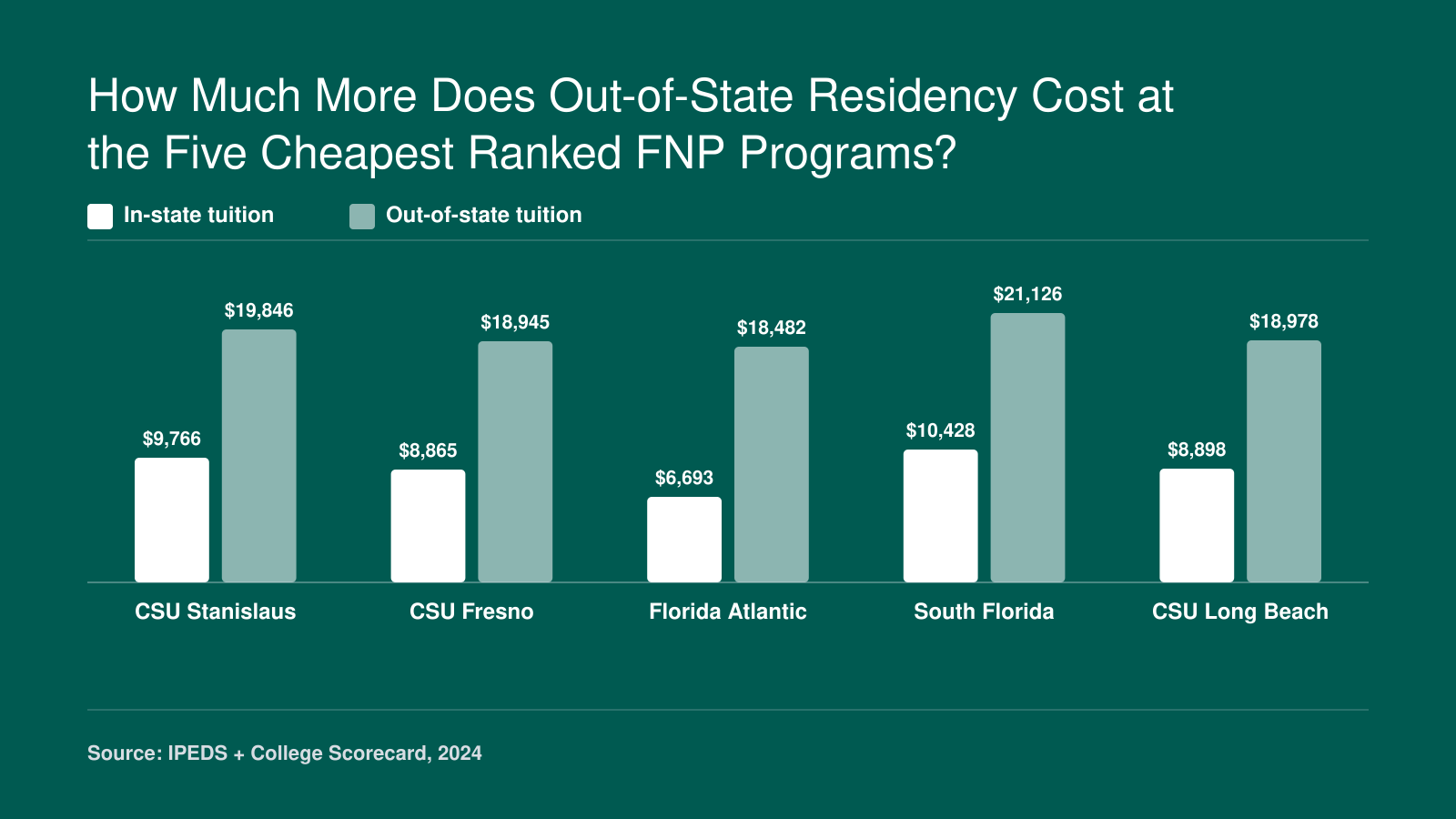
How Much More Does Out-of-State Residency Cost at the Five Cheapest Ranked FNP Programs?
Residency changes the price at every one of these five programs. The out-of-state premium runs from about $10,080 at the three California State campuses to about $11,800 at Florida Atlantic. Three of the five are hybrid, so students enrolling from another state should confirm with the school which rate applies to their format before counting on the in-state figure.
Related Articles
A program that leaves you to find your own clinical placements hasn't lowered its price. It has quietly handed you the extra cost, and the extra months, to absorb yourself.
Application Checklist: Prerequisites, Deadlines, and Funding Sources
Requirements vary by school, so confirm each program's current standards before you apply. These are the items that recur most often.
- Accredited BSN (or a bridge path)Most programs expect a BSN from a CCNE- or ACEN-accredited school. ADN-prepared nurses can often use an RN-to-MSN bridge, which adds coursework and time.
- Active, unencumbered RN licensePrograms require an unrestricted license. Many prefer or require it in the state where you will complete clinical placements.
- GPA and RN experienceA 3.0 GPA is common, though some schools want 3.2 or higher, or a B in statistics and science courses. Many MSN-FNP programs admit directly from the BSN. Others ask for about one year of RN work, and post-graduate or DNP tracks may expect more.
- GRE, references, essay, interviewThe GRE is increasingly waived or optional, especially for applicants with a qualifying GPA. Expect 2–3 professional or academic references, a personal statement, a CV, and transcripts. Many programs also interview selectively.
- DeadlinesFall is the main start. Applications often open in the prior summer or early fall and close between December and March, while some programs use earlier or rolling deadlines. Spring starts are less common, with applications often due August through November of the prior year. We have not verified 2026 dates for individual programs, so check each school's admissions page.
- NURSE Corps Scholarship and Loan RepaymentThe Scholarship requires at least two years of service at an eligible critical-shortage facility. The Loan Repayment Program pays 60% of qualifying nursing-education debt over the first two years, and up to 85% with an optional third year. Both require U.S. citizenship, national status, or permanent residency. Check HRSA for current award amounts and deadlines. The March 31, 2026 date belongs to the separate NHSC program.
- Employer tuition reimbursementMany hospital systems and health employers offer tuition benefits, often tied to a work commitment. Ask HR about caps and repayment terms before you enroll.
- Federal loan limitsGrad PLUS has ended for new graduate borrowers whose loans are first disbursed on or after July 1, 2026. Graduate students can borrow up to $20,500 a year and $100,000 in total. The higher professional limits of $50,000 a year and $200,000 in total apply only to students in programs the Department of Education classifies as professional. Confirm with each school's financial aid office whether its FNP program qualifies and how any existing-borrower exceptions apply.
Family Nurse Practitioner (FNP) programs by state
Straight Answers for Prospective Family Nurse Practitioner Students
These are the questions prospective students ask us most often about timelines, degree level, certification, and retakes. Figures below are typical published ranges for 2026, so confirm exact credit totals and policies with each program and certifying body before you apply.
How many years does it take to go from a BSN to a board-certified FNP?
Is a DNP now required to practice as a family nurse practitioner?
Should a new FNP sit for the AANPCB exam or the ANCC exam?
Can a working RN realistically finish an FNP program on a part-time schedule?
What happens if I don't pass the FNP certification exam on my first attempt?
Compare Family Nurse Practitioner (FNP) programs on the data that matters
Explore more Nursing specializations or browse every graduate field.
All Nursing programs