Best Family Nurse Practitioner (FNP) MSN Programs in North Carolina
Compare 6 accredited Family Nurse Practitioner (FNP) programs in North Carolina, with graduate earnings, cost, debt, and completion data from IPEDS and the U.S. College Scorecard.

North Carolina nurse practitioners earn a median of $128,990 a year, roughly $44,640 above the registered nurse median, and every FNP master's track in the state routes through national certification and a collaborative agreement with a physician before practice begins.
The decision rarely hinges on prestige. What separates options is cost, whether a school appears among the No-GRE master's programs, and whether you can finish in about two years without relocating. Campus, online, and hybrid programs sit together in the ranking that follows.
In a restricted-practice state with persistent rural primary care shortages, where your clinical placements land can matter as much as tuition.
Key Points
- NC nurse practitioners earn a median of $128,990, about $44,640 above RNs.
- Duke and UNC Chapel Hill FNP master's tracks run about 30 months.
- GRE policies vary by school, so verify before applying in 2027.
Top Family Nurse Practitioner Master's Programs in North Carolina, Ranked
A famous name matters less than whether students finish, find work, and avoid heavy debt. Every program below is a North Carolina MSN with a Family Nurse Practitioner track, and graduation rates cited are institution-wide, not FNP completion rates. Program-level earnings and debt figures are not yet published for these FNP programs, so we leave them out rather than estimate.
Duke University
#1Durham, NC · ~$67,000/yr (est.)
Best for: Applicants wanting rolling, holistic admissions
Duke University graduates about 97% of its students institution-wide, the highest rate on this list. Its School of Nursing carries the FNP track as a campus-based MSN, and Duke is CCNE accredited, though we found no published date for the most recent review. Duke lists 2026-2027 MSN tuition at $2,345 per credit hour, which makes it the priciest option here, so weigh that against the cheaper public programs below.
- MSN degree designation, coded R-FNP-MSN in the School of Nursing
- Listed in the 2026-2027 School of Nursing Bulletin
- Holistic, rolling application review rather than one annual deadline
- Emphasizes primary care across all ages and nurse-led care models
- 2026-2027 tuition listed at $2,345 per credit hour
University of North Carolina at Charlotte
#2Charlotte, NC · $5,000 – $10,000/yr (est.)
Best for: Full-time students who prefer campus classes
UNC Charlotte graduates about 69% of its students institution-wide and is CCNE accredited across its nursing programs. Its FNP track is an on-campus, full-time MSN with fall-only admission, which suits students who want a traditional cohort experience in the state's largest metro area. The school's 2026 catalog lists it as an active clinical MSN concentration, but we found no published date for the latest accreditation action.
- 46 total credit hours
- On-campus delivery with full-time enrollment
- Fall-only admissions
- Prepares for ANCC and AANP board certification exams
- Primary care focus for patients across the lifespan
- Clinical training and leadership development included
Western Carolina University
#3Cullowhee, NC · ~$8,000/yr (est.)
Best for: Nurses interested in a thesis option
Western Carolina University in Cullowhee graduates about 60% of its students institution-wide and is CCNE accredited. The FNP concentration is a two-year, 51 to 52 credit program with 640 clinical hours, and it is the only one here that offers a thesis or capstone option. Applicants should note the BSN, minimum GPA, work experience, and prerequisite requirements, and that GRE or MAT scores are recommended.
- 51 to 52 credit hours over a two-year program
- 640 clinical hours
- 2.9 GPA minimum and BSN required
- Three letters of recommendation and work experience required
- GRE or MAT scores recommended
- Thesis or capstone option, plus a written comprehensive exam
- Curriculum covers women's health, pediatrics, adults, and geriatrics
University of North Carolina at Greensboro
#4Greensboro, NC · ~$9,000/yr (est.)
UNC Greensboro graduates about 56% of its students institution-wide and is CCNE accredited. Its 44-credit FNP MSN is hybrid, with online coursework and one day per week on campus, and the school arranges clinical preceptors for students. One available estimate puts the 2025-2026 program cost near $17,600 at $400 per credit, a figure that may not include standard university and clinical expenses.
- 44 credit hours; five semesters full-time, part-time option available
- Hybrid format with one day per week on campus
- 540 clinical hours; UNCG secures preceptors
- Fall admission only, with rolling admissions
- BSN and current RN license required, plus three recommendations
- Prepares for AANP or ANCC certification exams
- No international students accepted
Winston-Salem State University
#5Winston-Salem, NC · $5,000 – $10,000/yr (est.)
Winston-Salem State University graduates about 47% of its students institution-wide, the lowest rate on this list, so ask the program about its own completion outcomes. It is CCNE accredited and offers a fully online FNP MSN with no GRE or MAT requirement. The program focuses on primary care for underserved patients and lists a Nurse Faculty Loan Program option among its financial aid.
- Fully online; 51 credit hours and 672 practicum hours
- Two years full-time or three years part-time
- No GRE or MAT required
- Fall enrollment; early admission deadline February 15, final April 30
- Active unencumbered NC RN license required
- Up to 10 transfer credits accepted; six years maximum to finish
- Prepares for AANP or ANCC certification exams
Cost & outcomes by school
Federal data for the highest-earning Family Nurse Practitioner (FNP) programs, independent of the ranking above. Earnings are this field's master's graduates four years after completing, where the Scorecard reports them.
| School | Earnings | Tuition / yr | Debt | Grads/yr | Format |
|---|---|---|---|---|---|
| University of North Carolina at Charlotte NC | $125,281 | $8,037 | $41,000 | 48 | Campus |
| Duke University NC | $122,410 | $66,523 | $89,495 | 198 | Campus |
| Winston-Salem State University NC | $119,602 | $6,597 | $26,157 | 24 | Hybrid |
| University of North Carolina at Chapel Hill NC | $114,707 | $12,751 | $41,000 | 48 | Online |
| University of North Carolina at Greensboro NC | $105,380 | $8,614 | — | 14 | Hybrid |
| University of North Carolina at Pembroke NC | — | $6,928 | — | 2 | Hybrid |
Sources: U.S. Department of Education. Tuition and graduates: IPEDS. Earnings and debt: College Scorecard, this field's master's graduates; a dash means no figure is reported.
Cost, debt & payoff
Median earnings of this field's master's graduates (4 yrs after completing) vs. their median federal loan debt · U.S. College Scorecard
Across these programs the median graduate earns about $119,602 and finishes with roughly $41,000 in debt — a ratio that clears a common rule of thumb (keep debt below first-year salary). Tuition and debt vary widely school to school, so check the per-school figures in the table above before you shortlist.
Family Nurse Practitioner Pay in North Carolina
Licensed nurse practitioners in North Carolina earn a median of $128,990 a year, about $44,640 more than the $84,350 median for registered nurses. That gap is the clearest statewide signal of what the master's adds. These figures are occupational wage data for all licensed NPs in the state (U.S. Bureau of Labor Statistics, 2025), not the earnings of any specific program's graduates.
| Occupation | Total Employment | 25th Percentile | Median | 75th Percentile | Mean |
|---|---|---|---|---|---|
| Nurse Practitioners | 9,800 | $114,260 | $128,990 | $142,180 | $130,870 |
| Registered Nurses | 111,120 | $78,770 | $84,350 | $102,040 | $90,470 |
Online and Hybrid FNP Master's Options Among NC's Ranked Schools
Which ranked North Carolina FNP programs can you realistically complete without relocating, and which still pull you to campus on a regular schedule? The ranked North Carolina family nurse practitioner programs split three ways.
- Fully online: Southern New Hampshire University's MSN FNP is one of the online family nurse practitioner programs available to North Carolina residents. It includes a required multi-day on-campus immersion, 750 clinical hours, and five practicum courses. You identify a potential preceptor, and clinical rotations happen in your area, not a fixed NC site. UNC Pembroke's 100% online MSN offers an FNP pathway; confirm current preceptor and clinical details with the school before applying.
- Hybrid: UNC Greensboro's five-semester MSN FNP typically meets one day per week on campus, and the school arranges clinical preceptors. Synchronous online expectations are not clearly published, so ask about required live sessions. UNC-Chapel Hill also appears in North Carolina FNP listings as hybrid, but published campus and preceptor specifics are too limited to state confidently.
- Campus-based: UNC Charlotte's Family Nurse Practitioner Across the Lifespan MSN is on-campus and admits in fall.
Start terms are not consistently published for every online or hybrid track, so verify fall, spring, or summer entry directly with admissions. Online students living outside North Carolina should confirm state authorization with the school before applying.
Related Articles
Which Ranked NC FNP Master's Programs Waive the GRE?
GRE policies vary across the schools here, and some details come from comparison sources rather than official admissions pages, so confirm each requirement with the program before you apply.
- GRE policy: no GREDuke and UNC Chapel Hill list no GRE for the 2026-2027 cycle; Duke's listing refers to its MSN NP program generally, not specifically the FNP track.
- GRE policy: optionalUNC Greensboro and East Carolina list the GRE as optional for 2026-2027, per a general comparison rather than an official page.
- GRE policy: required or alternativeUNC Charlotte requires the GRE (a combined score of 293 is reported; the 2026 cycle is unconfirmed). Winston-Salem State accepts the GRE or MAT, and UNC Wilmington is reported to use the MAT.
- GRE policy: not publishedUNC Pembroke publishes no GRE policy in the sources reviewed, which is not the same as the GRE being waived.
- BSN and RN licenseExpect a BSN from an accredited program and an active, unencumbered RN license (North Carolina or compact); UNC Chapel Hill and UNC Pembroke list the BSN explicitly.
- RN experienceUNC Chapel Hill, UNC Charlotte, Winston-Salem State and UNC Pembroke list 1 year; the other schools' minimums are not established.
- Minimum GPAReported at 3.0 for Duke, UNC Charlotte, East Carolina and UNC Pembroke (preferred, not absolute, at Pembroke), 2.75 for UNC Chapel Hill and 2.7 for Winston-Salem State; UNC Greensboro's sources conflict (2.9 vs 3.0).
- Prerequisite coursesStatistics at Duke and UNC Charlotte; statistics, research and health assessment at Winston-Salem State; nursing research at UNC Pembroke.
- Common add-onsMost programs also ask for references and a personal statement, and some add an interview; verify the exact list on each school's admissions page.
From RN to Practicing FNP in North Carolina: The Timeline
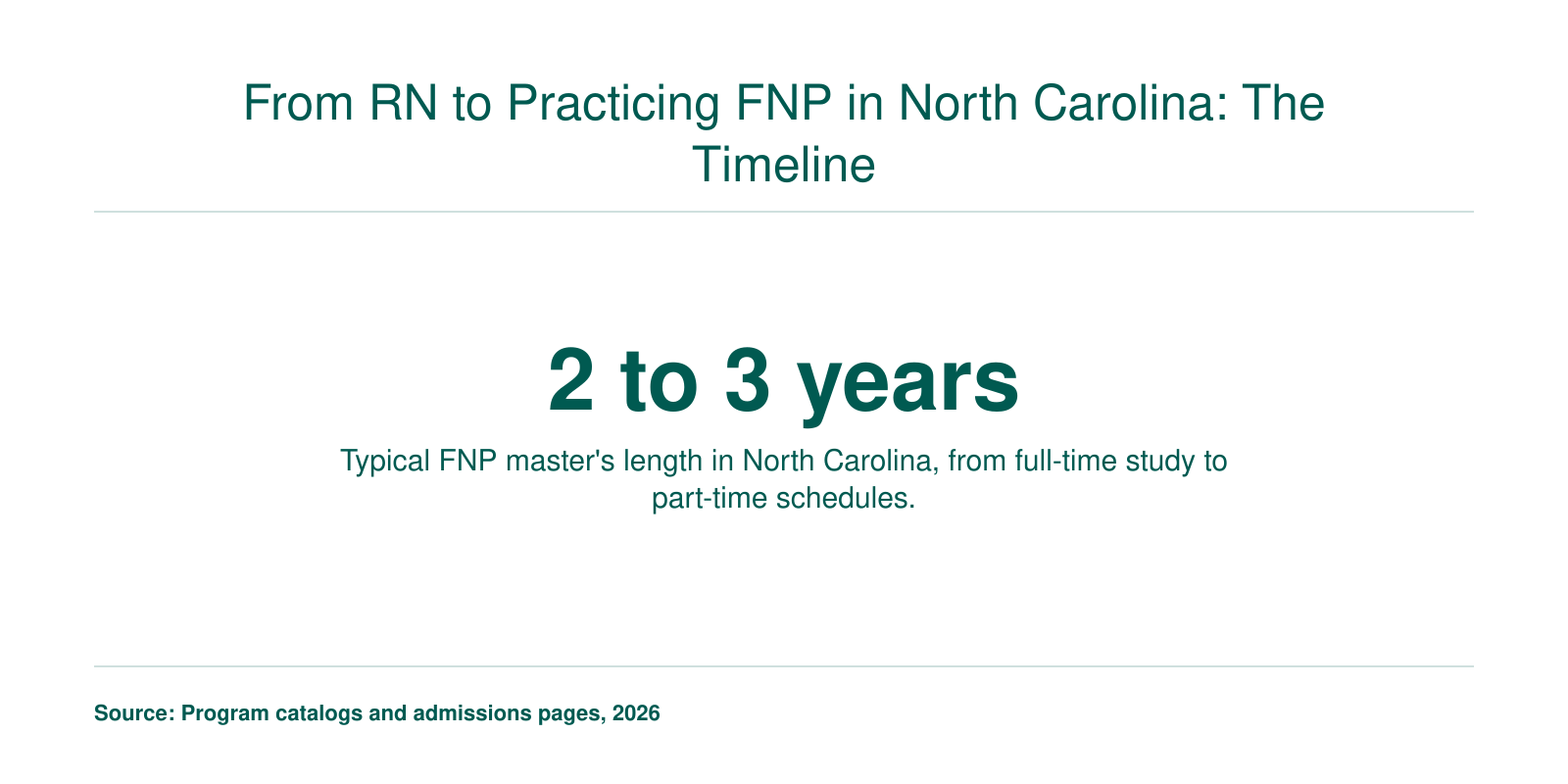
After a BSN and RN license (plus any RN experience a program requires), the FNP master's itself takes about two years full-time, or 30 months at Duke and UNC Chapel Hill. Part-time schedules commonly stretch to three years. National certification and North Carolina Board of Nursing approval follow, and a 2026 program guide puts typical processing at six to eight weeks. Counting from the start of the master's, full-time students often reach practice in roughly two and a half to three years, and part-time students in about three and a half to four, before any RN experience.
What an FNP Master's Costs in North Carolina, and How to Get Licensed
Cost in a North Carolina FNP master's program is not a single published number. It adds up from tuition, clinical fees, travel to campus or intensives, books, and certification expenses.
Tuition and Net Price Across Ranked Schools
In-state program tuition among the schools ranked here ranges from about $6,600 at Winston-Salem State University to roughly $66,500 at Duke. Out-of-state rates are higher, with Western Carolina University and Winston-Salem State showing the smallest gaps. Net price after grant aid generally falls between $11,000 and $15,400 at the public universities, but treat that as an approximate average, not a quote. Directory-reported totals often run from $18,000 to $86,000 and may not include clinical placement fees, travel, books, or exam costs.
North Carolina Licensure Steps
- Certification: Pass the AANP or ANCC FNP exam. Plan for roughly $240 to $395 depending on the exam and membership status.
- Joint approval: Apply to the North Carolina Board of Nursing and the Medical Board for nurse practitioner approval.
- Collaborative practice: Secure a written agreement with a primary supervising physician, renewed annually.
- Fees: Budget for a $25 registration fee and a $100 initial approval fee, but verify current amounts before applying.
What to Check Before Applying
Compare each ranked school's current per-credit rate and confirm whether clinical placement support is included, since that can add thousands or save you from self-sourcing a preceptor.
FNP Master's Programs in NC: Your Questions Answered
These answers draw on school-published information and 2026 sources. Where a school does not publish a figure, we say so rather than estimate it. Confirm details with each admissions office before you apply.
What is the cheapest FNP program in North Carolina?
How long does it take to become an FNP in NC?
Are there online FNP programs in North Carolina?
Where can FNP students in North Carolina complete clinical rotations?
What certification pass rates do ranked NC FNP programs report?
Do NC FNP master's programs require RN work experience?
Can you keep working as an RN while earning an FNP master's in North Carolina?
Compare Family Nurse Practitioner (FNP) programs on the data that matters
Explore more Nursing specializations or browse every graduate field.
All Nursing programs