Best Clinical Nurse Specialist (CNS) MSN Programs
Compare 40+ accredited Clinical Nurse Specialist programs at 30+ schools, with graduate earnings, cost, debt, and completion data from IPEDS and the U.S. College Scorecard.
A clinical nurse specialist is an advanced practice registered nurse who works on three fronts at once: direct care for complex patients, coaching and mentoring bedside nurses, and redesigning how a unit or a whole system delivers care through health systems management MSN and MSN Nurse Educator skill sets. Unlike an Adult-Gerontology Acute Care Nurse Practitioner focused on individual patient encounters, a CNS is expected to move outcomes across a population.
Cost varies sharply. Among the programs ranked here, the effective net price runs from roughly $58,000 to $74,000, with residency and format driving much of the spread.
Certification through AACN or ANCC hinges on two non-negotiables: at least 500 supervised clinical hours and an accredited program. Get either wrong and the exam stays closed to you.
Key Points
- All three CNS tracks require at least 500 supervised clinical hours before certification.
- Confirm CCNE or ACEN accreditation and secured preceptor placements before you enroll.
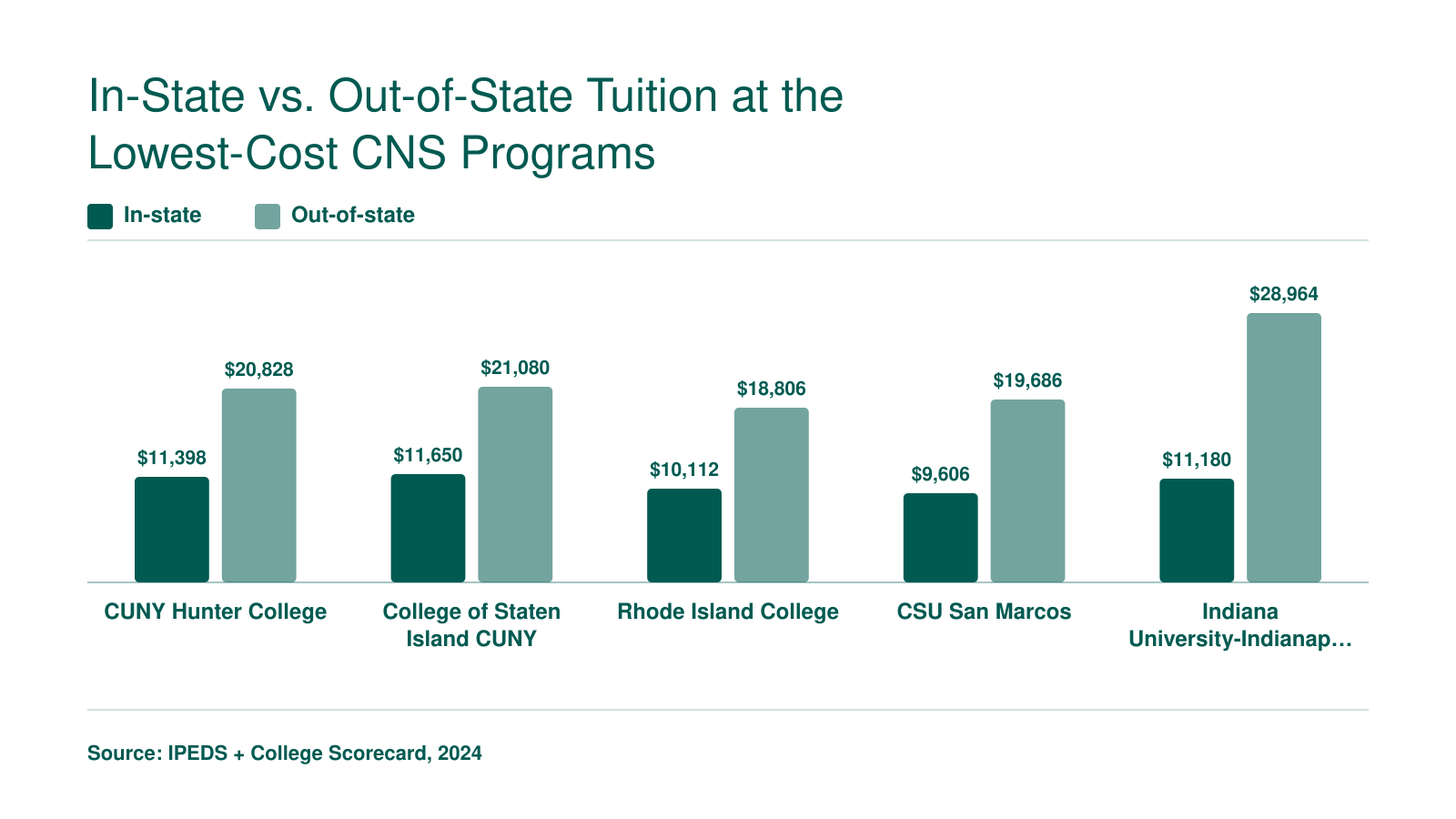
- In-state students at the lowest-cost public schools save roughly $8,700 to $17,800.
10 Clinical Nurse Specialist MSN Programs for 2027
This year's Clinical Nurse Specialist MSN rankings highlight ten programs that combine accredited nursing preparation, specialty concentrations, and practical clinical placements. From fully online adult-gerontology tracks to campus-based pediatric CNS pathways, the list reflects the range of formats and price points working nurses weigh. Use each card's net price and tuition figures to compare total cost while evaluating the specialty and delivery mode that fit your practice goals.
San Diego State University
#1San Diego, CA · ~$10,000/yr (est.)
Best for: California RNs wanting dual NP-CNS preparation
San Diego State University combines CNS preparation with nurse practitioner scope, making it a strong fit for California nurses who want dual advanced practice options. The program emphasizes evidence-based practice, leadership, and health equity, with clinical training in major teaching hospitals. CCNE accreditation and California Board of Registered Nursing approval reinforce the clinical foundation.
- 50 total credit hours
- Full-time and part-time options
- Dual preparation as adult-gerontology NP and CNS
- Clinical contracts with leading teaching hospitals
- CCNE accredited and approved by California BRN
- 3.0 GPA minimum and three recommendation letters
Michigan State University
#2East Lansing, MI · $22,000 – $42,000/yr (est.)
Best for: Out-of-state nurses wanting fully online program
Michigan State University's fully online adult-gerontology CNS track is built for nurses who need to stay in their own communities while completing clinical hours. The curriculum focuses on evidence-based practice, policy, and interdisciplinary collaboration, and students can prepare for two CNS certifications. CCNE accreditation and a direct pathway into the DNP make it a flexible advanced practice option.
- 100% online program
- Prepares for AGCNS-BC or AACNS-AG certification
- Reported 100% licensure pass rate
- Clinical placements arranged near the student
- Direct progression to DNP
- Adult-Gerontology concentration
- Ranked by U.S. News & World Report
Rutgers University-Newark
#3Newark, NJ · ~$23,000/yr (est.)
Best for: Nurses seeking flexible hybrid advanced practice
Rutgers University-Newark offers a hybrid MSN with a broad CNS concentration and multiple specialty options, so students can shape the program around a targeted population or setting. Coursework blends ethics, theory, research, and clinical science, with placements in hospitals, clinics, and specialty units. CCNE accreditation and an available B.S./M.S. to Ph.D. pathway support advanced practice and research ambitions.
- 42 total credit hours
- 8 concentration options
- Full-time and part-time options
- Hybrid format with online and internet-assisted courses
- Clinical placements with experienced preceptors
- B.S./M.S. to Ph.D. pathway available
- 3.0 GPA minimum
- Prepares for national certification exams
University of Detroit Mercy
#4Detroit, MI · ~$23,000/yr (est.)
University of Detroit Mercy's Adult-Gerontology CNS MSN is a fully online, 42-credit program with hands-on clinical practicums arranged near the student's home. The curriculum spans advanced pathophysiology, pharmacology, and CNS role theory across patient care, nursing practice, and systems leadership. CCNE accreditation and strong reported certification outcomes make it a focused choice for adult-gerontology practice.
- 42 total credit hours
- 100% online asynchronous courses
- 600 clinical practicum hours
- Part-time and full-time plans
- Fall, winter, or summer start terms
- Clinical placements near your home
- Reported 98% first-time CNS certification pass rate
- Ranked #58 Best Online MSN by U.S. News
University of Missouri
#5Columbia, MO · ~$14,000/yr (est.)
University of Missouri offers campus-based MSN tracks in pediatric and adult-gerontology clinical nurse specialist roles, with an emphasis on complex and vulnerable populations. Both concentrations blend advanced clinical science with leadership and evidence-based practice training. CCNE accreditation supports a focused route into either pediatric or adult-gerontology CNS certification.
- Prepares for ACCNS-P certification
- Focus on complex and vulnerable pediatric populations
- Campus-based program
- Advanced clinical nursing practicum
- Prepares for ANCC or AACN certification
- Focus on complex vulnerable populations
- Campus-based program
- Leadership and quality initiatives training
CUNY Hunter College
#6New York, NY · ~$11,000/yr (est.)
CUNY Hunter College provides an affordable Adult-Gerontology CNS master's with evening and late-afternoon classes that fit working nurses in the New York City area. The 42-credit program includes 500 practicum hours and clinical placements in medical-surgical specialties, with full- or part-time pacing. Students prepare for ANCC or AACN certification through a curriculum grounded in leadership, pathophysiology, and health assessment.
- 42 total credit hours
- 500 clinical practicum hours
- Full-time and part-time options
- Evening and late afternoon classes
- Prepares for ANCC or AACN certification
- Clinical placements in medical-surgical specialties
- Community-based placement opportunities
St. John Fisher University
#7Rochester, NY · ~$21,000/yr (est.)
St. John Fisher University blends live online classes with on-campus immersions in a simulated hospital, giving Adult/Gerontology CNS students structured clinical training. The 44-credit program includes 500 supervised clinical hours and small classes, with clinical partnerships across New York State. CCNE accreditation and preparation for national CNS certification support a supportive path into advanced practice.
- 44 total credit hours
- 500 supervised clinical hours
- Live online classes with on-campus immersions
- Small class sizes
- Top-10 nursing school in New York
- Ranked No. 50 nationally by U.S. News
- Two recommendation letters minimum
University of Arkansas
#8Fayetteville, AR · ~$12,000/yr (est.)
University of Arkansas offers an online MSN with a Clinical Nurse Specialist in Adult Health concentration through its Global Campus, designed for working nurses. Students complete 500 clinical hours with a preceptor and study advanced pathophysiology, pharmacology, and health promotion. CCNE accreditation and a flexible online format make it a practical option for adult health practice.
- Online through Global Campus
- 500 clinical hours with preceptor
- Prepares for CNS certification
- Two concentration options
- Holistic patient coaching approach
- Evidence-based nursing practice
West Chester University of Pennsylvania
#9West Chester, PA · $10,000 – $15,000/yr (est.)
West Chester University's Adult-Gerontology Clinical Nurse Specialist MSN is delivered fully online with both synchronous and asynchronous classes, accommodating full- or part-time schedules. The curriculum includes three clinical practicums and a clear pathway to the DNP, with small classes and employer reimbursement support. CCNE accreditation strengthens its fit for nurses balancing work and advanced study.
- 43 total credit hours
- 100% online with synchronous and asynchronous classes
- Full-time and part-time options
- Three clinical practicums
- Employer tuition reimbursement supported
- Small class sizes
- Clear pathway to DNP
California State University-San Marcos
#10San Marcos, CA · ~$10,000/yr (est.)
California State University San Marcos offers CNS concentrations in adult-gerontology, pediatrics, and advanced public health, with part-time pacing designed for working nurses. The curriculum integrates advanced assessment, pharmacology, and evidence-based practice with more than 500 clinical hours. CCNE accreditation and a focus on underserved populations support a broad advanced practice foundation.
- Three CNS specialization options
- Part-time program for working nurses
- Complete in 2.5 years part-time
- Fall admission with May 1 deadline
- Adult/gerontology concentration
- RN-to-MSN pathway available
- Eligible for national CNS certification
- Thesis or capstone option
- 42 total credit hours
- Pediatric CNS specialty track
- Concept analysis paper required
- Emphasizes cultural sensitivity
- Strong foundation in theory and research
- Multicultural and ethical perspectives
Cost & outcomes by school
Federal data for the highest-earning Clinical Nurse Specialist programs, independent of the ranking above. Earnings are this field's master's graduates four years after completing, where the Scorecard reports them.
| School | Earnings | Tuition / yr | Debt | Grads/yr | Format |
|---|---|---|---|---|---|
| San Diego State University CA | $165,564 | $10,252 | — | 31 | Campus |
| University of California-San Francisco CA | $159,229 | $14,738 | $77,233 | 136 | Campus |
| York College of Pennsylvania PA | $159,209 | $8,340 | $59,250 | 7 | Campus |
| St. Joseph's University-New York NY | $153,908 | $23,278 | $43,045 | 26 | Campus |
| California State University-San Marcos CA | $148,800 | $9,606 | $60,000 | 31 | Online |
| CUNY Hunter College NY | $142,731 | $11,398 | $20,500 | 143 | Campus |
| Rhode Island College RI | $138,536 | $10,112 | $41,000 | 25 | Hybrid |
| University of California-Los Angeles CA | $136,869 | $14,476 | $50,511 | 151 | Campus |
| Governors State University IL | $131,619 | $10,666 | $41,125 | 22 | Hybrid |
| Old Dominion University VA | $127,286 | $15,390 | $41,000 | 80 | Hybrid |
| University of Massachusetts-Boston MA | $126,694 | $20,456 | $35,661 | 42 | Hybrid |
| University of Detroit Mercy MI | $125,601 | $22,544 | $71,750 | 65 | Online |
Sources: U.S. Department of Education. Tuition and graduates: IPEDS. Earnings and debt: College Scorecard, this field's master's graduates; a dash means no figure is reported.
Cost, debt & payoff
Median earnings of this field's master's graduates (4 yrs after completing) vs. their median federal loan debt · U.S. College Scorecard
Across these programs the median graduate earns about $127,286 and finishes with roughly $43,045 in debt — a ratio that clears a common rule of thumb (keep debt below first-year salary). Tuition and debt vary widely school to school, so check the per-school figures in the table above before you shortlist.
How We Rank Clinical Nurse Specialist Programs
A CNS program earns its place here by what it costs and what it returns, not by how its name sounds. Reputation surveys reward size and history. They tell you little about whether a degree will pay for itself on a nurse's salary.
Outcomes Over Prestige
We compare programs on measures you can check:
- Net price: The amount a student pays after grants and scholarships, not the published tuition. This gap can be wide. CUNY Hunter College's average net price is under $3,000, while some private schools charge far more.
- Earnings after completion: What graduates of the nursing master's program earn once they finish.
- Median federal debt: How much borrowers typically owe when they leave.
- Graduation rate: An institution-wide signal of whether students who enroll actually finish.
Where the Data Runs Thin
Program-level earnings and debt appear only where federal College Scorecard data reports them specifically for the nursing master's credential. CNS cohorts are small, so many programs fall below the reporting threshold. In those cases we say plainly that program-level outcomes are not yet available instead of filling the gap with campus-wide averages that blend nurses with every other graduate.
What You Still Need to Verify
No dataset captures everything that shapes a good CNS education. Before you commit, check these yourself:
- Clinical placements: Does the school find your preceptors and sites, or are you expected to secure your own? This matters most in online programs.
- Faculty fit: Are faculty practicing CNSs in your target population (adult-gerontology, pediatric, or neonatal)?
- Certification alignment: Does the curriculum prepare you for the specific certification exam you plan to take?
Use the rankings to narrow your list. Use admissions conversations to settle the rest.
Accreditation and Clinical Hours: What to Verify Before You Apply
Clinical hour requirements for CNS preparation have been tightening rather than loosening, and the 2026 NACNS statement on CNS practice and education is the clearest signal yet. Master's and post-graduate certificate CNS programs still sit at a 500-hour floor, but post-baccalaureate DNP CNS programs now carry a 1,000-hour minimum. If you are choosing between an MSN and a direct-entry doctorate, that gap is worth understanding before you sign anything.
Why CCNE or ACEN Accreditation Is Non-Negotiable
Programmatic accreditation is the gatekeeper for everything that comes after graduation. Certification bodies require that your CNS preparation came from a program accredited by CCNE, ACEN, or NLN CNEA, and state boards of nursing generally tie APRN licensure to that same certification. The neonatal CNS exam (ACCNS-N), for example, requires a master's or higher from a CCNE- or ACEN-accredited program with a neonatal CNS concentration. Finish an unaccredited program and you may hold a degree you cannot license or certify with, in most states.
What the 500-Hour Minimum Actually Covers
The 500-hour figure appears across several authorities, which is why it has become the de facto standard: the 2008 APRN Consensus Model set it for APRN master's programs, AACN's 2021 Essentials require at least 500 practice hours at the advanced level, 2024 CCNE standards reinforce it, and NACNS holds master's and post-master's certificate CNS programs to it.
What counts is narrower than students expect. NACNS defines clinical clock hours as active implementation of the CNS role across one or more spheres of impact.1 Simulation, skills lab time, physical assessment practice, and travel to clinical sites do not count. And 500 is a floor, not a target: programs may require more, and NACNS expects programs preparing students for both a population focus and a specialty to exceed it, since clinical experiences must document both.1
Three Questions to Ask Before You Apply
- Confirm accreditation directly: Look the program up in the CCNE or ACEN directory rather than trusting a marketing page. Verify the CNS track specifically, not just the nursing school.
- Ask for the hour total in writing: Request the practicum clock hours for your intended track, and ask what the school excludes from that count.
- Check population alignment: Confirm the hours are specific to the population you plan to certify in, whether adult-gerontology, pediatric, or neonatal. Hours in the wrong population will not satisfy exam eligibility.
Related Articles
Clinical Nurse Specialist Specializations: Adult-Gerontology, Pediatric, and Neonatal
All three population-focused CNS tracks require at least 500 supervised clinical hours and a current, unencumbered RN or APRN license before you can sit for the certification exam. AACN Certification Corporation administers the exam for each track, and the American Nurses Credentialing Center offers a second option for adult-gerontology. To choose a track, match it to the patient population in your current RN experience.
| Track | Patient population | Certification exam | Certifying body | Recent first-time pass rate | Key eligibility requirements |
|---|---|---|---|---|---|
| Adult-Gerontology CNS | Adult-gerontology patients | ACCNS-AG (Adult-Gerontology Clinical Nurse Specialist) | AACN Certification Corporation | 95.45% | Current, unencumbered U.S. RN or APRN license; 500 supervised clinical hours in all adult-gerontology CNS roles; final graduate nursing transcripts; Educational Eligibility Form from the program director |
| Pediatric CNS | Pediatric patients | ACCNS-P (Pediatric Clinical Nurse Specialist) | AACN Certification Corporation | Current, unencumbered U.S. RN or APRN license; CCNE- or ACEN-accredited master's degree or higher with the relevant CNS concentration; at least 500 supervised clinical hours across CNS roles | |
| Neonatal CNS | Neonatal patients | ACCNS-N (Neonatal Clinical Nurse Specialist) | AACN Certification Corporation | 100.00% | 500 supervised clinical hours in all roles of the neonatal CNS within the graduate program; current, unencumbered U.S. RN or APRN license |
| Adult-Gerontology CNS (ANCC alternative) | Adult-gerontology patients | AGCNS-BC (Adult-Gerontology Clinical Nurse Specialist board certification) | American Nurses Credentialing Center (ANCC) | 88% | Current, active RN license; master's, post-graduate certificate, or DNP from an adult-gerontology CNS program accredited by CCNE, ACEN, or NLN CNEA; at least 500 faculty-supervised clinical hours |
Confirm your program holds CCNE or ACEN accreditation and secures your clinical placements before you enroll: an unaccredited program or an unsecured preceptor can block your path to CNS certification.
In-State vs. Out-of-State Tuition at the Lowest-Cost CNS Programs
Residency matters at these public schools. In-state students save roughly $8,700 to $17,800 in program tuition compared with out-of-state students, and the gap is widest at Indiana University-Indianapolis. CSU San Marcos is listed as an online program, and Rhode Island College offers up to 100% online courses, but the program descriptions do not state a flat online rate, so confirm per-credit pricing with each school before you assume out-of-state students pay the in-state price.
Admission Requirements for MSN-CNS Programs
Requirements differ by school, so confirm details on each admissions page. These patterns show up most often among the programs researched, including Michigan State, San Diego, Oklahoma Health Sciences Center, Memphis, Azusa Pacific, East Carolina, and National University.
- RN license and BSNExpect to need an active, unencumbered RN license and a BSN. Azusa Pacific asks for a BSN from an NLN- or CCNE-accredited program, and National University asks for one from a nationally accredited program. Licensure rules vary: San Diego wants a California license (out-of-state applicants need endorsement in progress), while Oklahoma accepts Oklahoma or compact-state licenses. RN-to-MSN routes are limited. Memphis's is aimed at applicants with a non-nursing bachelor's, and National University may admit RN-BSN students in their final course. Not every CNS track accepts these applicants.
- GPA and prerequisitesA 3.0 minimum is the norm at the schools researched, but the basis differs. Michigan State looks at the second half of the BSN, and Oklahoma looks at all college coursework. Statistics is the most common prerequisite. Michigan State wants a 3-credit course within the past five years. Azusa Pacific also lists health assessment, pathophysiology, nursing research, nursing leadership, and community health nursing.
- RN experiencePolicies vary. East Carolina requires one year of current practice for CNS applicants, and San Diego lists one year of clinical experience as preferred. Michigan State, Oklahoma, Memphis, Azusa Pacific, and National University do not set a general CNS experience minimum. Even so, experience in your target population strengthens an application.
- Application materialsPlan on a résumé or CV, a personal statement or essay, and recommendations. Michigan State asks for three and may interview invited applicants. East Carolina wants a third reference from a healthcare provider. Azusa Pacific may offer provisional admission.
- Deadlines and start termsOklahoma's deadline for Fall 2026 was February 2, 2026. Azusa Pacific's fall priority date is April 1, with a final deadline of June 15, and its spring priority date is October 20. Memphis accepts fall applications from September 1 to July 1 and spring applications from May 1 to December 1. Check each school's current calendar before you plan.
Clinical Nurse Specialist programs by state
Clinical Nurse Specialist MSN Programs: Frequently Asked Questions
These answers cover the questions applicants ask most about cost, format, post-master's routes, and state rules. Confirm anything tied to a specific school or state with that school and your state board of nursing.
How much does a clinical nurse specialist MSN program cost?
Are clinical nurse specialist MSN programs available online?
Can I become a CNS through a post-master's certificate if I already hold an MSN?
Do all states recognize clinical nurse specialists as APRNs with prescriptive authority?
Compare Clinical Nurse Specialist programs on the data that matters
Explore more Nursing specializations or browse every graduate field.
All Nursing programs