Best Neonatal Nurse Practitioner (NNP) MSN Programs
Compare 20+ accredited Neonatal Nurse Practitioner programs, with graduate earnings, cost, debt, and completion data from IPEDS and the U.S. College Scorecard.
A neonatal nurse practitioner is an advanced practice nurse who manages critically ill and premature newborns, usually in a Level III or IV NICU, and the MSN is the most common route in. Where programs list their requirements, clinical hours vary by program, the national standard is 750 direct-care hours, and most expect NICU experience before admission.
For a working NICU nurse, program choice shapes total cost, who secures your preceptor, and eligibility for national certification. The rankings here lean on federal data for net price, debt, and completer earnings, not reputation surveys.
The specialty is small, with about 7,360 NNPs holding national certification as of early 2024, so a program's clinical network matters more than its brand.
Key Points
- Duke's tuition runs about $89,225 versus Rush's $79,732, before fees.
- Vanderbilt's distance NNP students still travel to Nashville five times.
- NCC's NNP-BC pass rate fell to 84% in 2025 from 89%.
Best Neonatal Nurse Practitioner MSN Programs: 2027 Rankings
These are the 10 neonatal nurse practitioner MSN programs that combine strong student outcomes, clinical depth, and value for working nurses. Each card lists the school's overall graduation rate, published graduate tuition, and institution-wide average net price after aid. Use the rankings to compare programs side by side before checking admission requirements.
Vanderbilt University
#1Nashville, TN · ~$58,000/yr (est.)
Best for: Experienced RNs seeking hybrid NICU training
The hybrid MSN blends online coursework with five in-person sessions and 770 supervised clinical hours, mostly in Level II through IV NICUs. Students study embryology, neonatal physiology, pathophysiology, and family dynamics before moving into diagnostic reasoning and evidence-based management. Clinical placements are arranged in the student's preferred region whenever possible, and full-time students can finish in four semesters.
- CCNE accredited
- Complete in four semesters (16 months)
- Full-time and part-time options
- 770 clinical hours
- Clinical placements in preferred region
- Incorporates 2021 AACN Essentials
University of Pennsylvania
#2Philadelphia, PA · ~$48,000/yr (est.)
Best for: NICU nurses pursuing academic medical center clinicals
The MSN prepares nurses to care for infants and toddlers through age two, with study in advanced assessment, diagnostics, and holistic care. Clinical training takes place in Level III and IV NICUs at academic medical centers, and the full-time track runs four semesters. Small cohorts, online or hybrid lectures, and managed clinical placements define the experience.
- CCNE accredited
- Four-semester full-time track
- Part-time option available
- 3.0 GPA minimum
- Clinicals at Level III and IV NICUs
- Faculty manages clinical placements
- Eligible for national certification
Duke University
#3Durham, NC · ~$67,000/yr (est.)
Best for: Distance learners with local clinical rotations
A hybrid format combines online coursework with five required campus sessions and clinical placements near home through a network of more than 2,000 sites. The curriculum includes embryology, pathophysiology, development, pharmacology, and complex neonatal care, and applicants need two years of recent Level III or IV NICU experience before clinical courses. Recent cohorts report strong licensure pass and job placement outcomes.
- CCNE accredited
- Rolling admissions
- 100% licensure pass rate
- 100% job placement rate
- Clinical network of 2,000+ facilities
- Prepares for NCC
- Keep working while earning degree
Ohio State University
#4Columbus, OH · ~$14,000/yr (est.)
This NNP track focuses on developmental physiology, neonatal pharmacology, advanced health assessment, and developmental care, with clinical rotations in Level III or IV NICUs. Most coursework is online, but students attend three on-campus seminars in Columbus for simulation and skills practice. Applicants need 24 months of full-time RN experience in a Level III or IV NICU before clinicals, and graduates are eligible for national board certification through the National Certification Corporation.
- CCNE accredited
- Work experience required
- Eligible for national board certification
- Clinicals in Level III/IV NICUs
- Three on-campus seminars in Columbus
- Simulations and skills activities
- 16-20 hours weekly clinical practicum
The University of Texas Medical Branch at Galveston
#5Galveston, TX · ~$13,000/yr (est.)
The 48-credit track runs seven semesters part-time, with short campus visits each term and online coursework in between. Students progress through advanced pathophysiology, pharmacology, and neonatal health assessment, then complete three practicum sequences. A clinical placement coordinator arranges experiences around Houston and Galveston, and simulation labs prepare students for real neonatal scenarios.
- CCNE accredited
- 48 total credit hours
- Seven-semester part-time format
- Fully online option available
- 3.0 GPA minimum
- Three letters of recommendation
- Eligible for NCC certification
- Clinical placements in Houston/Galveston
The College of New Jersey
#6Ewing, NJ · ~$18,000/yr (est.)
The online MSN is offered in partnership with Thomas Jefferson University, so clinical courses draw on faculty from both schools. The 48-credit curriculum includes advanced pathophysiology, diagnostic reasoning, and pharmacotherapeutics, plus a 750-hour practicum with low- and high-risk newborns. Admission requires a 3.4 GPA, an active RN license, and at least three years in a NICU, and tuition remains the same regardless of residency.
- CCNE accredited
- $750 per credit
- Locked tuition rate
- 48 total credit hours
- Fully online option available
- 750 clinical hours
- 3.4 GPA minimum
- Partnership with Thomas Jefferson University
Stony Brook University
#7Stony Brook, NY · ~$14,000/yr (est.)
The hybrid MSN prepares registered nurses to manage care for premature and critically ill infants while working alongside neonatologists and multidisciplinary teams. Online coursework is paired with hands-on clinical training, allowing nurses to keep their jobs while studying. Graduates move into advanced practice roles in NICUs, delivery rooms, and newborn follow-up clinics.
- CCNE accredited
- Hybrid online coursework and clinical training
- Prepares for advanced NICU practice roles
- Fits nurses with bedside experience
University of Connecticut
#8Storrs, CT · ~$23,000/yr (est.)
The primarily online MSN includes 765 clinical hours across three 15-week practicums and two required on-campus simulation experiences. The 45-credit curriculum covers advanced pathophysiology, pharmacology, and neonatal assessment. Full-time students finish in five semesters, part-time in six to eight, and clinical placement assistance is provided.
- CCNE accredited
- 45 total credit hours
- 765 clinical hours
- Rolling admissions
- Three start dates per year
- Two required on-campus simulation experiences
- Clinical placement assistance provided
- Eligible for NNP certification exam
University of Rochester
#9Rochester, NY · ~$39,000/yr (est.)
This concentration sits inside a combined pediatric and neonatal nurse practitioner master's program and prepares graduates for dual national certification as an NNP and a pediatric nurse practitioner. Students train at the Level IV Gosnell Family Neonatal Intensive Care Unit at Golisano Children's Hospital, gaining experience in respiratory failure, heart disease, and neurologic injury. The curriculum covers primary and acute care, transport, delivery rooms, and outpatient follow-up.
- CCNE accredited
- Dual preparation for NNP and pediatric NP certification
- Clinical training at a Level IV NICU
- Covers primary and acute neonatal care
- Includes transport and delivery room training
Case Western Reserve University
#10Cleveland, OH · ~$54,000/yr (est.)
The 40-credit MSN requires 700 clinical hours in Level III NICUs, and full-time students can finish in 18 months. Coursework includes advanced pathophysiology, pharmacology, and assessment, with a focus on managing complex neonatal health. Applicants need two years of NICU nursing before starting, and graduates typically work in neonatal intensive care units at children's hospitals and large general hospitals.
- CCNE accredited
- 40 total credit hours
- 18-month full-time track
- 700 clinical hours
- Work experience required
- Part-time option available
- Dual degree options available
- Post-graduate APRN certificates available
Cost & outcomes by school
Federal data for the highest-earning Neonatal Nurse Practitioner programs, independent of the ranking above. Earnings are this field's master's graduates four years after completing, where the Scorecard reports them.
| School | Earnings | Tuition / yr | Debt | Grads/yr | Format |
|---|---|---|---|---|---|
| Northeastern University MA | $143,345 | $26,020 | $57,068 | — | Online |
| Northeastern University MA | $143,345 | $29,174 | $57,068 | 54 | Online |
| Wayne State University MI | $137,480 | $17,960 | $50,500 | 51 | Campus |
| Stony Brook University NY | $134,363 | $14,222 | $29,728 | 161 | Hybrid |
| Regis University CO | $133,420 | $24,300 | $41,000 | 88 | Hybrid |
| University of Connecticut CT | $133,363 | $22,872 | $42,717 | 65 | Online |
| University of Michigan-Flint MI | $129,633 | $14,473 | $45,578 | 95 | Online |
| Wright State University OH | $128,321 | $15,771 | $47,165 | 17 | Campus |
| Old Dominion University VA | $127,286 | $15,390 | $41,000 | 80 | Hybrid |
| The University of Texas Medical Branch at Galveston TX | $126,781 | $12,759 | $41,000 | 120 | Campus |
| Case Western Reserve University OH | $126,688 | $53,980 | $124,668 | 70 | Hybrid |
| Saint Francis Medical Center College of Nursing IL | $125,082 | $9,365 | $40,500 | 30 | Campus |
Sources: U.S. Department of Education. Tuition and graduates: IPEDS. Earnings and debt: College Scorecard, this field's master's graduates; a dash means no figure is reported.
Cost, debt & payoff
Median earnings of this field's master's graduates (4 yrs after completing) vs. their median federal loan debt · U.S. College Scorecard
Across these programs the median graduate earns about $123,518 and finishes with roughly $47,165 in debt — a ratio that clears a common rule of thumb (keep debt below first-year salary). Tuition and debt vary widely school to school, so check the per-school figures in the table above before you shortlist.
Why These Schools Made the Cut
This list rewards neonatal nurse practitioner MSN programs whose completers leave with manageable debt and strong early paychecks, not the schools with the loudest brand. A famous name can carry a steep price tag, and a modest regional program can deliver a better financial return.
The numbers that drive the comparison
Five inputs do most of the work:
- Graduate tuition: The sticker price you would face for the degree.
- Average net price: The remaining cost after grants and scholarships, often well below the sticker figure.
- Median debt and monthly payment: What graduates of the specific program borrow and what repayment looks like each month.
- Earnings after completion: What program graduates are paid in the first years after finishing.
- Completions: How many students finish the program, a rough signal of scale and track record.
Program data versus school-wide context
Keep the two levels of data separate. Debt, monthly payment, earnings after completion, and completions come from federal program-level reporting, so they describe NNP-related graduates specifically. Graduation rate, 10-year earnings, and net price are school-wide, mostly undergraduate measures. They are useful background on a school's overall student outcomes, but they say little about the NNP track itself, so weigh them accordingly.
What federal data cannot tell you
Federal figures do not track accreditation status or national certification pass rates, and both matter for becoming a board-certified NNP. Those are covered separately below, and you should confirm them directly with any school you are considering. If program-level figures are unavailable for a school, treat the gap as missing information rather than a verdict.
Best-Value NNP Schools: Net Price, Debt, and Early Earnings
A program's sticker price rarely tells the whole story. Total MSN cost depends on per-credit tuition multiplied by required credits, then adds clinical, technology, and on-campus intensive fees. For example, Duke's 43-credit NNP track charges $2,075 per credit (about $89,000 in tuition before fees), and Rush's 62-credit program at $1,286 per credit totals roughly $79,700 before fees. UAB lists $744 per credit plus a $235 technology fee. Compare the monthly loan payment against early-career earnings instead of judging programs by sticker price alone.
| School | Graduate tuition (in-state) | Graduate tuition (out-of-state) | Net price | Median federal student loan debt | Median 10-year monthly loan payment | Median earnings 1 year after graduation |
|---|---|---|---|---|---|---|
| Duke University | $68,758 | $68,758 | $29,612 | $13,000 | $1,018 | $109,702 |
| University of Pennsylvania | $68,686 | $68,686 | $28,699 | $15,715 | $562 | $115,382 |
| The University of Texas Medical Branch at Galveston | $12,759 | $25,530 | Not reported | $13,396 | $466 | $116,723 |
Campus, Hybrid, or Online NNP Programs: How Delivery Formats Differ
At Vanderbilt University, distance-track NNP students travel to Nashville five times for required campus blocks lasting three to seven days each. That is the reality behind online nurse practitioner programs: the didactic coursework can be delivered remotely, but the bedside training cannot be replaced by a screen.
What Online Actually Means
In an online NNP track, as in other accredited online nurse practitioner programs, lectures, readings, and discussion boards happen through a learning management system. Clinical hours still take place in person at a Level III or IV NICU, and most distance programs add on-campus intensives or simulation labs. The University of Alabama at Birmingham RN-to-MSN NNP pathway, for example, includes a Birmingham orientation and three multi-day intensives. The University of Connecticut requires three campus visits, one orientation and two hands-on simulation experiences. Ohio State's hybrid format builds in three on-campus seminars in Columbus with simulation and skills activities. The University of South Alabama schedules a mandatory three-to-four-day orientation in Mobile when the practicum begins, with clinical-skills workshops.
State Authorization Limits Where You Can Enroll
Online and hybrid programs cannot enroll students from every state. The University of Memphis is not authorized to enroll California residents, and students who relocate may need to finish in Tennessee or another authorized state. The University of Cincinnati's online graduate nursing program currently lists Arizona, Louisiana, Massachusetts, New York, Oregon, Rhode Island, and Tennessee as restricted, along with several U.S. territories. Stony Brook University asks non-New York applicants to contact the graduate program office before applying because authorization rules shift. Enrolling in a program is not the same as meeting a state's APRN licensure requirements, so verify clinical hours, preceptors, and curriculum separately.
Delivery Formats Across the Ranked Programs
The programs below span three delivery formats: campus, hybrid, and online. Fully online options such as the University of Connecticut still require in-person campus visits for simulation, while hybrid models like Vanderbilt, Duke, and Case Western Reserve combine remote coursework with scheduled campus intensives. Campus-based tracks such as the University of Pennsylvania and UTMB keep didactic instruction in person, which can suit learners who want continuous faculty supervision.
NICU Experience and Other Admission Prerequisites
Requirements vary by school, and the timing of each one matters as much as the requirement itself. Confirm current terms with each admissions office before you apply.
- Unencumbered RN licensePrograms generally expect an active, unencumbered U.S. RN license. The jurisdiction varies: UAB requires licensure in the state where you complete your practicum, Emory accepts Georgia or multistate licensure, and Pitt requires a Pennsylvania license before clinical work begins.
- BSN from an accredited programA bachelor's in nursing is the standard entry credential. Pitt specifies a program accredited by CCNE, ACEN, or similar bodies, and it also asks for a three-credit undergraduate statistics course with a grade of C or better.
- Level III or IV NICU experienceTwo years is the usual benchmark, and Duke, Northeastern, UAB, UTA, Emory, and Vanderbilt all point to it. Timing differs. Duke wants the experience before NNP clinical courses, and Duke's preclinical coursework can begin while you gain it. UAB and UTA tie it to the first clinical semester. Emory prefers it but does not treat it as absolute. Northeastern notes that most admitted students exceed two years.
- GPA and GREA 3.0 GPA is the common floor, sometimes measured on your last 60 credits. UAB asks for a GRE (297 combined) or GMAT (480) if your GPA is below 3.2. UTA offers an alternative pathway for GPAs of 2.8 to 2.99, with GRE scores required. Pitt requires the GRE but waives it for a BSN GPA of 3.5 or higher.
- References, statement, interview, and NRPExpect references, a personal statement, and possibly an interview. Some programs require Neonatal Resuscitation Program certification, and a NICU job usually makes it easy to hold already. Duke reviews applications on a rolling basis, so applying early helps.
Related Articles
Clinical Hours and Preceptor Placement: Who Finds Your NICU Rotation?
The hardest part of an NNP program is often not the coursework but securing a NICU preceptor, and the schools here handle it very differently.
How Many Hours to Expect
The national curriculum standard is 750 direct patient-care hours, with at least 600 in Level III or IV NICUs. The NCC certification exam itself requires a minimum of 600 clinical hours. Programs often exceed the floor. Louisville lists 756 patient-care hours plus 84 professional-role hours, and Wayne State's MSN totals 675 across three courses. Baylor's published practicum totals run higher still, at 1,125 hours for BSN entrants. Check the exact number for your degree track, not just the headline figure.
Who Secures the Site
No program we reviewed promises unconditional placement. Language tends to be about support, affiliations, and coordination. South Alabama cites clinical contracts across many areas of the country. Old Dominion asks for placement requests at least three months before a rotation and reviews them collaboratively. The University of Virginia offers guidance on finding preceptors but does not accept responsibility if you cannot secure one. NANN notes that programs are expected to find rotations, yet many struggle to.
For distance learners this gap matters most. If you live far from campus, you may need a qualified site near home, and that site must be in a state where the program is authorized to place students.
Site and Preceptor Requirements
Level III or IV NICUs are the core requirement. Preceptors are generally MSN-prepared or higher with national NNP certification and state licensure, or board-certified neonatologists. Wayne State also asks for at least one year of experience in the specialty or site.
Questions to Ask Admissions
- Placement: Does the school contract with NICUs for you, or will you be expected to find your own preceptors?
- Timeline: How far ahead must requests be submitted, and what happens to your progression if a site falls through?
- Location: Are approved sites available in your state, and will the program add a new affiliation if your hospital is not yet on its list?
NCC's most recent published NNP-BC exam statistic is for 2025: 84% of candidates passed overall, down from 89% in 2024. Note that this figure includes repeat test takers, and NCC does not publish a separate national first-time pass rate for the NNP-BC exam.
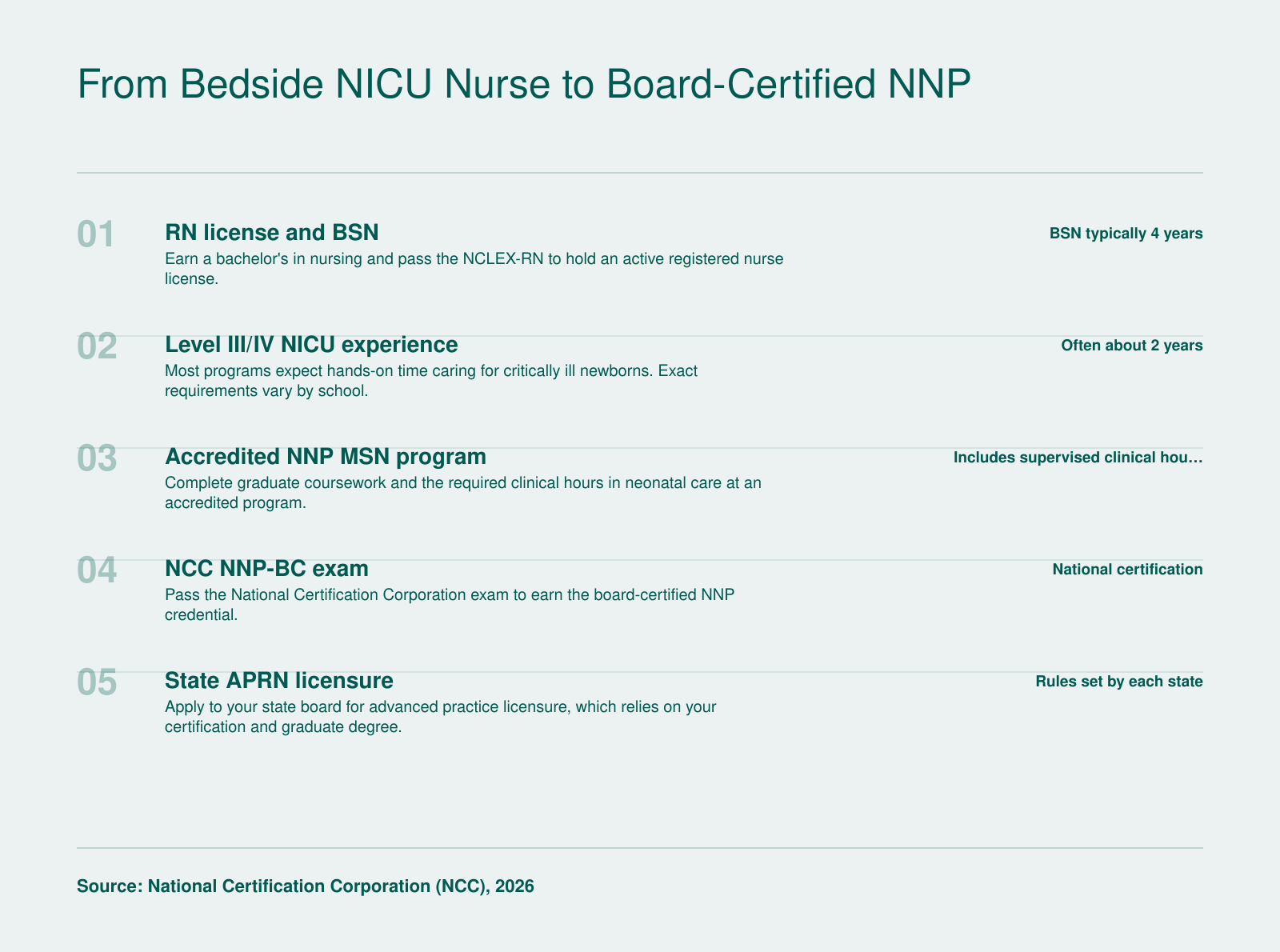
From Bedside NICU Nurse to Board-Certified NNP
Becoming a neonatal nurse practitioner follows a set order, and most programs expect each stage to be finished before you apply to the next. Both MSN and DNP routes lead to the same NCC certification, so the degree you choose changes your coursework and cost, not the credential you earn.
NNPs are a small slice of the nurse practitioner world. The National Association of Neonatal Nurses reports that 7,360 NNPs held national certification through NCC as of early 2024, and in 2022 they made up only about 0.5% of the roughly 355,000 licensed nurse practitioners in the U.S.
Neonatal Nurse Practitioner programs by state
Compare Neonatal Nurse Practitioner programs on the data that matters
Explore more Nursing specializations or browse every graduate field.
All Nursing programs