Best Neonatal Nurse Practitioner (NNP) MSN Programs in Ohio
Compare 3 accredited Neonatal Nurse Practitioner programs in Ohio, with graduate earnings, cost, debt, and completion data from IPEDS and the U.S. College Scorecard.

Ohio NNP applicants choose between a hybrid master's that leans on distance coursework and a campus-based one built around local hospital rotations. Either way, the entry bar is high: these programs expect working NICU experience before admission, and Wright State specifies a minimum of two years.
The tension is practical. A full-time NICU nurse has to fit in several hundred precepted clinical hours, and price swings widely from one school to the next. Because Ohio State, Case Western Reserve, and Wright State are the only schools here, each one matters, and the right fit usually comes down to schedule and cost rather than reputation.
Key Points
- Ohio State's NNP track requires 712.5 precepted clinical hours, above NCC's 600-hour minimum.
- Case Western Reserve charges $53,980 in tuition, versus $13,901 in-state at Ohio State.
- Ohio licenses NNPs as APRN-CNPs, so national NCC certification comes before your application.
Best Neonatal Nurse Practitioner MSN Programs in Ohio, Ranked
Ohio has a small but strong set of NNP master's options, and the differences come down to how much of the program you can complete from home, how much NICU experience you need before you start, and what you will pay. Below, the three programs are laid out with format, tuition, net price, graduation rate, and early earnings so you can compare them side by side.
Ohio State University
#1Columbus, OH · ~$14,000/yr (est.)
Best for: Working NICU nurses studying mostly online
Ohio State pairs a mostly online NNP curriculum with three on-campus seminars in Columbus for simulations and skills practice. Clinical rotations take place in Level III or IV NICUs, and the school's Wexner Medical Center and Nationwide Children's Hospital relationships give students access to high-acuity neonatal care. Applicants need 24 months of full-time RN experience in a Level III or IV NICU before clinicals. Program graduates reported median earnings of $100,925 one year after completion.
- CCNE accredited
- Hybrid: most coursework online, three on-campus seminars in Columbus
- 24 months of full-time Level III or IV NICU RN experience required
- Clinicals in Level III or IV NICUs, 16 to 20 hours weekly
- Includes high-risk deliveries and neonatal transport experience
- Simulation and skills activities during on-campus seminars
- Graduates eligible for national board certification through NCC
Case Western Reserve University
#2Cleveland, OH · ~$54,000/yr (est.)
Best for: Full-time students wanting built-in dual-degree options
Case Western Reserve's Frances Payne Bolton School of Nursing offers a 40-credit NNP MSN with 700 clinical hours in Level III NICUs. Cleveland-area partners include University Hospitals Rainbow Babies & Children's Hospital and Cleveland Clinic Children's Hospital. Full-time students can finish in 18 months, with part-time options, and dual degrees and post-graduate APRN certificates are available. Program graduates reported median earnings of $115,009 one year after completion, the highest of the three Ohio programs.
- CCNE accredited
- 40 total credit hours with 700 clinical hours
- 18-month full-time track, part-time also offered
- Two years of NICU nursing required before starting
- 3.0 GPA required for progression, 2.5 APRN GPA required
- Dual degrees in bioethics, anthropology, or public health
- Post-graduate APRN certificates available
Wright State University
#3Dayton, OH · ~$16,000/yr (est.)
Best for: Dayton-area nurses wanting flexible start terms
Wright State's NNP concentration is a campus-based 55-credit program that trains nurses to care for ill and premature newborns and high-risk children up to age 2. Rotations run through Dayton Children's Hospital, Miami Valley Hospital, and Kettering Hospital, with NNP faculty supervising clinical courses. It admits in summer, fall, and spring, and offers full-time and part-time plans. Program graduates reported median earnings of $104,352 one year after completion.
- CCNE accredited
- 55 total credit hours
- Full-time and part-time options, three start dates per year
- 3.0 GPA minimum and two letters of recommendation
- Entrance exam required
- Minimum two years of Level III NICU experience
- Rotations at Dayton Children's, Miami Valley, and Kettering hospitals
- Lab sessions at University of Cincinnati; post-master's training available
Cost & outcomes by school
Federal data for the highest-earning Neonatal Nurse Practitioner programs, independent of the ranking above. Earnings are this field's master's graduates four years after completing, where the Scorecard reports them.
| School | Earnings | Tuition / yr | Debt | Grads/yr | Format |
|---|---|---|---|---|---|
| Wright State University OH | $128,321 | $15,771 | $47,165 | 17 | Campus |
| Case Western Reserve University OH | $126,688 | $53,980 | $124,668 | 70 | Hybrid |
| Ohio State University OH | $109,662 | $13,901 | $49,134 | 214 | Hybrid |
Sources: U.S. Department of Education. Tuition and graduates: IPEDS. Earnings and debt: College Scorecard, this field's master's graduates; a dash means no figure is reported.
Cost, debt & payoff
Median earnings of this field's master's graduates (4 yrs after completing) vs. their median federal loan debt · U.S. College Scorecard
Across these programs the median graduate earns about $126,688 and finishes with roughly $49,134 in debt — a ratio that clears a common rule of thumb (keep debt below first-year salary). Tuition and debt vary widely school to school, so check the per-school figures in the table above before you shortlist.
Online and Hybrid NNP Master's Options in Ohio
No neonatal Nurse Practitioner MSN program in Ohio is a sit-at-home-and-click degree. Ohio State and Case Western Reserve both run their neonatal Nurse Practitioner tracks in a hybrid format, blending distance coursework with required in-person work, while Wright State's neonatal concentration is campus-based.
Ohio State's program builds in up to four on-campus seminars in Columbus, so plan travel and time off around them. Ohio State's clinicals happen in Level III and IV NICUs regardless of how your didactic courses are delivered.
Why your home state matters
If you live outside Ohio, check authorization before you apply. Ohio State's rules cover online courses and out-of-state clinical placements, and it generally will not enroll students located in a state where the program does not meet that state's educational requirements. Case Western Reserve, authorized by the Ohio Department of Higher Education, notes that its MSN curriculum is built on Ohio APRN law; another state's practice act may impose additional requirements.
Related Articles
NICU Experience, Clinical Hours, and Who Arranges Your Placement
Ohio State's NNP track requires 712.5 precepted clinical hours, above the National Certification Corporation (NCC) eligibility minimum of at least 600 direct clinical hours. Case Western Reserve reports approximately 700 Level III NICU hours for its NNP major; its general MSN minimum is 600.
Experience also differs. Ohio State expects 24 months of full-time Level III or IV NICU RN work before practicum, and Ohio State specifies two years within the prior five years for national NNP certification. Case Western Reserve requires one year of full-time Level III NICU nursing before the NNP major.
Placement varies among Nurse Practitioner MSN programs in Ohio and is the variable to ask about directly. Ohio State prefers placements near your city but may place outside it depending on resources; its handbook does not explicitly say whether students may find their own preceptors. Case Western Reserve lists regional sites including Rainbow Babies and Children's Hospital, Cleveland Clinic Children's, MetroHealth, and Akron Children's. Out-of-state students may complete hours in their own state, but the school publishes no state-by-state approval list or clear policy on student-found preceptors.
Which Ohio NNP Master's Programs Waive or Skip the GRE
Case Western Reserve University does not require GRE or MAT scores for its NNP master's, though it may request them when making an admission decision. The table below covers only what we could confirm from Case Western's current admissions pages. Check the Ohio State University and Wright State University admissions pages directly for GRE policy, GPA minimums and deadlines before you apply.
| School | GRE Policy | Minimum GPA | Application Deadline | NICU Experience Required |
|---|---|---|---|---|
| Case Western Reserve University (NNP MSN) | GRE/MAT not required to apply; scores may be requested for an admission decision | Not stated on the MSN admission page | March 15 for summer and fall; spring 2027 applications still being accepted | Not stated on the admission page |
| Case Western Reserve University (MN pathway for applicants with a non-nursing degree) | No GRE requirement stated in the admission instructions | 3.0 cumulative undergraduate; 2.75 in natural science and 2.75 in behavioral sciences | March 1 for fall | Not stated on the admission page |
Neonatal Nurse Practitioner MSN Program Cost in Ohio: Beyond Tuition
Sticker price now matters as much as NICU placement for working nurses choosing an NNP master's among Master's Programs in Ohio. Published graduate tuition in the data runs from $13,901 in-state at Ohio State to $15,771 at Wright State, and $53,980 at Case Western Reserve. Out-of-state, Ohio State climbs to $42,740 and Wright State to $25,759, while Case Western charges the same for everyone.
Per-credit rates help with a full-program estimate, though treat them as rough. One Ohio State listing shows $972.50 per credit; across the 56-credit program that is about $54,460, before a $200 per-semester out-of-state surcharge. Case Western lists $2,449 per credit, and its 40-credit plan would put tuition near $98,000. Wright State's program is 55 credits. Confirm every rate with the bursar, since schools say tuition can change.
Costs Comparisons Skip
Budget for clinical and technology fees, background checks, and travel to on-campus sessions (Ohio State requires up to four). Add the NCC certification exam at $325.
Aid That Fits NICU Nurses
Ask your employer about tuition reimbursement, check eligibility for the HRSA Nurse Corps scholarship, and compare the Most Affordable Neonatal Nurse Practitioner MSN Programs while asking each school about graduate assistantships.
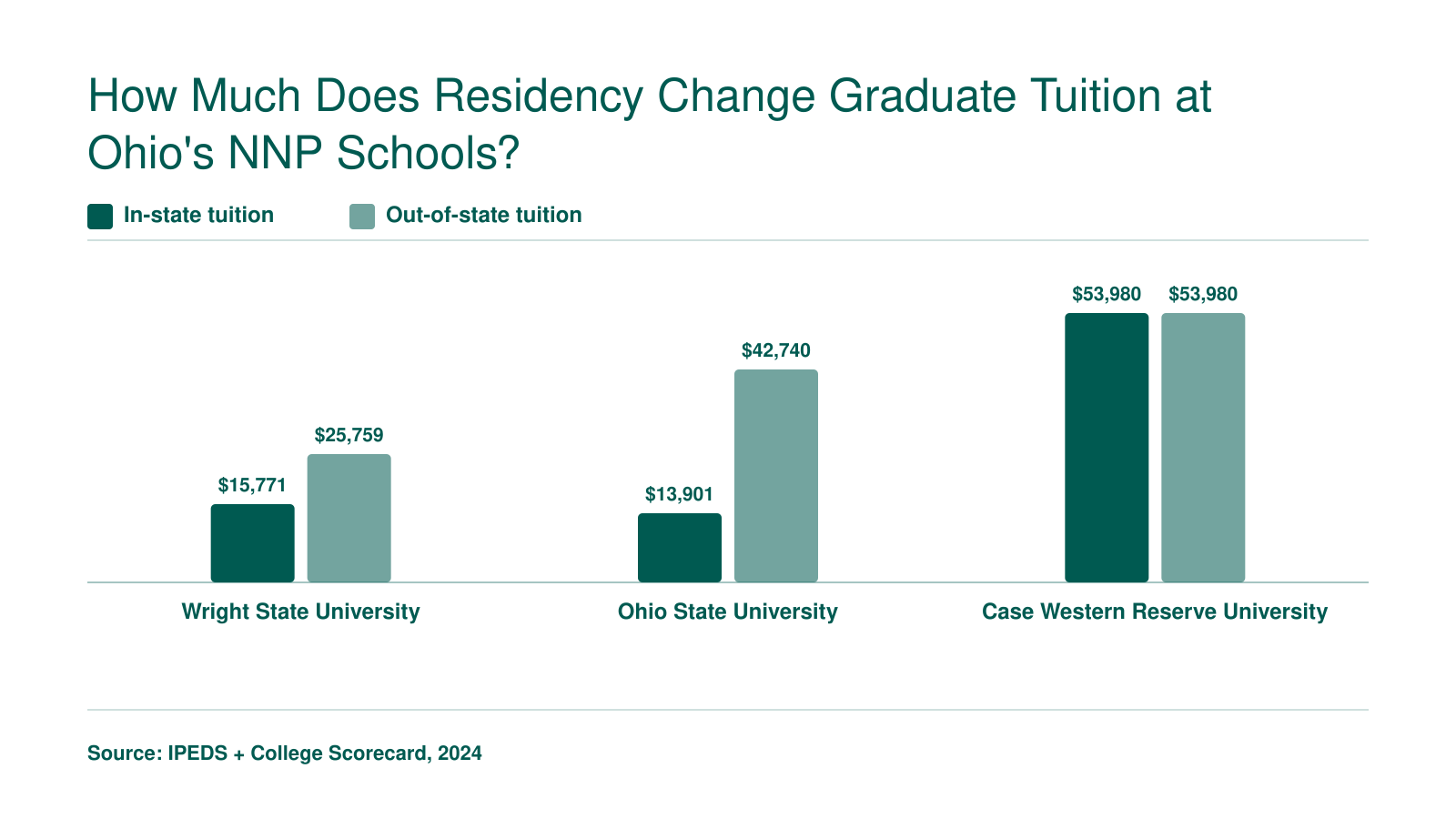
How Much Does Residency Change Graduate Tuition at Ohio's NNP Schools?
The residency gap is largest at Ohio State University, where out-of-state graduate tuition of $42,740 runs $28,839 above the $13,901 in-state figure. Wright State University shows a gap of $9,988. Case Western Reserve University, a private school, charges $53,980 regardless of residency, as private schools typically do. Out-of-state students save nothing by choosing a public program on price alone.
Ohio APRN Licensure After Your NNP Master's
What Ohio NNP Graduates Earn and Where They Work
For Ohio NNP students, borrowing now separates the options more sharply than salary does. Five years after finishing, nursing master's graduates of Case Western Reserve University earn a median $119,948. They carry median debt of $124,668, or about $1,418 a month on a standard ten-year plan. Wright State University graduates earn a median $111,248 five years out on $47,165 in debt ($537 a month). Ohio State University graduates earn $106,983 with $49,134 borrowed ($559 a month). These figures cover each school's broader nursing master's field, not the neonatal track alone.
Neonatal nurse practitioners typically work in Level III and IV NICUs at Ohio children's hospitals. They also attend high-risk deliveries, staff neonatal transport teams and follow infants in outpatient follow-up clinics.
Your next step: shortlist programs by format and by how much NICU experience each requires. Then ask every admissions office how it arranges clinical placements before you apply.
Quick Answers for Prospective Ohio NNP Students
These short answers cover the questions applicants ask most often about Ohio NNP master's programs. Where a figure could not be verified, we say so and point you to the section with more detail.
How many clinical hours are required for an NNP MSN in Ohio?
Do Ohio NNP MSN programs require the GRE?
What is the total cost of a neonatal nurse practitioner MSN in Ohio?
Are clinical placements guaranteed in Ohio NNP programs?
What is the pass rate on the NCC Neonatal Nurse Practitioner exam for Ohio programs?
Should I choose an NNP MSN, a post-master's neonatal certificate, or a BSN-to-DNP?
Compare Neonatal Nurse Practitioner programs on the data that matters
Explore more Nursing specializations or browse every graduate field.
All Nursing programs