Master's Programs With No GRE Required
Programs that publish no entrance-exam requirement or call the exam optional. Confirm with the school; test policies change every cycle.
Many graduate programs have dropped the GRE requirement, but the labels are inconsistent. "No GRE required," "GRE optional," and "waived" describe different rules, and a department can change its policy between application cycles. Applicants for fall 2026 and fall 2027 intakes may find that a roundup page, or last year's brochure, no longer matches the program's current admissions rules.
The practical tension is that dropping a test does not lower the cost, the accreditation bar, or the stakes of the degree. Net price, program accreditation, and graduate earnings still separate a good value from an expensive one.
The same questions apply to online, international-student, and no-GMAT applicants, and policy language is where they most often go wrong.
Key Points
- Check each program's own admissions page, since GRE policies can change by intake term.
- Online MS in Cybersecurity Studies at American Public University costs $18,290 in total, with no GRE or GMAT.
- International applicants still need English proficiency scores and credential reviews even when the GRE is dropped.
Business & Management
Education & Teaching
Nursing
Healthcare
Communications & Media
Psychology
Social Work & Social Sciences
Counseling
Computers & IT
Science & Engineering
Religion & Theology
Arts & Design
Criminal Justice & Law
No GRE Required vs. GRE Optional vs. Waived: What Each Label Means
"No GRE required" means you can submit a complete application without GRE scores, and the program does not expect them from you. That is different from "optional" and "waived," which sound similar but work differently. With an optional policy, scores you submit may still be considered, and a waiver usually depends on a GPA or coursework threshold plus an extra step on your part. Many schools set GRE policy program by program rather than school-wide, and some waivers or exemptions apply only to specific application terms, so confirm the policy for your exact program and entry term.
| Policy Label | What It Means | Example Program (Verified 2026) | Should You Submit Scores? |
|---|---|---|---|
| GRE not required | The GRE is required only for programs on a published list. Programs not on that list can be applied to without scores, though submitting them is permitted. | Boston University College of Arts & Sciences MA and MS programs not on its GRE-required list (policy checked October 6, 2026) | Only if you want the program to consider them. They are not required. |
| GRE optional | You may send scores for consideration, but an application is complete without them. Stanford's wording covers all of its PhD and master's programs for the 2025-2026 academic year. | Stanford Graduate School of Education master's programs (policy checked October 2, 2026) | Submit them if you believe they strengthen your application. Stanford states that not submitting them does not negatively affect your application. |
| GRE waiver available (GPA threshold) | GMAT/GRE is not required for applicants with a cumulative GPA of 3.0 or higher, but you must contact the master's office after applying and complete a waiver form. | Purdue University Daniels School of Business, MS Business Analytics and Information Management (policy checked October 8, 2026) | Not needed with a 3.0 or higher GPA, but scores are encouraged for scholarship consideration and competitiveness, and submitted scores are weighed in admission decisions. |
| GRE or GMAT required, waiver available (grades and coursework) | Scores are required unless you have an overall grade average of B or better and B+ or better, or equivalent, in statistics and/or calculus and intermediate economics. | Harvard Kennedy School, Master in Public Policy (policy checked October 3, 2026) | Submit scores unless you qualify for and use the waiver. |
| GRE or GMAT required, waiver available (grades and coursework) | Scores are required unless you have an overall grade average of B or better and B+ or better, or equivalent, in two college-level courses in economics, statistics, and/or mathematics at algebra level or higher. | Harvard Kennedy School, Master in Public Administration (policy checked October 3, 2026) | Submit scores unless you qualify for and use the waiver. |
How to Verify a Program's GRE Policy Before You Apply
A quick answer from a roundup page is convenient, but a policy tied to one intake term can lapse before the list is updated. The safest habit is to treat the program's own page as the only authority and to confirm it in writing.
A Five-Step Routine
- Department page first: Read the admissions page for the specific degree, not only the graduate school's general page. Policies often differ by college. Florida State's general waiver through Fall 2026, for example, excludes the College of Business.1
- Find the effective term: Look for the intake the policy covers. Stanford's Master of International Policy waiver applies to Fall 2026 applicants for Autumn Quarter only,2 and FAMU-FSU's engineering waiver runs through Fall 2026.3
- Read the waiver fine print: "No GRE" can mean different things. Carnegie Mellon's School of Computer Science waives the test only for CMU graduates or enrolled students.4 Northwestern's biomedical engineering program does not accept a GRE even if you submit one.5
- Email admissions: Ask whether the policy applies to your intake, degree track, and background. Keep the reply.
- Save a dated screenshot: Capture the policy page and note the date, so you can show what it said when you applied.
Why Timing Changes the Process
Some waivers require a separate request filed before the application itself. Wisconsin's Master of Real Estate has an October 15, 2026 deadline for Spring 2027, and its waiver request is due at least one week earlier, which is October 8.6 Wisconsin's supply chain program lists rounds from November 4, 2026 through June 3, 2027, with the same one-week lead for requests.7 Among master's in accounting programs, NYU Stern's MS in Accounting asks for waiver requests 15 days before the application deadline.8
Harvard Kennedy School's master's in public policy programs show how far ahead this can run: its waiver-request deadline of August 31, 2026 applies to Fall 2027 applicants, not to the current cycle.9
Other deadlines are plain application dates. Carnegie Mellon's School of Computer Science lists an early deadline of November 18, 2026 and a final one of December 9.4 Illinois Geography's December 15, 2026 deadline is for Fall 2027 entry.10 Northwestern's biomedical engineering program lists January 31, 2027 for Spring 2027.5 Deadlines vary widely by program, and some sources do not list a date for every term, so confirm the one for your intake directly.
Don't Rely on Third-Party Lists
Aggregated lists of no-GRE programs go stale because policies change by term, college, and applicant group. Use them to build a shortlist, then confirm each policy on the program's own page and by email before you pay an application fee.
Accredited Master's Programs Without the GRE, Field by Field
Does a no-GRE master's program have to be accredited to be worth applying to? Not legally, but a missing GRE requirement says nothing about quality. Accreditation does. The field-by-field breakdown here is organized around one admission question: is the GRE not required, or can it be waived? It is not a ranking of value or price. GRE policies change from cycle to cycle, so confirm each program's current policy and any waiver conditions on its official admissions page before you apply.
Which Accreditors Apply to Each Field
Every legitimate program sits inside a university with institutional (regional) accreditation. Many fields add a programmatic accreditor on top of that.
- Business: AACSB accredits business and accounting programs, including many No-GRE MBA options. Check the AACSB accredited schools directory.1
- Engineering and computer science: ABET accredits computing and engineering programs, including at the master's level.2 ABET-accredited programs are offered by regionally accredited U.S. institutions.3
- Nursing and health: CCNE accredits master's nursing programs and lets you search by institution, state, and program.4
- Social work: CSWE lists CSWE-accredited MSW programs, and also shows programs in candidacy or pre-candidacy, which is not the same as fully accredited.5
- Counseling: CACREP accredits master's and doctoral programs solely in counseling.6
- Education: CAEP is the national accreditor for educator preparation. Teacher licensure also depends on state approval of the program, so check both.
- Psychology: MPCAC accredits master's programs in psychology and counseling. That accreditation is optional and far less standardized than CACREP or CSWE.
Why Programmatic Accreditation Matters
In counseling, social work, and nursing, the accredited degree can decide whether you qualify for a license. Many state boards expect a CACREP or CSWE degree, and nurse practitioner certification and licensure generally expect graduation from an accredited nursing program. A school's regional accreditation alone may not satisfy those boards. Confirm the requirement with your state board before you pay a deposit.
A Note on Psychology Master's Programs
The American Psychological Association accredits doctoral programs, internships, and postdoctoral programs, not master's programs in psychology. So an applicant to accredited master's in psychology programs shouldn't look for APA accreditation. Check the university's institutional accreditation, look at whether the program holds MPCAC or CACREP status if it leads to counseling, and read your state's licensure rules. A degree titled "psychology" does not automatically lead to a counseling or clinical license.
How to Confirm Accreditation Yourself
We don't list a university as GRE-free here unless the school's own page and the accreditor directories both back it up. You should run the same check:
- Search the school in the U.S. Department of Education's database of accredited postsecondary institutions and programs, and in CHEA's directory7, to confirm the institutional accreditor is recognized.
- Look up the specific program in the relevant programmatic directory (AACSB, ABET, CCNE, CSWE, CACREP, or CAEP).
- Match the exact degree and campus or online format. Accreditation can apply to one program and not another at the same school.
- Save a screenshot of the GRE policy page with the date, in case the policy changes before your deadline.
Graduate Programs That Don't Require the GRE or GMAT
A traditional MBA application often leans on a GMAT or GRE score; a specialized business master's like a Master's in Finance, Accounting, or Business Analytics may weigh quantitative coursework and work history instead. The distinction matters because business schools set GMAT and GRE policies separately. A program can drop the GRE and still expect the GMAT, so applicants should check both before assuming a test-optional admission.
How No-GMAT Waivers Usually Work
Waiver rules are set school by school, not by any single accreditor. Common criteria include years of professional experience, undergraduate GPA cutoffs, prior graduate degrees, and professional certifications such as CPA or CFA. Dartmouth Tuck, for example, lists at least two years of post-graduate work experience for a test waiver. Minnesota Carlson points to a 3.2 undergraduate GPA for most majors, or 3.0 for STEM majors, alongside indicators like work experience, a graduate degree, a CPA or CFA, or U.S. military service. Cornell Johnson accepts a STEM, business, or quantitative degree with a 3.0 GPA, analytical work, or a CPA/CFA. In practice these indicators often support a request rather than guarantee an automatic waiver.
MBA vs. Specialized Master's: Where Waivers Vary
MBA programs frequently tie waivers to substantial work experience. Rice Jones asks for at least three years of post-undergraduate experience plus another condition. UVA Darden reviews waivers case by case for three or more years of quantitative work or an advanced analytical degree. Specialized programs can be broader or narrower. La Salle's M.S. in Business Systems and Analytics waives the GMAT/GRE with a 3.0 GPA in any undergraduate discipline and two years of business experience. NYU Stern's M.S. in Accounting generally expects a final undergraduate GPA of at least 3.00 at conferral. Georgetown McDonough accepts the GMAT, GRE, or Executive Assessment and lists waiver evidence such as a 3.1 GPA in a STEM or business field or a 3.3 in other fields, plus two quantitative courses with a B or better.
Can You Get In Without the GRE or GMAT?
Yes, at the schools above and many others. The tradeoff is evidence. If you skip the test, admissions committees look harder at your GPA in quantitative courses, your work history, and professional credentials. Check each program's current waiver form and deadlines, because policies change year to year.
What Replaces the GRE in Admissions Decisions
When a program drops the GRE, the committee still needs evidence that you can handle graduate-level work. Here is what typically fills that gap. Requirements vary by school and field, so confirm each one on the program's admissions page.
- Undergraduate GPAMany programs set a minimum around 3.0, though some are higher. Years of grades show sustained academic performance, which is the readiness the GRE tried to capture in a single sitting. Some committees weigh the last 60 credits or major coursework more heavily.
- Relevant work experienceProfessional experience shows you can apply field knowledge, meet deadlines, and work with others. It is often the most persuasive substitute in fields like business, nursing, education, and public administration.
- Statement of purposeA clear, specific essay shows writing ability and analytical thinking, and it explains your goals and why this program fits them. It does the work the GRE writing section was meant to do.
- Letters of recommendationProfessors and supervisors can speak to your work ethic, research ability, and potential in ways a test score cannot. Choose recommenders who know your work well.
- Resume or CVIt gives the committee a quick view of your roles, accomplishments, and progression, and it shows whether your background matches the program's focus.
- Prerequisite courseworkCompleted classes in statistics, biology, or core business subjects show you have the quantitative and subject foundation the program assumes. Missing prerequisites can often be completed before or alongside enrollment.
- Portfolio or interviewSome programs, especially in design, counseling, and certain professional fields, ask for work samples or a conversation. These show skills and communication in practice, which standardized tests cannot.
Online and Affordable No-GRE Master's Programs Compared
Yes, many accredited universities offer online master's programs that do not require the GRE, including MBA, data science, nursing, and health science degrees. The table puts published per-credit rates and credit totals side by side, with estimated tuition shown on the same basis. Treat the per-credit rate as a starting point: published totals for some programs, such as Nebraska at Omaha and Montclair State, run higher than rate times credits, which suggests that technology, program, or graduation fees are included. Other schools list tuition only, so check each school's fee schedule and confirm the current GRE policy before applying. Rates are for 2025-26 or 2026-27 as noted, and several programs charge different rates by residency.
| School & Program | Format | Per-Credit Tuition | Total Credits | Estimated Total Tuition | GRE Policy |
|---|---|---|---|---|---|
| University of Colorado Boulder, Professional MS in Data Science (2026-27) | Online on Coursera | $525 for in-state, out-of-state, and international students | 30 | $15,750 | No GRE requirement stated |
| University of Nebraska at Omaha, Online MBA (2025-26) | Online | $442 resident; $663 Omaha Urban Rate; $1,025 non-resident and international | 33 | $17,319.75 resident; $24,612.75 Urban Rate; $36,558.75 non-resident; $37,158.75 international | No GRE requirement stated |
| George Mason University, Online MSN Family Nurse Practitioner (2025-26) | Online | $850 | 24 (implied by published total) | $20,400 | No GRE requirement stated |
| Montclair State University, Online MBA (2026-27) | Online | $875 | 33 | $34,155 | No GRE requirement stated |
| University of Michigan Ross, Online MBA (2025-26) | Online | $1,907 first credit and $2,148 additional credits for Michigan residents; $2,083 first credit and $2,324 additional credits for non-residents and international students | 57 | $120,000 Michigan residents; $130,000 non-residents and international students | No GRE requirement stated |
| Augusta University, Online MS in Data Science (2026-27) | Online | $405 in-state; $1,193 out-of-state; $1,228 out-of-country | N/A | N/A (waivers may be available for students who do not qualify as Georgia residents) | No GRE requirement stated |
| Drexel University, Online MS in Infection Control and Prevention (2026-27) | 100% online, no residency component | $850 | N/A | N/A | No GRE required |
The Full Cost of an Online No-GRE Master's
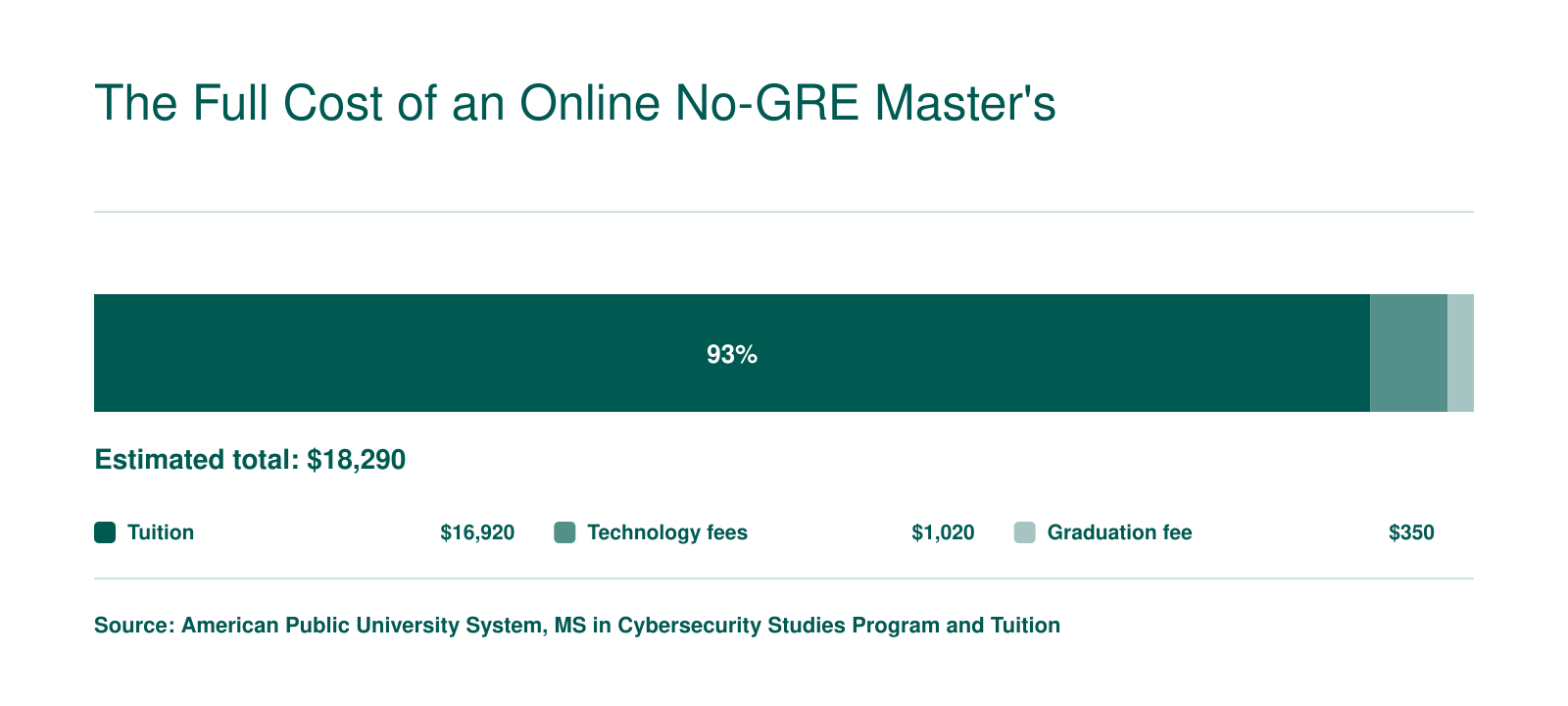
American Public University System's online MS in Cybersecurity Studies requires no GRE or GMAT. It charges $470 per credit for 36 credits, and the published fees bring the itemized total to $18,290. The school lists a $0 application fee and $0 for textbooks and eBooks, but its estimate leaves out other course materials, supplies, software, and lab fees. The technology fee ($85 per course) assumes the standard course structure and can shift with transfer credits. Before you commit to any program, request a full cost-of-attendance sheet, not just the per-credit rate.
International Students and No-GRE Admissions
A no-GRE policy removes one test, but international applicants still face English proficiency scores, credential reviews, funding documents, and visa rules. These steps are separate from the GRE decision and often come with earlier deadlines.
English Proficiency Still Applies
Minimum scores vary by program. The University of Hartford sets a general graduate minimum of 80 TOEFL iBT, 6.5 IELTS, and 110 Duolingo; its M.S. Computer Science & Engineering accepts 79, 6.0, and 100.1 The University of Denver lists 95 TOEFL iBT, 7.0 IELTS, and 125 Duolingo.2 Always confirm whether the program uses the pre-January 2026 TOEFL scale or the revised scale, because score thresholds and test dates matter.
Credential Reviews and Funding Documents
A foreign degree must generally be comparable to a U.S. bachelor's degree. Some programs ask for a course-by-course evaluation from WES, ECE, or ACEI; others accept official transcripts and degree certificates. Sacramento State recommends WES, ECE, or ACEI for graduate applicants.3 A WES course-by-course report includes degree equivalency, program length, courses, grades, and a U.S. GPA, and requires translated documents.456 After admission, the international office issues an I-20 only after you document funding for the school's estimated cost of attendance, including tuition, fees, living expenses, insurance, books, and dependents. Exact amounts and accepted documents vary by institution; sponsorship usually requires an affidavit.
Visa Status, Fully Online Study, and GRE Waivers
F-1 rules generally do not allow a student to maintain status through a fully online degree. Limited online credits may count toward full-time enrollment, but you normally need an in-person or hybrid format. If you need F-1 status, focus on on-campus or hybrid no-GRE options rather than fully online programs.
Use the field-by-field table in the previous section as a starting point and confirm each program's policy. A no-GRE label often applies to all applicants, but some programs waive the GRE for domestic applicants only. Before spending on transcripts or tests, email the admissions office and ask whether the waiver covers international applicants and what substitute materials they want.
According to the Open Doors 2025 report from the Institute of International Education, 488,481 international graduate students were enrolled in U.S. institutions in academic year 2024/25, down 3% from the prior year after three years of growth.
Career Outcomes: What to Check Before You Enroll
How do you know whether a no-GRE master's program will actually pay off? The GRE requirement tells you almost nothing about employment, but graduate earnings, debt, job placement, and licensure pass rates do.
Check program-level earnings and debt on College Scorecard
Instead of relying on university marketing, start with the College Scorecard's Field of Study pages. Choose "Master's degree" and search by subject or school to find program-level median earnings and median debt for recent completers. For example, a mental health counseling master's program page may report median earnings in the low-to-mid $50,000s and median debt that varies widely by institution. Compare that debt to the likely monthly payment and to the median earnings shown. Program-level figures are not the same as occupation-wide wages, but they show what actual graduates from that school earned at a specific point after finishing. Be sure you are viewing the master's credential level, not bachelor's outcomes. If the median debt exceeds a typical first-year salary for that field, proceed carefully.
Licensure pass rates and placement reports matter more than the GRE
For licensed fields, ask for the program's first-time pass rate on the relevant exam: the NCLEX for nursing, the NCE for counseling, and the ASWB exam for social work. A clinical mental health counseling masters no GRE program with a weak NCE pass rate is a red flag. A program with strong licensure pass rates and a transparent job placement report is a better signal than a program that simply dropped the GRE. Some schools also publish employment rates within six months of graduation; request that report if it is not posted.
Wages to benchmark against no-GRE career paths
Bureau of Labor Statistics May 2025 medians give useful anchors. Substance abuse, behavioral disorder, and mental health counselors earned a median of $59,350 per year.1 Social workers, who often compare affordable MSW programs, earned $61,780.2 Postsecondary education administrators earned $104,590.3 For nurse anesthetists, nurse midwives, and nurse practitioners, roles covered by MSN programs, BLS reports a median of at least $100,0004, though that figure includes nurse anesthetists and nurse midwives. These are occupation-wide medians, not starting salaries, and your own earnings will depend on location, specialty, and experience.
Before you enroll
Run a four-part check: employment rate within 6 months, median earnings for the specific program, debt-to-earnings ratio using that median earnings figure, and licensure pass rate in your state.
Nurse Practitioner Pay
Common Questions About No-GRE Master's Programs
GRE policies vary by school, department, and admissions cycle, so check the current official page for any program you are considering. These answers reflect the policies and caveats covered in the sections above.