Master of Arts in Teaching (MAT) Programs With No GRE Required
Compare 1,000+ accredited no-gre Teaching programs at 570+ schools, with graduate earnings, cost, debt, and completion data from IPEDS and the U.S. College Scorecard.
Pepperdine's Accelerated Master of Arts in Teaching (MAT) runs 11 months and includes 600 clinical hours. American University's takes 15 months across 33 credits. Neither asks for a GRE score, and for a career changer who already holds a bachelor's degree and has no appetite for test prep, that matters.
Accredited programs increasingly admit on transcripts, essays, recommendations, and classroom experience instead. The ranking, affordable MAT programs, licensure and student-teaching realities, and MAT-versus-MEd question all follow from that shift.
The GPA floor typically replaces the test: 2.7 at Virginia, 3.0 at several others.
Key Points
- Every licensure-track MAT requires supervised student teaching in a real classroom.
- The federal TEACH Grant can help fund no-GRE MAT tuition.
- State approval in one state doesn't guarantee licensure elsewhere.
Best MAT Programs With No GRE Required
These MAT programs draw from institutions where the GRE is waived or not required for admission. The list is ordered by a composite of retention, completion, institutional quality, and moderate cost and earnings factors, not by any single metric. Because test requirements can change, confirm each school's current GRE policy before applying.
University of California-Berkeley
#1Berkeley, CA · ~$16,000/yr (est.)
Best for: Social justice-oriented California teacher candidates
UC Berkeley's BTEP Teacher MA + Credential Program is a 15-month, campus-based route to a California teaching credential and Master of Arts in Education. Students select from Multiple Subject, English, History/Social Science, Math, or Science and progress through gradual immersion in Bay Area schools. The program emphasizes social justice, inclusive pedagogy, and evidence-based inquiry, with financial aid and fellowships available. Educator preparation accreditation status is not verified in the sources we reviewed.
- 15-month campus-based credential plus MA
- Concentrations: Multiple Subject, English, History/Social Science, Math, Science
- No GRE required for admission
- Gradual immersion into Bay Area classrooms
- Social justice and equity focus
- Student teaching in Bay Area schools
- Financial aid and fellowships available
University of Virginia
#2Charlottesville, VA · ~$24,000/yr (est.)
Best for: Online learners pursuing special education licensure
UVA's online Master of Teaching in Special Education prepares K-12 educators to work with students with mild to moderate disabilities in general curriculum settings. The part-time program blends behavior management, reading and math instruction, and assessment with supervised practicum and student teaching. Graduates earn initial Virginia licensure with a Special Education endorsement, and no GRE is required. Educator preparation accreditation status is not verified in the sources we reviewed.
- Online part-time format for working adults
- Prepares for initial Virginia licensure in Special Education
- No GRE required
- 2.7 GPA minimum; Praxis prep included
- Practicum and student teaching required
- Top-ranked special education program
- Transfer up to 6 credits
- Discounted tuition for Virginia educators
Marquette University
#3Milwaukee, WI · ~$25,000/yr (est.)
Best for: STEM professionals shifting to math teaching
Marquette's campus-based Master of Education in STEM Teaching with a math concentration is an accelerated 14-month route to initial Wisconsin teacher licensure for grades 4-12. The full-time program blends teaching theory, integrated STEM methods, and clinical practice, with optional computer science certification through Praxis. It is funded by the NSF Robert Noyce Teacher Scholarship and offers merit and need-based aid. Educator preparation accreditation status is not verified in the sources we reviewed.
- Full-time campus-based 14-month program
- Math concentration with initial Wisconsin teacher licensure
- No entrance exam required; test optional
- 36 total credit hours
- 3.0 GPA minimum
- Prepares for Praxis
- NSF Robert Noyce Scholarship funded
- Praxis II required for certification
Trinity University
#4San Antonio, TX · $20,000 – $25,000/yr (est.)
Trinity University's Master of Arts in Teaching is a cohort-based, 30-credit program with Elementary, Secondary, and All-Level Music tracks. Students complete a summer start and two semesters, earning Texas teacher certification with options for supplemental Special Education or ESL endorsements. The program does not require the GRE and accepts military service credit. Educator preparation accreditation status is not verified in the sources we reviewed.
- 30-credit cohort for EC-6 preparation
- No GRE required for admission
- 3.0 GPA and four references required
- Supplemental Special Education and ESL endorsements
- Field-based clinical practice built in
- Military service credit accepted
- 30-credit cohort for grades 7-12 preparation
- GRE not required for admission
- 3.0 GPA and four references plus interview
- Supplemental ESL and Special Education certificates
- Wide range of teaching field certifications
- Requires criminal background check
- 30-credit cohort for all-level music certification
- Admission does not require GRE
- Clinical practice in music classrooms
- Can add Special Education or ESL endorsement
University at Buffalo
#5Buffalo, NY · $10,000 – $15,000/yr (est.)
The University at Buffalo's Graduate School of Education offers master's degrees in teacher education that lead to professional licensure. Admission does not require GRE or MAT scores, and students complete a year-long teaching residency modeled after medical residencies. New York State certification is recognized by most other states, and the programs are positioned as affordable expanded pathways. Educator preparation accreditation status is not verified in the sources we reviewed.
- No GRE or MAT scores required for admission
- Year-long teaching residency modeled on medical residencies
- Dozens of teacher preparation programs
- New York State certification recognized by most states
- Pathways to initial and professional licensure
- Expanded certification pathways
Manhattan University
#6Riverdale, NY · ~$25,000/yr (est.)
Manhattan University offers a five-year combined B.S./M.S. Ed. in Childhood/Special Education for grades 1-6. Students complete 154 credits, begin graduate coursework as undergraduates, and finish with a full-semester special education internship and fieldwork in New York City metro schools. The program prepares for dual New York State certification in Childhood Education and Students with Disabilities. Educator preparation accreditation status is not verified in the sources we reviewed.
- Five-year combined BS/MS Ed. program
- Dual NYS certification in Childhood Education and Students with Disabilities
- No entrance exam required; SAT/ACT optional
- 154 total credit hours
- Full-semester special education internship
- Fieldwork in New York City metro schools
- Locked tuition rate via Jasper Guarantee
University of South Carolina
#7Columbia, SC · ~$14,000/yr (est.)
The University of South Carolina's M.A.T. in Art Education blends studio practice, art history, and pedagogy for K-12 teaching licensure. Students complete 48 to 74 credits, including a full semester of directed teaching in a public school, and earn a South Carolina teaching license after passing Praxis exams. Small cohorts and faculty mentorship support hands-on learning in diverse environments. Educator preparation accreditation status is not verified in the sources we reviewed.
- Prepares for K-12 South Carolina teaching licensure
- 48 to 74 credit program
- No entrance exam required; test optional
- 3.0 GPA minimum; two recommendations
- Portfolio of 20 images required
- Full semester of directed teaching
- Prepares for Praxis exams
American University
#8Washington, DC · ~$37,000/yr (est.)
American University's Master of Arts in Teaching with an Elementary Education concentration prepares students to teach grades 1-6. The 33-credit program includes more than 600 hours of clinical experience and is offered online or on campus. Graduates earn a teaching license transferable to 48 states, and no GRE is required. Educator preparation accreditation status is not verified in the sources we reviewed.
- Online or on-campus formats available
- 33 credits and 600 clinical hours
- No GRE required
- Prepares for DC, Maryland, Virginia licensure
- 15-month cohort model
- Blends neurodevelopmental research and social-emotional learning
- 100% job placement rate reported
Pepperdine University
#9Malibu, CA · $40,000 – $45,000/yr (est.)
Pepperdine University offers an online/hybrid Master of Arts in Teaching with Elementary (Multiple Subject) and Secondary (Single Subject) tracks. The 11-month, 30-credit program combines weekly live online classes with 600 hours of student teaching at more than 200 partner sites. No GRE is required, and the program is accredited by the California Commission on Teacher Credentialing and WSCUC.
- Hybrid format blends online classes and student teaching
- 11-month, 30-credit program
- No GRE or standardized tests required
- 600 clinical hours at partner sites
- Prepares for Multiple Subject teaching credential
- Weekly live online classes
- CTC and WSCUC accredited
- Equity and social justice focus
- Hybrid format with 600 clinical hours
- 11-month program with 30 credits
- GRE and standardized tests not required
- 600 clinical hours at 200+ partner sites
- Prepares for Single Subject teaching credential
- Live online classes each week
- Accredited by CTC and WSCUC
- Application fee waivers available
Montclair State University
#10Montclair, NJ · ~$16,000/yr (est.)
Montclair State University's Master of Arts in Teaching leads to initial New Jersey teacher certification with Early Childhood (P-3), Elementary (K-6), or Subject Area (P-12) tracks. The campus-based program includes clinical experience in the final two semesters and student teaching in partner schools. A dual certification option adds Teacher of Students with Disabilities, and standardized tests are not required. Educator preparation accreditation status is not verified in the sources we reviewed.
- Campus-based initial New Jersey certification
- P-3, K-6, or P-12 subject-area tracks
- No standardized tests required
- 2.8 GPA minimum; two recommendations
- Clinical experience final two semesters
- Student teaching in partner schools
- Dual certification in Teacher of Students with Disabilities option
- $60 application fee
Cost & outcomes by school
Federal data for the highest-earning Teaching programs, independent of the ranking above. Earnings are this field's master's graduates four years after completing, where the Scorecard reports them.
| School | Earnings | Tuition / yr | Debt | Grads/yr | Format |
|---|---|---|---|---|---|
| University of California-Irvine CA | $79,921 | $14,827 | $30,500 | 136 | Campus |
| Wayne State College NE | — | $5,784 | — | — | Online |
| Buena Vista University IA | — | $9,061 | — | — | Online |
Sources: U.S. Department of Education. Tuition and graduates: IPEDS. Earnings and debt: College Scorecard, this field's master's graduates; a dash means no figure is reported.
Cost, debt & payoff
Median earnings of this field's master's graduates (4 yrs after completing) vs. their median federal loan debt · U.S. College Scorecard
Across these programs the median graduate earns about $58,919 and finishes with roughly $27,974 in debt — a ratio that clears a common rule of thumb (keep debt below first-year salary). Tuition and debt vary widely school to school, so check the per-school figures in the table above before you shortlist.
Most Affordable No-GRE MAT Schools
These three schools have the lowest published graduate tuition among the no-GRE MAT programs shown. Net price is an institution-wide average after grant and scholarship aid, not a quote for MAT students. For MAT-specific funding, the federal TEACH Grant lists an award of up to $3,772 per year and a maximum of $8,000 total for graduate study, with a four-year service obligation in a low-income school or educational service agency in a high-need field. State options such as Washington's Teacher Shortage Conditional Scholarship (up to $8,000 per year) and the Kansas Teacher Service Scholarship ($3,400) may also help, but eligibility must be confirmed. Compare total program cost by multiplying credits by the per-credit rate, not just the annual figure.
| School | In-State Graduate Tuition | Out-of-State Graduate Tuition | Average Net Price |
|---|---|---|---|
| Oakland University | $15,262 | $23,188 | $9,120 |
| University of North Georgia | $5,285 | $16,503 | $9,823 |
| North Carolina A & T State University | $6,813 | $20,673 | $10,846 |
Licensure and State Approval: Will Your No-GRE MAT Lead to a Teaching License?
Skipping the GRE is easy to verify, but among No-GRE master's programs, a degree that doesn't lead to a license in your state is a costly mistake. Most Master of Arts in Teaching (MAT) programs are initial-licensure programs approved in their home state, and approval there doesn't automatically carry over elsewhere. Online programs at Title IV schools must publish a professional licensure disclosure (34 CFR 668.43) stating, state by state, whether the curriculum meets educational requirements.2 Disclosure is not a guarantee, since the state still issues the credential.
How Reciprocity Really Works
The NASDTEC Interstate Agreement is a framework, not an interstate compact.1 It is not binding, it doesn't transfer a license automatically, and the receiving state decides what to issue. Many states still require their own exams, such as the Praxis, or extra coursework.
A California Example
California participates in NASDTEC3, but completing an out-of-state program or master's is not enough.4 The Commission on Teacher Credentialing generally expects a professional-level credential from another state, earned through a program that included student teaching.4 Graduates who instead pursue a preliminary credential through a CTC-approved California program face CalTPA or edTPA and, where applicable, RICA requirements.5 Career Technical Education credentials have no direct reciprocity.4
Your 3-Step Check
- Read the disclosure: Find the program's licensure disclosure page and look for your state of residence.
- Call your state agency: Confirm with your state education department that the program qualifies.
- Verify testing: Ask which exams and performance assessments you must still pass.
Related Articles
Student Teaching and In-Person Requirements in Online MAT Programs
In online MAT programs, online coursework is not the same as online clinical practice. You can watch lectures and submit assignments from anywhere, but every MAT that leads to a teaching license requires you to stand in a real classroom for an extended, in-person placement. Expect a full semester at minimum, and often a yearlong stretch.
How Long and How Close to Home
USC Rossier's online MAT illustrates the pattern. Student teaching begins in the second semester at a site near your home: an elementary school for multiple-subject candidates or a local middle or high school for single-subject.1 The commitment is substantial, four full days a week and at least 28 hours weekly, running roughly 30 weeks across two semesters.2 USC's catalogue also lists 800 clinical hours toward the credential.3 Classes stay online, but the placement is hands-on and local.
Placements, Pay, and Career Changers
Some programs arrange placements for you; others ask you to secure one. Programs may also be unable to place students in certain states, so confirm yours is covered. Paid pathways exist but vary: USC's separate Teacher Preparation Residency assigns candidates to greater Los Angeles partner schools (LAUSD, Ednovate, Alliance), pays a $20,000 to $35,000 stipend, and requires a four-year teaching commitment. USC does not recommend full-time work while enrolled.4
Before enrolling, ask admissions: Who secures my placement? Can you place students in my state? Does my current teaching job count? What is the total hour requirement?
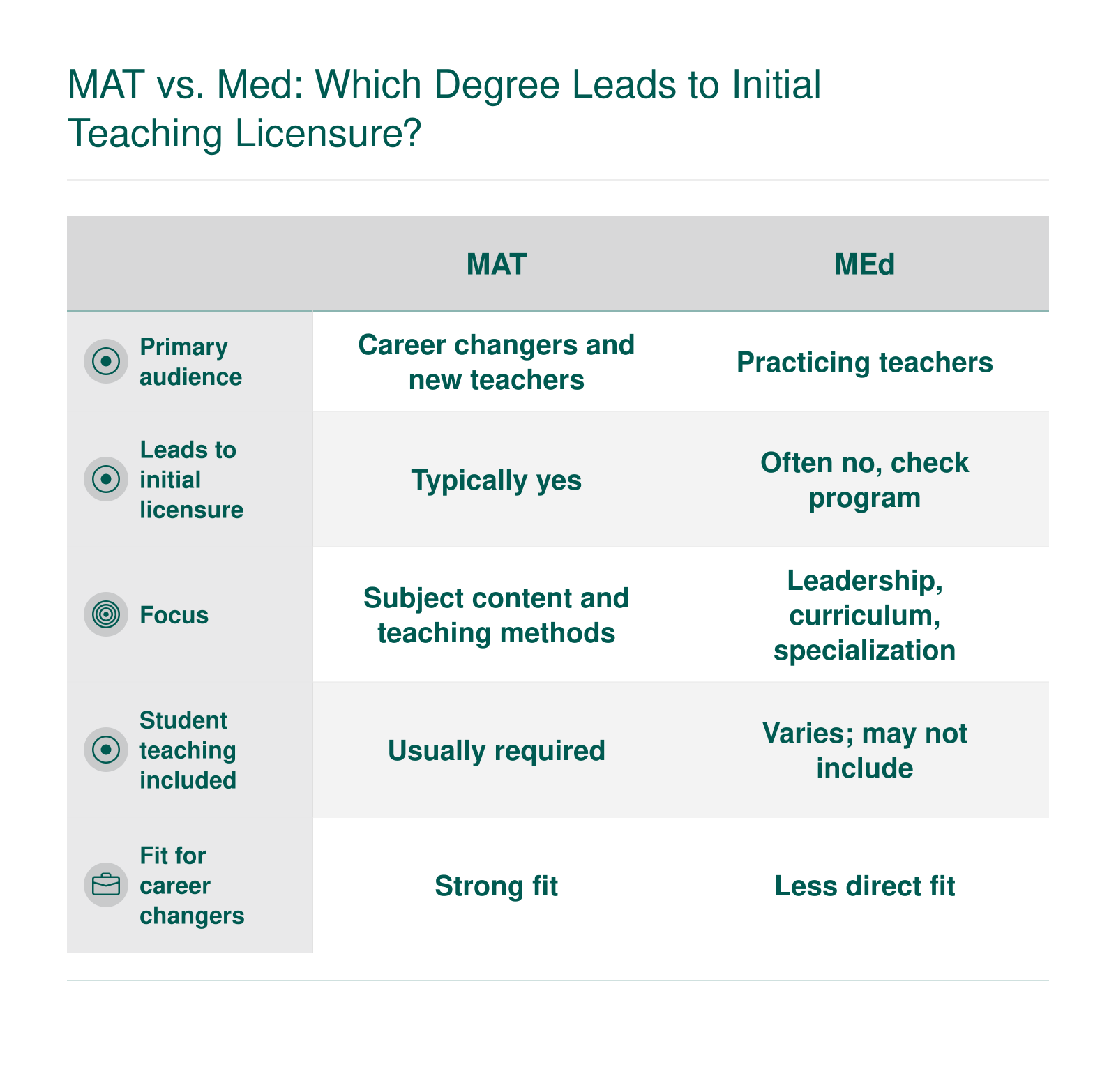
MAT vs. Med: Which Degree Leads to Initial Teaching Licensure?
The MAT is typically built for aspiring teachers, while the MEd is often designed for practicing educators. However, some MEd programs do include initial licensure, so verify each program's certification pathway before deciding.
What No-GRE MAT Programs Ask for Instead
Dropping the GRE shifts the focus to evidence that you can handle graduate coursework and clinical training.
- Bachelor’s degree and GPAAn accredited bachelor’s degree is usually required, with a minimum GPA often in the 2.75–3.0 range; some programs review the last 60 credits.
- Supporting documentsPlan on a statement of purpose, résumé, and two or three recommendation letters. Secondary-track applicants may need subject-area prerequisites or a content exam.
- Background and licensureMany MAT programs require a background check before student teaching, plus any state content or pedagogy exams for certification.
- Deadlines, fees, and transfer creditDeadlines vary by term and priority cycle; fee waivers may be available for military, financial need, alumni, or partner programs. Transfer policies often allow about six prior graduate credits, with some schools accepting up to twelve.
Teaching programs by state
Common Questions About No-GRE MAT Programs
Quick answers to common concerns for no-GRE MAT applicants.
Can international students enroll in no-GRE MAT programs?
Are there no-GRE MAT programs in California, and do they lead to a California credential?
Are no-GRE MAT programs less respected by school districts?
Compare Teaching programs on the data that matters
Explore more Education & Teaching specializations or browse every graduate field.
All Education & Teaching programs