Best Master of Arts in Teaching (MAT) Programs in Virginia
Compare 29 accredited Teaching programs in Virginia at 18 schools, with graduate earnings, cost, debt, and completion data from IPEDS and the U.S. College Scorecard.

A career changer with a biology or history degree can earn a Virginia classroom license through a master's, but the routes differ sharply: a one-year cohort in Charlottesville, evening hybrid classes in Richmond, or eight-week online courses at Liberty University.
Campus and online programs are ranked together here on federal cost and debt data. Program-level earnings are not yet published, so tuition, format, and licensure fit carry most of the comparison.
Every route ends at the same gate: a bachelor's degree and passing Praxis scores for initial licensure.
Key Points
- Sweet Briar College lists the lowest graduate tuition among ranked schools, at $12,750.
- Liberty University's online MAT uses eight-week courses and requires at least 90 clinical hours.
- Virginia licenses come from the state Department of Education, not from the MAT degree itself.
Top-Ranked Master's in Teaching Programs in Virginia
These Virginia programs pair licensure-focused teacher preparation with tuition and outcome figures from federal IPEDS and College Scorecard data. Program-level earnings and debt are not yet published for these programs, so cost, format, and licensure fit carry most of the comparison.
University of Virginia
#1Charlottesville, VA · ~$24,000/yr (est.)
Best for: Full-time students wanting an immersive cohort year
The University of Virginia offers one-year, cohort-based Master of Teaching programs in Charlottesville, plus an online part-time special education track. Each leads to initial Virginia licensure, and the School of Education and Human Development is ranked #6 nationally by U.S. News and World Report. The university graduates about 96% of its students overall, and CAEP lists its initial and advanced preparation as fully accredited.
- One-year, full-time cohort running June through May
- Leads to Virginia ESL preK-12 initial licensure
- Internships in both elementary and secondary ESL classrooms
- Professional Field Project required; no entrance exam required
- 2.7 GPA minimum; discounted tuition for Virginia preK-12 educators
- One-year cohort starting each summer
- Initial licensure in Virginia
- 2.7 GPA minimum; prerequisite courses required
- Capstone required; internships in diverse schools
- Full-time, in-person, one-year summer start
- Ranked #10 nationally in elementary teacher education
- Initial Virginia licensure; Praxis exams required
- No entrance exam required; capstone project
- Endorsements in biology, chemistry, earth science, physics
- GRE not required for admission
- Robert Noyce Scholarship of $18,000 per year listed
- One-year cohort from June through May
- Online and part-time; starts spring, summer or fall
- Test optional; no GRE required
- Practicum and student teaching included
- Transfer up to 6 credits; initial Virginia licensure
University of Richmond
#2University of Richmond, VA · ~$31,000/yr (est.)
Best for: Working professionals taking evening classes
The University of Richmond designs its Master of Teaching for career changers with a non-education bachelor's degree. Evening, part-time classes (some hybrid) suit working adults, and candidates complete either a 15-week internship or a yearlong paid residency. The university graduates about 85% of students overall, and the program reports that graduates often receive job offers before their internships end.
- Two-year, part-time program with summer and fall starts
- 15-week clinical experience or yearlong paid residency
- Elementary PreK-6, secondary 6-12, or PreK-12 endorsement areas
- Add-on endorsements in ESL, gifted, or special education
- Leads to a Virginia teaching license; capstone required
- Hybrid delivery with evening classes
- Part-time, two-year format for working adults
- Add-on endorsements available in ESL, gifted, special education
- Capstone required; scholarships available
James Madison University
#3Harrisonburg, VA · ~$13,000/yr (est.)
Best for: Aspiring secondary teachers in core subjects
James Madison University in Harrisonburg offers campus-based M.A.T. tracks in secondary, elementary, and special education. The university's educator-preparation unit holds CAEP accreditation through June 2033, and the elementary page notes Virginia Department of Education approval. It graduates about 80% of students overall.
- 33 credits; requires the pre-professional SEED minor
- Licensure in English, math, sciences, history/social sciences
- Internship in middle and secondary settings
- 2.7 GPA minimum; Praxis required
- Three-semester accelerated format, 33 credits
- Comprehensive action research project
- Content areas: English, math, science, social studies
- Capstone required; prepares for Virginia licensure
- 31 credits; five-year integrated program
- Student teaching internship required
- 2.8 GPA minimum
- Listed as approved by the Virginia Department of Education
- Minimum 30 graduate credits; post-baccalaureate entry
- Three concentration options
- 2.5 GPA minimum; two recommendation letters
- Comprehensive examination required
George Mason University
#4Fairfax, VA · $15,000 – $20,000/yr (est.)
George Mason University in Fairfax offers a teaching pathway through its M.A. in History rather than a stand-alone MAT. Paired with the Secondary Education Licensure Graduate Certificate, it makes graduates eligible for an initial Virginia license in history and social science. The university graduates about 68% of students overall.
- 36 credits, including 15 history and 15 education credits
- Requires one U.S., one European, and one world history course
- Licensure also requires the Secondary Education Licensure Graduate Certificate
- Priority deadlines: March 15 for fall, November 1 for spring
Christopher Newport University
#5Newport News, VA · $13,000 – $23,000/yr (est.)
Christopher Newport University in Newport News runs a campus-based MAT with 12 endorsement areas and three pathways: a five-year combined bachelor's to MAT, a standalone MAT, and an initial licensure track. Its teacher preparation program earned full CAEP accreditation in 2024, and the university graduates about 72% of students overall. Available 2026-27 figures show roughly $762 per credit for Virginia residents and $1,312 for nonresidents.
- Three pathways: five-year combined, standalone MAT, non-degree licensure
- 12 CAEP-accredited endorsement areas
- Dedicated MAT Field Experience component
- CAEP Frank Murray Leadership Recognition for continuous improvement
- Prepares for a Virginia license with reciprocity
- Five-year bachelor's to MAT option
- Financial aid and scholarships available
- Endorsements such as biology and chemistry
- Licensure in Virginia and other states
- Already-degreed route leads to licensure
University of Mary Washington
#6Fredericksburg, VA · ~$12,000/yr (est.)
The University of Mary Washington in Fredericksburg offers a post-baccalaureate M.Ed. in initial teacher licensure (an M.Ed. rather than a MAT). Six pathways cover elementary, special education, secondary, PreK-12, and middle grades, each ending in a semester-long internship in local schools. The university graduates about 66% of students overall.
- Six pathways, including special education general and adapted curriculum
- Credit totals run 36 to 45 depending on pathway
- Semester-long internship (EDCI 550) in local schools
- 2.5 GPA minimum; essay and literacy proficiency score required
- Transfer up to nine graduate credits
Liberty University
#7Lynchburg, VA · ~$9,000/yr (est.)
Liberty University offers a fully online MAT built for flexibility: asynchronous courses, eight-week terms, and eight start dates a year. Graduate tuition is $450 per credit, or $310 for military students, and GRE scores are not required. The School of Education states CAEP accreditation and Virginia Department of Education approval, and the university graduates about 65% of students overall.
- Fully online, asynchronous; 8-week courses, 8 starts per year
- 36-credit shortest licensure route; 42, 45, or 48 for dual endorsements
- Endorsements in elementary, middle, secondary subjects, and special education
- Student-teaching semester in a classroom
- $450 per credit; $310 for military students; no GRE
Virginia Commonwealth University
#8Richmond, VA · ~$17,000/yr (est.)
Virginia Commonwealth University in Richmond offers a Master of Teaching with seven secondary endorsement areas and fall, spring, or summer starts. VCU takes part in state-funded teacher-residency partnerships, including the Richmond Teacher Residency. CAEP lists its School of Education accreditation for initial and advanced preparation, and the university graduates about 63% of students overall.
- Minimum 34 credits; qualifying course EDUS 301 required
- Endorsements: biology, chemistry, earth science, English, history, math, physics
- Two internships; student teaching in spring
- 3.0 GPA minimum and three recommendation letters
- Praxis II required before the student-teaching year; background check required
Shenandoah University
#9Winchester, VA · ~$27,000/yr (est.)
Shenandoah University in Winchester offers an online MAT for provisionally licensed teachers who are already instructors of record in a K-12 classroom. Courses run in eight-week terms over 16 to 24 months at $490 per credit plus a $20 technology fee per course. No entrance exam or application fee is required. The university graduates about 67% of students overall.
- Online for working teachers with provisional licensure
- Elementary PreK-6, middle 6-8, or secondary 6-12
- 30 to 42 credits in 12 to 16 courses
- $490 per credit plus $20 technology fee per course
- Next deadline 12/15/26 for a 1/11/27 start; no entrance exam
Hampton University
#10Hampton, VA · $10,000 – $15,000/yr (est.)
Hampton University offers a Master of Teaching in Secondary Education in English on its campus. The program is an integrated structure totaling 136 credits, 120 undergraduate and 16 graduate. It suits students already on the undergraduate path who want to teach English language arts. The university graduates about 57% of students overall.
- 136 total credits: 120 undergraduate and 16 graduate
- Teaching English in secondary schools coursework
- Standards-aligned curriculum development
- Leadership paths in literacy and curriculum
Cost & outcomes by school
Federal data for the highest-earning Teaching programs, independent of the ranking above. Earnings are this field's master's graduates four years after completing, where the Scorecard reports them.
| School | Earnings | Tuition / yr | Debt | Grads/yr | Format |
|---|---|---|---|---|---|
| Norfolk State University VA | $59,973 | $13,412 | $57,919 | 18 | Campus |
| University of Virginia VA | $59,940 | $23,526 | $21,113 | — | Campus |
| Old Dominion University VA | $58,916 | $15,390 | $27,000 | 54 | Campus |
| University of Mary Washington VA | $57,480 | $12,462 | $20,500 | 12 | Campus |
| Christopher Newport University VA | $56,921 | $13,050 | $20,500 | 34 | Campus |
| Mary Baldwin University VA | $52,656 | $18,865 | $20,700 | 15 | Online |
| Liberty University VA | $52,482 | $8,730 | $32,858 | 522 | Online |
| Hollins University VA | $50,137 | $18,710 | — | 10 | Hybrid |
| Sweet Briar College VA | — | $12,750 | — | — | Campus |
| William & Mary VA | — | $17,666 | — | — | Campus |
| George Mason University VA | — | $17,964 | — | — | Campus |
| Randolph College VA | — | $18,310 | — | — | Online |
Sources: U.S. Department of Education. Tuition and graduates: IPEDS. Earnings and debt: College Scorecard, this field's master's graduates; a dash means no figure is reported.
Cost, debt & payoff
Median earnings of this field's master's graduates (4 yrs after completing) vs. their median federal loan debt · U.S. College Scorecard
Across these programs the median graduate earns about $58,916 and finishes with roughly $21,113 in debt — a ratio that clears a common rule of thumb (keep debt below first-year salary). Tuition and debt vary widely school to school, so check the per-school figures in the table above before you shortlist.
Lowest-Cost MAT Programs in Virginia by Graduate Tuition
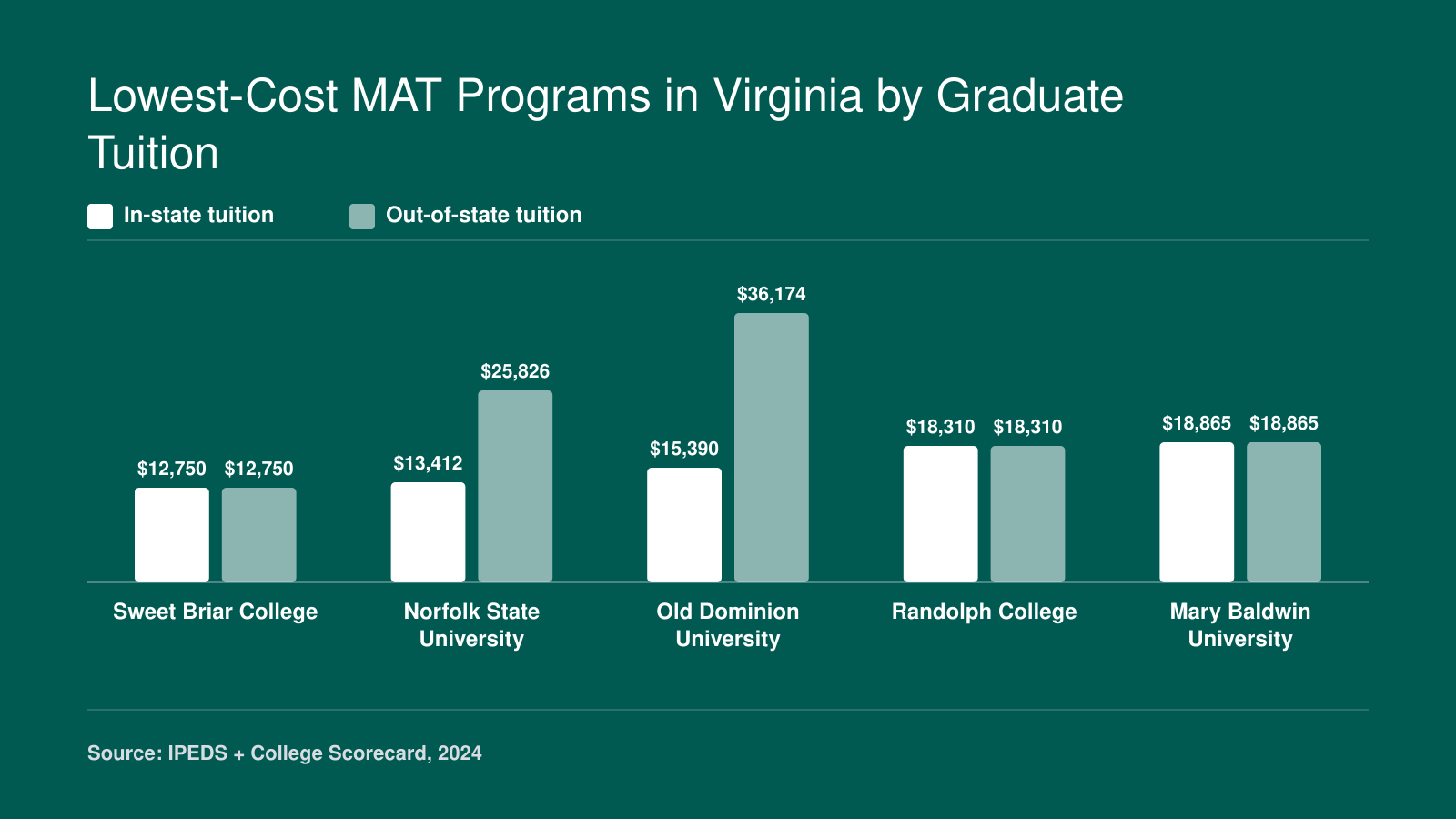
What is the cheapest MAT program in Virginia? Among the ranked schools, Sweet Briar College has the lowest listed graduate tuition at $12,750, followed by Norfolk State University at $13,412 in-state. Old Dominion and Norfolk State charge much more to out-of-state students, while the private schools here charge one rate to everyone. Net price is an institution-wide average after aid, not a personal quote, and Mary Baldwin's tuition varies by endorsement, so confirm your own cost with the school.
Online and Hybrid Master's in Teaching Options in Virginia
Liberty University's online Master of Arts in Teaching (MAT) runs on eight-week courses, with asynchronous classes and a clinical component of at least 90 hours.
Fully online programs
- Liberty University: Student teaching happens in an accredited school under a licensed cooperating teacher. The school does not state geographic limits for placements. Some courses may require scheduled meetings, required logins, or campus travel, so confirm before enrolling.
- Shenandoah University: Offers a fully online option with eight-week accelerated courses over 16 to 24 months. It does not publish whether sessions are live, and it does not detail how placements are arranged.
- University of Virginia: Its online Master of Teaching in Special Education leads to the Special Education-General Curriculum K-12 endorsement. It includes a 1-credit practicum and a semester-long internship, and candidates already working in schools may be able to complete it at their place of employment, subject to approval. UVA's English as a Second Language track is in-person.
Hybrid programs
- University of Richmond: Its Master of Teaching is hybrid, with evening classes for working professionals and a 15-week clinical placement or yearlong paid internship. It does not specify how often students must be on campus.
Do online programs count for Virginia licensure?
Yes, if the program is state-approved and includes a supervised clinical experience. Delivery format is not the deciding factor for online master's programs in Virginia. Ask each admissions office how placements work for your location before you commit.
Related Articles
Which Ranked Virginia MAT Programs Waive or Skip the GRE
The GRE is not a gatekeeper for most of the Education & Teaching Master's Programs in Virginia here: several master's programs with no GRE required drop it outright, and others never publish a testing policy at all.
No GRE Required
- University of Virginia: The Master of Teaching has no GRE requirement. Applicants may submit especially strong scores, but withholding them does not hurt the review. Admission generally expects a bachelor's, a 2.7 overall GPA, and a 3.0 major GPA, with below-threshold candidates still considered.
- Shenandoah University: Shenandoah requires no entrance exam. A bachelor's is needed, a 3.0 GPA is preferred, and applicants review holistically below that. Candidates must already be a K-12 instructor of record holding a Virginia provisional license.1
- Mary Baldwin University: No GRE or GMAT. Full admission expects a regionally accredited bachelor's and a 3.0 GPA.2
No Published Testing Policy
- Liberty University: The 2026 materials do not mention the GRE or any substitute; good standing requires an accredited bachelor's and a 2.5 GPA.
- Norfolk State University: The catalog does not address the GRE; it requires a liberal-arts bachelor's and a 2.75 GPA.
- George Mason University: The School of Art MAT page does not state whether the GRE is required or optional.
Cost and Virginia Teaching Licensure: What MAT Students Should Know
What the Price Tag Leaves Out
Institution-wide net price gives a rough benchmark. It averages about $20,000 at the public schools here and about $17,700 at the private ones. Treat both as approximate, because they reflect each school's overall figures, not graduate teacher-prep pricing. Per-credit rates tell you more than broad net price, so compare most affordable M.Ed. programs for program-level tuition. Randolph College lists $400 per credit and Hollins University $450, while Regent University lists $250 plus $700 in university fees each semester.
Budget for technology or program fees, exam registration, background checks, and student teaching. Student teaching is often unpaid and can mean cutting back work hours for a semester. Hollins notes that a student teaching grant covers 12 credits, so ask every school what similar support exists.
Virginia Exams and Required Training
The VCLA was eliminated as a licensure requirement on July 1, 20241, though some school catalogs still mention it. Confirm current rules with your program. Candidates generally take:
- Praxis Subject Assessment: Required for most endorsement areas.2
- Reading assessment: Praxis Teaching Reading: Elementary (5205), or RVE 5306 under the transition rule, for elementary and special education candidates; see also master's in reading and literacy programs.3
State-required trainings typically include child abuse recognition, dyslexia awareness, and CPR or first aid. Check the current list with the Virginia Department of Education.1
Pass Rates and Program Approval
Virginia Tech, the University of Virginia, and Randolph College each publish 100% licensure exam pass rates in their CAEP reporting.45 The other schools here do not report this figure in the sources reviewed.
Program choice matters: only a state-approved educator preparation program can recommend you for Virginia licensure.
Virginia Licensure Path and Out-of-State Reciprocity
Compare Teaching programs on the data that matters
Explore more Education & Teaching specializations or browse every graduate field.
All Education & Teaching programs