Best Master's in Elementary Education Programs
Compare 380+ accredited Elementary Education programs at 320+ schools, with graduate earnings, cost, debt, and completion data from IPEDS and the U.S. College Scorecard.

A master's in elementary education serves two different buyers: career changers who need initial licensure, and licensed teachers pursuing an advanced degree or a salary-schedule step.
Listed program tuition across the top ten runs from about $12,700 to $65,100, a fivefold spread. Format varies far less: nine programs are on campus, one is online, and none is hybrid.
Cost and format matter, but state licensure rules matter more. A degree that does not lead to a license in the state where you plan to teach is just expensive coursework.
Key Points
- CUNY Hunter College's in-state versus out-of-state tuition gap is about $9,400.
- Every online program we reviewed still requires in-person student teaching.
- All 51 U.S. jurisdictions join NASDTEC, yet license transfers still need extra steps.
10 Best Master's in Elementary Education Programs for 2027
These ten elementary education master's programs stand out for their combination of licensure preparation, classroom-based training, and measurable outcomes. The list includes both private research universities and public flagships, with options to match different schedules and career paths. Use the cost, net price, and earnings details in each card to compare value, not just name recognition.
Vanderbilt University
#1Nashville, TN · ~$58,000/yr (est.)
Best for: Recent graduates wanting an intensive licensure track
Vanderbilt's Peabody College offers an 11-month, 33-credit M.Ed. that leads to K-5 licensure and pairs coursework with two full days per week in Nashville-area schools. A capstone and full-time student teaching build readiness for classroom roles, and the program reports a 100% job placement rate for job-seeking graduates. The Teacher Pathway Scholarship provides a minimum 30% scholarship for Elementary Education students.
- 11-month, 33-credit full-time plan
- Starts summer with rolling admissions
- Leads to K-5 teacher licensure
- Two full days per week in Nashville-area schools
- Capstone project required
- Reports 100% job placement rate for job-seeking graduates
- Teacher Pathway Scholarship provides a minimum 30% scholarship
- Median earnings one year after completion: $50,383
University of Florida
#2Gainesville, FL · ~$13,000/yr (est.)
Best for: Online learners balancing work and study
The University of Florida's M.Ed. in Elementary Education emphasizes research-based practices, inclusive teaching, and content-area methods in reading, math, science, and social studies. Students also complete an internship in elementary schools. For career changers, a yearlong alternative certification pathway leads to Florida certification with a full-time clinical internship and mentor coach.
- Emphasizes research-based best practices
- Focus on inclusive teaching practices
- Coursework covers reading, math, science, social studies, and educational technology
- Includes internship in elementary schools
- Median earnings one year after completion: $50,802
- State-designated Educator Preparation Institute
- Designed for career changers and graduates
- Yearlong program with full-time clinical internship and mentor coach
- Leads to Florida certification
- Taught by UF education professors
Northwestern University
#3Evanston, IL · ~$55,000/yr (est.)
Best for: Social justice-oriented aspiring elementary teachers
Northwestern's MS in Education in Elementary Education is an 18-month campus program grounded in social justice and equity. Students earn an Illinois teaching license and can add ESL or bilingual endorsements, with small cohorts, faculty mentorship, and field experiences in diverse schools. The program prepares candidates for grades 1-6.
- 18-month program with fall start
- Social justice-oriented curriculum
- Prepares for grades 1-6 teaching
- Leads to Illinois teaching license
- Optional ESL or Bilingual Education endorsements
- Small cohorts and personalized faculty mentorship
- Field experiences in diverse school settings
University of Maryland-College Park
#4College Park, MD · ~$18,000/yr (est.)
Maryland's certification M.Ed. is a 36-credit, non-thesis program that integrates reading, mathematics, science, social studies, and writing instruction. A five-credit internship and emphasis on diagnostic assessment provide hands-on, practice-oriented preparation. Graduates become eligible for certification after passing required exams including Praxis II.
- 36-credit, non-thesis certification track
- Covers reading, mathematics, science, social studies, and writing processes
- Includes foundations of education and digital learning tools
- Five-credit internship in education
- Prepares for Praxis II
- Emphasizes diversity and diagnostic assessment
Boston College
#5Chestnut Hill, MA · ~$38,000/yr (est.)
Boston College's Lynch School M.Ed. prepares educators for grades 1-6 through a humanistic, developmentally appropriate curriculum spanning literacy, math, science, and bilingual education. Students complete 37 credits and a semester-long practicum across Greater Boston, with both licensure and non-licensure pathways and an optional Donovan Urban Scholars Program. The Lynch School reports more than $13.8 million in annual financial aid.
- 37 total credit hours and 13 courses
- Full-time and part-time options
- Licensure and non-licensure pathways
- Prepares for grades 1-6 and Praxis
- Full practicum in Greater Boston schools
- Donovan Urban Scholars Program available
- SEI Endorsement courses included
- Median earnings one year after completion: $56,482
Washington University in St Louis
#6St. Louis, MO · ~$65,000/yr (est.)
Washington University in St. Louis offers teacher education master's programs in elementary education within an interdisciplinary community that bridges theory and practice. Small classes emphasize equity, inclusion, child development, instructional strategies, and culturally responsive teaching. The program prepares graduates for diverse elementary classrooms and further study in education policy or psychology.
- Interdisciplinary community bridging theory and practice
- Small class sizes for meaningful interactions
- Focus on equity and inclusion
- Covers child development, instructional strategies, and culturally responsive teaching
Lehigh University
#7Bethlehem, PA · ~$29,000/yr (est.)
Lehigh's 42-credit M.Ed. leads to Pennsylvania PreK-4 certification and offers reciprocity in most states. The program includes student teaching in local schools and optional dual certification in Special Education PreK-12 or an English as a Second Language emphasis. Students can start in fall, spring, or summer.
- 2-year, 42-credit, 14-course program
- 3 start dates per year
- 3.0 GPA minimum and 2 letters of recommendation
- Leads to Pennsylvania PreK-4 certification
- Student teaching in final semester
- Certification reciprocity in most states
- Median earnings one year after completion: $57,438
- Dual certification option in Special Education PreK-12
- Available through additional coursework
- Addresses teacher shortage in Pennsylvania
- ESL emphasis for language acquisition and inclusive practice
- Meets Pennsylvania Department of Education certification requirements
- Prepares for preschool and elementary classroom roles
University of Illinois Urbana-Champaign
#8Champaign, IL · ~$19,000/yr (est.)
Illinois's EdM in Elementary Education is designed for career changers with a non-education bachelor's degree and leads to an Illinois Professional Educator License for grades 1-6. The 32-credit program offers concentrations in Bilingual-Bicultural Education and Digital Learning, with a fall-only start and a minimum 3.0 GPA.
- 2-year, 32-credit licensure track
- Designed for career changers with a non-education degree
- Leads to Illinois Professional Educator License, Grades 1-6
- 3.0 GPA minimum and 3 letters of recommendation
- Fall-only admission
- Personal graduate adviser assigned
- Financial aid, assistantships, and scholarships available
- Median earnings one year after completion: $53,164
- Concentration in Bilingual-Bicultural Education
- Research resources through CREATE and DELTA
- SLATE program for language acquisition
- Concentration in Digital Learning
- Culturally responsive teaching embedded in coursework
- Connected to University of Illinois Writing Project
- Field placement experience required
University of Massachusetts-Amherst
#9Amherst, MA · $15,000 – $20,000/yr (est.)
UMass Amherst's accelerated 4+1 elementary education M.Ed. lets current undergraduates earn up to 9 graduate credits before finishing the bachelor's degree and complete a master's plus initial Massachusetts teaching license in one additional year. The program emphasizes child development, elementary math methods, and social justice-oriented pedagogy.
- 4+1 accelerated pathway for current UMass undergraduates
- Earn up to 9 graduate credits while an undergrad
- Complete master's and initial teaching license in one additional year
- 3.0 GPA minimum with prerequisite coursework
- Approved for Massachusetts licensure
- Social justice-oriented program
Virginia Polytechnic Institute and State University
#10Blacksburg, VA · ~$19,000/yr (est.)
Virginia Tech's M.A.Ed. in Elementary Education is an initial licensure program for PK-6, using a cohort model that structures coursework and field experiences. Students complete student teaching in local schools and earn eligibility for Virginia teaching licensure; the program is approved by the Virginia Department of Education.
- Initial teacher licensure pathway for PK-6
- Cohort-based structure
- Leads to Virginia teaching licensure
- Approved by Virginia Department of Education
- CAEP and SACSCOC accredited
Cost & outcomes by school
Federal data for the highest-earning Elementary Education programs, independent of the ranking above. Earnings are this field's master's graduates four years after completing, where the Scorecard reports them.
| School | Earnings | Tuition / yr | Debt | Grads/yr | Format |
|---|---|---|---|---|---|
| St. John's University-New York NY | $83,019 | $36,227 | $52,441 | 15 | Campus |
| University of Washington-Seattle Campus WA | $80,738 | $18,792 | $30,990 | 103 | Hybrid |
| University of Washington-Tacoma Campus WA | $80,738 | $18,987 | $30,990 | 20 | Campus |
| CUNY Brooklyn College NY | $80,655 | $11,524 | $27,668 | 124 | Online |
| University of California-Irvine CA | $79,921 | $14,827 | $30,500 | 136 | Campus |
| CUNY City College NY | $79,740 | $11,402 | $27,301 | 43 | Campus |
| Molloy University NY | $79,134 | $27,520 | $41,000 | 24 | Hybrid |
| CUNY Lehman College NY | $78,311 | $11,570 | $25,825 | 79 | Campus |
| San Francisco State University CA | $77,699 | $9,370 | $18,834 | — | Campus |
| Pacific Lutheran University WA | $77,198 | $30,535 | $34,896 | 37 | Hybrid |
| CUNY Hunter College NY | $77,067 | $11,398 | $25,523 | 127 | Hybrid |
| Alliant International University-San Diego CA | $75,075 | $19,690 | $35,450 | 215 | Online |
Sources: U.S. Department of Education. Tuition and graduates: IPEDS. Earnings and debt: College Scorecard, this field's master's graduates; a dash means no figure is reported.
Cost, debt & payoff
Median earnings of this field's master's graduates (4 yrs after completing) vs. their median federal loan debt · U.S. College Scorecard
Across these programs the median graduate earns about $58,916 and finishes with roughly $28,371 in debt — a ratio that clears a common rule of thumb (keep debt below first-year salary). Tuition and debt vary widely school to school, so check the per-school figures in the table above before you shortlist.
How We Ranked These Elementary Education Master's Programs
Some rankings reward institutional prestige and selectivity. Ours starts with the financial and employment outcomes that determine whether a degree pays off.
What we measured
We reviewed each program using two federal sources. IPEDS supplies graduate tuition and fee figures. College Scorecard adds program-level median earnings at one, two, four, and five years after completion, median federal debt, and completion counts. For elementary education specifically, these program-level figures show what graduates actually earn and owe, not what a university-wide average suggests. We did not invent a single ranking score; instead, we describe each factor so you can weigh the tradeoffs yourself.
Why the distinction matters
Program-level earnings and debt refer to graduates of the elementary education master's program. School-wide figures, including graduation rate and net price, cover the entire institution. Net price is an institution-wide average; treat it as a planning benchmark rather than a personal price quote.
What else we tracked
We recorded whether each program is offered online, on campus, or both, so readers can filter by delivery mode. Delivery format matters because student teaching placements and licensure requirements often differ by state and format. We did not assign hidden weights or rank by reputation.
Limits to keep in mind
Scorecard does not publish every program figure for every school. When program-level data is unavailable, we mark it as missing rather than substituting an estimate.
Initial Licensure vs. Advanced Master's: Which Track Fits You?
An elementary education master's program generally falls into one of two broad tracks. Initial licensure programs are designed for people who already have a bachelor's degree in another field and need to earn a teaching certificate while completing the master's. Advanced M.Ed. programs are built for teachers who already hold a license and want to deepen their practice, move into a specialty such as special education, or qualify for a salary lane change.
Initial Licensure Track
Initial licensure programs, often labeled MAT or M.Ed. with certification, include student teaching and state-required licensure coursework. Credit totals commonly run from 33 to 481, with full-time students finishing in 12 to 24 months, often across three or four semesters. Student teaching is usually one full-time semester. West Chester University places candidates in a 15-week, five-days-a-week final spring placement; the University of Hartford uses a 14-week full-day placement. Merrimack College reports 450 total field hours1. Some programs count student teaching separately, so a 48-credit total at Tennessee State includes 12 credits of student teaching beyond coursework3.
Advanced M.Ed. Track
Advanced programs usually range from about 30 to 37 credits2 and also take 12 to 24 months, but they are more often designed part time for working teachers over roughly two years. These programs skip the initial student-teaching semester because candidates are already licensed and employed. They may still include practicum work, as Boston College and UMass Boston do within 37-credit programs.
Admission and State Approval
Admissions differ by track. Initial licensure programs may require basic-skills, content, or subject-area exams before or during the program. Tennessee State lists edTPA and Praxis subject-area exams3, and Webster University requires proof of attempt or passage of Missouri's certification-area exam4. Advanced programs generally require an existing teaching license. GPA minimums vary, with examples around 2.75 at the University of Louisville5 and Rider University6, and 3.0 at the University of Hartford and American College of Education, sometimes with conditional admission.
Whichever track you choose, confirm the program is approved for licensure in the state where you plan to teach, not only where the university is located. A program in one state may not automatically lead to certification elsewhere.
Which One Should You Choose?
- No license: Choose an initial licensure track. The extra credits are often the student-teaching semester you need to become classroom-ready.
- Already licensed: Choose an advanced M.Ed. if you want a pay bump, a specialty, or a leadership pathway. Look for part-time or accelerated options that fit a full-time teaching schedule.
Program Cost and Net Price: What You'll Actually Pay
Published tuition at the public universities in the table shows a wide resident versus nonresident gap, while average net price after aid is often much lower. Net price is an institution-wide average, not a program-specific quote. CUNY Hunter College posts the lowest average net price here at $2,984, while the University of Florida pairs a $6,541 average net price with a 91% school-wide graduation rate.
| Program | Format | In-State Graduate Tuition | Out-of-State Graduate Tuition | Average Net Price | Institution-Wide Graduation Rate |
|---|---|---|---|---|---|
| CUNY Hunter College | Hybrid | $11,398 | $20,828 | $2,984 | 57% |
| California State University-Stanislaus | Campus | $9,766 | $19,846 | $6,067 | 53% |
| University of Florida | Online | $12,737 | $30,130 | $6,541 | 91% |
| University of Washington-Tacoma Campus | Campus | $18,987 | $33,006 | $10,163 | 63% |
| University of Central Florida | Online | $8,872 | $28,657 | $10,411 | 78% |
| University of Illinois Urbana-Champaign | Campus | $19,278 | $34,406 | $14,355 | 85% |
| Arizona State University | Online | $13,587 | $27,521 | $14,967 | 68% |
| University of Oklahoma | Campus | $9,353 | $26,142 | $15,300 | 75% |
| University of Maryland-College Park | Campus | $18,276 | $38,207 | $15,678 | 89% |
| Vanderbilt University | Campus | $57,868 | $57,868 | $15,846 | 94% |
Beyond Tuition: The Hidden Costs of Becoming an Elementary Teacher
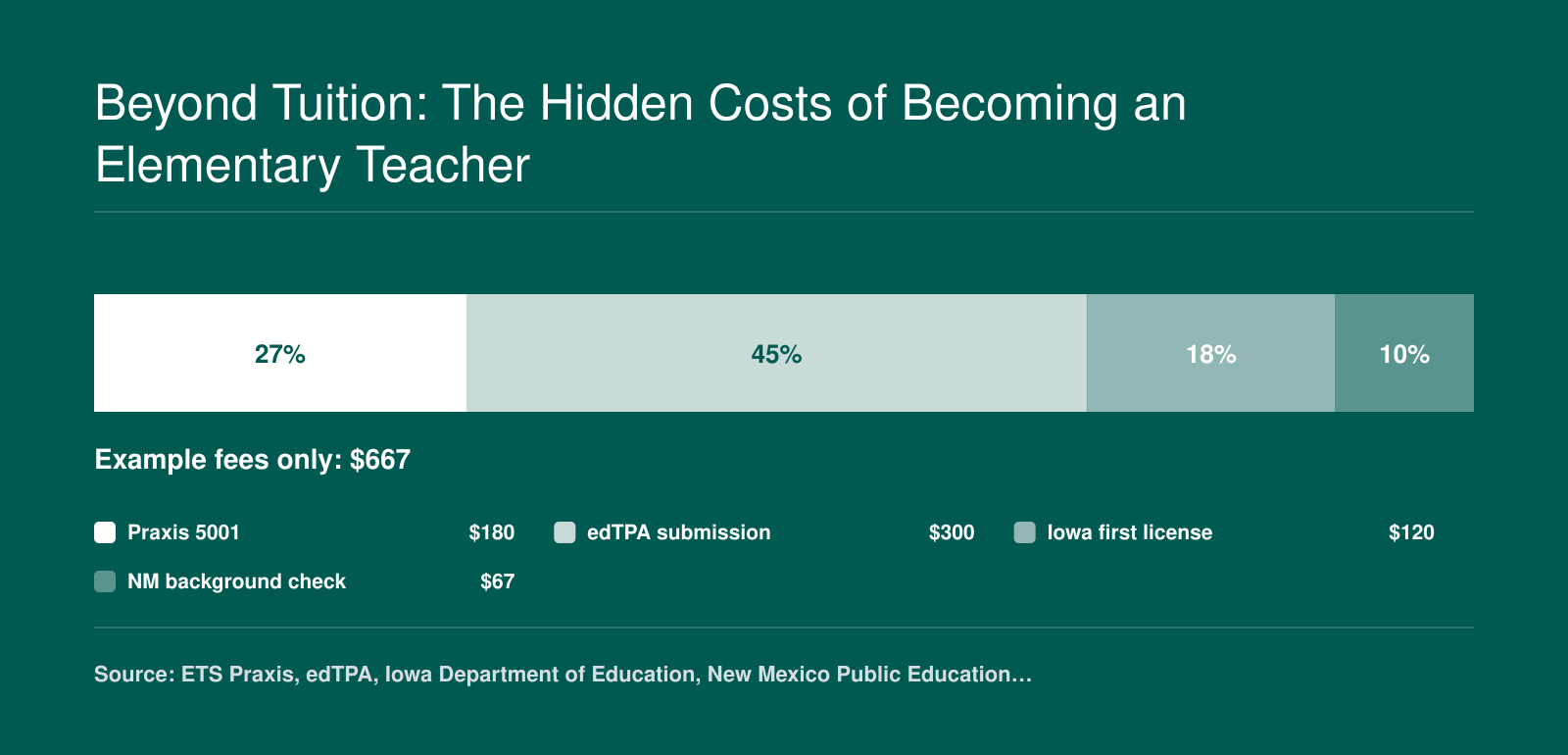
Tuition is only part of the bill. The chart shows four published fees: the Praxis Elementary Education: Multiple Subjects (5001) exam, the edTPA submission, an Iowa first license, and the New Mexico background check, which rose to $67 on October 1, 2026. Because licensing is set state by state, the total is an example, not a typical budget. Books, materials, and unpaid student teaching are not priced here because no reliable figure exists for master's students. For career changers, unpaid student teaching is often the largest hidden cost, so ask each program whether it offers a paid residency or stipend. Praxis fees can change without notice, and taking the four subtests separately costs $256.
Related Articles
Online vs. Campus: Choosing Your Elementary Education Format
Online elementary education master's programs move coursework off campus, but not the classroom. Every program we reviewed still requires in-person field experience and supervised student teaching, so the real difference is how coursework is delivered and who arranges your placement. Check state authorization before anything else, because it determines whether the degree can lead to a license where you live.
| Factor | Online | Campus |
|---|---|---|
| Coursework delivery | Varies by program. North Park University is fully asynchronous, WGU requires some live synchronous sessions, and West Chester University's hybrid format may be either. | In-person or mixed formats. Roosevelt University combines online and in-person evening classes, and Washington State University Vancouver uses daytime campus classes. |
| Field placement and student teaching | In-person and required. Examples include North Park's 35-hour local mini-teaching experience and 60-day practicum, and WGU's full-time placement of at least 12 to 16 weeks. | In-person and often more structured. Merrimack College requires 15 weeks and 450 hours, and Oakland University requires at least 100 field hours before the internship. |
| Who arranges your placement | The program, usually in your home area. Drexel University's Field Placement Office considers your preferred district and does not let students arrange placements independently. If a suitable site cannot be secured, ask about alternatives before enrolling. | The program places you in partner schools nearby. At the University of Alabama, the clinical placement is most often your own classroom if you already teach. |
| Schedule flexibility for working adults | Highest flexibility for coursework, but student teaching is usually full-time on a school-day schedule. | Evening options exist, such as Roosevelt's. Others, like Washington State Vancouver, require two full school days a week at a placement school, then a five-day internship. |
| Cost and residency pricing | Confirm whether the program charges one online rate or splits by residency, and add travel costs for placements. | Public programs may price in-state and out-of-state students differently, so compare net price using your own residency. |
| Peer and faculty interaction | Depends on live sessions, mentor teachers, and support staff. Asynchronous formats offer the least face-to-face contact. | Built-in cohort contact and easier access to faculty and campus supervisors. |
| State authorization and licensure | Not every online program can lead to licensure in every state. Distance programs may need extra approval from state licensing boards, and the University of Hartford requires student teaching in Connecticut. | Licensure is most straightforward in the program's home state. Check reciprocity if you plan to teach elsewhere. |
| Best for | Working adults or career changers in a state the program is authorized to serve. | Students who want a cohort, close supervision, and local school partnerships. |
All 51 U.S. jurisdictions, the 50 states plus Washington, D.C., participate in the NASDTEC Interstate Agreement. But that agreement eases, not guarantees, license transfers. Teachers who move states often still face additional state tests or coursework before they can be certified in the new state.
Licensure and Accreditation: What to Check Before You Apply
Accreditation and state licensure are separate questions. Confirm both before you submit an application or pay a deposit.
- AccreditationLook up the school in the CAEP accredited provider search or the AAQEP Accredited Programs page, not on its marketing site. "CAEP-aligned" or "seeking accreditation" is not proof, so look for a status such as Full Accreditation. CAEP accredits at the provider level, while AAQEP accreditation is program-specific.
- State approvalConfirm with your state education agency that the program is an approved educator preparation program for the state where you plan to teach. National accreditation does not settle this.
- Licensure disclosureUnder 34 CFR 668.43, programs leading to professional licensure must publish state-specific disclosures, online or on campus. Read the page for your state at initial enrollment, the last-updated date, and whether it covers this specific elementary program.
- Track matchIf you are not yet certified, choose a program that leads to initial licensure. An advanced credential or endorsement will not make you eligible to teach on its own.
- Required examsIdentify the tests your state requires, such as Praxis, edTPA, or a state-specific exam. Ask whether the program builds in test prep and supervised practice.
- Reciprocity planIf you may relocate, review the target state's rules for out-of-state licensees. Many require an application, a valid license, a background check, and exams in content, pedagogy, reading, or civics. Some also require coursework in areas such as special education or state law. License transfer is typically handled case by case.
The Master's Degree Pay Premium for Teachers
Public school teachers with a master's degree earn more in base salary than those with only a bachelor's.
Elementary Education programs by state
Frequently Asked Questions About Elementary Education Master's Programs
How long does a master's in elementary education take?
Can I earn an elementary education master's degree online?
Can I keep working full time while completing student teaching?
Do I need to pass the Praxis before starting a master's in elementary education?
Compare Elementary Education programs on the data that matters
Explore more Education & Teaching specializations or browse every graduate field.
All Education & Teaching programs