Best Master's in Elementary Education Programs in Kansas
Compare 9 accredited Elementary Education programs in Kansas at 8 schools, with graduate earnings, cost, debt, and completion data from IPEDS and the U.S. College Scorecard.

A Kansas master's in elementary education serves two different readers, and picking the wrong track costs time and money. Career changers with a bachelor's degree need a licensure-track program that includes student teaching and prepares them for the Praxis. Already-licensed teachers want an advanced degree that deepens practice without repeating certification.
The schools ranked here include every eligible Kansas program, campus and online, with cost and outcome figures drawn from IPEDS and College Scorecard.
Tuition across Kansas varies by more than $8,000, so the cheapest option is rarely the one that fits the format you need.
Key Points
- Fort Hays State's online tuition is $4,949; MidAmerica Nazarene's hybrid is $13,597.
- Admissions pages reviewed show no formal GRE waiver for 2027.
- KSDE initial licensure requires approved prep and the Praxis elementary content assessment.
Best Master's in Elementary Education Schools in Kansas: 2027 Rankings
The Kansas master's in elementary education programs below are ordered by affordability after aid and measurable graduate earnings, not by reputation or prestige. Each entry highlights delivery format, cost, and whether the program supports Kansas licensure.
Fort Hays State University
#1Hays, KS · ~$5,000/yr (est.)
Best for: Accelerated career changers seeking licensure
Fort Hays State University's online Master of Science in Education in Elementary Education is an accelerated PreK-6 licensure route with a 12-month timeline and multiple start dates. In-state graduate tuition is $5,923, and the university's institution-wide net price after aid is $12,569. The school's overall graduation rate is 48%, and the Kansas State Department of Education lists the elementary preparation program as approved through 2029. Students can add a Special Education provisional endorsement with one additional summer and may qualify for a Limited Elementary Residency license to teach while completing the degree.
- 12-month program
- Three start dates per year
- 2.8 GPA minimum
- Two letters of recommendation
- Add Special Education provisional endorsement
- Limited Elementary Residency Program license
- One additional summer for dual credentials
- No teaching position required
Emporia State University
#2Emporia, KS · ~$9,000/yr (est.)
Best for: Online learners wanting clinical flexibility
Emporia State University's fully online MS in Elementary Education is built for career changers and can be completed in as little as two years, with clinical placements arranged near home. In-state graduate tuition is $7,106, and the institution-wide net price after aid is $16,261. The school's overall graduation rate is 56%, and median earnings one year after completion are $51,665. The program is authorized for elementary endorsement by the Kansas State Department of Education.
- Two-year completion
- Fully online with local clinical placement
- Designed for career changers
- Eligible for elementary teaching license
- Aligned with Kansas licensure standards
- Capstone required
Pittsburg State University
#3Pittsburg, KS · ~$9,000/yr (est.)
Best for: Affordability-focused alternative-route teachers
Pittsburg State University offers a fully online master's degree in Curriculum and Instruction with an Elementary Education emphasis, designed for teachers and candidates pursuing Kansas alternative licensure. In-state graduate tuition is $8,400, and the institution-wide net price after aid is $15,784. The school's overall graduation rate is 57%, and median earnings one year after completion are $49,852.
- Fully online option
- Trends and issues in education
- Current teaching practices
- ELL instructional methods
- Research methods
- Focus on elementary-aged learners
University of Saint Mary
#4Leavenworth, KS · ~$9,000/yr (est.)
University of Saint Mary's hybrid Master of Arts in Teaching in Elementary Education meets one evening per week in 8-week sessions, with remote or Johnson County attendance options. Tuition is $35,380, and the institution-wide net price after aid is $22,519. The school's overall graduation rate is 48%, and median earnings one year after completion are $43,355. The university is recognized among Kansas-approved alternative teacher-preparation providers.
- Three concentration options
- 8-week accelerated courses
- Courses meet one night per week
- Remote or in-person attendance
- Leads to Kansas teacher licensure
- Employer tuition reimbursement supported
- Unified Elementary and Special Education
- 37 total credit hours
- 2.8 GPA minimum
- Leads to Kansas initial licensure
- Small cohorts and personalized mentoring
- Faculty are practitioners in the field
MidAmerica Nazarene University
#5Olathe, KS · ~$14,000/yr (est.)
MidAmerica Nazarene University offers a hybrid Master of Science in Elementary Education Unified for adult learners with a bachelor's degree, finishing in about 18 months through 7-week modules and field experiences. Tuition is $37,174, and the institution-wide net price after aid is $32,165. The school's overall graduation rate is 54%, and the university is included among Kansas-approved alternative teacher-preparation providers.
- 18-month completion
- Cohort-based structure
- 2.8 GPA minimum
- 40 clinical hours
- 7-week course modules
- Praxis content, pedagogy, and SPED prep
- 12 weeks elementary, 6 weeks SPED student teaching
- Non-licensure Master of Education alternative
Ottawa University-Kansas City
#6Overland Park, KS · ~$13,000/yr (est.)
Ottawa University-Kansas City offers a hybrid Master of Arts in Education with an Elementary Education concentration, blending online coursework with Kansas City-area campus experiences in a 36-credit format. The university describes the program as CAEP-accredited and state-approved in Kansas, with pathways for licensure. The program serves licensed teachers seeking to deepen practice and advance into instructional coaching or curriculum roles.
- 36 total credit hours
- Hybrid online and Kansas City campus
- CAEP accredited
- Pathways for Kansas licensure
- Self-paced learning, day or night
- Master's research project required
- Four concentration options
Cost & outcomes by school
Federal data for the highest-earning Elementary Education programs, independent of the ranking above. Earnings are this field's master's graduates four years after completing, where the Scorecard reports them.
| School | Earnings | Tuition / yr | Debt | Grads/yr | Format |
|---|---|---|---|---|---|
| Emporia State University KS | $53,602 | $8,843 | $23,075 | 81 | Online |
| Pittsburg State University KS | $52,964 | $9,470 | $25,428 | 82 | Online |
| University of Saint Mary KS | $48,991 | $9,073 | — | 6 | Hybrid |
| Fort Hays State University KS | — | $4,949 | — | — | Online |
| Wichita State University KS | — | $7,986 | — | — | Campus |
| Newman University KS | — | $8,224 | — | — | Hybrid |
| Ottawa University-Kansas City KS | — | $13,002 | — | 8 | Hybrid |
| MidAmerica Nazarene University KS | — | $13,597 | — | 4 | Hybrid |
Sources: U.S. Department of Education. Tuition and graduates: IPEDS. Earnings and debt: College Scorecard, this field's master's graduates; a dash means no figure is reported.
Online & Hybrid Master's in Elementary Education Programs in Kansas
An online master's in elementary education moves coursework to the web. A hybrid program pairs online classes with campus or live-video meetings. Pittsburg State, Emporia State and Fort Hays State list their programs as online. University of Saint Mary, MidAmerica Nazarene and Ottawa University-Kansas City use hybrid formats.
Live Sessions or Your Own Schedule
For working teachers, the schedule matters more than the label.
- University of Saint Mary: Classes are synchronous and meet one night per week. You can attend remotely or in person.
- MidAmerica Nazarene: Seminars are held on campus, and remote students join by Zoom.
- Ottawa University-Kansas City: The school describes its learning as self-paced, day or night.
- Fort Hays State: Courses are largely asynchronous, though some may include live sessions.
- Emporia State: Ask the department whether any courses meet live.
Online Still Means Classroom Time
Licensure-track programs require in-person teaching. Fort Hays requires a practicum in an approved K-6 classroom. Emporia State has two field components:
- a 2-credit practicum (EL 819)
- a 12-week, 480-hour clinical experience in a PK-6 classroom, placed near where you live
MidAmerica Nazarene requires 12 weeks of elementary student teaching plus 6 weeks in special education. Plan for that time away from your job.
One practical step before you apply: if you are weighing an online program based outside Kansas, confirm it is authorized to lead to Kansas licensure before you enroll.
How Kansas Licenses New Elementary Teachers
Which Kansas Master's in Elementary Education Programs Waive the GRE?
Do Kansas elementary education master's programs require the GRE? On admissions pages we reviewed for Master's Programs in Kansas, none announces a formal waiver, and most never mention the test. Silence is not a waiver; even master's programs with no GRE required make that policy explicit, so confirm with the admissions office before you skip it.
School by school
- Fort Hays State: No GRE policy stated. The program cites a 2.75 GPA (another listing says 2.8), and the Graduate School sets a 2.5 floor.
- Emporia State: No GRE policy or program GPA stated. Listed items are the Graduate School application, transcripts, and a valid teaching license if applicable.
- Pittsburg State: GRE or MAT appears among its elementary education checkpoint requirements, with no minimum score or waiver given. It cites a 2.80 GPA.
- University of Saint Mary: A 2.8 GPA and two recommendation letters are listed. We found no GRE policy.
- MidAmerica Nazarene: A 2.8 GPA minimum and conditional acceptance are listed. We found no GRE policy.
- Ottawa University-Kansas City: We found no published GRE or GPA policy.
What stands in for test scores
Published requirements generally ask for a minimum GPA of roughly 2.75 to 3.0, official transcripts, two recommendation letters, and a statement of purpose; Fort Hays State asks for 250 words.
Extras for licensure-track applicants
If you need a license, plan for more. Pittsburg State lists a criminal background check, a writing sample, and prerequisites. Fort Hays State requires minimum grades in English Composition II, speech, and college math. Programs may also expect basic skills or content testing, so ask each school what applies to you.
Related Articles
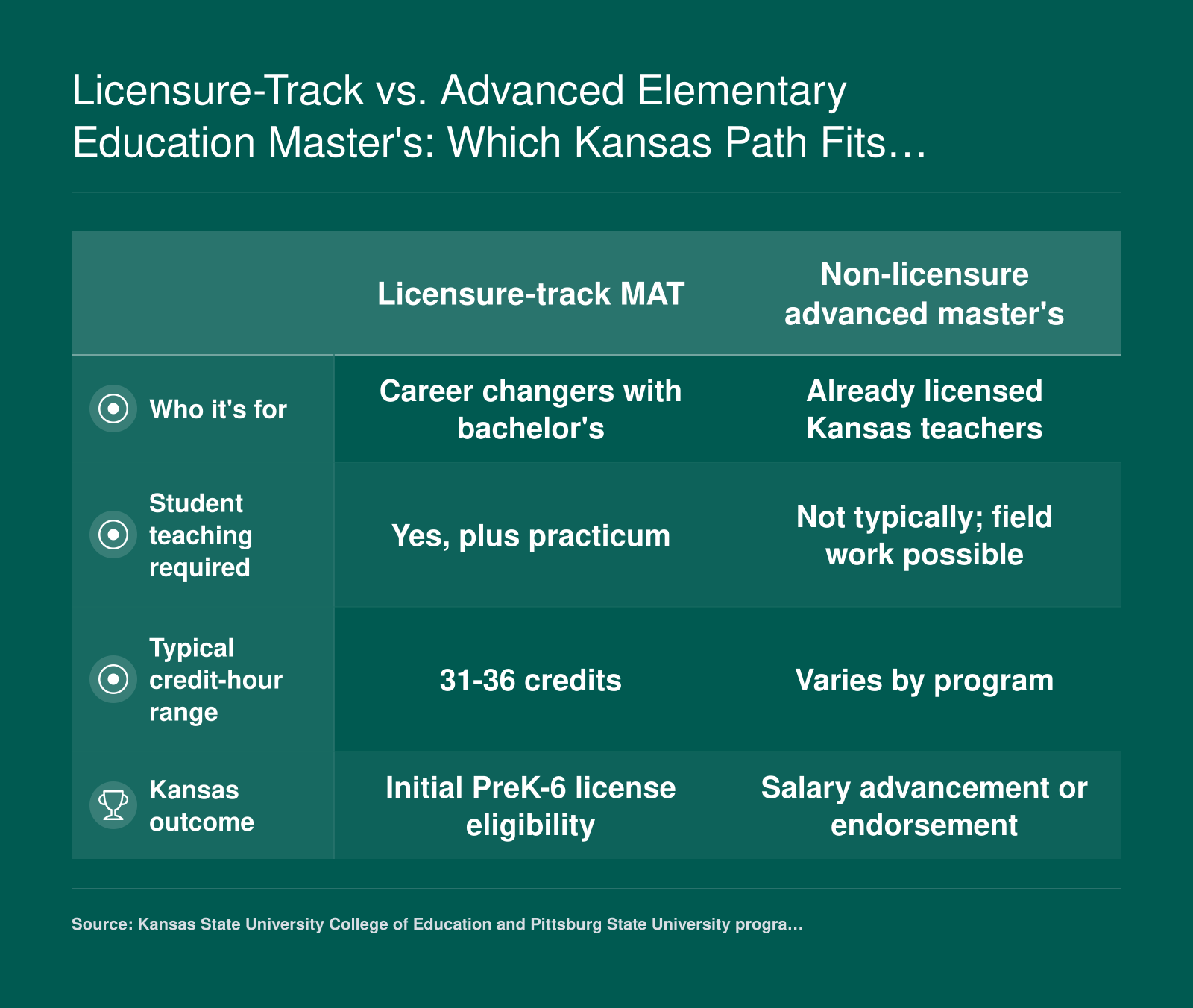
Licensure-Track vs. Advanced Elementary Education Master's: Which Kansas Path Fits You
Kansas elementary education master's programs split by purpose. A licensure-track MAT is for bachelor's holders who need initial PreK-6 licensure, while an advanced non-licensure master's is for already licensed teachers who want to deepen practice and move along the salary schedule.
What a Kansas Elementary Education Master's Costs and Whether It Leads to Licensure
Fort Hays State University posts the lowest program tuition among the schools here: $4,949 in-state and $12,745 out-of-state for its online MSE in elementary education, a result that fits the Most Affordable Master's in Elementary Education Programs list. MidAmerica Nazarene University sits at the other end, at $13,597 for its hybrid program. Institution-wide average net price tells a similar story: about $12,569 at Fort Hays State against $32,165 at MidAmerica Nazarene.
Per-credit rates and total cost
Fort Hays State's online graduate rate is $362.73 per credit, or $3,264.57 for nine credits. Its on-campus graduate rate is $243.73 per credit for residents and regional students and $694.18 for non-residents, plus $39.13 in campus fees and a $1.52 additional fee per credit. The published sources do not confirm whether those campus fees apply to the online program, so ask the school. University of Saint Mary lists $430 per credit. Multiply any rate by the program's total credit hours, then add fees. Current per-credit figures for Emporia State, Pittsburg State and Ottawa University-Kansas City were not available to confirm, so check their bursar pages; for comparison, Kansas State's published standard graduate rate is $418.95 per credit plus a $4 academic infrastructure fee.
Licensure adds to the bill
Licensure-track programs often cost more than tuition suggests. Student teaching, Praxis exam fees and the state licensure application fee come on top. MidAmerica Nazarene's program, for example, includes 12 weeks of elementary and 6 weeks of special education student teaching.
Before you compare prices, confirm that the program is approved by the Kansas State Department of Education (KSDE) for the license or endorsement you need. A cheaper degree that does not lead to a Kansas license costs more in the end.
Kansas Elementary Education Master's: Quick Answers
How long does it take to finish a master's in elementary education in Kansas?
Does every Kansas elementary education master's lead to a teaching license?
Can a career changer finish a Kansas elementary education MAT while working full time?
Compare Elementary Education programs on the data that matters
Explore more Education & Teaching specializations or browse every graduate field.
All Education & Teaching programs