Best Master's in Special Education Programs in Kansas
Compare 14 accredited Special Education programs in Kansas at 11 schools, with graduate earnings, cost, debt, and completion data from IPEDS and the U.S. College Scorecard.

A special education master's in Kansas qualifies you to add a state endorsement in a specific area: high-incidence disabilities, low-incidence, gifted education master's programs in Kansas, and a few others. Which program fits depends largely on one thing: whether you already hold a Kansas teaching license or need initial licensure first.
In-state graduate tuition across the programs ranked here runs from roughly $4,900 at Fort Hays State to about $39,800 at Southwestern College, so the choice carries real financial weight. Several programs now charge the same rate regardless of residency, which reshapes the math for out-of-state applicants.
Key Points
- In 2027, Emporia State's online M.S. uses asynchronous seven-week courses.
- Fort Hays State lists special education graduate tuition at $362.73 per credit.
- Kansas licensed teachers add special education endorsements; career changers need initial licensure.
Best Master's in Special Education Schools in Kansas: 2027 Rankings
These 10 Kansas programs earned their place on a straightforward test: cost after aid, the share of students who finish, and what completers go on to earn, not on reputation surveys. The concentration matters more than the campus, because high-incidence, low-incidence, gifted, autism, and early childhood tracks lead to different endorsements. Treat the net price column as an approximate average after aid, not a quote.
University of Kansas
#1Lawrence, KS · $12,000 – $27,000/yr (est.)
Best for: Low-incidence disability endorsement seekers
The state's flagship offers the broadest mix of special education emphases, including autism spectrum disorder, early childhood unified, high-incidence, low-incidence, and secondary special education transition tracks. The low-incidence master's uses an inclusive, strengths-based approach to prepare educators for students with extensive support needs and can lead toward a Kansas licensure endorsement. KU's educator preparation is accredited through CAEP under NCATE standards.
- CAEP-accredited educator preparation
- 33 total credit hours
- Prepares for Kansas low-incidence endorsement
- Strengths-based inclusive teaching focus
- Serves students with extensive support needs
- Career paths include program specialist and inclusion specialist
Kansas State University
#2Manhattan, KS · $12,000 – $26,000/yr (est.)
Best for: Elementary teachers pursuing flexible endorsement paths
Kansas State's cross-categorical special education master's gives you two clear endorsement tracks: high-incidence and low-incidence. The program is approved by the Kansas State Department of Education for special education endorsement, and admission expects relevant teaching experience and prior coursework equivalents. The QuickStart pathway lets elementary education graduates begin working with a provisional high-incidence endorsement while finishing the degree.
- High-incidence and low-incidence specialization tracks
- 30 total credit hours
- KSDE-approved for special education endorsement
- Teaching experience required for admission
- Prerequisite EDSP 323 or EDSP 324 or equivalent
- QuickStart pathway for elementary graduates
Pittsburg State University
#3Pittsburg, KS · ~$9,000/yr (est.)
Best for: Cost-conscious out-of-state learners
Pittsburg State combines a broad special education teaching curriculum with practical licensure preparation, including required elementary and secondary practicums and Praxis exam readiness. The program covers high-incidence and low-incidence learning needs, behavior analysis and management, special education law, and K-2 literacy instruction. Its Gorilla Advantage rate extends in-state tuition to residents of 32 states, which can lower the cost for out-of-state learners.
- General education license required first
- Prerequisites SPED 738 and SPED 852
- Elementary and secondary practicums required
- Prepares for Praxis special education exams
- Coursework in special education law and behavior
- In-state tuition available in 32 states
Emporia State University
#4Emporia, KS · ~$9,000/yr (est.)
Emporia State's 30-credit gifted, talented, and creative master's is built for educators who already hold a teaching license and want to add a gifted endorsement focus. The accelerated seven-week courses cover gifted characteristics, affective needs, creative teaching, assessment, and behavior management, with a supervised practicum arranged in your own school. All fees are included in the per-credit tuition, and the Teachers College holds CAEP accreditation.
- CAEP-accredited Teachers College
- 30 total credit hours
- 10 seven-week accelerated courses
- No scheduled class meetings
- Teaching license required for admission
- Practicum arranged in your own school
- Same tuition rate in-state and out-of-state
Washburn University
#5Topeka, KS · ~$11,000/yr (est.)
Washburn's high-incidence elementary (K-6) master's is designed for licensed elementary teachers who want to build specialized skills for self-contained classrooms, resource rooms, and itinerant consulting roles. The 33-credit curriculum includes research methods, learning and behavior problems, educational planning, assessment, and practicum experiences, with three start dates and a self-paced timeline. A licensure-only option is available for educators not seeking the full master's degree.
- 33 total credit hours
- Complete in two to three years
- Three start dates per year
- High-incidence elementary K-6 focus
- Licensure-only option available
- Limited Apprentice Program for paraprofessionals
Wichita State University
#6Wichita, KS · ~$8,000/yr (est.)
Wichita State's early childhood unified master's prepares K-6 certified teachers to work with children from birth through third grade. The 30-hour program includes four internships, early childhood assessment, family collaboration, Universal Design for Learning, and a capstone, and it leads to Kansas licensure in early childhood unified. Admission is selective, with a 3.0 GPA expectation and a rolling review process.
- 30 total credit hours
- Leads to KSDE early childhood unified licensure
- Birth through third grade focus
- 3.0 GPA in last 60 hours required
- Elementary KSDE license required
- Four internships plus capstone
- Provisional endorsement after 9 credits
Fort Hays State University
#7Hays, KS · ~$5,000/yr (est.)
Fort Hays State's gifted master's is reserved for Kansas educators who want to add gifted facilitation skills without leaving the classroom. The 36-credit degree includes strategies, curriculum, and collaboration for gifted special education, with a separate 15-credit endorsement pathway. Admission requires a teaching license, a 3.0 GPA on recent coursework, a personal statement, and two recommendation letters.
- 36 total credit hours
- 15-credit gifted endorsement pathway
- Admission requires teaching license copy
- 3.0 GPA on recent undergraduate credits
- Two letters of recommendation required
- Offered only to Kansas educators
- CAEP-accredited advanced education programs
Friends University
#8Wichita, KS · ~$12,000/yr (est.)
Friends University offers three special education master's concentrations, including high-incidence licensure, dyslexia and literacy interventionist, and a general education pathway. The high-incidence track is approved for Kansas licensure and emphasizes curriculum adaptation, individualized instruction, and behavior assessment. Wichita Public Schools employees can access tuition reimbursement of up to $9,500 toward endorsement coursework.
- KSDE-approved licensure track
- Focus on high-incidence learner needs
- Covers curriculum adaptation and assessment
- Wichita Public Schools reimbursement available
- CAEP-accredited dyslexia preparation
- Partnership with Phillips Fundamental Learning Center
- Focus on Structured Literacy instruction
- State-approved dyslexia preparation
- Become a Dyslexia and Literacy Interventionist
- CAEP-accredited general education concentration
- High-incidence disability emphasis
- State-approved Kansas program
- Covers individualized instructional strategies
- Includes learning and behavior assessments
Baker University
#9Baldwin City, KS · ~$12,000/yr (est.)
Baker University's special education master's is designed for working professionals, with weekly virtual class meetings and two practicum courses built in. The 33-36 credit program focuses on high-incidence learning disabilities and prepares graduates for Kansas teaching licensure, with the option to apply for a provisional K-12 license after three courses. Admission does not require an entrance exam.
- No entrance exam required
- 33-36 total credit hours
- Two practicum courses included
- Provisional K-12 license after three courses
- 2.8 GPA minimum for admission
- Three letters of recommendation required
Southwestern College
#10Winfield, KS · ~$12,000/yr (est.)
Southwestern College's Master of Education in special education is grounded in the National Board for Professional Teaching Standards and is built to strengthen practicing teachers' skills. The program offers a theoretical base for continued study and includes special education as a major within the broader M.Ed.
- Grounded in National Board standards
- Builds teacher-practitioner skills
- Theoretical base for continued study
- Special education major within the M.Ed.
Cost & outcomes by school
Federal data for the highest-earning Special Education programs, independent of the ranking above. Earnings are this field's master's graduates four years after completing, where the Scorecard reports them.
| School | Earnings | Tuition / yr | Debt | Grads/yr | Format |
|---|---|---|---|---|---|
| Wichita State University KS | $61,632 | $7,986 | — | 48 | Online |
| Fort Hays State University KS | $60,958 | $4,949 | $27,127 | 116 | Online |
| Friends University KS | $59,653 | $11,988 | — | 3 | Online |
| University of Kansas KS | $59,173 | $11,971 | $29,867 | 73 | Campus |
| Emporia State University KS | $58,389 | $8,843 | $12,963 | 40 | Online |
| Pittsburg State University KS | $56,317 | $9,470 | $22,743 | 27 | Online |
| Benedictine College KS | — | $6,670 | — | — | Online |
| Baker University KS | — | $12,246 | $20,618 | 2 | Online |
| Washburn University KS | — | $10,787 | — | 7 | Online |
| Kansas State University KS | — | $12,089 | — | 13 | Online |
| Southwestern College KS | — | $11,544 | — | 1 | Campus |
Sources: U.S. Department of Education. Tuition and graduates: IPEDS. Earnings and debt: College Scorecard, this field's master's graduates; a dash means no figure is reported.
Cost, debt & payoff
Median earnings of this field's master's graduates (4 yrs after completing) vs. their median federal loan debt · U.S. College Scorecard
Across these programs the median graduate earns about $59,653 and finishes with roughly $22,743 in debt — a ratio that clears a common rule of thumb (keep debt below first-year salary). Tuition and debt vary widely school to school, so check the per-school figures in the table above before you shortlist.
Online and Hybrid Master's in Special Education Options in Kansas
Online delivery has become the practical default for many Kansas special education teachers pursuing Master's Programs in Kansas while working. Emporia State's fully online M.S. in Special Education is among Accelerated Master's in Special Education Programs: asynchronous courses with no scheduled class times, 7-week sessions, and a 30-credit structure that can finish in about 12 months; you can transfer nine or more credits and complete practicum work in your own classroom. The University of Kansas's online M.S.E. programs are also mostly asynchronous, with 8-week courses3, a 30 to 36 credit load2, and a minimum of about two years; expect 15 to 20 hours of coursework weekly.3 Baker University is 100% online but requires weekly live virtual meetings, adding a synchronous checkpoint, and takes roughly two years. Fort Hays State's online M.S. in Special Education, Low Incidence requires 36 credits1 and typically finishes in 18 to 24 months. Southwestern College offers a campus-based route for students who want face-to-face classes. No matter the format, online students still complete supervised practicum or field hours, usually in their own Kansas classroom.
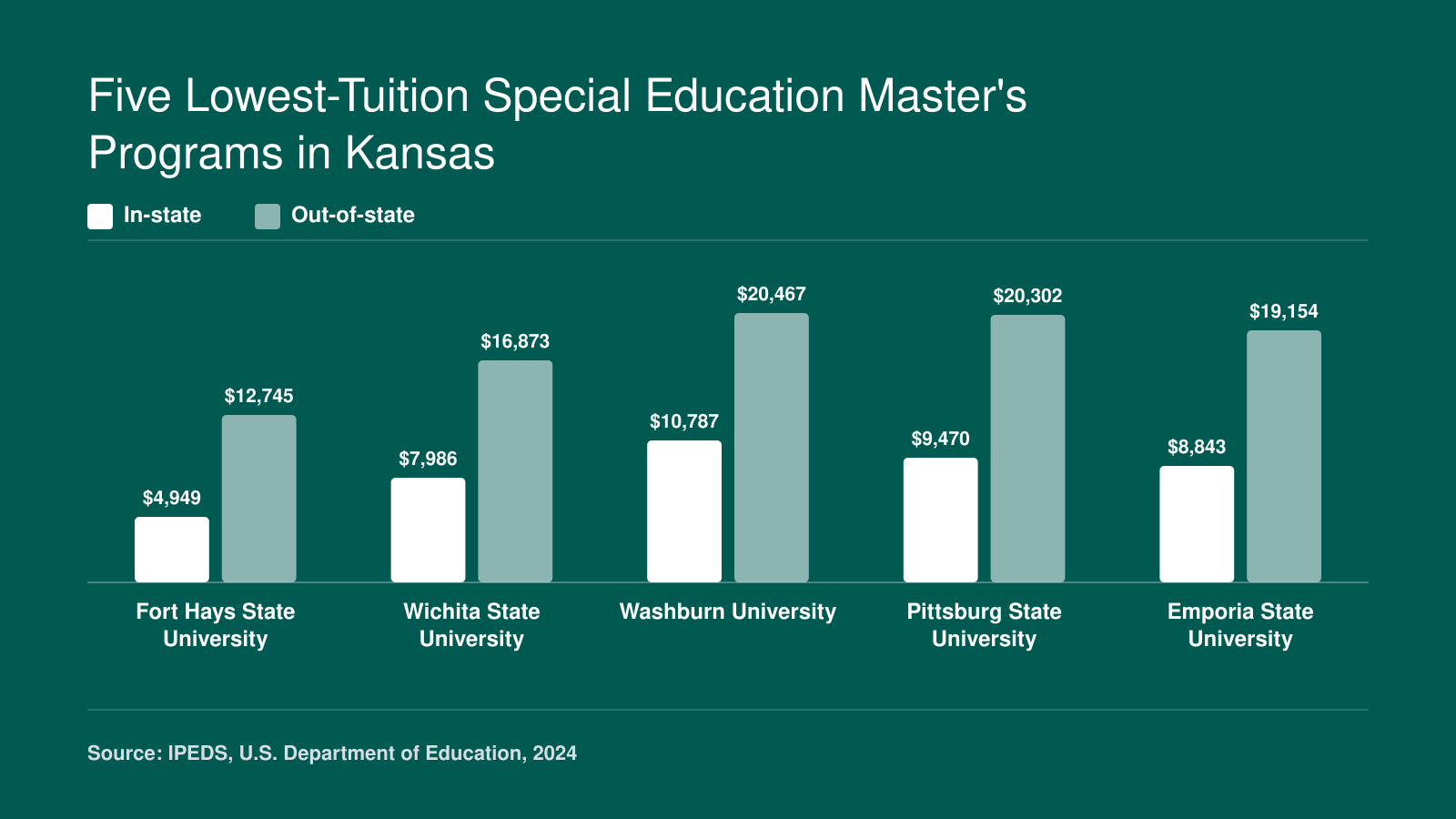
Five Lowest-Tuition Special Education Master's Programs in Kansas
For each program, the chart shows in-state and out-of-state graduate tuition and fee amounts. A few online programs charge one rate regardless of residency, and program or online fees can raise the total. Published per-credit costs include $362.73 at Fort Hays State and $593.25 at Kansas State.
Related Articles
Paying for a Special Education Master's and Earning Your Kansas Endorsement
Kansas continues to split its special education pipeline into two very different paths: one for teachers who already hold a teaching license and one for career changers starting without one.
Two routes, different costs
Licensed teachers add a high-incidence or low-incidence special education endorsement by completing a Kansas-approved endorsement program and passing the required Praxis content assessment2. Kansas does not allow a testing-only route for these two endorsements1, so the program is the real gatekeeper. Report scores to Kansas code 7270 when you apply. Career changers need an initial Kansas teaching license, which requires a bachelor's or higher, a Kansas-approved teacher preparation program, such as the Best MAT programs in Kansas, a content assessment, and a fingerprint background check. That first license is valid for 24 months while you work toward the professional license.
What Kansas requires
Out-of-state teachers are not automatically granted Kansas licensure. They submit an online application, transcripts, a Praxis or comparable content assessment, and a current standard license in good standing, and the requested Kansas endorsement must match the out-of-state license.
Cost follows the route
Endorsement-only sequences, such as Fort Hays State's 15-credit Kansas-educator pathway, can cost less than a full 30-credit master's. Among the Most Affordable Master's in Special Education Programs on this page, estimated net price after aid runs from roughly $12,600 to $16,300, with Emporia State noting employer reimbursement is supported for its online gifted program.
Kansas Special Education Licensing Snapshot
What Kansas Special Education Master's Graduates Earn
The highest-earning special education master's programs in Kansas are shown below, drawn from program-level earnings reported to the U.S. Department of Education. Each figure reflects the most recent outcome window available for that school, either four or five years after finishing. Median program debt is included where reported.
| School | Earnings window | Median earnings | Median program debt |
|---|---|---|---|
| Wichita State University | Five years after finishing | $62,039 | N/A |
| Friends University | Four years after finishing | $59,653 | N/A |
| Southwestern College | Five years after finishing | $59,310 | N/A |
| University of Kansas | Five years after finishing | $58,818 | $29,867 |
| Fort Hays State University | Five years after finishing | $55,408 | $27,127 |
Kansas Special Education Master's: Quick Answers Before You Apply
What does a special education master's cost in Kansas?
Can I earn a special education master's fully online in Kansas?
Do I need a Kansas teaching license before starting a special education master's?
How long does a special education master's take if I'm teaching full time?
What GPA and application deadlines do Kansas special education master's programs set?
Which Kansas programs add a high-incidence or low-incidence endorsement?
Can I teach special education on a provisional or waiver license while finishing my degree?
Compare Special Education programs on the data that matters
Explore more Education & Teaching specializations or browse every graduate field.
All Education & Teaching programs