Best Master's in Special Education Programs in Illinois
Compare 21 accredited Special Education programs in Illinois at 16 schools, with graduate earnings, cost, debt, and completion data from IPEDS and the U.S. College Scorecard.

Illinois schools rely on the Learning Behavior Specialist I endorsement to staff special education, and the route to it depends on where you start: initial licensure for career-changers, or an added endorsement for teachers who already hold a Professional Educator License.
Graduate tuition among the schools here runs from about $9,200 to $34,500. Campus, online, and hybrid programs share this page.
Price matters, but licensure fit matters more. A cheaper degree that doesn't match your license status can cost you another year.
Key Points
- Loyola University Chicago lists $1,115 per credit, about $33,450 for its 30-credit program.
- Illinois had 1,079 unfilled special education teaching positions in 2025-26, per ISBE.
- LBS-I is for new special educators; LBS-II is for licensed teachers who want to specialize.
The 10 Best Special Education Master's Programs in Illinois
These 10 programs earned their spots by balancing graduate tuition, net price after aid, and how reliably each school moves students to completion. Graduation rates cited below are institution-wide, not program-specific, and the licensure route differs a lot from school to school, so check which endorsement each program leads to before you apply.
University of Illinois Urbana-Champaign
#1Champaign, IL · ~$19,000/yr (est.)
Best for: Early childhood special educators
The University of Illinois Urbana-Champaign offers a campus-based master's in early childhood special education through its College of Education, with an Early Intervention Certificate option. Its institution-wide graduation rate is about 85%, the highest on this list. The program site covers practicum notebooks, portfolios and Illini ECSE community partners, but admissions details sit on a separate page.
- Campus-based master's housed in the College of Education
- Early Intervention Certificate option
- Illini ECSE community partners
- Practicum notebooks and portfolios are part of the program
- EdM track options include ECSE, LBS-I and LBS-II
- Full-time students typically finish in about two years
University of Illinois Chicago
#2Chicago, IL · ~$18,000/yr (est.)
Best for: Career changers needing evening hybrid classes
UIC's MEd in Special Education serves students with disabilities ages 5 to 21 and has an urban focus on Chicago schools. Classes run in the evening in hybrid, online or face-to-face formats, and the program does not require the GRE. The institution-wide graduation rate is about 62%. Federal scholarship initiatives such as CHIME and TEACH Grants add funding routes that most Illinois programs lack.
- 33 credits across 11 courses
- No entrance exam required; test optional
- Full-time and part-time evening options
- Prepares for the Illinois PEL and LBS1
- Optional endorsements: bilingual/ESL or early childhood special education
- Student teaching internship for initial licensure
- Federal and state scholarship opportunities
- Collaborative teaching for young children with high-intensity needs
- 37 credits over five semesters in two years
- Includes full tuition, fees and a book stipend
- Service obligation and work experience required
- Earns LBS1 endorsement and ECSE approval
- Reportedly final cohort; spring 2027 applications were due October 1, 2026
Loyola University Chicago
#3Chicago, IL · ~$22,000/yr (est.)
Best for: Paraprofessionals earning while they learn
Loyola University Chicago's MEd is built around a learn-and-earn apprenticeship in a partner school district, with coursework delivered online and clinical experience at your own worksite. The institution-wide graduation rate is about 73%. Tuition is a flat per-credit rate with a discount for admits, which makes the total easy to forecast.
- 30 graduate credits, building on 24 credits of LBS1 coursework
- $1,115 per credit, about $33,450 total
- 30% tuition discount for admitted students
- Synchronous and asynchronous online formats
- Summer start with rolling admission
- Requires a Paraprofessional Educator License and work experience
- Up to 6 transfer credits accepted
- Graduates qualify for the Illinois PEL with LBS1
University of St Francis
#4Joliet, IL · ~$15,000/yr (est.)
University of St. Francis in Joliet offers a 24-month MEd with licensure for career changers who hold a bachelor's degree in another field. The program runs online or in person at $515 per credit hour. The university states that it is accredited by the Higher Learning Commission and that its College of Education programs are approved by the Illinois State Board of Education. Institution-wide graduation rate is about 67%.
- 24-month program with licensure
- $515 per credit hour
- Leads to an initial PEL with a special education endorsement, K to age 22
- Designed for bachelor's holders from other fields
- Prior coursework can be reviewed to set individual requirements
- Online or in-person delivery
DePaul University
#5Chicago, IL · ~$23,000/yr (est.)
DePaul's MEd in Special Education offers three concentrations on the Lincoln Park Campus, so you can match the degree to whether you need initial licensure or are adding an endorsement. Its partnership with the AUSL teacher residency ties study to Chicago classrooms. The institution-wide graduation rate is about 68%.
- Initial licensure path for K-12 special education teaching
- Eligible for the LBS1 endorsement (Pre-K to 21)
- AUSL residency partnership with in-classroom experience
- In-person classes on the Lincoln Park Campus
- Field experiences and student teaching
- Combined special education and elementary endorsements
- Elementary Education endorsement for grades 1 to 6
- Includes LBS1 endorsement eligibility
- Starts fall; application deadline August 15
- Can be completed in two to three years
- For teachers adding LBS1 to an existing Professional Educator License
- 13 to 17 courses depending on concentration
- Letters of recommendation required
- Professional development workshops for alumni
Illinois State University
#6Normal, IL · ~$10,000/yr (est.)
Illinois State's MS in Education with an LBS I concentration adds the endorsement to a Professional Educator License, so it fits practicing teachers rather than career changers. Courses are taught by graduate faculty in the Department of Special Education, with an institution-wide graduation rate of about 65%. A separate, newer online sequence in Deaf and Hard of Hearing education, run with Chicago Public Schools, is distinct from this LBS I program.
- Requires a Professional Educator License
- Adds the LBS I endorsement to your license
- Built for practicing educators
- Taught by graduate faculty with special education expertise
- Housed in the Department of Special Education
- Financial aid available
Elmhurst University
#7Elmhurst, IL · ~$34,000/yr (est.)
Elmhurst University's M.S.Ed. is a hybrid cohort program for licensed teachers, with classes every other week on campus or online. Total program tuition is $18,360, among the clearest published totals for a private school here. Institution-wide graduation rate is about 70%.
- $18,360 total program tuition
- Two years full-time or up to four years part-time
- Starts fall, spring or summer
- Hybrid cohort with classes every other week
- Evening classes from 6 to 8:30 p.m.
- Teacher leadership focus; prepares for LBS1 endorsement
- Grants available through EXCEMPILS and Project RISE
Dominican University
#8River Forest, IL · ~$19,000/yr (est.)
Dominican University's MS in Special Education serves both licensed teachers and career changers, with small cohorts and one evening class per week. The program is approved by the Illinois State Board of Education and leads to the LBS1 endorsement. Institution-wide graduation rate is about 55%.
- Leads to the Learning Behavior Specialist 1 endorsement
- Approved by the Illinois State Board of Education
- Three concentration options
- As few as 30 hours, depending on your preparation
- 3.0 GPA minimum and two letters of recommendation
- Entrance exam listed as required
- Evening classes one night a week
Southern Illinois University Edwardsville
#9Edwardsville, IL · $10,000 – $15,000/yr (est.)
Southern Illinois University Edwardsville packages special education as a specialization within its Curriculum and Instruction master's, so it suits educators who want a broader degree rather than a licensure-first route. Coursework covers assessment, special education law, and methods for mild to severe disabilities. Institution-wide graduation rate is about 57%.
- 15-hour professional core
- 6-hour research sequence
- 15 hours of electives
- Action research capstone project
- Legal Aspects of Special Education course
- Methods courses for mild/moderate and severe disabilities
- Individualized educational assessment course
Northern Illinois University
#10Dekalb, IL · $5,000 – $10,000/yr (est.)
Northern Illinois University's MS in Education is aimed at certified special education teachers who want advanced practice and leadership skills, with courses on campus and at regional sites. It offers six concentrations and a thesis option. Institution-wide graduation rate is about 49%, the lowest on this list.
- Designed for certified special education teachers
- 3.0 GPA minimum and three letters of recommendation
- GRE listed as an admission exam
- Comprehensive exam with capstone project
- Thesis option of 3 to 6 credits
- Courses offered at regional sites
- 35 credit hours
- Prepares for national rehabilitation teacher certification
- Teaches independent living skills
- Supervised clinical experiences and internships
- Open to certified and non-certified teachers
- 35 credit hours
- Prepares for early childhood special education approval
- Prepares for an early intervention credential
- Practicum in early childhood special education
- Thesis or capstone option
Cost & outcomes by school
Federal data for the highest-earning Special Education programs, independent of the ranking above. Earnings are this field's master's graduates four years after completing, where the Scorecard reports them.
| School | Earnings | Tuition / yr | Debt | Grads/yr | Format |
|---|---|---|---|---|---|
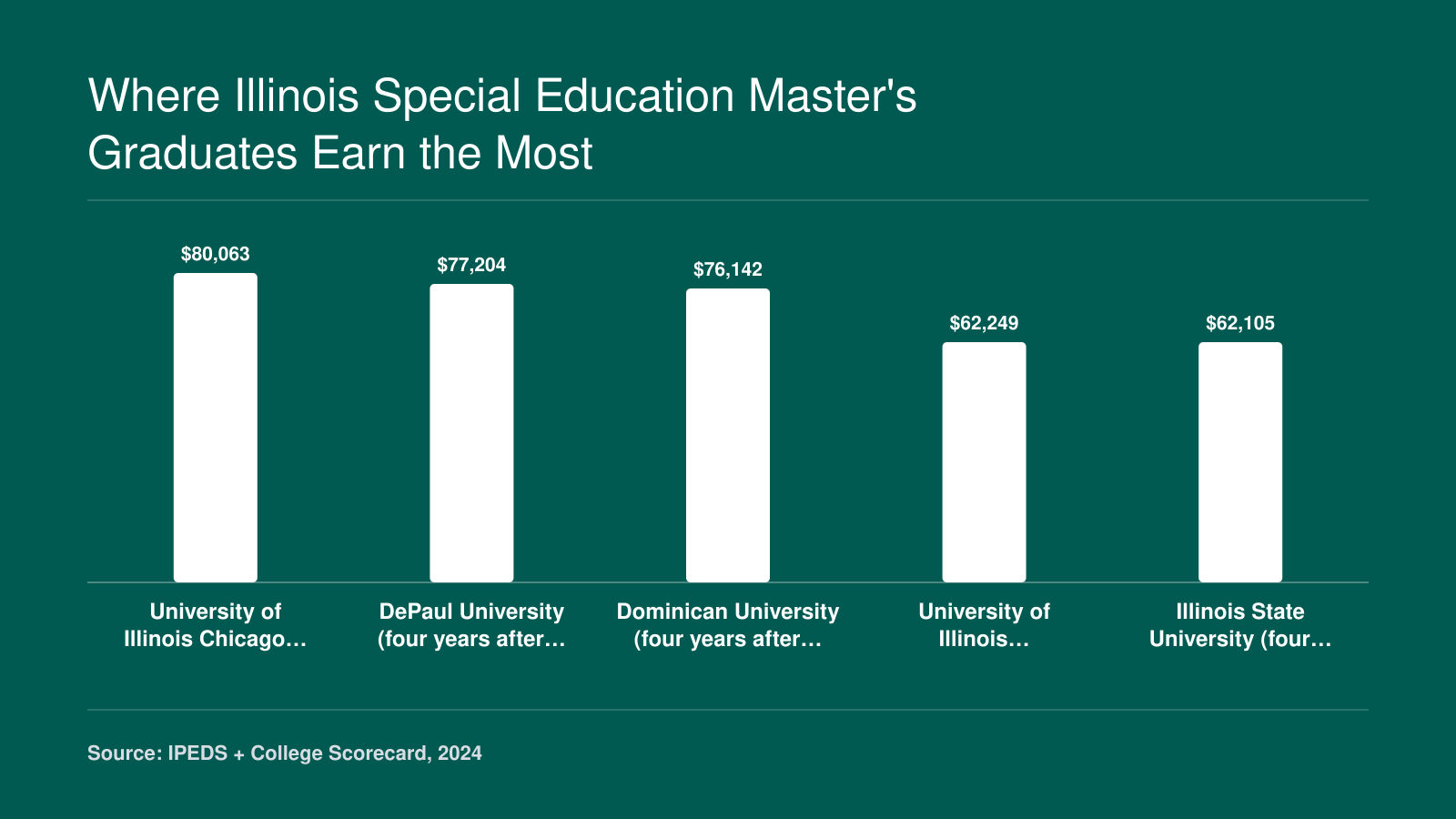
| DePaul University IL | $77,204 | $23,358 | $27,333 | 41 | Campus |
| Dominican University IL | $76,142 | $18,500 | — | 12 | Hybrid |
| University of Illinois Chicago IL | $74,270 | $17,550 | $28,963 | 33 | Hybrid |
| Illinois State University IL | $62,105 | $10,218 | — | 29 | Campus |
| Northern Illinois University IL | $62,066 | $9,176 | $26,549 | 49 | Campus |
| McKendree University IL | — | $9,450 | — | — | Online |
| Erikson Institute IL | — | $14,164 | — | — | Online or campus |
| Chicago State University IL | — | $10,294 | — | 9 | Hybrid |
| Southern Illinois University Edwardsville IL | — | $10,488 | — | — | Campus |
| Eastern Illinois University IL | — | $11,647 | — | 13 | Campus |
| Western Illinois University IL | — | $13,683 | — | 8 | Online |
| Rockford University IL | — | $14,060 | — | 7 | Online |
Sources: U.S. Department of Education. Tuition and graduates: IPEDS. Earnings and debt: College Scorecard, this field's master's graduates; a dash means no figure is reported.
Cost, debt & payoff
Median earnings of this field's master's graduates (4 yrs after completing) vs. their median federal loan debt · U.S. College Scorecard
Across these programs the median graduate earns about $74,270 and finishes with roughly $27,333 in debt — a ratio that clears a common rule of thumb (keep debt below first-year salary). Tuition and debt vary widely school to school, so check the per-school figures in the table above before you shortlist.
Online and Hybrid Master's in Special Education Programs in Illinois
Online flexibility is the draw, but special education is a licensure field, and in-person classroom hours still anchor every program. Loyola University Chicago is the one school here listed as fully online, with synchronous and asynchronous options, 30 credits, and a learn-and-earn apprenticeship in your own school. Work experience and a Paraprofessional Educator License are required. University of Illinois Chicago, University of St Francis, Elmhurst University, and Dominican University are hybrid. UIC blends online and face-to-face courses, Elmhurst meets in evening cohorts every other week, and Dominican meets one night a week. The University of Illinois Urbana-Champaign's online master's in special education runs courses in 8-week terms (6 in summer) for 32 credits, though its page doesn't say whether sessions are live.
Credit totals run from about 30 to 33 before licensure add-ons. UIC adds 13 credits, including student teaching, for initial-license seekers. St Francis lists a 24-month program.
Out-of-state applicants should confirm state authorization directly with the school. An Illinois PEL with LBS I won't automatically license you elsewhere, so check your home state's requirements first.
LBS-I vs. LBS-II: Matching an Illinois Master's to Your Licensure Goal
Do you need a license to teach special education, or do you already hold one and want to specialize? Your answer decides which endorsement and which of the master's programs in Illinois fits your goal.
What each endorsement covers
The Learning Behavior Specialist I (LBS I) is the Illinois State Board of Education's initial cross-categorical special education endorsement, covering ages 5 to 21. It is the credential career changers and new teachers pursue, and candidates must complete a CEC-aligned preparation program (the 2025 Combined Initial Specialty Set standards now apply) plus the required Illinois tests. The LBS II is an advanced endorsement for educators who already hold an LBS I, deaf/hard-of-hearing, or blind/visually-impaired endorsement. It deepens a specialty rather than granting a first license.
Sorting the programs
Only ISBE-approved educator preparation programs lead to licensure. Confirm a program's current status on the ISBE educator preparation pages before you apply.
- Initial-licensure tracks (for career changers): Dominican University's 39-credit initial route embeds clinical practice across four semesters and two summers.
- Add-on and advanced tracks (for current PEL holders): Illinois State University adds LBS I for licensed teachers and expects completed student teaching.1 University of Illinois Chicago offers an advanced LBS II path that builds on prerequisite special education coursework for existing LBS I holders.
Field experience and student teaching requirements vary by program, so clock-hour totals and whether a full-semester placement is required differ. Verify the clinical structure directly with each program.
Illinois public schools had 1,079 unfilled special education teacher positions for the 2025-26 school year, according to ISBE's 2026 Unfilled Positions data collection. That's roughly a third of all unfilled teaching positions statewide, though the special education figure fell by 280 full-time slots versus two years earlier.
Which Illinois Special Education Master's Programs Make the GRE Optional?
The GRE is a standardized graduate admissions test, and the schools here split into three groups on it.
- No-GRE master's programs: The University of Illinois Chicago says the exam is not required for its M.Ed. The University of Illinois Urbana-Champaign's Graduate College does not require it either, though it notes that individual programs may.
- Waivable: Illinois State University's Special Education Master of Science program asks for GRE scores only from applicants with a cumulative GPA below 3.0.
- Required: Northern Illinois University lists the GRE, and Dominican University lists an entrance exam.
Loyola University Chicago, University of St Francis, DePaul University, Elmhurst University and Southern Illinois University Edwardsville publish no GRE policy in the materials we reviewed, so we won't guess. The same goes for Chicago State, Eastern Illinois and Western Illinois.
Deadlines and Materials
Urbana-Champaign listed March 1 for 2026 fall and summer entry, and Illinois State lists March 30 for fall. UIC's page shows conflicting dates, so check with Graduate Admissions. Loyola admits on a rolling basis. Expect transcripts, a GPA minimum (2.8 to 3.0 where published), and recommendation letters.
GRE rules change between cycles, so confirm the policy with each program before you apply.
Related Articles
Where Illinois Special Education Master's Graduates Earn the Most
These are program-level median earnings for special education master's graduates, not institution-wide figures. Each bar shows the latest window the federal data reports for that program, so compare them with that in mind. Weigh them against the tuition and net price in the cost section that follows.
What a Master's in Special Education Costs in Illinois
Public universities in Illinois generally price graduate study below private ones, though Dominican University shows a private school can land in a similar range. For a private comparison, Loyola University Chicago lists $1,115 per credit, or about $33,450 for its 30-credit M.Ed., with a 30% discount for admitted students. The University of St Francis lists $515 per credit for its M.Ed. Confirm the academic year with each bursar, since total credits and fees vary. Net price is an approximate institution-wide average, not a program quote. For aid, ask about the TEACH Grant, which requires a teaching service commitment in a high-need field such as special education, and about district tuition reimbursement if you already work in a school.
| School | Graduate tuition (in-state) | Graduate tuition (out-of-state) | Approx. average net price (institution-wide) | Total credits |
|---|---|---|---|---|
| University of Illinois Chicago | $17,550 | $27,748 | $10,974 | 33 |
| Dominican University | $18,500 | $18,500 | $11,745 | As few as 30, depending on preparation |
| Chicago State University | $10,294 | $16,162 | $12,335 | 34 |
| Eastern Illinois University | $11,647 | $23,214 | $12,786 | 33 |
| Western Illinois University | $13,683 | $13,683 | $12,937 | 36 |
Special Education Master's in Illinois: Quick Answers
Can I earn a master's in special education online in Illinois if I'm not yet a licensed teacher?
Are there fully funded master's in special education options in Illinois?
Will an Illinois special education master's help my license transfer to another state?
How much more do Illinois teachers earn after completing a master's?
Compare Special Education programs on the data that matters
Explore more Education & Teaching specializations or browse every graduate field.
All Education & Teaching programs