Best Master's in Special Education Programs in Texas
Compare 55 accredited Special Education programs in Texas at 30 schools, with graduate earnings, cost, debt, and completion data from IPEDS and the U.S. College Scorecard.

A Texas special education master's does not lead to one outcome. Depending on the program, it can earn an initial teaching certificate, prepare experienced teachers for advanced classroom roles, or set up the coursework for the state Educational Diagnostician certificate, which also requires three years of teaching and a valid classroom certificate. The credential you want should drive the program you pick.
Cost compounds that choice. In-state graduate tuition across the schools ranked here runs from roughly $8,500 at the lowest to about $38,700 at private institutions, so format and GRE policy matter alongside certification fit. The right degree depends on which end of that spread, and which career path, you are aiming for.
Key Points
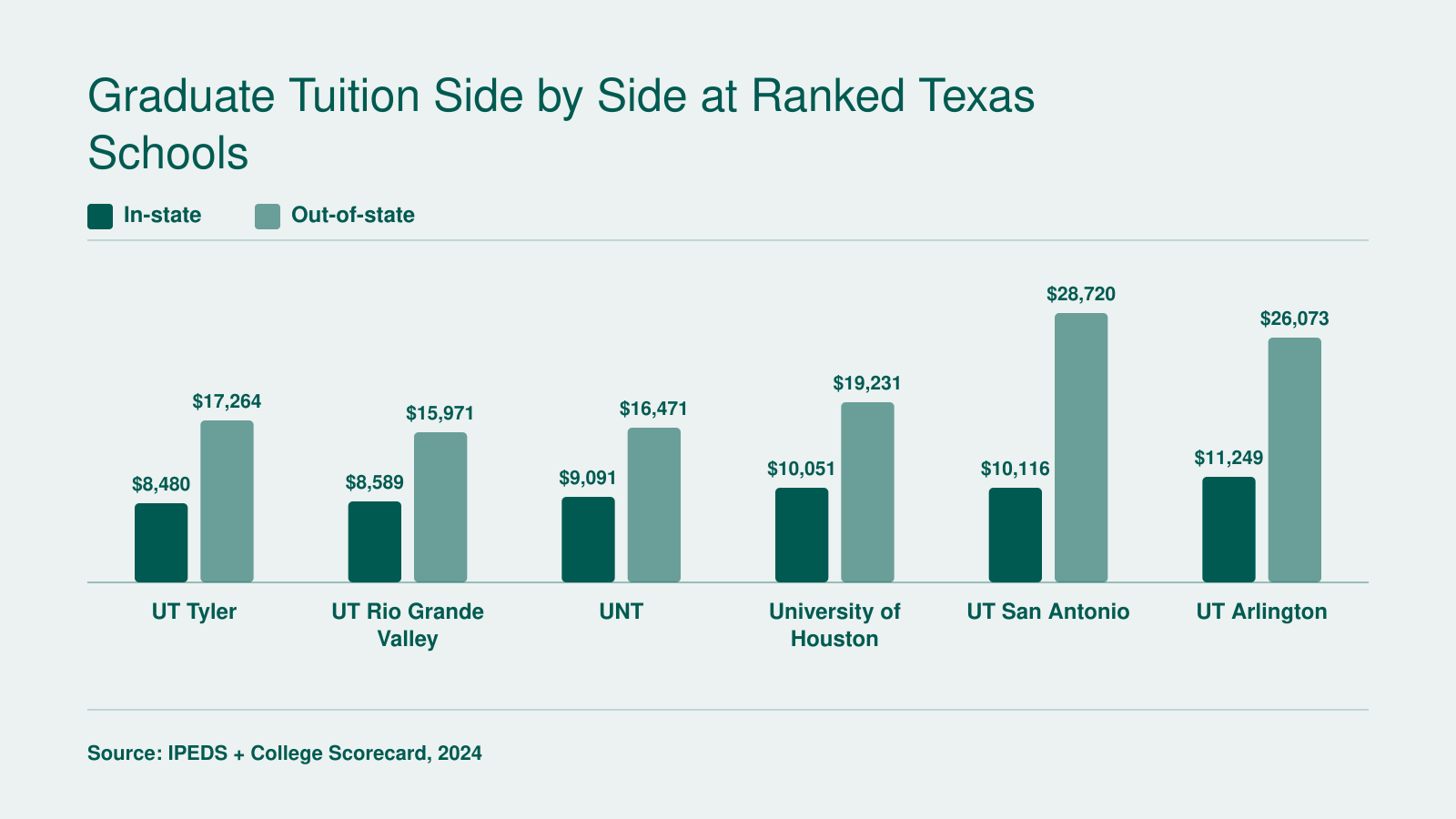
- In-state tuition runs from $8,480 at UT Tyler to $11,249 at UT Arlington.
- Diagnostician certification needs three years of classroom teaching plus a TEA-approved preparation program, not just the degree.
- Several programs here, including UT Austin, skip the GRE, but check each school's admissions page.
Top 10 Special Education Master's Programs in Texas for 2027
These 10 programs rose to the top when we weighed what Texas educators pay against what schools deliver. Cards show institution-wide graduation rates and net price from federal data, and program-level earnings are not yet published for these degrees. Use each card to match a program to your situation, whether you are a working teacher, a career changer, or a future diagnostician.
The University of Texas at Austin
#1Austin, TX · ~$12,000/yr (est.)
Best for: Aspiring behavior analysts studying online
UT Austin pairs the strongest graduation record on this list (the school graduates 89% of students) with in-state graduate tuition of about $12,006 and an average net price near $19,857. Its autism and early childhood intervention concentrations both prepare students for BCBA coursework, with online and hybrid delivery. It suits educators and clinicians who want a behavior analysis credential alongside the degree.
- Autism and Developmental Disabilities concentration, 36 credit hours
- Can be finished in 12 months of full-time study
- Synchronous online classes, fall start, rolling admissions
- Test optional; no entrance exam required
- Meets BACB coursework requirements toward BCBA certification
- Three practical experiences included
- Early Childhood Intervention concentration in a hybrid online and in-person format
- Prepares for BCBA certification
- Training in Naturalistic Developmental Behavioral Interventions
- Caregiver-implemented interventions and culturally responsive practice
- Small interactive classes
Texas A&M University-College Station
#2College Station, TX · ~$12,000/yr (est.)
Best for: Career changers without a teaching certificate
Texas A&M's fully online M.Ed. costs in-state students about $6,885 in graduate tuition, with an average net price near $21,315, and the school graduates 84% of students. It requires neither a teaching certificate nor GRE scores, which opens it to career changers and paraprofessionals. The coursework lines up with BCBA requirements, and Project SUCCESS funding is available.
- 36 credits, two-year, fully online format
- No teaching certificate or entrance exam required
- Aligns with BACB coursework toward BCBA certification
- Three letters of recommendation minimum
- Project SUCCESS funding available
- Out-of-state applicants accepted
Southern Methodist University
#3Dallas, TX · ~$37,000/yr (est.)
Best for: Certified teachers taking evening campus classes
SMU is a private option in Dallas with graduate tuition near $31,590 and an average net price around $40,892. The school graduates 84% of students. The M.Ed. is built for certified or experienced teachers, with classes held after school hours and in summer, so it fits working teachers who can commit to campus evenings.
- 36 credit hours with a capstone action research project
- Three supervised field experiences in your own school setting
- Courses meet after school hours and in summer
- 3.0 GPA minimum; $40 application fee
- Special education law and policy in the curriculum
- Face-to-face instruction with online materials
Texas Christian University
#4Fort Worth, TX · $35,000 – $40,000/yr (est.)
TCU in Fort Worth charges about $38,610 in graduate tuition, with an average net price near $36,660, and the school graduates 86% of students. Its draw is two on-campus laboratory schools, Starpoint and KinderFrogs, for hands-on training. A separate track leads to Texas Educational Diagnostician certification, which makes TCU a fit for future diagnosticians who already teach.
- For certified teachers or experienced individuals; not for initial certification
- Special Education Interventionist concentration
- Starpoint and KinderFrogs on-campus laboratory schools
- Starts summer, fall, or spring
- Accelerated five-year bachelor's to M.Ed. option
- Leads to Texas Educational Diagnostician certification
- 36 credit hours with a required treatise
- Cognitive and culturally responsive assessment training
- For certified teachers or related fields
University of Houston
#5Houston, TX · $10,000 – $19,000/yr (est.)
The University of Houston offers in-state graduate tuition of about $9,019 and an average net price near $14,276, and the school graduates 65% of students. Its M.Ed. in Special Populations has online and hybrid tracks and waives the GRE. Project BRIDGE, a federally funded initiative, plans to cover full tuition for up to 42 Houston-area certified educators, with a first cohort scheduled for January 2027.
- Online delivery; one to two years to complete
- Five tracks available within the degree
- GRE requirement waived
- Comprehensive exam as capstone
- Hybrid format on the UH main campus
- Meets Texas EC-12 certification requirements
- Comprehensive exam required
- GRE requirement waived
- Prepares for EC-12 special education coordinator roles
- Hybrid classes on the main campus
- Special education law, policy, and ethical decision making
- No GRE required
University of North Texas
#6Denton, TX · $9,000 – $16,000/yr (est.)
UNT in Denton has the widest menu here, with in-state graduate tuition near $7,160, an average net price around $15,649, and a school graduation rate of 61%. Concentrations include autism intervention, high-incidence disabilities, and educational diagnostician, in campus, hybrid, and online formats. Five start dates a year and 8-week terms suit working teachers and future diagnosticians.
- 51 credit hours with three concentration options
- 8-week terms in fall and spring
- Five-year accelerated bachelor's plus master's path
- Careers include behavior intervention specialist, teacher, diagnostician
- 33 credit hours; as little as 15 months
- Campus and online options
- Five start dates per year
- Affiliated with the Kristin Farmer Autism Center
- 33 credit hours; complete in 1 to 3 years
- Campus and online options; full-time or part-time
- Prepares for special education certification
- Careers: master teacher, intervention specialist
- 33 credit hours in an accelerated online format; about 15 months
- Prepares for TEA certification
- Courses in ABA and ASD assessment
- Careers: diagnostician, psychometrist
The University of Texas at Arlington
#7Arlington, TX · ~$11,000/yr (est.)
UT Arlington's fully online M.Ed. costs about $9,189 in in-state graduate tuition, with an average net price near $13,951. The school graduates 54% of students. It is designed for practicing teachers who want applied behavior analysis and multi-tiered support skills without pursuing initial certification, and it can be finished in five semesters.
- 30 credit hours, 100% accelerated online, five semesters
- Fall cohort start with 8-week terms
- Applied behavior analysis emphasis
- 3.0 GPA minimum; two letters of recommendation
- No thesis or capstone; no entrance exam
- TEACH grant up to $3,772 yearly
The University of Texas Rio Grande Valley
#8Edinburg, TX · $5,000 – $10,000/yr (est.)
UTRGV is the lowest-cost option on this list, with in-state graduate tuition near $7,001 and an average net price around $4,831. The school graduates 51% of students. The online M.Ed. runs 7-week courses and can be completed in as few as ten months, which works for working teachers and career changers in the Rio Grande Valley and beyond.
- 30 credit hours; $13,750 total program tuition
- As few as ten months, 100% online
- 7-week courses; summer start
- No teaching certificate required; TEACH Grant eligible
- 3.0 GPA minimum; $0 application fee
The University of Texas at Tyler
#9Tyler, TX · ~$8,000/yr (est.)
UT Tyler's online M.Ed. is geared toward certified Texas teachers aiming to become educational diagnosticians. In-state graduate tuition is about $6,534, the average net price is near $13,323, and the school graduates 54% of students. The program reports a 100% pass rate on the TExES Educational Diagnostician exam, and admission includes a GRE option.
- 36 credits over two years; cohort starts each summer
- Prepares for TExES Educational Diagnostician exam
- Reports 100% licensure pass rate for May 2025
- Texas teacher certification required for admission
- Four seminars plus practicum and field experiences
- Zoom interview; transfer up to nine graduate credits
The University of Texas at San Antonio
#10San Antonio, TX · $10,000 – $29,000/yr (est.)
UTSA in San Antonio charges about $7,641 in in-state graduate tuition, with an average net price near $10,836, and the school graduates 53% of students. The M.A. is delivered online with a required campus experience, and classes meet at night. It suits working teachers in the San Antonio area who want a evening schedule at a public price.
- Online synchronous or asynchronous courses, with a required campus experience
- Night classes meet once weekly for three hours
- 3.0 GPA minimum; decisions in four to six weeks
- Capstone research synthesis plus a workshop for colleagues
- Online format does not satisfy student visa requirements
Cost & outcomes by school
Federal data for the highest-earning Special Education programs, independent of the ranking above. Earnings are this field's master's graduates four years after completing, where the Scorecard reports them.
| School | Earnings | Tuition / yr | Debt | Grads/yr | Format |
|---|---|---|---|---|---|
| Sam Houston State University TX | $70,757 | $8,954 | $39,049 | 37 | Online |
| The University of Texas at Tyler TX | $64,946 | $8,480 | $23,712 | 12 | Online |
| Lamar University TX | $64,598 | $8,642 | $19,608 | 327 | Online |
| Texas A&M University-College Station TX | $63,853 | $11,748 | — | 30 | Online |
| East Texas A&M University TX | $63,451 | $7,338 | $24,699 | 8 | Online |
| University of North Texas TX | $63,310 | $9,091 | — | 34 | Online |
| Texas State University TX | $62,709 | $8,997 | $30,500 | 38 | Hybrid |
| Texas A & M International University TX | $62,691 | $6,650 | $19,455 | 14 | Online |
| Stephen F. Austin State University TX | $62,368 | $7,829 | $18,555 | 16 | Online |
| Texas Woman's University TX | $61,736 | $8,520 | $31,992 | 35 | Online |
| Midwestern State University TX | $61,418 | $8,198 | $28,493 | 70 | Online |
| Texas A&M University-San Antonio TX | $61,312 | $6,650 | $29,092 | 4 | Hybrid |
Sources: U.S. Department of Education. Tuition and graduates: IPEDS. Earnings and debt: College Scorecard, this field's master's graduates; a dash means no figure is reported.
Cost, debt & payoff
Median earnings of this field's master's graduates (4 yrs after completing) vs. their median federal loan debt · U.S. College Scorecard
Across these programs the median graduate earns about $63,010 and finishes with roughly $26,596 in debt — a ratio that clears a common rule of thumb (keep debt below first-year salary). Tuition and debt vary widely school to school, so check the per-school figures in the table above before you shortlist.
What Earned These Texas Programs a Spot on Our List
A low tuition bill means little if the degree can't lead to a Texas credential. We weigh graduate tuition and average net price for affordability, add program-level College Scorecard earnings and debt wherever they are published, and use the institution-wide graduation rate as a signal of stability. Those measures are school-wide, not special-education outcomes, and net price is an average, not a personal quote.
Accreditation is the second check for accredited special education master's programs. Midwestern State, Stephen F. Austin, Sam Houston, UT Rio Grande Valley, and UT Permian Basin hold CAEP accreditation,1 and Abilene Christian holds AAQEP.2 For Texas Tech, one CAEP listing shows probation for its College of Education, so confirm its current status directly.1 For master's programs in Texas, TEA approval, not national accreditation, is what makes a graduate eligible for certification. Sam Houston, UTRGV, UT Permian Basin, TCU, and Texas State show TEA approval,345 but Texas State's M.Ed. is a non-certification degree.
Online and Hybrid Special Education Master's Options in Texas
Can you earn a Texas special education master's without setting foot on campus? Mostly, yes, but the details of an online master's in special education vary enough that you should read the fine print before you commit.
Fully Online and Hybrid Formats
Several programs below run entirely online, including the Autism and Developmental Disabilities M.Ed. at UT Austin, the special education M.Ed. at Texas A&M University, and the Online M.Ed. in Special Education, Educational Diagnostician at UNT, as well as online options at UT Arlington, UT Rio Grande Valley, and UT Tyler; UH's M.Ed. in Special Populations is hybrid.1 UT San Antonio lists a hybrid format with both synchronous and asynchronous options. UT Austin schedules synchronous online classes, and UT San Antonio's night courses meet once weekly. Most other programs do not publish whether coursework is live or self-paced, so confirm the schedule directly with each school. UT Tyler requires a Zoom admission interview rather than a campus visit.
The Field-Experience Catch
Here is the part an online format cannot waive: practicum, student teaching, and diagnostician internship hours typically must be logged in a Texas school under an approved supervisor.2 Even a 100% online degree sends you into a real classroom for those hours.
If you already teach, ask whether the practicum can be completed in your current district or classroom. Many programs allow it, which saves you from arranging a placement from scratch.
Graduate Tuition Side by Side at Ranked Texas Schools
Among the lowest-tuition schools on this list, in-state tuition runs from $8,480 at UT Tyler to $11,249 at UT Arlington, a gap of $2,769. Out-of-state, the spread widens to $12,749, from $15,971 at UT Rio Grande Valley to $28,720 at UT San Antonio. These are annual graduate tuition and fees, not total program cost, so multiply by your program's length and credit load. UT Tyler, UT Rio Grande Valley, the University of Houston, and UT Arlington are delivered online, and UT San Antonio offers a fully online option within a hybrid format. UNT is campus-based.
Which Ranked Texas Special Education Master's Programs Skip the GRE
The GRE is a standardized graduate admissions test, and most Education & Teaching Master's Programs here do not make it a hurdle. Policies still differ by school, so confirm before you apply.
- No-GRE master's programs: UT Austin (its Autism and Developmental Disabilities M.Ed. is listed as test optional), Texas A&M University in College Station, and the University of Houston, which waives the requirement.
- Waivable or limited: UT Arlington's accelerated online M.Ed. needs no GRE for unconditional admission for most students. The program page does not spell out who falls outside that group.
- GRE or MAT required: UT Tyler and Dallas Baptist (waivers available).1
- No clear policy published: SMU, TCU, UNT, UTRGV, and UTSA. The program details we reviewed do not state a GRE policy plainly (UTSA lists only English proficiency tests), so ask each admissions office directly.
Other admission items matter more than the test. A 3.0 minimum GPA appears at SMU, UT Arlington, UTRGV, and UTSA, and UT Tyler asks for 3.3. SMU and TCU design their programs for certified or experienced teachers, while Texas A&M and UTRGV do not require a teaching certificate. For diagnostician preparation, UT Tyler requires Texas teacher certification and a Zoom interview, and UNT names diagnosticians among its graduates.
Related Articles
Texas Educational Diagnostician Certification at a Glance
Cost, Aid, and Texas Certification Paths for Special Education Master's Students
The Texas Educational Diagnostician certificate requires three years of classroom teaching experience, a valid classroom teaching certificate, an accredited master's degree, and a state exam completed through a TEA-approved educator preparation program. The degree by itself never confers the credential.
Degree versus credential
A master's in special education is an academic degree; Special Education EC-12 certification and the diagnostician certificate are Texas Education Agency credentials. Some programs here embed preparation coursework, others do not. UT Arlington's initial-certification track (30 credit hours, 40 field experience hours) leads to EC-12 certification but is open to Texas residents only. UT Tyler's program prepares candidates for the TExES Educational Diagnostician exam and requires an existing Texas teaching certificate. TCU states plainly that its program is not for initial certification, and SMU's is built for already-certified or experienced teachers. Verify each program's TEA approval and certification plan before you enroll.
What the degree title signals
Most options here are MEd degrees, typically practice-oriented; UT San Antonio awards an MA. Neither label determines certification eligibility, which rests on preparation program approval, exams, and experience. If behavior analysis is your goal, UT Austin and Texas A&M both align coursework with BCBA certification requirements.
Cost, timeline, and aid
Programs run 30 to 42 credit hours. At public campuses on this list, published in-state graduate tuition generally falls between roughly $8,500 and $12,000 per year, putting total cost in the high teens to low twenties; private options cost considerably more. Plan on roughly 1.5 to 2 years part-time, less in accelerated formats.1
Check the federal TEACH Grant, Texas loan repayment for special education teachers in shortage areas, and your district's tuition reimbursement. Confirm current amounts and service obligations directly.
Pick the credential first. Then compare cost only among programs that actually lead to it.
Compare Special Education programs on the data that matters
Explore more Education & Teaching specializations or browse every graduate field.
All Education & Teaching programs