Master's Programs in Mississippi
Every master's program reported by a school in Mississippi: 360+ programs at 16 graduate schools, with the online options, costs and outcomes behind each one.

Most Mississippi graduate-school shoppers start with the same three questions: what will it cost, can I finish through online master's programs while holding a job, and will the degree pay off without leaving the state. The answers vary more by program than by campus.
Mississippi's public universities generally charge some of the lower graduate tuition rates in the region, though residency rules, flat-rate pricing, and fees can change the real bill. Teaching, nursing, counseling, and business degrees often tie directly to a license, a pay scale, or a hiring pipeline.
The cheapest program is not always the best value. A degree that misses a licensing board's requirements, or earns little more than a bachelor's, costs more in the end.
Key Points
- Ole Miss, Mississippi State, Southern Miss and Jackson State all hold SACSCOC accreditation.
- Ole Miss charges nonresidents nearly triple resident rates; Mississippi State uses one flat graduate rate.
- Mississippi State MBA graduates reported $79,600 median earnings against $20,500 median debt.
Popular degrees in Mississippi
Master's programs in Mississippi by field
Education & Teaching
- Teaching27 programs
- Music Education14 programs
- Special Education11 programs
- Elementary Education11 programs
- Secondary Education11 programs
- Educational Leadership8 programs
- Curriculum & Instruction7 programs
- STEM Education or Science Education or Mathematics Education4 programs
Business & Management
- Accounting15 programs
- Healthcare Administration9 programs
- General Business8 programs
- Public Administration8 programs
- Management Information Systems7 programs
- Management6 programs
- Project Management6 programs
- Analytics5 programs
Healthcare
- Public Health6 programs
- Speech Pathology6 programs
- Health Administration4 programs
- Exercise Science4 programs
- Nutrition3 programs
- Health Education2 programs
- Health Informatics1 program
Communications & Media
- Communication Disorders6 programs
- Communication5 programs
- Speech Pathology4 programs
- Strategic Communication2 programs
- Journalism1 program
- Public Relations1 program
- Media Communication1 program
- Health Communication1 program
Social Work & Social Sciences
- Political Science, Government6 programs
- Sociology5 programs
- Social Work Advanced Standing4 programs
- Social Work4 programs
Counseling
- Clinical Mental Health Counseling8 programs
- School Counseling7 programs
- Marriage and Family Therapy or Marriage and Family Counseling3 programs
Nursing
- Nursing Education or Nurse Educator4 programs
- Family Nurse Practitioner (FNP)3 programs
- Nurse Administrator2 programs
- Direct Entry MSN (MENP) or (DEMSN)1 program
- Clinical Nurse Leader1 program
- Psychiatric Mental Health Nurse Practitioner1 program
Computers & IT
- Cybersecurity6 programs
- Data Analytics2 programs
- Information Security & Assurance2 programs
- Machine Learning1 program
Arts & Design
- Creative Writing8 programs
- Fine Arts2 programs
Psychology
- Applied Behavior Analysis3 programs
- Educational Psychology or School Psychology2 programs
- Counseling Psychology2 programs
- Child Psychology1 program
Religion & Theology
- Divinity3 programs
- Theology3 programs
- Christian Ministry1 program
Criminal Justice & Law
- Public Policy2 programs
- Master of Laws2 programs
- Homeland Security2 programs
Science & Engineering
- Environmental Science3 programs
- Sustainability or Environmental Management2 programs
What 'Accredited' Means for a Mississippi Master's Degree
The 2025-2026 Mississippi Commission on College Accreditation list shows Ole Miss, Mississippi State, Southern Miss, Jackson State, Delta State, Mississippi College, UMMC, Alcorn State and Mississippi University for Women all hold accreditation from SACSCOC, the Southern Association of Colleges and Schools Commission on Colleges.1 That is the regional accreditor for the state, and it is the baseline you need.
Institutional accreditation
SACSCOC accredits the university as a whole, including its degree levels and delivery modes within the approved scope.1 Federal financial aid eligibility depends on it, and so does the willingness of other schools and employers to accept your credits and your degree. Southern Miss, for example, is authorized for bachelor's, master's, specialist's and doctoral degrees. Institutional accreditation does not tell you whether a specific program meets professional standards.
Programmatic accreditation
For licensure fields, the program-level accreditor often matters more. Common examples:
- Counseling: CACREP, which many state licensing boards look to for clinical mental health counseling programs.
- Nursing: CCNE or ACEN, which many state licensing boards look to for MSN Nurse Educator programs.
- Social work: CSWE, the body behind CSWE-accredited MSW programs. Mississippi Valley State University's MSW appears in the CSWE directory.4
- Business: AACSB. Southern Miss holds it for its MBA, Master of Professional Accountancy, MS in Sport Management and MS in Economic Development.2
- Education: CAEP. Mississippi College holds full CAEP accreditation (2021), covering advanced programs such as the MEd in Educational Leadership, Special Education (Mild/Moderate) and Dyslexia Therapy.3
Coverage varies by program, even within one university. A school can be accredited overall and still lack the specialized credential your field requires.
How to verify in two steps
- Step 1: Confirm the institution in the SACSCOC member directory or the CHEA database.1
- Step 2: Look up the specific program in the specialized accreditor's own directory (CACREP, CSWE, CCNE, ACEN, AACSB or CAEP), not just the school's marketing page.
Online programs
An online master's at a Mississippi university carries the same institutional accreditation as the campus version at that school. So yes, accredited online master's programs exist in Mississippi. Still run the second check, because programmatic accreditation is granted to the specific program, and you should confirm it covers the online format you plan to take.
Online, Hybrid, or on Campus: How Mississippi Universities Deliver Graduate Degrees
Online and hybrid master's formats can lower the cost of moving and let working students keep a paycheck, but flexibility is rarely uniform. The real question is not whether a program is labeled online, but what online demands: live class times, campus residencies, or clinical placements that cannot be done remotely.
How the major online arms are organized
Ole Miss Online groups many of the University of Mississippi's fully online graduate degrees and advertises multiple start dates across programs. Mississippi State's online graduate programs are presented as fully online with no campus visits required unless the student chooses to attend commencement, and the university charges in-state tuition to online students from anywhere in the U.S. Ole Miss and the University of Southern Mississippi (USM) pricing details should be checked on the specific program page because a program's delivery format can change the rate.
Asynchronous, synchronous, and hybrid realities
Neither Ole Miss nor Mississippi State publishes a single school-wide rule that every online class is asynchronous. Some courses may be completed on the student's own schedule, while individual programs may require live sessions or scheduled check-ins. At Ole Miss, the Registered Play Therapist pathway is a clear hybrid example: the credential requires 25 credits, 350 to 600 supervised hours, and a three-day on-campus residency, normally in the first or second week of June.
Typical time to degree and accelerated options
A 30 to 36 credit master's commonly takes one and a half to two years full time, while part-time online students often need two to three years. Accelerated formats exist but are program specific. Ole Miss's Master of Public Health is 42 credits with eight-week accelerated terms and a listed completion time of 18 to 24 months. The MS in Sport Analytics is 30 credits and can be finished in about 12 months full time, while the MS in Criminal Justice Leadership runs in eight-week blocks. Online graduate credit totals at Ole Miss range from 30 to more than 42 depending on the discipline. Mississippi State notes many online graduate students can finish in two years at a six-credit load per spring, summer, and fall term.
Licensure fields add in-person requirements
Counseling, nursing, and social work tracks, including online MSN programs, typically involve practicum or clinical placements even when the didactic coursework is online. Mississippi's online delivery does not remove those supervised hours. The play therapy example above is one reminder that a fully online program may still require structured, in-person clinical or residency components.
USM Online's format details are not clearly established from available public sources, so verify synchronous or asynchronous policies and residency requirements directly with the program before enrolling.
What Does a Master's Degree Cost in Mississippi?
Residency-based pricing and flat-rate pricing produce very different bills in Mississippi. The University of Mississippi charges nonresidents nearly three times what residents pay. Mississippi State University charges the same graduate rate for all students. If you are coming from out of state, that difference can outweigh almost any other cost factor.
Published Graduate Tuition, 2026-27
These are the rates each university publishes for the 2026-27 academic year, quoted per credit hour:
- University of Mississippi, resident: $484.25 per credit hour (base graduate tuition)
- University of Mississippi, nonresident: $1,388.25 per credit hour (base graduate tuition)
- Mississippi State, resident and nonresident (on campus): $627.50 per credit hour, made up of $602.50 tuition plus a $25.00 instructional support fee1
- Mississippi State, online (1 to 8 hours per term): $627.50 per credit hour2
Mississippi State states that all distance students pay in-state tuition regardless of location. For online students taking 9 or more hours in a term, the university uses a separate per-semester structure, and that total was not available at publication.2 Ole Miss's published schedule does not clearly establish a separate online rate, but online students qualify for in-state tuition; confirm current rates and any program fees with the bursar.
For the University of Southern Mississippi, Jackson State, Delta State, and Mississippi University for Women, a current official graduate tuition schedule for 2025-26 or 2026-27 could not be confirmed. Check each school's bursar page directly rather than relying on older figures.
What a Full Degree Costs
Most Mississippi master's degrees require 30 to 36 credit hours. At published per-credit rates, before any program fees:
- Ole Miss, resident: about $14,528 for 30 credits, or $17,433 for 36
- Ole Miss, nonresident: about $41,648 for 30 credits, or $49,977 for 36
- Mississippi State, any residency: about $18,825 for 30 credits, or $22,590 for 361
The takeaway is practical. A Mississippi resident pays less in base tuition at Ole Miss. A student from Alabama, Tennessee, or farther away could save more than $25,000 on a 36-credit degree by choosing Mississippi State's flat rate, assuming the program fits. Tuition also tends to rise from year to year, so a two-year degree will likely cost somewhat more than these single-year rates suggest.
Fees That Raise the Base Rate
Published per-credit tuition is a floor, not a final price. The Ole Miss figures above are base tuition only and do not reflect the full set of required fees. Mississippi State notes that additional distance-learning fees apply to online courses but does not list the amount on its general tuition page.1 Programs such as MBA programs, nursing, and other professional degrees often carry their own differential tuition or course fees on top of the standard rate.
Before comparing offers, ask each program for a written estimate covering tuition, required university fees, program fees, and any per-course online charges for your full credit load.
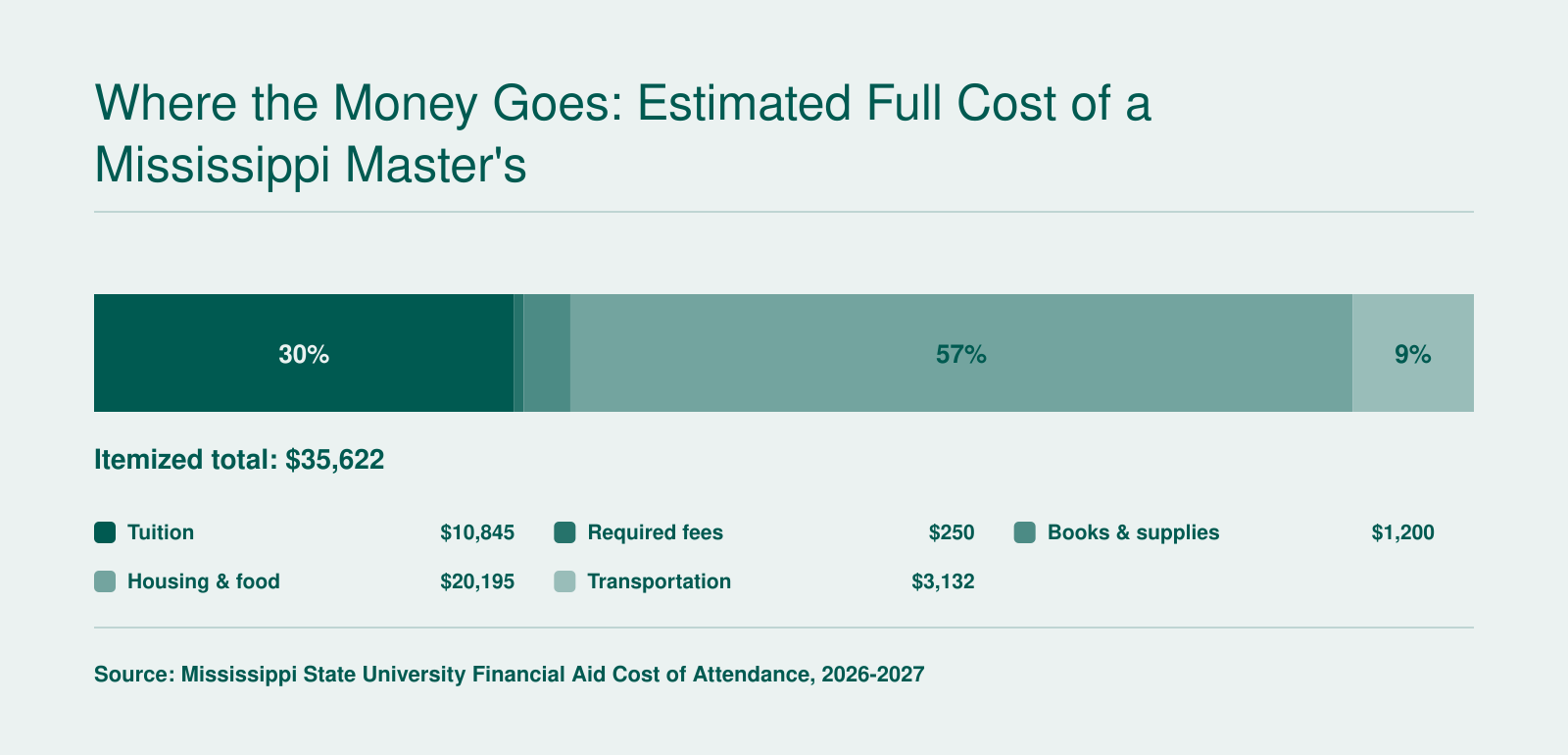
Where the Money Goes: Estimated Full Cost of a Mississippi Master's
This chart splits one full-time, in-state graduate year at Mississippi State University (Starkville, living on campus, 2026-2027) into the main budget lines. Mississippi State's published on-campus budget totals $39,426, which is higher than the itemized lines shown here, so it includes additional allowances not broken out. The cost-of-attendance budget, not tuition alone, is what financial aid offices use to set your aid.
Admissions Requirements, GRE Policies, and Deadlines
Mississippi's major graduate schools set a baseline and then let individual programs raise it, so treat the figures below as typical starting points and confirm them with your program before you apply. Do Mississippi master's programs require the GRE? Often not: the graduate schools at Mississippi State and Southern Miss leave test requirements to individual programs, while Ole Miss has no single university-wide rule.
- Accredited bachelor's degreeEvery program expects a completed undergraduate degree from a regionally accredited institution, with official transcripts sent directly to the school.
- Minimum GPAExpect roughly 2.75 to 3.0, often measured on your last 60 undergraduate hours: Southern Miss and Mississippi State's Curriculum, Instruction, and Special Education program start at 2.75, while Ole Miss accountancy and taxation programs and Mississippi State's M.S. in Information Systems ask for 3.0.
- GRE/GMAT statusMississippi State's Graduate School no longer requires the GRE or GMAT universally, Southern Miss lets programs decide, and Ole Miss varies by program; the Ole Miss Master of Accountancy waives the GMAT for admission if you meet the GPA standard but still requires it for a Patterson assistantship.
- Test-optional examplesThe Southern Miss English graduate program no longer requires the GRE, and Mississippi State's Information Systems M.S. still asks for a competitive GRE or GMAT score, so check each department.
- Letters of recommendationMost programs request recommendation letters, typically from faculty or supervisors who can speak to your academic or professional readiness.
- Statement of purposeExpect a written statement explaining your goals and fit, and some departments add a résumé or writing sample.
- Prerequisites and licensesProfessional programs may require credentials before admission, such as an RN license for an MSN or a teaching license for some M.Ed. tracks.
- Deadlines and entry termsFall, spring, and summer starts are common, but no major school uses one university-wide rolling policy; Mississippi State's fall deadlines run from May 1 for international applicants to August 1 for distance students, and Southern Miss lists general dates in early to mid-August, January, and May that differ between its admissions guide and its bulletin.
- Priority deadlines for fundingPrograms with assistantships often set earlier dates, such as Southern Miss English's February 10 priority date for fall, so apply well ahead of the final deadline if you want funding considered.
How to Pay for Your Master's: Assistantships, Waivers, and Employer Aid
Funding for master's students in Mississippi now depends less on a single national formula and more on which department, which university, and which year's policy you are reading. Assistantship terms differ by campus, and some published figures are already out of date.
Graduate Assistantships
An assistantship pairs paid work (teaching, research, or administrative support) with a tuition waiver. The University of Southern Mississippi publishes the clearest terms. A full-time assistantship is 0.5 FTE, about 20 hours a week, and carries a full tuition waiver for 9 to 13 credit hours, including nonresident tuition when it applies. A half-time post is 0.25 FTE, about 10 hours a week, with a 50 percent waiver, and you pay the remainder. Minimum stipends are set on a 20-hour week: $12,000 for a nine-month master's contract, plus at least $3,000 for a summer. USM covers additional fees on top of tuition, and departments can pay above the minimum when funding allows.
Mississippi State's 2026 guidance gives teaching, support, and research assistants a 100 percent assessed-tuition exemption, and nonresidents also get their nonresident tuition covered.1 Exclusions matter: extra online-enrollment fees, ESL tuition above nine credits, and Winter Session are not covered.2 An older handbook cites a $600 monthly minimum stipend and a roughly 71 percent in-state exemption, but it conflicts with the 2026 page, so confirm the current terms before budgeting.3 We could not verify 2026 stipend, waiver, or hours policies for the University of Mississippi, so ask its graduate school directly.
State Aid and Federal Loans
The Mississippi Office of Student Financial Aid has run forgivable loans for nursing and teaching, in which you sign a service contract and the loan is discharged once you complete it.4 If you breach the contract, the loan comes due with interest. Status matters here: the graduate teacher forgivable loan is listed as inactive, and the health care professions forgivable loan is unfunded.5 The nurse retention loan repayment program is listed as active.6 We could not confirm 2026 award amounts, deadlines, or service terms, so verify them with the office before you count on any of them.
Federal borrowing rules for graduate students changed for new borrowers beginning in July 2026, including the end of Grad PLUS for new borrowers and new annual and lifetime caps on Direct Unsubsidized loans. Check your personal limit at studentaid.gov, because the caps affect how much of a program's cost you can borrow.
Employer Aid and Asking Directly
Many employers offer tuition assistance, and public employers may have their own tuition benefits, so ask HR before you enroll. Many assistantships are also never posted centrally. Email the program coordinator in your department, ask what is available for incoming students, and ask about summer funding, fee coverage, and whether online coursework qualifies.
Licensure and Certification: Which Mississippi Master's Programs Lead There
A master's degree leads to a license in Mississippi only if it matches the licensing board's rules, and the program's marketing does not change that. A cheaper or shorter program that misses the board's accreditation or credit-hour requirements can leave you with a degree you cannot use for licensure.
Counseling (LPC)
The Mississippi State Board of Examiners for Licensed Professional Counselors points to a 60 semester-hour degree. A CACREP-accredited 60-hour program is the safest route. The Board's published summary ties the degree to its own rule rather than naming CACREP as mandatory, so verify against the current rule before enrolling.
Full licensure comes after graduation. Rule material dated September 2026 describes 3,000 clinical hours, including 1,200 of direct client service, with 100 hours of individual and 50 hours of group supervision. It calls for at least 18 months of experience, a cap of 40 hours per week, and completion within seven years. You also sit the NCE and NCMHCE, plus a pass/fail jurisprudence exam. Ask the Board which version of the rule applies on your application date.
Nursing (APRN)
The Mississippi Board of Nursing requires a current Mississippi RN license or an active, unrestricted Compact license for Nurse Practitioner and other APRN roles. It also requires a master's degree or higher in nursing, nurse anesthesia, or nurse midwifery from an accredited program. Graduates after 1998 need a specialty concentration. Next come a national certification exam in your practice area and a background check with fingerprinting. CACREP is a counseling accreditor and plays no role here.
Social Work (LMSW and LCSW)
The Mississippi Board of Examiners for Social Workers and Marriage and Family Therapists issues both license levels. The clinical license sits above the master's-level license, including for marriage and family therapy master's programs, and involves supervised experience after the degree. We could not confirm the Board's current accreditation, exam, or supervised-hour details, so get them from the Board directly before you commit to a program.
Education
Teaching licensure runs through the state's approved-program route. The same principle applies: confirm that the program is approved for the endorsement you want.
Out-of-State Online Students
If you study online from outside Mississippi, a Mississippi program does not satisfy your home state's board. Check that board's rules on degree, accreditation, and supervised practice first.
Teachers: The Master's-Level License in Mississippi
Career Outcomes and Salary Expectations for Mississippi Graduates
Mississippi State University's General MBA graduates reported median earnings of $79,600 in the year after graduation, against median debt of $20,500, according to GradReports data compiled in December 2020. That is roughly a dollar of debt for every four dollars of first-year pay, a ratio most graduate students would happily take. MSU's master's in accounting looked similar: $56,300 in median earnings against $19,980 in debt.
Where the Returns Get Thinner
The same MSU data tells a different story in education and counseling:
- Education (General): $46,090 median earnings, $39,080 median debt
- Teacher Education (Specific Levels and Methods): $38,020 earnings, $33,440 debt
- Educational Administration and Supervision: $35,950 earnings, $31,020 debt
- Student Counseling and Personnel Services: $36,370 earnings, $44,000 debt
In the counseling program, typical debt exceeded a full year of early-career pay. These numbers are not a verdict on the value of the work. Pay in these fields is largely set by state salary schedules, school districts, and public agencies, so a master's degree moves you up a defined pay step rather than into open-market bargaining. Because the salary ceiling is fixed by someone else, your return depends almost entirely on what you spend. Choosing among affordable master's degrees, using district tuition support, or finishing while employed matters more here than in business or health fields.
Nursing as an Occupational Benchmark
Program-level earnings for Mississippi MSN programs are not currently available in the federal data we reviewed. For context, federal wage data from May 2025 puts the median annual wage for Mississippi nurse practitioners at $124,730, with the middle 80% earning between $98,780 and $156,830. That figure covers every practicing NP in the state, not new graduates of a specific program, and Mississippi ranks 47th among the states and D.C. on this measure. Even near the bottom nationally, though, NP pay in Mississippi sits well above the debt levels seen in other graduate fields, and comparatively modest living costs in much of the state help that salary go further.
How to Read These Numbers
Treat Scorecard figures as directional. They count only graduates who received federal financial aid, they measure earnings shortly after completion rather than over a career, and the MSU figures above come from an older reporting cycle. Newer releases may differ, and figures from different years should not be compared head to head. Use them to spot patterns, such as which fields carry heavy debt relative to pay, then check each program's current data before committing.
A Mississippi Master's That Pays Off Fast
Nurse practitioners are among the best-paid master's-level professionals in the state.
Graduate schools in Mississippi with the most master's programs
| School | City | Type | Master's programs | Online | Grad tuition / yr |
|---|---|---|---|---|---|
| University of Mississippi | University | Public | 52 | 19 | $9,772 |
| Mississippi State University | Mississippi State | Public | 48 | 28 | $10,202 |
| University of Southern Mississippi | Hattiesburg | Public | 45 | 25 | $9,998 |
| Mississippi Christian University | Clinton | Private nonprofit | 35 | 26 | $15,500 |
| Belhaven University | Jackson | Private nonprofit | 29 | 25 | $11,700 |
| Strayer University-Mississippi | Jackson | Private for-profit | 29 | 28 | $15,135 |
| Jackson State University | Jackson | Public | 27 | 5 | $8,965 |
| Delta State University | Cleveland | Public | 25 | 23 | $8,605 |
| William Carey University | Hattiesburg | Private nonprofit | 25 | 21 | $11,880 |
| Mississippi University for Women | Columbus | Public | 17 | 6 | $8,492 |
| Alcorn State University | Alcorn State | Public | 13 | 6 | $9,520 |
| Mississippi Valley State University | Itta Bena | Public | 8 | 0 | $8,385 |
| Blue Mountain Christian University | Blue Mountain | Private nonprofit | 4 | 3 | $12,956 |
| Wesley Biblical Seminary | Ridgeland | Private nonprofit | 3 | 3 | $13,800 |
| Millsaps College | Jackson | Private nonprofit | 2 | 0 | $18,000 |
Program counts are the verified master's listings in our directory; tuition is the school-wide average for a full-time graduate student (IPEDS).
Common Questions About Master's Programs in Mississippi
These answers cover the questions prospective students ask most often. Policies change and often vary by program, so confirm specifics with the graduate school before you apply.
What is the best master's program in Mississippi?
How long does it take to complete a master's degree in Mississippi?
Can out-of-state students get in-state tuition for an online Mississippi master's?
Can I transfer graduate credits into a Mississippi master's program?
Compare programs nationwide
Many Mississippi residents study online. Every ranked list above has an online lens, or browse every field.
Online master's programs Browse all fields