Best Master's in Environmental Science Programs in Mississippi
Compare 3 accredited Environmental Science programs in Mississippi at 2 schools, with graduate earnings, cost, debt, and completion data from IPEDS and the U.S. College Scorecard.

A master's in environmental science in Mississippi is a short list, not a crowded market. Mississippi State University and the University of Southern Mississippi are the two master's-level options, and Jackson State University is a doctoral program. With so few choices, prestige barely separates them. Format, cost, and research fit do.
Titles also vary. Mississippi State's online degree is an M.S. in Geosciences with an Environmental Geosciences concentration, so the label on the diploma may not read "environmental science." Southern Miss uses Earth and Environmental Science. Adjacent fields such as environmental toxicology, marine science, and environmental health get flagged where they appear.
Most employers in the state hire for field, GIS, and regulatory skills, not the degree name.
Key Points
- Mississippi State offers the only fully online environmental geosciences master's in Mississippi.
- In-state tuition is $8,965 at Jackson State and $10,202 at Mississippi State.
- Mississippi has no general environmental scientist license; state regulators credential regulated work.
Best Master's in Environmental Science Programs in Mississippi, Ranked
Mississippi offers a compact set of graduate options for environmental science students. The strongest master's-level fits are at Mississippi State University and the University of Southern Mississippi, while Jackson State University appears in our data for its doctoral program rather than a master's degree. Each listing below highlights delivery format, concentrations, and what makes the school distinctive.
Mississippi State University
#1Mississippi State, MS · ~$10,000/yr (est.)
Best for: Working professionals wanting online geoscience training
Mississippi State's qualifying master's option is an online M.S. in Geosciences with an Environmental Geosciences concentration, an adjacent degree rather than a program titled environmental science. The 30-credit, non-thesis format uses in-state tuition for all students and does not require the GRE. The school's institution-wide graduation rate is about 67%, and Mississippi State is SACSCOC accredited. The online delivery and geospatial curriculum make it a flexible fit for working professionals.
- 30-credit, non-thesis online program
- Concentration in Environmental Geosciences
- Covers ocean science, climatology, and GIS
- All students receive in-state tuition rate
- No GRE requirement
- Prerequisites: physical geology and weather/climate
- Year-round admissions with fall, spring, summer starts
- Comprehensive exam required
University of Southern Mississippi
#2Hattiesburg, MS · ~$10,000/yr (est.)
Best for: Campus learners seeking hands-on environmental field training
Southern Miss offers a campus-based Master of Science in Earth and Environmental Science, with thesis and non-thesis options and concentrations such as environmental consulting, natural resource management, and wildlife science. The program draws on resources including a 291-acre environmental center, herbarium, and fish museum, and integrates geospatial technology and field methods. The school's institution-wide graduation rate is about 49%, and it holds SACSCOC accreditation. This is the most direct environmental science master's degree in the state.
- Campus program with thesis and non-thesis options
- Covers geography, geology, and biology
- Includes data analysis and geospatial technology
- Field methods and hands-on courses
- Faculty mentorship required
- Located in Hattiesburg with 291-acre environmental center
- 36 credit hours required
- Focus on environmental consulting
- 3.0 GPA required for graduation
- GRE scores needed
- Three recommendation letters
- Comprehensive exam required
- 36 graduate hours required
- Natural resource management concentration
- Ecology and policy coursework
- Field methods included
- Laboratory sections available
- Wildlife science concentration
- Organismal electives available
- Ecological processes electives
- Natural resource policy covered
- Field methods in curriculum
- Courses numbered 600 or higher
Jackson State University
#3Jackson, MS · ~$9,000/yr (est.)
Jackson State appears in our data for a campus-based Environmental Science Ph.D., the only doctoral program of its kind in Mississippi, not a master's degree. The interdisciplinary program emphasizes water contamination, air pollution, and sustainable resource use, with laboratory and field work and collaborations with national labs and other universities. The institution-wide graduation rate is about 51%, and prospective master's students should treat this listing as doctoral-only.
- Campus-based doctoral program
- Interdisciplinary research curriculum
- Focus on water contamination and air pollution
- Collaborations with national laboratories and universities
- Laboratory and field work integrated
- Sustainable resource use and toxic waste management
Cost & outcomes by school
Federal data for the highest-earning Environmental Science programs, independent of the ranking above. Earnings are this field's master's graduates four years after completing, where the Scorecard reports them.
| School | Earnings | Tuition / yr | Debt | Grads/yr | Format |
|---|---|---|---|---|---|
| Mississippi State University MS | — | $10,202 | — | 12 | Online |
| University of Southern Mississippi MS | — | $9,998 | — | — | Campus |
Sources: U.S. Department of Education. Tuition and graduates: IPEDS. Earnings and debt: College Scorecard, this field's master's graduates; a dash means no figure is reported.
Online and Hybrid Master's in Environmental Science Options in Mississippi
Among Master's Programs in Mississippi, one online path into graduate environmental science exists: the M.S. in Geosciences with an Environmental Geosciences concentration at Mississippi State University, delivered online as a 30-credit, non-thesis program with a comprehensive exam, a face-to-face field-study component, and in-state tuition rates for every student regardless of residency. The other programs here are campus-based. The Earth and Environmental Science master's at the University of Southern Mississippi is taught in Hattiesburg and leans on field methods, lab work, and faculty mentorship, while Jackson State University's environmental science graduate work in Jackson is similarly hands-on, with laboratory and field components built in.
That split reflects a real trade-off. Environmental science careers that depend on sampling, instrumentation, and bench chemistry are hard to learn through a screen, and campus programs give you lab access plus a thesis advisor. Online study suits working professionals already in regulatory, compliance, or consulting roles who need credentials without leaving a job.
If an online format is non-negotiable and the Mississippi State option is not a fit, out-of-state environmental science master's programs are worth comparing. Also check whether any hybrid coursework carries a summer field session or on-site research requirement before you enroll.
Application Deadlines and Prerequisites for Mississippi Programs
Common requirements include a bachelor's degree, transcripts, statement of purpose, letters of recommendation, and a faculty advisor contact for thesis tracks. Science prerequisites in biology, chemistry, and math/statistics are typical but not always specified.
- University of Southern MississippiFor the M.S. in Environmental Sciences, apply by July 15 for fall or November 15 for spring (international May 1 and October 1). Aim for at least a 3.0 GPA in your last two years and in proposed-field courses, and submit GRE General scores. Assistantship seekers should be admitted by July 1 for fall or December 1 for spring.
- Mississippi State UniversityUniversity-wide deadlines are August 1 domestic fall and December 1 domestic spring; international deadlines are May 1 fall and October 1 spring. Departments may set earlier deadlines, and no environmental science-specific GPA or prerequisite list is published here, so confirm with the graduate coordinator.
- Jackson State UniversityProgram-specific application deadlines and minimum GPA are not published in the materials reviewed. Contact Jackson State's graduate program directly for current deadlines, prerequisites, and assistantship consideration dates.
Which Mississippi Master's Programs Waive or Make the GRE Optional?
Jackson State University sets the highest stated bar: its M.S. in Environmental Science, housed in the Department of Biology, asks for a combined verbal and quantitative GRE score of 800.1 Applicants who score below that receive partial credit, but the published page names no optional or waived pathway.
Mississippi State University
The Graduate School no longer requires the GRE or GMAT for admission.2 Individual departments can still ask for scores to determine assistantship eligibility, so check with the program's Graduate Coordinator. The Environmental Geosciences concentration in the M.S. in Geosciences states plainly that no GRE is required, as do other masters in environmental science no GRE programs.3 The M.S. in Civil and Environmental Engineering requires scores only from applicants without an EAC/ABET-accredited civil, construction, or environmental engineering degree. It sets no minimum, though successful applicants typically post a Quantitative Reasoning score of 157 or higher, and scores stay valid five years.4
University of Southern Mississippi
The M.S. in Environmental Sciences requires GRE General Test scores. The Graduate School says test-score waivers are rare and go through the Dean for particularly well-qualified applicants or those with extensive field experience. The program publishes no specific waiver criteria.
Before you apply
A strong score can still strengthen an assistantship bid where a department says scores matter. Graduate school and department policies sometimes differ, so confirm directly with the department before paying for the exam.
Related Articles
Master's in Environmental Science Cost and Funding in Mississippi
Residency status, more than the program itself, now drives what a Mississippi master's in environmental science costs. Published annual tuition and fees for in-state students run $8,965 at Jackson State University, $9,998 at the University of Southern Mississippi, and $10,202 at Mississippi State University. For out-of-state students the figures are $11,965, $11,998, and $27,637. Southern Miss and Jackson State add only about $2,000 to $3,000 for nonresidents, while Mississippi State adds more than $17,000.
Estimating a Degree Total
Among online environmental science master's programs, Mississippi State's online M.S. in Geosciences (Environmental Geosciences) lists $602.50 tuition plus a $25 instructional fee per credit, with in-state rates for all students. Across its 30 credits, that comes to roughly $18,180 before application and other fees. Southern Miss lists 30 to 36 credits for its M.S. in Environmental Sciences; a current per-credit rate is not confirmed, so check its bursar page before multiplying.
The federal average net price (about $17,600 at Mississippi State, $21,700 at Southern Miss, $23,800 at Jackson State) covers the whole institution. Treat it as a rough guide for graduate students, especially those comparing affordable environmental science master's programs.
Funding Options
Mississippi State is the clearest on assistantships. Graduate assistants receive a 100% tuition exemption for 20 hours of work weekly, but only with full admission, and online distance fees are not covered. Students can also apply for university, college, and departmental scholarships through myState. Southern Miss and Jackson State publish less, so ask each department about assistantships and waivers directly.
Mississippi Licensure and Certification for Environmental Science Graduates
Career Outcomes and Earnings for Mississippi Environmental Science Master's Graduates
Mississippi State's online geosciences master's names geotechnician and environmental consultant work as its target roles, and that pairing describes the Mississippi market well. Southern Miss builds its Earth and environmental science degree around field methods, geospatial technology, and data analysis, skills that transfer directly to consulting and resource management. Jackson State's campus program concentrates on water contamination, air pollution, and toxic waste management, which maps closely to regulatory work.
Where graduates land
- State government: The Mississippi Department of Environmental Quality and allied state agencies hire for permitting, monitoring, and remediation oversight.
- Gulf Coast consulting: Site assessment, wetlands delineation, and coastal restoration firms cluster along the coast and draw on Hattiesburg-trained graduates.
- Federal roles: EPA, USDA, and the U.S. Army Corps of Engineers all maintain a presence in the region.
- Industry compliance: Manufacturing, energy, and forestry employers need staff who can manage discharge permits and reporting.
Your next step
Shortlist two schools, confirm the GRE policy and application deadline details covered above, then email a faculty member whose research matches your interests about thesis supervision.
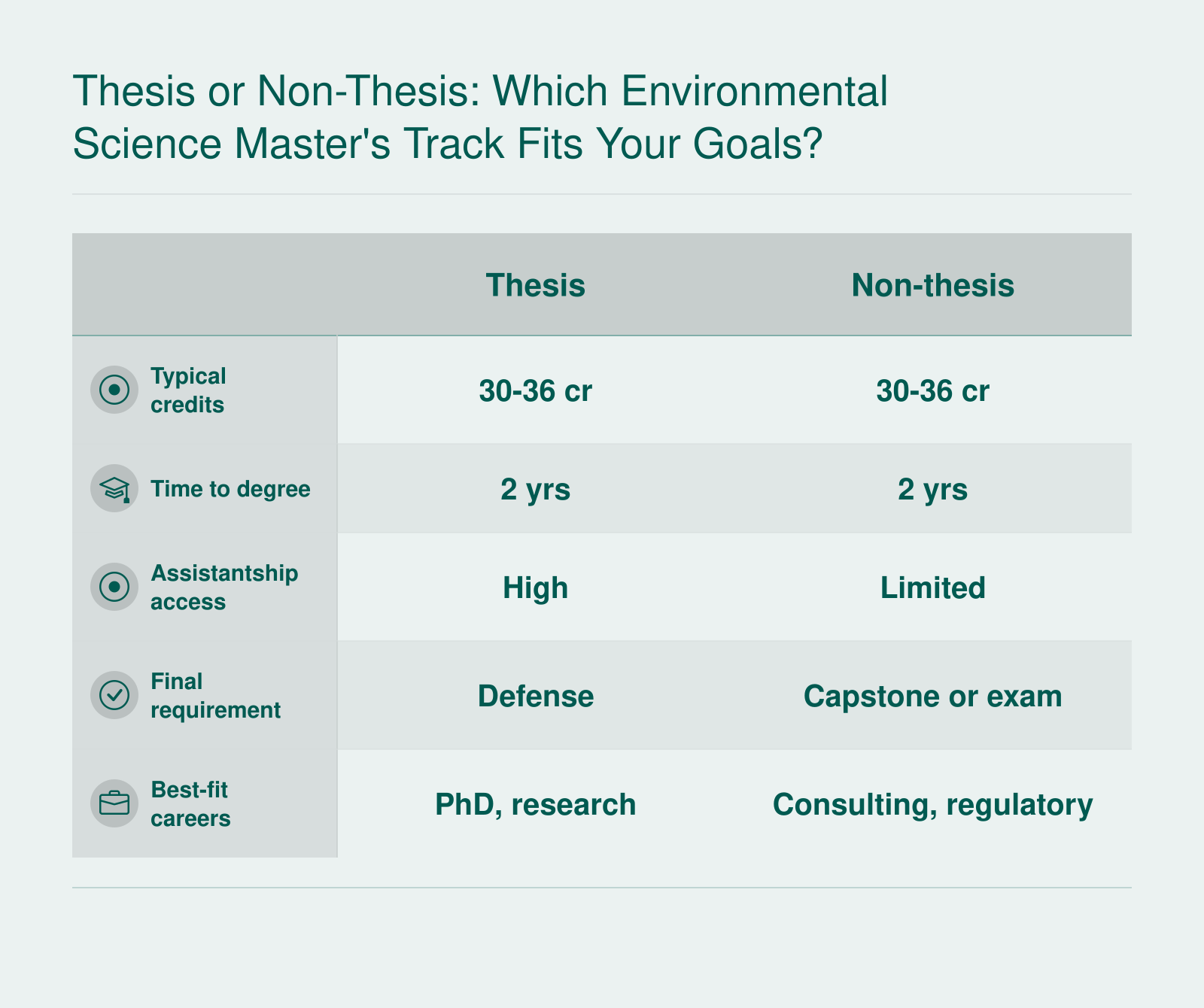
Thesis or Non-Thesis: Which Environmental Science Master's Track Fits Your Goals?
At Mississippi research universities, the thesis track is often the route to funded assistantships, while the non-thesis track prioritizes applied coursework. Use this side-by-side to weigh the tradeoff.
Compare Environmental Science programs on the data that matters
Explore more Science & Engineering specializations or browse every graduate field.
All Science & Engineering programs