Best Master's in Environmental Science Programs in North Carolina
Compare 14 accredited Environmental Science programs in North Carolina at 8 schools, with graduate earnings, cost, debt, and completion data from IPEDS and the U.S. College Scorecard.

Seventeen river basins, a long coastline, and a large public university network make North Carolina a working laboratory for environmental science. The ranked programs pair campus research at Duke, UNC Chapel Hill, and NC State with online options at NC State and UNC Greensboro; published in-state tuition spans $4,630 at Western Carolina to $68,758 at Duke.
That range makes cost an early filter, not the decisive one. GRE policies, thesis requirements, and graduate earnings differ sharply across the list, so the lower-priced program is not always the weaker bet.
Key Points
- NC State's Master of Environmental Assessment can be completed entirely online.
- Both UNC Chapel Hill options do not require the GRE for admission.
- North Carolina has no single required license, but Chapter 89F and 89E credentials need specific coursework.
Best Master's in Environmental Science Programs in North Carolina: 2027 Rankings
What separates North Carolina's top tier is a mix of research depth, format flexibility, and cost, and few schools lead on all three. The research universities in the Triangle offer the deepest science and the strongest graduation rates, while several UNC system campuses offer much lower graduate tuition and online options. The graduation rates below describe each school as a whole, not completion in the master's program itself.
Duke University
#1Durham, NC · ~$67,000/yr (est.)
Best for: Future environmental lawyers pursuing dual degrees
Duke's Master of Environmental Management is run with the Nicholas School of the Environment and is offered in Durham with several concentrations. The listed versions are paired with a JD, and students complete a master's project that commonly involves an outside industry, government, or nonprofit partner. Duke's institution-wide graduation rate is about 97%, but its graduate tuition is the highest in the state at roughly $65,000 a year. Students can also take selected courses at partner universities across North Carolina.
- Four-year dual degree with a JD
- Campus-based, no online option
- Master's project and internship opportunities
- Admission through separate law and environment applications
- Concentration in ecosystems science and conservation
- Curriculum blends science and policy
- Master's project required
- Concentration in ecotoxicology and environmental health
- Focus on environmental health science and policy
- Requires a bachelor's degree
University of North Carolina at Chapel Hill
#2Chapel Hill, NC · ~$13,000/yr (est.)
Best for: Research-minded students planning thesis work
UNC Chapel Hill's Master of Science in Environmental Sciences and Engineering sits in the Gillings School of Global Public Health and is built around research. It is thesis-based and combines environmental science with public health and epidemiology coursework. In-state graduate tuition is roughly $7,000, far below Duke, and the institution-wide graduation rate is about 91%.
- Campus-based with a required thesis
- 31 credit hours minimum
- Includes public health and epidemiology coursework
- Part of the Gillings School of Global Public Health
- Admission expects a science or engineering background
North Carolina State University at Raleigh
#3Raleigh, NC · $12,000 – $33,000/yr (est.)
Best for: Working professionals needing online flexibility
NC State offers both an online professional degree and a thesis-based campus degree in conservation science. The online Master of Environmental Assessment suits working professionals, while the on-campus fisheries, wildlife, and conservation biology degree serves research-focused students. The institution-wide graduation rate is about 85%, and in-state graduate tuition is under $10,000 before fees.
- 30 credit hours, fully online
- No GRE required
- 3.0 GPA expected for admission
- Professional project included
- Graduate certificate option
- Campus-based, thesis required
- 30 credit hours
- Interdisciplinary faculty supervision
- Applied research emphasis in conservation biology
University of North Carolina Wilmington
#4Wilmington, NC · $8,000 – $24,000/yr (est.)
UNC Wilmington's Master of Science in Environmental Sciences is a coastal-region program with several concentration paths. Its 33 credits include core work in field methods and applied research, ending in a practicum or final project. Graduate tuition is among the lower options in the state, and the institution-wide graduation rate is about 71%.
- 33 credit hours, campus-based
- Concentrations: coastal management, environmental education, environmental conservation
- Individualized study option
- 3.0 minimum GPA and three recommendations
- Practicum or final project plus capstone
- Fall and spring admission
University of North Carolina at Greensboro
#5Greensboro, NC · ~$9,000/yr (est.)
UNC Greensboro delivers its Master of Science in Sustainability and Environment fully online and asynchronously. Students choose among three concentrations and finish with an internship, capstone, or thesis. The institution-wide graduation rate is about 56%, and graduate tuition is modest for in-state students.
- 36 credit hours, online and asynchronous
- Internship, capstone, or thesis option
- Graduate certificates available
- Bachelor's degree required
- Concentration centered on equity and society
- Flexible course selection
- Concentration in ethics and aesthetics
- Customizable curriculum built around sustainability
Western Carolina University
#6Cullowhee, NC · ~$8,000/yr (est.)
Western Carolina's option is a Master of Science in Chemistry with an environmental chemistry concentration, so it suits students with a chemistry background. The program centers on chemicals in air, water, and soil and includes an environmental thesis. It has the lowest in-state graduate tuition on this list, about $4,600 before fees, and an institution-wide graduation rate near 60%.
- 30 semester hours, campus-based
- Thesis tied to an environmental topic
- Research areas include remediation and natural products
- Admission expects a bachelor's in chemistry or a related field
North Carolina A & T State University
#7Greensboro, NC · ~$8,000/yr (est.)
North Carolina A&T offers a Master of Science in Agricultural and Environmental Systems through its College of Agriculture and Environmental Sciences. The concentrations lean toward natural resources, agribusiness, and animal health rather than general environmental science. Admission expects strong science and math preparation, and the institution-wide graduation rate is about 57%.
- Campus-based, thesis or project required
- Math and science prerequisites
- Faculty-directed research
- Covers horticulture, agroecology, and remediation
- Focus on agribusiness management
- Emphasis on industry partnerships
- Sustainable agriculture focus
- Focus on animal health systems
- Includes genetics and nutrition
- Interdisciplinary research approach
University of North Carolina Asheville
#8Asheville, NC · $5,000 – $10,000/yr (est.)
UNC Asheville's Master of Science in Environmental Resilience is a new one-year climate-resilience degree that began in fall 2025. Students complete an internship and applied research project with Asheville-area community and governmental partners, working alongside UNC Asheville's National Environmental Modeling and Analysis Center. Published 2025-26 tuition and fees are about $11,068 in state and $32,831 out of state. The institution-wide graduation rate is about 54%.
- One-year, 30-credit campus program
- Courses in climate science, GIS, economics, and data visualization
- Required internship and applied research project
- Small cohort with community-engaged research
- 3.0 GPA and prerequisites in science, economics, statistics
Lenoir-Rhyne University
#9Hickory, NC · ~$13,000/yr (est.)
Lenoir-Rhyne offers a Master of Science in Sustainability Studies, an interdisciplinary degree that draws on science, business, and public policy. It suits career-changers and working professionals more than lab researchers. Graduate tuition is a flat private rate of about $12,400, and the institution-wide graduation rate is about 48%.
- 33 credit hours, campus-based, offered in Asheville
- Capstone project required
- Core courses in sustainability science, business, and public policy
- Experiential learning component
North Carolina Central University
#10Durham, NC · $5,000 – $10,000/yr (est.)
North Carolina Central University, a historically Black university in Durham, offers a campus Master of Science in Environmental and Geographic Sciences and an online environmental, earth, and geospatial sciences degree. Both emphasize GIS and remote sensing. In-state graduate tuition is under $5,000 before fees, and the institution-wide graduation rate is about 42%.
- 30 credits, campus-based
- Thesis and non-thesis options
- Comprehensive exam and internship opportunities
- Strengths in GIS, remote sensing, and environmental health
- 30-credit online program
- Asynchronous and synchronous options
- Capstone project required
- Full-time completion in three semesters
- GRE may be waived
Cost & outcomes by school
Federal data for the highest-earning Environmental Science programs, independent of the ranking above. Earnings are this field's master's graduates four years after completing, where the Scorecard reports them.
| School | Earnings | Tuition / yr | Debt | Grads/yr | Format |
|---|---|---|---|---|---|
| Duke University NC | $96,411 | $66,523 | $48,310 | 150 | Campus |
| University of North Carolina Wilmington NC | $53,362 | $8,112 | — | 10 | Campus |
| North Carolina Central University NC | — | $7,638 | — | — | Campus |
| Western Carolina University NC | — | $7,876 | — | — | Campus |
| University of North Carolina Asheville NC | — | $8,293 | — | — | Campus |
| North Carolina A & T State University NC | — | $8,368 | — | — | Campus |
| University of North Carolina at Chapel Hill NC | — | $12,751 | — | 26 | Campus |
| University of North Carolina at Greensboro NC | — | $8,614 | — | 8 | Online |
Sources: U.S. Department of Education. Tuition and graduates: IPEDS. Earnings and debt: College Scorecard, this field's master's graduates; a dash means no figure is reported.
Cost, debt & payoff
Median earnings of this field's master's graduates (4 yrs after completing) vs. their median federal loan debt · U.S. College Scorecard
Across these programs the median graduate earns about $96,411 and finishes with roughly $48,310 in debt — a ratio that clears a common rule of thumb (keep debt below first-year salary). Tuition and debt vary widely school to school, so check the per-school figures in the table above before you shortlist.
How We Ranked These North Carolina Master's in Environmental Science Programs
How do you confirm that a master's program in North Carolina in environmental science is STEM-designated and properly accredited? Work through these checks yourself before you apply.
- Verify STEM status: Look for the environmental science master's program's CIP code or a written STEM-designation statement on the program page and the university catalog. If neither shows it, ask the admissions office and the international student office directly, since STEM OPT eligibility is decided at the program level, not the department level.
- Confirm regional accreditation: Search the institution on the SACSCOC website, then cross-check the school's own accreditation page. SACSCOC is the regional accreditor for North Carolina institutions.
- Check specialized accreditation: Review the program website, the department handbook, and the relevant professional association. If accreditation is not stated plainly, email the program coordinator and ask.
- Ground the career side: Use BLS.gov for occupational outlook and wage context, then ask programs where their recent graduates actually landed.
Online and Hybrid Master's in Environmental Science Options in North Carolina
Flexibility usually costs you something: either field depth or face-to-face access to faculty. Among the schools here, three programs offer real flexibility, and each trades differently.
- NC State, Master of Environmental Assessment: Can be completed entirely online. It requires 30 credits, including a 6-credit professional project, and no residency, lab, or field course is listed.1
- UNC Greensboro's Master's in Sustainability and Environment M.S.: Fully online, finishable in as little as two years full-time, with part-time pacing available.2
- UNC Greensboro, Environmental Sciences (MSSE): Core courses are asynchronous online, but some electives are campus-only or synchronous. Part-time study is supported, and no residency is required.3
NC State's Master of Environmental Engineering (non-thesis track) lists on-campus, online, and hybrid delivery, though its evening and part-time options are unclear.4 UNC Chapel Hill's programs are residential. UNC Wilmington's published material does not establish online or part-time status, so ask the program directly.
Before applying, confirm each program's current page. If your path involves sampling or lab work, ask how the program handles it, since online tracks often cover those skills through projects or internships you arrange locally.
What a Master's in Environmental Science Costs in North Carolina
The table runs from the lowest to the highest average net price, an institution-wide average after aid, not a quote for any one student. Tuition figures are approximate annual amounts that shift with program, credit load, and fees. The in-state gap is large at the public schools: UNC Asheville charges about $11,068 in-state versus $32,831 out-of-state, and NC State shows a similar spread. North Carolina A & T State University and UNC Greensboro have the lowest net prices here, and Western Carolina University and North Carolina Central University have the lowest sticker tuition. Funding can cut these costs further: for 2026-2027, UNC-Chapel Hill lists minimum assistantship stipends of $8,651 per semester for terminal master's students, and eligible students may also receive in-state tuition awards or tuition remission. Confirm funding for your specific program directly with each school.
| School | In-State Tuition and Fees (approx. per year) | Out-of-State Tuition and Fees (approx. per year) | Average Net Price (institution-wide, after aid) | Median Program Debt |
|---|---|---|---|---|
| North Carolina A & T State University | $8,368 | $21,168 | $10,846 | N/A |
| University of North Carolina at Greensboro | $8,614 | $23,329 | $10,965 | N/A |
| University of North Carolina at Chapel Hill | $12,751 | $31,408 | $11,655 | N/A |
| University of North Carolina Asheville | $11,068 | $32,831 | $12,250 | N/A |
| Western Carolina University | $7,876 | $18,595 | $13,315 | N/A |
| North Carolina Central University | $7,638 | $20,946 | $15,359 | N/A |
| North Carolina State University at Raleigh | $12,101 | $32,874 | $17,303 | N/A |
| University of North Carolina Wilmington | $8,112 | $24,198 | $20,109 | N/A |
| Lenoir-Rhyne University | $13,020 (single rate) | $13,020 (single rate) | $20,689 | N/A |
| Duke University | $66,523 (single rate) | $66,523 (single rate) | $29,612 | $48,310 |
Which North Carolina Master's in Environmental Science Programs Waive or Make the GRE Optional
The difference between No-GRE master's programs and test-required tracks is a real dividing line among the programs here, and it changes how early you need to start planning.
- GRE not required: Both UNC Chapel Hill options, the Environmental Sciences and Engineering master's at the Gillings School and the Earth, Marine, and Environmental Sciences master's, have dropped the GRE.
- GRE recommended, not mandatory: North Carolina A&T encourages the GRE for its Agricultural and Environmental Systems master's but does not list it as required.2
- GRE required: Both North Carolina Central master's programs, Environmental, Earth and Geospatial Sciences and Earth Sciences, require scores no more than five years old.13
- No published policy: The remaining programs ranked here do not state a GRE policy on their admissions pages, so ask the department directly rather than assume.
Expect a science, math, or engineering bachelor's, strong undergraduate preparation (A&T specifies chemistry plus botany or plant science), recommendation letters, and a statement of purpose. Fall deadlines range from December at UNC Chapel Hill to June 1 at A&T and July 1 at NCCU. Confirm dates on the program page, since they shift each cycle.
Related Articles
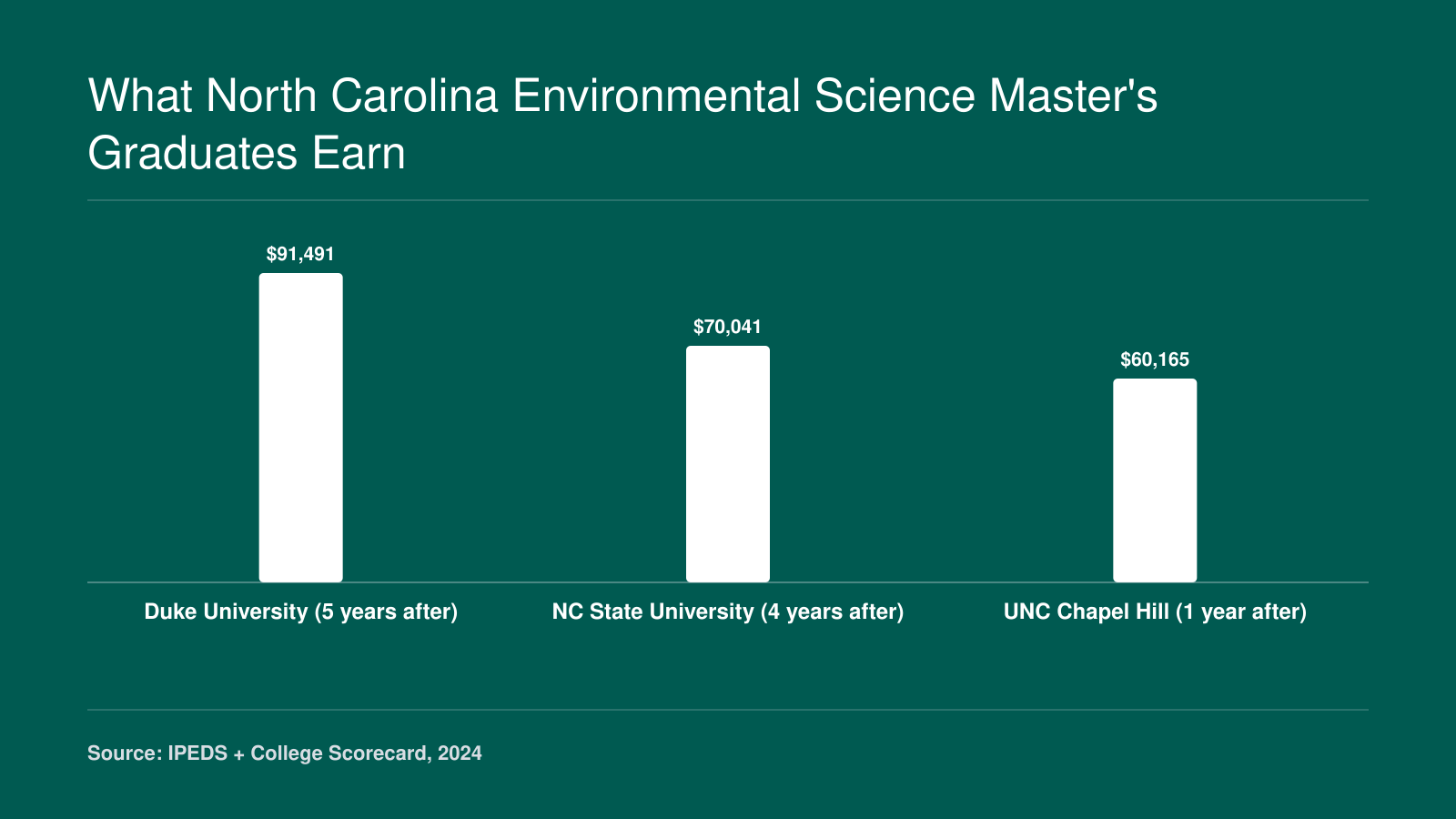
What North Carolina Environmental Science Master's Graduates Earn
Graduates commonly move into state environmental agencies, consulting firms, utilities, and conservation nonprofits. The chart shows median earnings for programs that publish program-level figures, and each label states the time window after completion. Where available, the share of graduates working one year after completion is a useful companion measure, so check it alongside pay.
North Carolina Licensure and Certification Pathways for Environmental Science Graduates
Thesis vs. Non-Thesis: Choosing Your Master's in Environmental Science Path
A thesis is an original research project, directed by a faculty mentor, that ends in a written study you defend; a non-thesis or capstone track swaps that research for additional coursework and an applied project. Which one you need depends on the program and your goals.
At the University of North Carolina at Chapel Hill, the Master of Science in Environmental Sciences and Engineering is thesis-based: students complete a master's thesis, and the published materials do not describe a separate non-thesis option. The degree runs a minimum of 30 to 31 semester hours depending on the catalog year, including at least 24 credits of formal coursework, and third-party listings put typical completion at about two years full-time.1 Credit totals and tracks at other programs on this list vary, so confirm each on the official graduate catalog before applying.
The choice tends to sort by destination. A thesis suits students aiming at a PhD or a research role at an agency, and it often pairs with a funded assistantship. A non-thesis or capstone path fits working professionals and consulting careers.
Our recommendation: choose the thesis if research is your goal, and the capstone if practice is.
Compare Environmental Science programs on the data that matters
Explore more Science & Engineering specializations or browse every graduate field.
All Science & Engineering programs