Master's Programs in Vermont
Every master's program reported by a school in Vermont: 100+ programs at 10 graduate schools, with the online options, costs and outcomes behind each one.

Vermont's public graduate options were reshuffled in 2023, when several state colleges consolidated into Vermont State University, leaving the state with one public research university in Burlington and one merged system covering most of the rest.
Smallness shapes the economics. Residency status moves tuition far more than reputation does, and much of the private-college graduate work here runs online, low-residency, or in summer sessions built around working teachers and clinicians.
The harder constraint is licensure. Counseling, social work, and nursing degrees carry supervised practice requirements after graduation, and pay in the first two trails business and nursing, so a convenient format can still mean a long, modestly paid runway to a full credential.
Key Points
- Residency status, not reputation, is the biggest lever on Vermont master's tuition.
- UVM's CACREP-accredited counseling programs require 700 hours of practicum and internship.
- Check accreditation, total cost, and format before you commit to any program.
Popular degrees in Vermont
Master's programs in Vermont by field
Business & Management
- Public Administration5 programs
- Marketing5 programs
- Analytics4 programs
- Healthcare Administration4 programs
- Accounting4 programs
- Organizational Leadership3 programs
- Project Management3 programs
- Healthcare Management2 programs
Education & Teaching
- Secondary Education3 programs
- Teaching3 programs
- Educational Leadership3 programs
- Special Education2 programs
- Art Education2 programs
- Curriculum & Instruction1 program
- Educational Technology or Instructional Design1 program
- Higher Education or Adult Education1 program
Nursing
- Nursing Education or Nurse Educator2 programs
- Psychiatric Mental Health Nurse Practitioner1 program
- Family Nurse Practitioner (FNP)1 program
- Adult Gerontology Acute Care Nurse Practitioner1 program
- Clinical Nurse Leader1 program
- Nurse Educator1 program
- Health/Nursing Informatics1 program
- Direct Entry MSN (MENP) or (DEMSN)1 program
Counseling
- Clinical Mental Health Counseling6 programs
- School Counseling2 programs
Healthcare
- Public Health2 programs
- Health Administration2 programs
- Speech Pathology1 program
- Nutrition1 program
- Clinical Research Management1 program
- Exercise Science1 program
Psychology
- Counseling Psychology4 programs
- Clinical Psychology2 programs
- General Psychology1 program
Communications & Media
- Speech Pathology3 programs
- Communication Disorders1 program
Computers & IT
- Cybersecurity2 programs
- Data Analytics1 program
- Information Security & Assurance1 program
Arts & Design
- Creative Writing2 programs
- Fine Arts2 programs
Social Work & Social Sciences
- Social Work2 programs
- Social Work Advanced Standing1 program
Criminal Justice & Law
- Legal Studies1 program
- Master of Laws1 program
What Vermont Master's Programs Cost: Tuition at UVM, Vermont State, and Private Colleges
Residency status, not reputation, is the biggest single lever on the total cost of a master's degree in Vermont. Two public universities roughly 40 miles apart charge nearly identical in-state rates and wildly different out-of-state rates, and that gap is worth more to your budget than any ranking.
Published per-credit graduate rates
- University of Vermont: $706 per credit in-state, $1,944 per credit out-of-state.
- Vermont State University: $708 per credit in-state, $911 per credit out-of-state.
- Norwich University (online graduate): most programs $725 per credit, with the MBA and some online MSN programs at $825 and cybersecurity at $850. A discounted all-graduate rate of $550 per credit also appears on Norwich's online tuition page.1
- Norwich University (campus): $961 per credit hour.2
Notice what is missing from the private and online-first entries: a second column. Norwich quotes one rate whether you live in Barre or Baton Rouge, which is typical of private and online-first graduate pricing in the state. Champlain College, Saint Michael's College, Vermont Law and Graduate School, and Middlebury's Bread Loaf School of English follow their own published schedules, and you should pull current figures directly from each bursar's office before building a budget.
Fees deserve their own line
UVM's comprehensive fee scales with enrollment and climbs steeply once you pass a part-time threshold: roughly $10 to $40 for one to four credits, then $495 at five credits, rising to $1,211 per semester at nine or more. Add a graduate student senate fee of $15 or $25 depending on load, and a continuous registration fee of $100 to $300 per semester if you are between active terms. Over a multi-year program, that is real money.
Norwich's online graduate fees run $75 per term for the library, $300 per term for technology ($350 for nursing), plus $22 per credit hour for its ACCESS service.1 On the residential side, Norwich lists basic health, technology, and activities fees at $3,760 for 2026-27.2
Multiply before you compare
Sticker rate per credit tells you almost nothing until you multiply it by the credits your program actually requires. A 30-credit master's at Vermont State's in-state rate of $708 comes to $21,240 in tuition. The same 30 credits at UVM's out-of-state rate of $1,944 comes to $58,320, a difference of more than $37,000 for the same credential length.
That math also reshuffles the public-private assumption. For a nonresident, Vermont State at $911 per credit ($27,330 for 30 credits) undercuts UVM's out-of-state rate by a wide margin, and Norwich's online programs at $725 per credit ($21,750 for 30 credits, plus about $660 in ACCESS fees and per-term charges) land in the same neighborhood as in-state public pricing.1
So the cheapest path usually comes down to three numbers: your residency, the per-credit rate, and the total credits required. A 36-credit program at a modest rate can easily cost more than a 30-credit program priced $100 higher per credit. Ask every admissions office for the credit total in writing, then do the multiplication yourself.
Online, Hybrid, Low-Residency, and On-Campus Options by School
The real choice in Vermont graduate study is not online versus on-campus so much as how often you need to be physically in the state. Some programs let you finish entirely from a laptop; others build around a summer or two in Vermont. Matching that rhythm to your work and family life matters more than any brochure.
A Format Matrix by School
| School | Primary formats | Typical length |
|---|---|---|
| University of Vermont | Online, hybrid, and on-campus depending on the program | 1, 2 years full-time; 2, 3 years part-time |
| Middlebury (Bread Loaf School of English) | Summer residential, mostly in person, limited online | Usually 4, 5 summers; up to 10 years allowed |
| Middlebury Language Schools | Summer and year-round, in Vermont, abroad, and online | Varies by language |
| Counseling and MSW tracks (statewide) | On-campus or hybrid with required in-person fieldwork | Often 2, 3 years for 60-credit programs |
At UVM, delivery varies by department. The master's in higher education and student affairs, for instance, mixes online, in-person, and hybrid courses so students can build a schedule that fits, while the Agroecology M.S. runs its required synchronous coursework online. Full-time UVM students generally finish in one to two years; part-time students run closer to two or three.
Middlebury's Quirks
Middlebury does not work like a standard commuter campus. The Bread Loaf School of English meets in summers, with students usually taking two units per term; most finish in four or five summers, and the school requires at least six of ten units in person and at least one summer on the Vermont campus.1 The Language Schools run in summer and year-round, in Vermont, abroad, and online, with delivery differing by language.2 One common point of confusion: the Middlebury Institute of International Studies is in Monterey, California, not Vermont, so it is not an option for anyone who specifically wants to study in state.
Three Takeaways
- Fully online fits working adults and out-of-state students who cannot relocate. Programs with synchronous or flexible online coursework let you keep a job while earning the credential.
- Low-residency and summer models fit teachers and seasonal workers. Bread Loaf's summer rhythm is built for educators who can commit a few weeks each year rather than full semesters.
- Licensure programs still pull you into Vermont. Counseling, campus-based MSW programs, and similar clinical tracks require supervised practicum or internship placements that must happen in person, usually at approved Vermont sites, even when lecture content is partly online. Budget time for that fieldwork before you assume a program is truly remote.
What You'll Need to Apply
Requirements vary by school and degree, but most Vermont master's applications ask for the same core materials. Confirm the details with each program before you start.
- Bachelor's degreeA degree from a regionally accredited institution is the baseline. Some programs also require prerequisite coursework or credentials, such as an active nursing license for MSN tracks.
- Minimum GPAA 3.0 is a common benchmark. Many programs review applications holistically, so work experience, a strong statement, or recent coursework can offset a lower GPA.
- Core application materialsExpect official transcripts from every college attended, two to three letters of recommendation, a statement of purpose, and a current resume.
- GREMany Vermont programs now make the GRE optional or don't require it. Policies differ by program, even within one university, so check each one.
- English proficiencyInternational applicants whose prior instruction wasn't in English typically submit TOEFL or IELTS scores. Minimum scores vary by program.
- Program-specific extrasCounseling programs often include an interview. MFA and English programs usually want a writing sample. Clinical and education programs commonly require background checks before placements begin.
Deadlines and GRE Policies at Vermont's Major Graduate Programs
Do UVM master's applicants still need to take the GRE, and when do Vermont programs actually close? The short answer: it depends on the department, and the deadlines that matter most are usually the early funding deadlines, not the final application cutoff.
UVM and the GRE: no single policy
UVM's Graduate College does not publish one university-wide GRE requirement for all master's programs. Whether the GRE is required, recommended, or waived is set at the program level. As a practical rule, clinical licensure tracks and research-heavy degrees are the most likely to still request or recommend scores, while many applied and professional programs have moved to test-optional or test-free admission. Because there is no centrally published list, check the program page before registering for the GRE, especially if you are targeting No-GRE master's programs.
Priority deadlines vs rolling admission
For on-campus programs that offer assistantships or scholarships, the deadline that matters is usually not the final one. Many Vermont graduate programs use January or February priority deadlines for funding consideration. Submit by that date if you want to be considered for a graduate assistantship or program scholarship. Applicants who meet the later final deadline may still be admitted, but the funded offers are often already allocated.
Online-first schools such as Norwich University and Champlain College Online, known for Online Master's Programs, are generally structured around rolling admission and multiple start terms throughout the year, rather than one annual deadline. That gives working students more flexibility, but it also means you should confirm current start dates directly, because term calendars shift.
Summer programs: Middlebury Bread Loaf
Middlebury's Bread Loaf School of English opens its application cycle in September or October for the following summer and reviews new applicants on a rolling basis from mid-December through mid-May.1 The 2026 cycle has closed; the summer 2027 application is expected to open in early fall 2026.1 Bread Loaf does not mention a GRE requirement, but it does require a bachelor's degree, two letters of reference, a statement of purpose, and a writing sample.2 The application fee is $75, and Middlebury undergraduates and alumni qualify for a waiver.2
Planning timeline
A simple rule works for most applicants: start 9 to 12 months before your target term if you want a funded on-campus program, so you can line up recommenders, take required tests once, and meet January or February priority deadlines. For rolling online programs, 2 to 3 months is usually enough if you already have transcripts and recommendations in hand.
Paying for It: Assistantships, Scholarships, and Employer Benefits
Paying for graduate school in Vermont usually means combining several funding sources rather than finding one award that covers everything. The right mix depends on whether the degree is research-focused or professional.
Graduate Assistantships at the University of Vermont
At UVM, a graduate assistantship can cover much of the core cost. The 2026-2027 minimum stipend is $25,781 for a nine-month appointment and $34,375 for a twelve-month appointment. The package also includes the single student health insurance premium, a tuition scholarship for up to 9 credits per semester, up to 5 summer credits, and the Comprehensive Fee scholarship. Some colleges pay above the minimum, so amounts vary. Tuition support excludes audited or physical education courses and most courses below the 5000 level except approved 3000- and 4000-level Graduate College courses; dependent health, dental, vision, and certain mandatory fees are not included.
Research-funded master's roles are more common in the sciences and engineering. In professional programs such as counseling, MBA programs, and M.Ed. programs, assistantships are scarcer, so applicants should treat them as possible but not guaranteed.
State Forgivable Loans and Federal Aid
VSAC offers workforce-specific forgivable loans that work like service awards. The Mental Health Professional Forgivable Loan covers up to 100% of tuition, with a maximum award of $17,628 in 20261, for eligible master's programs in social work, mental health counseling, Marriage & Family Therapy, psychology, community counseling, clinical mental health, and forensic mental health. It is interest-free and forgiven after one year of full-time Vermont mental health work per year of aid after licensure. VSAC's nursing workforce program, run with the Vermont Department of Health, covers up to full tuition and is forgiven through service obligations.2
For federal borrowing, graduate students can use the Direct Unsubsidized Loan up to $20,500 in 20263, and Grad PLUS loans can cover remaining costs after a credit review. VSAC's Vermont Advantage student loan is a separate option with rates from 4.49% to 6.75% and terms of 10 to 15 years4; it is not a forgivable workforce program.
Military, Employer, and Department Funding
Norwich University advertises reduced per-credit graduate military tuition for eligible military members, spouses, veterans, first responders, and some federal agencies in online master's programs. The rate varies by program and military status.5 Yellow Ribbon benefits apply automatically for students using the Post-9/11 GI Bill at the 100% rate when tuition exceeds the state cap; they do not apply to active-duty members, spouses, or veterans below 100%.6
Employer tuition assistance can close a significant gap, but rules vary by employer. Before applying, contact the graduate program directly about assistantships. Many UVM assistantships are filled through the department rather than a central portal, and asking early is the most reliable way to find funding.
Vermont Licensing at a Glance
Which Vermont Master's Degrees Lead to Licensure
The University of Vermont's counseling master's programs require 700 hours of practicum and internship and are CACREP-accredited through October 2029. That accreditation is the first thing to check in any licensure-track degree, because the program, not just the school, has to meet the profession's standard.
Counseling
UVM offers 60-credit School Counseling and Clinical Mental Health Counseling degrees, plus a 69-credit dual option that requires both internship sequences. School Counseling meets Vermont Department of Education requirements for K-12 school-counselor licensure. Clinical Mental Health Counseling meets the academic requirements of the Vermont Board of Allied Mental Health Practitioners for clinical mental health counselor licensure. CACREP status also tends to ease licensure when you move to another state. Post-degree requirements may still apply, so confirm them with the board. The sources reviewed identify UVM as Vermont's CACREP-accredited counseling provider.
Social Work, Nursing, and Education
- Social work: UVM says it hosts Vermont's only master's social work program. It is accredited by the Council on Social Work Education through February 2027. Ask about the next review before you enroll.
- Nursing: UVM's graduate nursing programs, including the Doctor of Nursing Practice and Clinical Nurse Leader, are CCNE-accredited and approved by the State of Vermont Board of Nursing. Confirm the accreditor for any other school's MSN or DNP track.
- Education: Vermont's traditional route to licensure runs through a state-approved educator preparation program, which can be a master's program, plus the institution's recommendation.1 Approval runs through ROPA, overseen by the Vermont Standards Board for Professional Educators.2 Ask a program whether it is approved for the specific license or endorsement you want.
A Warning for Online Students
An online degree from an out-of-state school may not satisfy Vermont's requirements, even when the school is regionally accredited. Every program should publish a professional licensure disclosure listing the states where it meets requirements. Find it, check that Vermont appears, and get the answer in writing if the page is vague.
Placements matter just as much. Practicum and internship sites usually have to be arranged in Vermont or your home state, even in online programs. Ask who secures the site, whether the program has existing partners near you, and whether a site supervisor holds the credential your board requires.
Before paying a deposit, confirm four things: the programmatic accreditor, the licensing board's current requirements, the state disclosure, and how placements are handled.
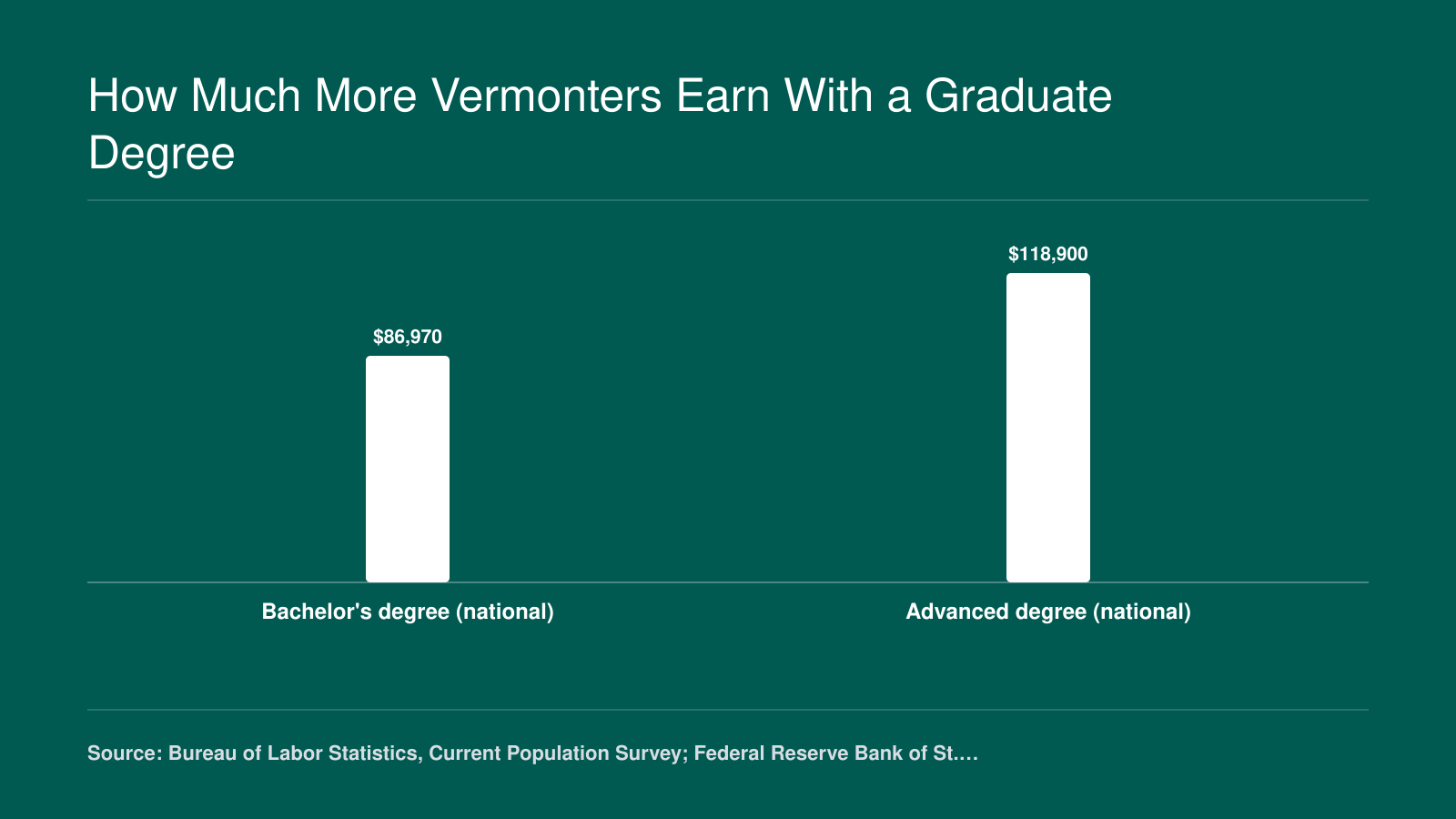
How Much More Vermonters Earn With a Graduate Degree
Current Census ACS median earnings for Vermont by degree level were not available when this page was published, so check the primary sources yourself. Start at data.census.gov (ACS table S1501 or B15003) for Vermont earnings by educational attainment, then use BLS.gov (OEWS and the Occupational Outlook Handbook) for Vermont wages by occupation and typical entry education. Ask career services at UVM, Vermont State University, and other graduate schools for program-level salary outcomes and alumni reports, and check professional associations for salary surveys. Then compare 3-5 Vermont job postings or O*NET and BLS wage estimates for your target role, and call program advisors for current local pay ranges. The national figures below give context only.
Career Outcomes for Vermont Master's Graduates
Vermont master's degrees pay off most clearly in business and nursing, and more modestly in social work and counseling, so the return depends heavily on the field you choose. The figures below come from two different data types, and they should not be mixed.
Graduate Earnings at UVM
The University of Vermont page on College Scorecard reports earnings by field of study. Treat the numbers below as approximate, because the secondary sources that republish them do not always make the cohort year or degree level clear.
- Business administration and management: about $83,600 median, based on 195 graduates.
- Registered nursing and nursing administration: about $78,700 median, based on 109 graduates. One other source puts master's-level nursing closer to $83,500, so read this as a range.
- Social work: about $54,700 in a non-official listing with no stated methodology. Confirm it against the Scorecard before relying on it.
I could not establish a reliable UVM master's earnings figure for education, so check the Scorecard directly for any M.Ed. you are considering.
What Vermont Employers Pay
These are wages for people in an occupation, not earnings for graduates of a particular program. For mental health counselors, the Bureau of Labor Statistics reported a May 2024 median of $66,230 a year ($31.84 an hour) in the Burlington-South Burlington area, with roughly 420 people employed.1 The national median for the broader counselor category was $65,100.2 Statewide Vermont median hourly wage for nurse practitioners was $64.78 in May 20242; education administrator medians were not available in the data I could verify, so look those up in the BLS wage tables before you build a budget.
The Labor-Market Reality
Demand is steady in healthcare, K-12 education, and mental health, and those fields drive most of the state's master's-level hiring. The private-sector market is smaller than in larger states, and much of it is concentrated around Burlington. Graduates in business or technical fields may have fewer local employers to choose from and sometimes look to neighboring states.
A Quick Value Read
Set these earnings against the tuition figures above. Nursing and business, especially the most affordable MBA programs, show the strongest pay relative to typical program costs. Social work and counseling pay less, but they lead to licensed, in-demand roles, so a lower-cost program or one with an assistantship matters more there. A reasonable rule of thumb is to avoid borrowing more for the degree than you expect to earn in your first year afterward.
Top-Paying Master's-Level Role in Vermont
How to Choose a Vermont Graduate Program
Choosing by brand or per-credit price is the fast route. Checking accreditation, total cost, format, and career fit is the reliable one, and it matters more in Vermont right now than in most states.
Start With Accreditation
Confirm institutional accreditation through the New England Commission of Higher Education (NECHE) before anything else. Check the school's NECHE institution page directly, because the status can change. Middlebury, Champlain, and Vermont State University are listed as members.123 Saint Michael's is also a member, but NECHE's September 2026 action issued a show cause for probation tied to institutional resources.45 The final outcome was not available when this was written, so ask the school where it stands. Vermont College of Fine Arts and Sterling College both had closure notifications accepted in April 2026.5 For licensure fields such as counseling, teaching, nursing, or law, also verify the specific programmatic accreditor. Vermont Law and Graduate School's ABA recognition is separate from its NECHE institutional accreditation.6
Compare Total Cost, Not Sticker Price
Multiply the per-credit rate by the credits required, add fees, then subtract funding you can realistically expect. A 60-credit counseling degree at a modest rate can cost more than a 36-credit degree at a higher one, so compare the clinical mental health counseling degree cost across programs before choosing. Assistantships and tuition remission often exist for on-campus students, and employer benefits can change the math for working professionals.
Match Format to Your Life
- On-campus: Best if you want an assistantship or research stipend.
- Online or hybrid: Suits working professionals who cannot relocate or step back from a job.
- Low-residency or summer: A traditional fit for teachers and writers pursuing best MFA programs who need intensive terms and flexible schedules.
Check Career Fit
Ask whether the program meets Vermont licensure requirements, how practicum or internship sites are arranged, and what graduate outcome data the school can share. Federal College Scorecard figures are a useful baseline, but program-level earnings are not published for every degree, so ask for placement and licensure pass rates directly.
Your Next Step
Shortlist two or three programs. Then email each admissions office before the priority deadline with four questions:
- Is the GRE waived or optional for my application?
- What funding is available, and how many students actually receive it?
- Does the program lead to Vermont licensure, and in what written disclosure?
- What is the school's current NECHE status?
The answers, and how quickly and clearly they arrive, will often settle the choice.
Graduate schools in Vermont with the most master's programs
| School | City | Type | Master's programs | Online | Grad tuition / yr |
|---|---|---|---|---|---|
| University of Vermont | Burlington | Public | 28 | 5 | $14,426 |
| Champlain College | Burlington | Private nonprofit | 26 | 25 | $10,710 |
| Vermont State University | Randolph | Public | 17 | 17 | $7,932 |
| Norwich University | Northfield | Private nonprofit | 15 | 15 | $25,056 |
| Saint Michael's College | Colchester | Private nonprofit | 9 | 2 | $13,400 |
| Bennington College | Bennington | Private nonprofit | 4 | 4 | $24,617 |
| Middlebury College | Middlebury | Private nonprofit | 3 | 0 | $15,210 |
| Vermont Law and Graduate School | South Royalton | Private nonprofit | 3 | 2 | $46,540 |
| Vermont College of Fine Arts | Montpelier | Private nonprofit | 2 | 1 | $26,593 |
| SIT Graduate Institute | Brattleboro | Private nonprofit | 1 | 0 | $45,445 |
Program counts are the verified master's listings in our directory; tuition is the school-wide average for a full-time graduate student (IPEDS).
Vermont Master's Programs: Common Questions
These answers cover the questions prospective students ask most often about time, tuition, Middlebury, and working while enrolled. Policies vary by school and program, so confirm details with the admissions office before you apply.
How long does a master's degree take in Vermont?
Do online master's programs from Vermont schools charge out-of-state tuition?
Are Middlebury College's graduate programs actually in Vermont?
Can I keep working full-time while earning a Vermont master's?
Compare programs nationwide
Many Vermont residents study online. Every ranked list above has an online lens, or browse every field.
Online master's programs Browse all fields