Most Affordable MBA Programs
Compare 5,400+ accredited most affordable MBA programs at 1,100+ schools, with graduate earnings, cost, debt, and completion data from IPEDS and the U.S. College Scorecard.

Total tuition for an MBA varies enormously. Baruch College's Executive MBA lists $86,500 over 22 months, while the University of Texas Rio Grande Valley lists $17,000 for a 12-month online business analytics MBA. The ten schools in our ranking sit at the low end, with in-state graduate tuition between $8,589 and $13,090.
Some of these programs offer supply chain management concentrations, though availability differs by campus and is worth confirming before you apply.
A low sticker price rarely settles the question. Fees, residency status, and program length can each shift the final bill by thousands of dollars.
Key Points
- Humphreys University charges every MBA student $11,286, with no residency gap.
- Cal State LA and Cal State San Bernardino charge out-of-state students the steepest premiums.
- Program-level MBA earnings and debt are unpublished, so verify accreditation and net price before enrolling.
Best Affordable MBA Schools: Top 10 Ranked for 2027
Affordable doesn't have to mean limited. These ten schools pair low in-state tuition and manageable net price with MBA tracks in supply chain, analytics, finance, and healthcare, so you can align cost with a concentration that actually moves your career.
Brigham Young University
#1Provo, UT · $5,000 – $10,000/yr (est.) · ASWB pass rate 97.9% (3-yr weighted avg)
Best for: Campus-based supply chain learners
Brigham Young University's Marriott School MBA emphasizes operations and supply chain management, with coursework in sourcing, logistics, distribution, and demand forecasting. Students can also pursue concentrations in finance, strategic human resources, and marketing, and an executive MBA is available in a hybrid format. The campus-based program includes hands-on projects and close faculty mentorship. The school has an institution-wide graduation rate of 94%.
- 5 concentration options
- Covers sourcing, logistics, and demand forecasting
- Prepares for supply chain manager roles
- Focuses on production-to-sales process
- Trains for vendor and customer relationships
- One of five concentration options
- 5 concentration options
- Rated #1 in Princeton Review 2024
- Prepares for HR leadership roles
- Focuses on data analytics in HR
- Builds organizational change management skills
- 8 concentration options
- Develops strategic marketing leaders
- Focus on product management
- Emphasis on understanding customer needs
- Prepares for roles in product and brand management
- 54 total credit hours
- Cohort-based structure
- Classes at BYU Salt Lake Center
- Every other weekend schedule
- Includes required foreign business excursion
- Entrance exams: GMAT and LSAT required
- Four-year joint degree program
- Careers in M&A, venture capital, private equity
- Lower debt burden compared to separate degrees
- Work experience requirement waived
Nebraska Wesleyan University
#2Lincoln, NE · ~$10,000/yr (est.) · ASWB pass rate 100% (2-yr weighted avg)
Best for: Working adults needing online analytics
Nebraska Wesleyan's online MBA with a Business Analytics specialization prepares working professionals to turn data into business decisions using SQL and Tableau. The program runs fully online in eight-week sessions, with no GMAT or GRE requirement, and includes monthly mentoring across two semesters. The school has an institution-wide graduation rate of 66%, and the MBA emphasizes small classes and real-world projects.
- 5 concentration options
- No entrance exam required
- Fully online in eight-week sessions
- Monthly mentoring for two semesters
- Hands-on SQL and Tableau training
- Bachelor's degree in any field accepted
- Real-world projects and case studies
The University of Texas at Austin
#3Austin, TX · ~$12,000/yr (est.) · ASWB pass rate 95.8% (3-yr weighted avg)
Best for: Texas residents seeking in-state tuition
The University of Texas at Austin offers a campus-based MBA with a supply chain and operations management concentration that covers logistics, procurement, operations strategy, and analytics. The McCombs School also provides finance, marketing, executive, and joint degree options, with strong industry connections and student organizations. The school has an institution-wide graduation rate of 89%.
- Prepares for supply chain analyst roles
- Covers logistics, procurement, and operations
- Consulting firms highly value skills
- Cross-functional curriculum
- Access to Operations Fellows and Graduate Operations Group
- AACSB accredited
- 6 concentration options
- Entrance exam: GMAT required
- 2-year full-time program
- STEM designation available
- 40% of job offers in finance
- AACSB accredited
- Top 10 Best MBA Marketing Program
- Access to industry leaders
- Real-world experience opportunities
- Top 20 Executive MBA program in the U.S.
- Six Executive MBA Immersions
- Global Immersion study tour
- One class weekend per month
- 117 total credit hours
- Dual degree in law and business
- First year at the Law School
- Both degrees awarded simultaneously
- No entrance exam required
- 41 total credit hours
- Exclusive to Dell Med students
- Healthcare industry focus
- CSWE accredited
- Earn MSSW and MBA
- Human service delivery systems focus
- Separate admission to each program
Utah Valley University
#4Orem, UT · $10,000 – $15,000/yr (est.) · ASWB pass rate 88.2% (3-yr weighted avg)
Utah Valley University's MBA Management Concentration offers strategic planning, financial analysis, and personnel management, with coursework in operations, marketing, and corporate finance. Students can complete the program full-time in one year or part-time in one to two years, and courses are available in person or online. The school has an institution-wide graduation rate of 45%, and the program includes an international consulting course.
- No entrance exam required
- Exams: GMAT and GRE optional
- Complete in 1-2 years
- Full-time MBA takes 1 year
- International consulting course included
- Operations and supply chain focus
- Project management focus
- Applied business research focus
Utah State University
#5Logan, UT · $8,000 – $25,000/yr (est.) · ASWB pass rate 89.5% (3-yr weighted avg)
Utah State University's Jon M. Huntsman MBA is a 36-credit online program priced at $1,000 per credit, with in-person executive MBA options also available. The curriculum emphasizes leadership, analytics, negotiation, brand and marketing, and data-driven decision-making. The school has an institution-wide graduation rate of 59%.
- 36 total credit hours
- $1,000 per credit
- Fully online option available
- Starts January 11, 2027
- Covers analytics and data-driven decision-making
- Negotiation skills practiced
- 6-semester program
- Financial aid available
- Designed for working executives
- One-night-a-week or Thursday evening schedule
- Leadership focus with ethical innovation
- Broadcast and face-to-face delivery
- Customizable curriculum
- Two degrees in two years
- Part-time track for working executives
- MMIS takes 12-16 months
- Cybersecurity certificate available
- Careers in proactive cyber defense
San Diego State University
#6San Diego, CA · ~$10,000/yr (est.) · ASWB pass rate 87.5% (3-yr weighted avg)
San Diego State University offers a full-time Sports Management MBA that runs 12 months in the classroom followed by a four-month supervised consultancy, with an international excursion to the Dominican Republic. The program requires no GMAT or GRE and charges the same tuition for in-state and out-of-state students. The university also offers a Health Services Administration concentration in its MBA. The school has an institution-wide graduation rate of 76%.
- No entrance exam required
- 12-month classroom phase
- 4-month supervised consultancy
- International excursion to Dominican Republic
- Same tuition for in-state and out-of-state
- 35-40 students per cohort
- 3 concentration options
- 2-year program
- 36 total credit hours
- Full-time and part-time options
- Consulting projects with real companies
- Ranked #32 Part-Time MBA Program (Public)
Portland State University
#7Portland, OR · ~$18,000/yr (est.) · ASWB pass rate 89.6% (3-yr weighted avg)
Portland State University offers a dual MBA/MS in Global Supply Chain Management that combines AACSB-accredited business training with online supply chain coursework covering data analytics, AI, and circular economy models. The Portland MBA is also available in flexible hybrid formats, and the school has an institution-wide graduation rate of 53%.
- 90 total credit hours
- Dual MBA and MSGSCM degree
- Online MSGSCM coursework
- Data analytics and AI focus
- Circular economy and restorative models
- International field study opportunities
- 21-month program
- 63 total credit hours
- Part-time enrollment
- Partnership with Oregon Health & Science University
- Top 1% AACSB-accredited business school
- Fully online option available
- Starts fall, winter, spring, summer
- Full-time MBA qualifies for F-1 visa
- Evening MBA for career accelerators
- Joint JD/MBA degree offered
- 4-year program
- 42 total credit hours
- Reduced tuition by approximately $21,000
- Sustainability and social impact emphasis
- Hands-on capstone consulting project
University of Utah
#8Salt Lake City, UT · $9,000 – $28,000/yr (est.) · ASWB pass rate 88.2% (3-yr weighted avg)
The University of Utah's Eccles School offers a hybrid Executive MBA with weekend classes, international trips, and a network of over 1,500 alumni leaders. The program is ranked #17 in the U.S. by the Financial Times and includes scholarship opportunities up to $7,000. The university has an institution-wide graduation rate of 65%.
- Scholarships available up to $7,000
- #17 in the U.S. by Financial Times
- International trips included
- Weekend class schedule
- 1,500+ alumni network
- 8-semester program
- Up to 12 law credits count toward MBA
- Up to 12 MBA credits count toward JD
- Separate applications to law and business schools
- Entrance exam: GMAT or GRE required
- 50 total credit hours
- Apply during third year of MD
- MBA integrated into fourth and fifth years
- 4-semester program
- IT Consulting or Management careers
- Computer Systems Analysis careers
- Integrates technology with business
University of Wisconsin-Madison
#9Madison, WI · ~$12,000/yr (est.) · ASWB pass rate 91.3% (3-yr weighted avg)
University of Wisconsin-Madison offers a full-time MBA in Supply Chain Management that is STEM-designated, ranks #9 in North America, and includes Six Sigma Yellow Belt certification and global trips. The university also provides finance, HR, marketing, and a flexible hybrid general management MBA. The school has an institution-wide graduation rate of 90%.
- 2-year program
- STEM designated
- Six Sigma Yellow Belt certification included
- Global trips to Norway and Japan
- $102,741 median earnings
- #9 supply chain program in North America
- SHRM accredited
- 52 total credit hours
- Ranked #2 Best Human Resources MBA
- Earn SHRM-CP credential eligibility
- $103,458 median earnings
- 84% job placement rate
- $111,322 median earnings
- Consult with real companies
- Access to Bloomberg Terminal
- Investment Banking pathway
- Courses in mergers and acquisitions
- Fixed income or derivatives electives
- Finance and Analytics Lab access
- Entrepreneurial Finance pathway
- Business Valuation course
- Applied Corporate Finance with consulting
- Capital IQ and FactSet access
- 2 concentration options
- 2-year program
- Top 4 Best Marketing MBA
- Company visits with senior executives
- Marketing Leadership Institute support
- Full-time MBA program
- Marketing Analytics and Insights specialization
- Campus-based delivery format
- Courses in marketing research and analytics
- Data visualization coursework
- Specialization in Technology Product Marketing
- On-campus delivery format
- Courses include Tech Product Marketing Management
- Applied learning opportunities
- Company visits and seminars
- Part-time, flexible 2-5 years
- 50% on-campus, 50% online
- 44 credit requirement
- 11 concentration options
- Evening and weekend classes
- Global Business immersive trip included
- Transfer up to 12 graduate credits
- 18-month program
- 32 total credit hours
- $86,400 total program tuition
- Hybrid course format
- Two week-long residences
- Work experience required
- 15 shared credits maximum
- Apply to both programs in same year
- MBA admission deferred one year
Idaho State University
#10Pocatello, ID · ~$12,000/yr (est.) · ASWB pass rate 87.9% (3-yr weighted avg)
Idaho State University's MBA offers accounting emphasis that prepares students for CPA and CMA exams, with nine total concentrations including finance and healthcare administration. The program is available full-time or part-time, with evening classes in Pocatello and online options, and requires GMAT or GRE scores. The school has an institution-wide graduation rate of 39%.
- 51 total credit hours
- Prepares for CPA and CMA exams
- Evening classes in Pocatello
- No GMAT required for master's holders
- AACSB accredited
- 8 concentration options
- Fully online option available
- 1-year program possible
- Starts fall, spring, summer
- Synchronous and asynchronous options
- Graduate assistantships available
- 8 concentration options
- Open to all academic backgrounds
- May waive MBA-Core I courses
- Blends coursework with practical application
Cost & outcomes by school
Federal data for the highest-earning MBA programs, independent of the ranking above. Earnings are this field's master's graduates four years after completing, where the Scorecard reports them.
| School | Earnings | Tuition / yr | Debt | Grads/yr | Format |
|---|---|---|---|---|---|
| Bakke Graduate University TX | — | $850 | — | 12 | Online |
| Nichols College MA | — | $1,200 | — | 260 | Online |
| Albright College PA | — | $1,540 | — | 96 | Online |
| University of the Cumberlands KY | — | $3,195 | — | 8,772 | Online or campus |
| Missouri Valley College MO | — | $3,870 | — | 24 | Online or campus |
| Columbia Southern University AL | — | $3,936 | — | 4,312 | Online |
| Georgia Southwestern State University GA | — | $4,626 | — | 760 | Online |
| Park University MO | — | $4,783 | — | 916 | Hybrid |
| Fort Hays State University KS | — | $4,949 | — | 1,544 | Campus |
| Southeastern Oklahoma State University OK | — | $5,220 | — | 2,478 | Online |
| University of West Georgia GA | — | $6,046 | — | 2,558 | Campus |
| Fitchburg State University MA | — | $6,246 | — | 2,418 | Online |
Sources: U.S. Department of Education. Tuition and graduates: IPEDS. Earnings and debt: College Scorecard, this field's master's graduates; a dash means no figure is reported.
How We Rank the Most Affordable MBA Schools
An MBA forces a tradeoff between what you pay now and what you earn later, so our ranking leads with the cost that actually lands on your bill, then filters for MBA programs that still deliver completion and earnings.
What We Look At
We start with published graduate tuition and required fees from federal IPEDS data, because sticker price is the most predictable piece. We then layer in average net price from College Scorecard, which reflects reported aid and gives a truer out-of-pocket estimate. Finally, we check program-level earnings and debt outcomes from Scorecard where available.
How Costs Are Weighted
Affordability carries the most weight. A program that is cheap but rarely graduates students or leaves graduates with weak earnings does not stay near the top for long. Financial aid, completion, and career outcomes are supporting factors that help separate otherwise similar price tags.
What to Keep in Mind
Graduation rates and net price cover the whole institution, not one MBA cohort. Your own cost will depend on residency, aid eligibility, and attendance pace, whether standard or Accelerated MBA Programs, so treat these figures as a comparison starting point, not a personal quote. Schools revise per-credit rates every year; confirm the current tuition and fee schedule directly before you commit.
True Cost Comparison: Tuition, Fees, and Net Price
Building a true cost comparison matters more than the sticker price. The table below shows annual in-state and out-of-state tuition and fees alongside the average net price for each school in the ranking. Several programs keep annual in-state costs below $10,000, and after grant aid the average net price falls below $5,000 at Baruch College and Cal State San Bernardino. So yes, an MBA can be completed for under $20,000 in tuition and fees at the low end, and the cheapest total published program cost we reviewed was $6,779.73 at HTC Agora (not shown in the table). Online learners should note that some programs, such as Eastern New Mexico University and Champlain College, charge a flat per-credit rate regardless of residency. For example, Champlain lists $595 per credit, or $450 per credit discounted, while Eastern New Mexico lists $317 per credit. Mandatory fees also add up: Texas Wesleyan University charges a $150 technology fee, University of St. Mary a $100 technology fee, and UT Chattanooga has a $36 technology fee, $25 library fee, and $168 online support fee.
| School | In-State Tuition & Fees | Out-of-State Tuition & Fees | Average Net Price | Format |
|---|---|---|---|---|
| Baruch College | 7464 | 15414 | 3033 | Hybrid |
| Cal State San Bernardino | 8093 | 20693 | 4564 | Campus |
| Eastern New Mexico University | 7194 | 9174 | 4904 | Online |
| Utah Valley University | 6507 | 18489 | 6376 | Hybrid |
| Portland State University | 11679 | 31074 | 9552 | Hybrid |
| Cal State San Marcos | 8082 | 20682 | 10229 | Campus |
| Weber State University | 6557 | 17545 | 10258 | Hybrid |
| Idaho State University | 8610 | 27720 | 12193 | Campus |
| San Francisco State University | 7950 | 20550 | 12278 | Campus |
| Northern Michigan University | 14277 | 19773 | 14085 | Campus |
The Residency Gap: In-State vs. Out-of-State MBA Tuition
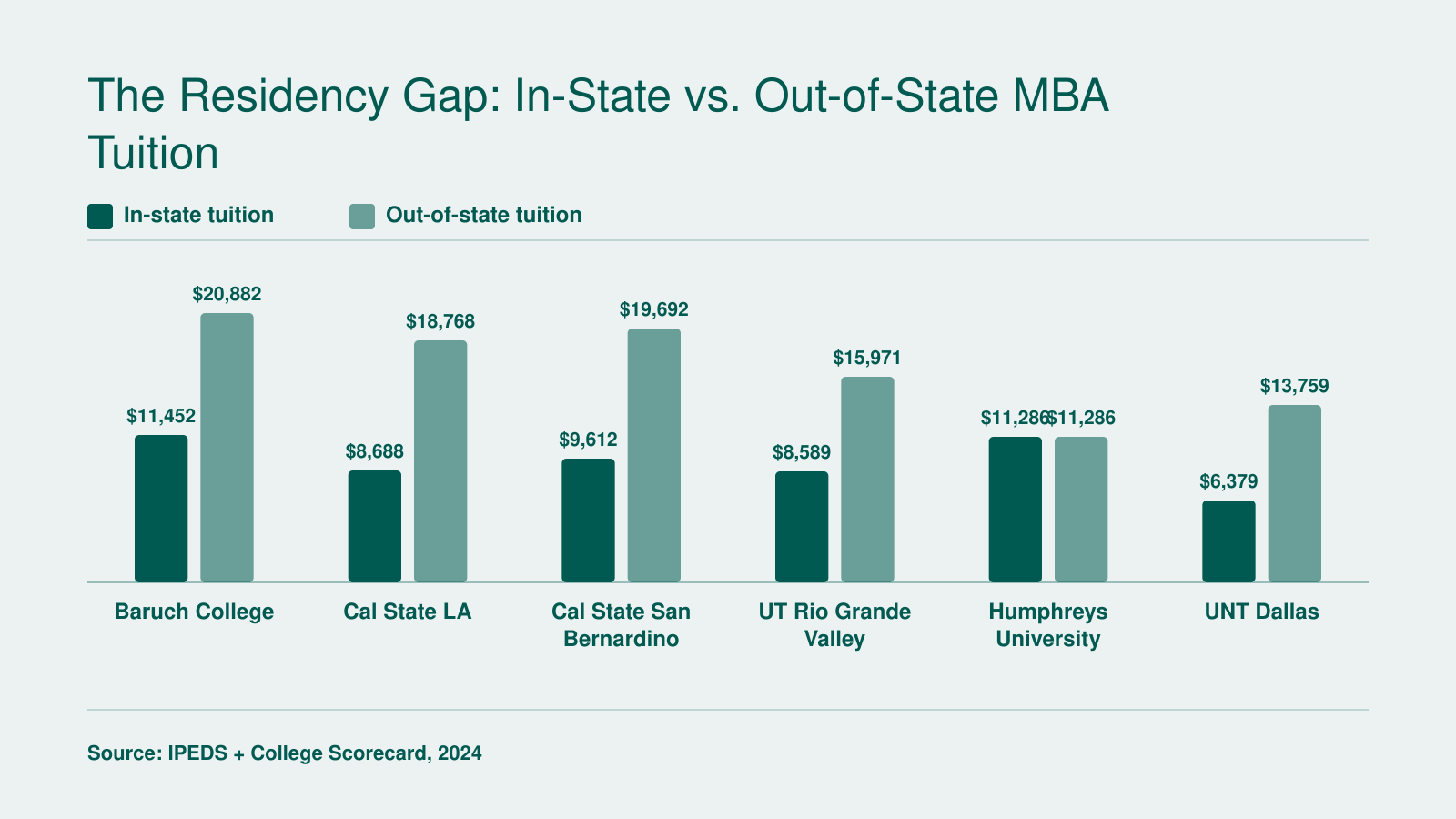
Residency can add thousands to an MBA bill at public universities. Humphreys University shows no gap at all, because the private school charges $11,286 to everyone. Cal State LA and Cal State San Bernardino penalize out-of-state students most, at $10,080 more each, followed by Baruch College at $9,430. UT Rio Grande Valley and UNT Dallas add about $7,400. Online formats can sidestep this premium where a school charges one rate regardless of location, so confirm the online price with each admissions office before assuming a discount.
Related Articles
Accreditation and Quality: AACSB, ACBSP, and IACBE Explained
Does an affordable MBA need AACSB accreditation to be worth the money? Not always, but a low sticker price with no business-school accreditation at all is a red flag.
The Three Business Accreditors
AACSB is the most selective and the one employers recognize most readily. ACBSP and IACBE put more weight on teaching quality and measurable student outcomes. All three review the business school itself, which is separate from the university's overall approval.
Institutional vs. Programmatic Accreditation
Institutional (regional) accreditation covers the whole university. It affects federal financial aid eligibility and whether credits transfer. Business-school accreditation is a second, programmatic layer that speaks to the MBA's curriculum and faculty. A cheap MBA should have both.
Where the Affordable Schools Stand
Among the lowest-cost programs we reviewed, AACSB accreditation is common. These schools are AACSB accredited:
- Texas A&M University-Corpus Christi
- Georgia Southwestern State University
- Fayetteville State University
- East Carolina University
- University of North Carolina at Pembroke
- Columbus State University
On our ranked list, Cal State LA, Cal State Fullerton, Cal State Fresno, and Cal State Northridge also describe their MBAs as AACSB accredited. Albany State University holds ACBSP accreditation. We could not confirm IACBE status for any school on the affordability lists, and we could not confirm which schools pair AACSB accreditation with a supply chain management MBA. Check each program page for that concentration before you apply.
How to Verify Status Yourself
Search the school by name in the AACSB, ACBSP, and IACBE member directories. Confirm that the business school is listed, not just the university, and note whether the listing covers the MBA. If a school claims accreditation and appears in none of the three, ask the admissions office to explain.
Do Employers Respect Affordable Online MBAs?
Generally, employers look at the school's name and its accreditation, and the diploma carries both. It does not carry the price you paid. An online MBA from an AACSB-accredited public university reads the same as the on-campus degree, which is why accreditation should come before cost when you narrow your list.
Career Outcomes and ROI: Which Cheap MBAs Pay Off Fastest
Which cheap MBA pays for itself fastest? For these ten programs, the honest answer is that program-level median earnings, median debt, and the 10-year monthly payment have not been published, so no one can rank them on verified MBA payback today. We won't fill that gap with guesses.
School Context, Not MBA Outcomes
Some institution-wide figures exist, but they describe each school's whole student population, not MBA graduates. Median earnings for former students about ten years after first enrolling run from $75,971 at Baruch College and $75,790 at Brigham Young to $71,588 at the University of Florida, $67,699 at UC Riverside, and $59,211 at Cal State LA. Median federal debt at those schools is $11,512, $11,069, $15,000, $17,500, and $13,000, respectively. Treat these as a read on the school's general value, nothing more.
Why Program Cost Drives Payback
When earnings data is missing, the price you pay is the one number you can verify. Published total program tuition varies widely:
- Beulah Heights University: $17,000 for a 14-month online MBA.
- University of Florida: $26,473 for the 22-month Full-Time MBA. The school reports a $124,783 average base salary and 87% job placement, though these are school-reported figures.
- Baruch College Executive MBA: $86,500 over 22 months. The school reports 75% of students promoted within two years.
Here is a hypothetical to show the logic. A $5,000 annual raise recovers $17,000 in about three and a half years, but $86,500 would take over 17 years. A low-cost program with modest debt can pay back faster even if the salary bump is smaller. An expensive program needs a much bigger jump, or an employer footing the bill, to compete.
What to Ask Before Enrolling
Request each program's own graduate salary report, the share of students borrowing, and typical loan balances. If a school can't provide them, weigh its total cost and your current salary more heavily than its brand.
Online vs. Hybrid vs. On-Campus: Affordable MBA Formats Compared
Affordable MBAs fall into three delivery patterns: fully asynchronous online, online with required live sessions, and hybrid programs with campus visits. Where a program lands changes your schedule more than your tuition bill. Some online programs also add distance-learning fees, so check the full cost line by line before you compare sticker prices.
| Factor | Fully asynchronous online | Online with live sessions | Hybrid with campus visits |
|---|---|---|---|
| Examples from our research | Nexford University and University of the People (no live lectures); WGU and SNHU (100% online) | Texas A&M International (weekly Wednesday evening sessions); Illinois Gies iMBA and UNC Kenan-Flagler (required weekly live classes) | Carnegie Mellon Tepper Online Hybrid MBA (periodic in-person Access Weekends) |
| Cost and fees | Often the lowest price tier. Confirm whether a distance-learning fee is added to tuition. | Pricing varies widely. Check for distance-learning or technology fees on top of tuition. | Tuition tends to be higher, and travel and lodging for campus weekends add to total cost. |
| Schedule flexibility | Highest. You complete coursework on your own time. | Moderate. Work is flexible, but you must be available at set weekly times. | Moderate. Online work is flexible, but you must plan around scheduled on-site dates. |
| Networking | Most limited. Peer contact happens mainly through discussion boards and projects. | Stronger. Weekly live classes give regular contact with faculty and classmates. | Strongest. In-person weekends build face-to-face relationships. |
| Residency requirements | None at WGU, SNHU, and Nexford. | No campus residency noted for the programs we reviewed, but live attendance is required. | Yes. Tepper requires periodic on-site Access Weekends. |
| Pace options | Typically the most self-paced, which suits students who want to move faster or slower. | Pace follows the course calendar, so progress is more structured. | Pace follows a cohort schedule built around campus events. |
| Best fit | Full-time workers with unpredictable hours who want the lowest cost. | Students who want accountability and faculty interaction without relocating. | Students who value in-person networking and can budget for travel. |
MBA programs by state
Frequently Asked Questions About Affordable MBA Programs
Cost, test requirements, and aid rules vary by school, so confirm details with each admissions office before you apply. The answers below draw on published program criteria and the most recent figures we reviewed.
Can I get an MBA for under $20,000?
Do affordable MBA programs waive the GMAT or GRE?
What scholarships and financial aid can lower the cost of an affordable MBA?
What are the most affordable MBA programs for international students?
Compare MBA programs on the data that matters
Explore more MBA specializations or browse every graduate field.
All MBA programs