Master's Programs in Wisconsin
Every master's program reported by a school in Wisconsin: 730+ programs at 30+ graduate schools, with the online options, costs and outcomes behind each one.

How much does a master's degree actually cost in Wisconsin, and will it lead to a state credential? Those two questions decide most applications. The price gap is wide: UW Extended Campus bills its online MS in Sustainable Management at $750 per credit flat, while resident and nonresident rates at a flagship department can differ by thousands, and some programs charge a premium tuition on top.
Add the online-versus-on-campus choice and the licensing question, and the tradeoffs compound. A clinical mental health counseling degree answers to the DSPS; a school counseling or school psychology degree answers to the DPI. Enroll in the wrong program and the credential you want never arrives. Verifiable tuition, deadlines, and licensure pathways matter more here than reputation.
Key Points
- UW Extended Campus charges $750 per credit online, regardless of Wisconsin residency.
- UW-Madison assistantships at 33% or more generally trigger tuition remission.
- Counselor and school psychologist licenses run through DPI, so confirm program approval before enrolling.
Popular degrees in Wisconsin
Master's programs in Wisconsin by field
Business & Management
- Healthcare Administration25 programs
- Management22 programs
- Analytics22 programs
- Finance21 programs
- Accounting17 programs
- Healthcare Management16 programs
- Marketing16 programs
- General Business14 programs
Nursing
- RN to MSN14 programs
- Psychiatric Mental Health Nurse Practitioner11 programs
- Nursing Education or Nurse Educator10 programs
- Nurse Administrator10 programs
- Direct Entry MSN (MENP) or (DEMSN)9 programs
- Family Nurse Practitioner (FNP)9 programs
- Public Health8 programs
- Adult Gerontology Primary Care Nurse Practitioner6 programs
Education & Teaching
- Special Education13 programs
- Educational Leadership11 programs
- Reading & Literacy11 programs
- Library Science or Library and Information Science or Library Media10 programs
- Teaching9 programs
- Elementary Education7 programs
- Curriculum & Instruction6 programs
- Higher Education or Adult Education6 programs
Psychology
- Counseling Psychology15 programs
- Educational Psychology or School Psychology11 programs
- School Psychology6 programs
- General Psychology3 programs
- Sports Psychology3 programs
- Industrial Organizational Psychology2 programs
- Health Psychology2 programs
- Forensic Psychology1 program
Healthcare
- Health Administration14 programs
- Speech Pathology10 programs
- Public Health9 programs
- Health Informatics6 programs
- Exercise Science4 programs
- Health Education2 programs
Communications & Media
- Communication Disorders13 programs
- Speech Pathology13 programs
- Communication7 programs
- Media Communication2 programs
- Public Relations2 programs
- Journalism1 program
- Strategic Communication1 program
- Social Media1 program
Counseling
- Clinical Mental Health Counseling18 programs
- School Counseling11 programs
- Marriage and Family Therapy or Marriage and Family Counseling3 programs
- Addiction Counseling3 programs
- Christian Counseling1 program
Social Work & Social Sciences
- Social Work16 programs
- Social Work Advanced Standing10 programs
- Human Services3 programs
- Sociology3 programs
- Political Science, Government3 programs
Computers & IT
- Information Security & Assurance8 programs
- Cybersecurity6 programs
- Data Analytics6 programs
- Machine Learning5 programs
Science & Engineering
- Sustainability or Environmental Management10 programs
- Environmental Science4 programs
- Geography2 programs
Religion & Theology
- Theology5 programs
- Divinity4 programs
- Christian Leadership1 program
- Urban Ministry1 program
- Christian Ministry1 program
Arts & Design
- Creative Writing4 programs
- Fine Arts2 programs
What Does a Master's Degree Cost in Wisconsin?
The cost question in Wisconsin is rarely public versus private. It is resident versus nonresident, and whether your specific program bills at the standard graduate rate or a premium one. Two students in the same building can pay very different amounts for the same number of credits.
Published 2025-26 graduate rates
These are the rates each school published for the 2025-26 academic year. Tuition is quoted separately from segregated fees, course fees, and distance education fees, so budget above these numbers rather than at them.
- UW-Madison: $10,728 per year for Wisconsin residents and $24,054 per year for nonresidents at the standard graduate rate.1
- UW-Milwaukee: $12,728 per year for residents and $33,261 per year for nonresidents, the widest resident/nonresident gap among the public options here.2
- UW-Whitewater: $539.95 per credit, with Minnesota reciprocity students billed an additional $194.34 per credit on top of that base. Whitewater notes that course and distance education fees may apply on top.
- Marquette University: billed per credit hour with no resident discount, since it is private. Marquette's schedules list roughly $1,400 to $1,450 per credit for the Graduate School, $1,400 for the Graduate School of Management, about $1,045 to $1,080 for education graduate programs, and a lower humanities rate in the $500 to $625 range.34
Smaller UW campuses generally bill per credit rather than per year, which makes part-time study easier to price but harder to compare against an annual figure. Check the bursar page for the specific campus and academic year before you build a budget.
What is the cheapest master's program in Wisconsin?
The lowest sticker prices sit at the UW regional campuses, where per-credit rates in the mid-$500s mean a 30-credit master's lands in the mid-teens in total tuition for a resident. Several affordable online master's programs across the UW system also run a flat per-credit rate that applies regardless of residency, which can make an online degree cheaper for an out-of-state student than any on-campus seat.
Sticker price is not net price. Assistantships, tuition remission, employer reimbursement, and departmental awards routinely cut the published figure, and they are distributed unevenly by field. A funded assistantship at UW-Madison can cost a resident less out of pocket than paying full freight at a regional campus.
Professional programs carry a premium
MBA programs, nursing, engineering, and some health science programs frequently charge differential tuition above the standard graduate rate. Marquette's online MBA, for instance, bills at the full management rate rather than a discounted online one. Never assume the graduate school's base number applies to your program. Find the rate your department publishes, then multiply by the credit total in the curriculum guide.
Online, Hybrid, and On-Campus Formats in Wisconsin
UW Extended Campus charges $750 per credit for its online MS in Sustainable Management, or $25,500 over 34 credits, and the rate is the same for Wisconsin residents and nonresidents. That program is 100% online, and it is one of several fully online master's options in the state.
Fully Online Options Exist
Other UW Extended Campus master's programs delivered online include Information Technology Management and Cybersecurity at $850 per credit, and Applied Biotechnology at $875 per credit ($27,125 for 31 credits). UW-Madison offers online degrees too, including the iSchool's MA in Library and Information Studies ($850 per credit) and MS in Information ($1,100 per credit)1, plus a part-time online MS in Data, Insights, and Analytics. UW-Milwaukee lists its online graduate programs, including online MPH programs, in its online program finder.2
What "Online" Actually Means
Published program pages do not state a single format across these schools, so confirm each one directly. Asynchronous courses let you work through material on your own schedule within weekly deadlines. Synchronous courses meet live at set times. Some programs add a campus residency or immersion, and health, education, and MSW programs typically require in-person clinicals, practicums, or internships even when coursework is online. Ask admissions where and when those hours must be completed.
How Long It Takes
Full-time study usually takes 1.5 to 2 years. Part-time schedules for working adults often run longer; UW-Madison's online Data, Insights, and Analytics master's is typically two years part-time. Shorter paths exist: UW-Madison's specialized business master's programs range from 6 months to 2 years, with most taking one year, and the Agricultural and Applied Economics Professional MS takes 15 months3. A true 12-month master's is not offered everywhere, so verify the completion time for the specific program.
When Online Tuition Is Flat
Flat per-credit pricing applies to the UW Extended Campus programs above, the UW-Madison iSchool programs, and UW-Milwaukee's online MPH, which lists no extra fees.2 It is not universal. Some UW-Madison professional degrees list $670.47 per credit for residents and $1,503.40 for nonresidents.3 At the iSchool, the per-credit rate does not fall when you take heavier loads.1 Extended Campus pages list no technology or program fees, but textbooks are billed separately.
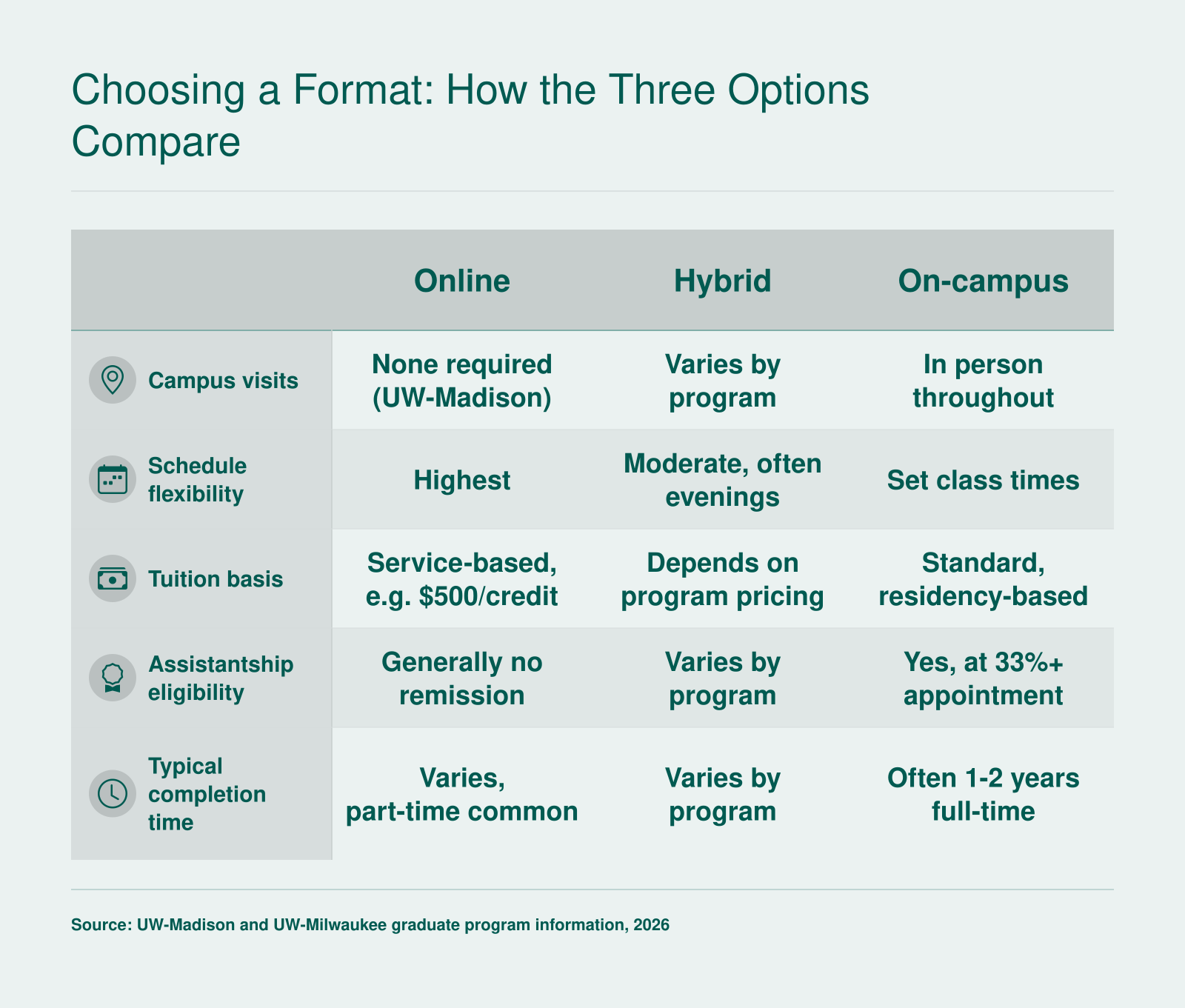
Choosing a Format: How the Three Options Compare
Format affects more than your schedule in Wisconsin. It can change how you are billed and whether you qualify for an assistantship with tuition remission. Rules vary by program, so treat this as a starting point and confirm details with each program.
Admissions: GPA, GRE, and Application Deadlines
Wisconsin admissions are decided program by program, so the university-wide numbers only get you started.
What GPA Do You Need?
The UW-Madison Graduate School generally expects at least a 3.00 undergraduate GPA, typically calculated over your last 60 semester credits. Individual programs can set a higher bar, and clearing the minimum does not guarantee an offer. Many programs will consider applicants below the line, sometimes with conditional admission, but you should confirm this with the program directly. The published sources do not say whether the figure changed for 2026, so check the Graduate School's current requirements before you apply.
Do Wisconsin Master's Programs Require the GRE?
There is no single rule. At UW-Madison, departments decide whether the GRE is required, optional, or not considered at all. UW-Milwaukee works the same way: each program sets its own policy, so some are No-GRE master's programs and others still require or accept the exam. The undergraduate test-optional policy you may have read about covers the SAT and ACT, not graduate testing. Treat the program's own admissions page as the final word, and do not spend money on a test until you have read it.
Deadlines: Program-Set at UW-Madison
UW-Madison does not publish one master's deadline. Patterns include:
- Early December: common for competitive programs and applicants seeking funding consideration.
- January to February: a large middle group of programs.
- March to April, or rolling: typical of some professional programs and Online Master's Programs.
International and domestic deadlines can differ, and so can funding deadlines. If you need an assistantship or fellowship, aim for the earliest date listed. Private universities in the state more often review applications on a rolling basis, which gives you more flexibility but can mean fewer open seats later in the cycle.
Acceptance Rate in Context
For fall 2025, the UW-Madison Graduate School admitted 23.3% of applicants, and 39.5% of those admitted enrolled. That is the most recent official graduate-level figure. Do not confuse it with the undergraduate rate, or with unofficial estimates that run higher. It is also an institution-wide average. A small, research-heavy program may admit a far smaller share, while a professional or online program may admit a much larger one. Use the 23.3% as a backdrop, then look for the selectivity of the specific program you want.
Funding Your Wisconsin Graduate Degree
Assistantships: What the Appointment Percentage Means
At UW-Madison, a teaching, project, or research assistantship at 33% or more generally triggers tuition remission.1 For 2026-27, the published stipend for a 50% appointment is $30,614 for teaching assistants, and $30,614 to $37,417 for project and research assistants, depending on the role.2 Lecturer and student assistants start at $33,574.2 Assistants at 33% or more are also eligible for health and dental coverage if the appointment runs a full semester (academic-year) or six months (annual).3 The coverage is not necessarily free, since assistants pay a premium. Segregated fees, listed at $726 per semester, are still billed to the student.1
UW-Milwaukee's 2026 graduate assistant handbook lists a minimum stipend of $29,547.4 The 33% rule is stricter there: a single appointment must reach 33% on its own, because separate appointments cannot be combined.4 Below that line you receive a stipend but owe tuition. Qualifying assistants may receive health insurance, with a biweekly premium deducted from pay.5
One caution: Madison excludes programs with service-based pricing, including many online programs and Accelerated Master's Programs, from tuition remission even when the appointment is above 33%.1
Fellowships and Departmental Awards
The Advanced Opportunity Fellowship at UW-Madison has published stipends of $29,157 to $35,636, though those figures may not match the central 2026-27 fellowship minimums, so confirm the amount with your department.6 The Advanced Opportunity Program at UW-Milwaukee is open to master's and doctoral students and is renewable for up to two years at the master's level. Eligibility changed on June 18, 2026: the Universities of Wisconsin can no longer use the earlier race and ethnicity criteria for new awards. The fellowships now go to disadvantaged graduate students who are U.S. citizens or permanent residents, with preference for qualified Wisconsin residents.7 Offers made before that date for 2026-27 are being honored. Departments also run their own awards, so check each program's funding page.
When Assistantships Are Scarce
Many professional and online master's programs offer few assistantships. If you are in one, plan around:
- Employer tuition reimbursement: Get the annual cap and any repayment terms in writing before you enroll.
- Federal loans: Direct Unsubsidized loans remain the baseline. Grad PLUS has been phased out for most new borrowers beginning July 2026, so confirm current limits with the financial aid office.
A Practical Tip
Ask about funding before you apply, not after you are admitted. Email the program coordinator and ask what share of master's students receive assistantships, when appointments are made, and whether fellowship nominations happen at admission. The answers can change which programs belong on your list.
Which Wisconsin Master's Degrees Lead to Licensure
Wisconsin splits master's-level licensure between two agencies: the Department of Safety and Professional Services (DSPS) for clinical professions and the Department of Public Instruction (DPI) for school roles. Match the program to the credential you want before you enroll, because a program without the required accreditation or DPI approval can block licensure. Details we could not confirm from official sources are marked, so check them with the licensing body. Advanced practice nursing is licensed through the Board of Nursing and is not detailed in the table.
| Master's Field | Wisconsin Credential | Licensing Body | Required Program Accreditation | Post-Degree Requirements |
|---|---|---|---|---|
| Counseling | Licensed Professional Counselor (LPC) | DSPS, Marriage and Family Therapy, Professional Counseling and Social Work Examining Board | CACREP is the common national benchmark; confirm the board's current education requirements | 3,000 hours of supervised professional counseling practice, including 1,000 hours of face-to-face client contact; National Exam required for full licensure |
| Social Work | Licensed Clinical Social Worker (LCSW) | DSPS, Marriage and Family Therapy, Professional Counseling and Social Work Examining Board | Not confirmed in our sources; confirm with the board | Not confirmed in our sources; confirm supervised hours and exam with the board |
| Marriage and Family Therapy | Marriage and Family Therapist (MFT) | DSPS, Marriage and Family Therapy, Professional Counseling and Social Work Examining Board | Not confirmed in our sources; confirm with the board | Not confirmed in our sources; confirm supervised hours and exam with the board |
| School Counseling | Wisconsin Initial Educator License, School Counselor (PK-12) | DPI | Wisconsin DPI-approved preparation program | Complete a master's degree with specialized coursework and practicum or internship in school counseling, finish all approved pupil-services licensure program requirements, and apply through the ELO System |
| Educational Leadership | Wisconsin Principal license (principal or assistant principal at the building level, K-12) | DPI | Not confirmed in our sources; choose a DPI-approved preparation program | Not confirmed in our sources; confirm degree and experience requirements with DPI |
| Speech-Language Pathology (school setting) | Wisconsin school-based speech-language pathologist credential | DPI | Not confirmed in our sources; confirm with DPI | Not confirmed in our sources; confirm supervised hours and exams with DPI |
Wisconsin Educator Licensing Through DPI
Checking Programmatic Accreditation, Not Just the University's
A university's accreditation is easy to confirm, but it says little about whether your specific master's degree will satisfy a licensing board or employer. The two checks answer different questions.
Institutional vs. Program-Level
Wisconsin universities are accredited institutionally by the Higher Learning Commission (HLC). Recent actions reaffirmed UW-La Crosse and Herzing University in August 20261 and UW-Stout in February 2026.2 That status covers the institution, not every degree it offers, so confirm each school in the HLC directory.
Program accreditors vary by field:
- Business: AACSB, which generally applies to the business school, so confirm your MBA or MS sits inside it. UW-Madison and UW-Milwaukee are both listed.34
- Engineering: ABET.
- Nursing: CCNE or ACEN. UW-Milwaukee's CCNE listing covers its BS in Nursing5, so don't assume the same listing covers MSN programs.
- Social work: CSWE.
- Counseling: CACREP.
- Education: CAEP, which accredits many M.Ed. programs.
How to Verify Status
The CHEA database shows which accreditors are recognized, but that alone doesn't prove your program is accredited. Search the accreditor's own directory for the exact campus and degree title.
Then read the status carefully. CSWE separates full accreditation from candidacy. UW-Milwaukee's MSW is accredited, with its next review in June 2031.6 UW-Stevens Point's MSW is in candidacy, with review due October 2026.6 Mount Mary University's online MSW is in candidacy, with review due February 2027. Candidacy is not full accreditation, so ask how the school handles graduates admitted during that period.
Watch the Marketing Language
A page advertising "accredited masters programs in wisconsin" may mean only the institution. Look for the accreditor's name, the program's exact title, and a review date. If a directory and a school page disagree, trust the directory and ask admissions to explain.
Career Outcomes and Return on Investment
Return on investment for a master's degree is the gap between what the degree costs you and the extra income it produces over time. In Wisconsin that gap varies a lot by field, and the published data has limits worth knowing before you lean on it.
What Graduates Earn After Finishing
College Scorecard reports earnings by institution and field category, not always by the exact degree you are considering. Treat these figures as directional.
- MBA: A Wisconsin MBA earnings compilation puts one-year median earnings near $117,734 for Marquette graduates and $71,460 for UW-Milwaukee.1 That is a wide spread for the same degree title. UW-Madison's College Scorecard field-of-study earnings figure is $119,655, but it does not tell you what an MBA graduate earns.2
- Social work: UW-Madison social work graduates show one-year median earnings of $37,264 with median debt of $26,140. Those figures reflect UW-Madison's social work field and may include more than master's-level completers.
- Nursing: Wisconsin psychiatric and mental-health nursing graduates report $71,623 one year out, with $25,750 in median debt.1 Program-level figures for Marquette's MSN were not available to us.
What Established Professionals Earn
Bureau of Labor Statistics data for May 2025 shows where these careers can lead. Nurse practitioners in Wisconsin earn a median of $131,980 across roughly 5,160 jobs. Healthcare social workers earn $66,910 (about 3,770 jobs). Mental health and substance abuse social workers earn $61,860. We could not confirm a Wisconsin median for mental health counselors or education administrators, so check the BLS directly for those.
Note the difference between a graduate's first-year pay and a seasoned worker's median. The first is where you start, and the second is closer to where you may be after several years.
Simple Payback Math
Compare total cost, including lost income if you study full time, against the annual raise the degree produces. As an illustration, a $26,000 program that raises your pay by $10,000 a year pays back in under three years. The same program with a $3,000 raise takes nearly nine.
Where the Premium Is Thin
Social work, Marriage & Family Therapy, and school-based roles often have modest pay gains, since salaries are set by agency budgets or district schedules. In those fields the degree is often valued mainly because it opens licensure, not because it raises pay sharply. Nurse practitioner and top-tier MBA in Finance paths show larger premiums, but they also tend to cost more, so run the numbers for each program you are weighing.
Nurse Practitioner Pay in Wisconsin
Nurse practitioners are among the highest-paid master's-level professionals in the state.
Public vs. Private Universities in Wisconsin
The public-private decision in Wisconsin is less about prestige than about residency, schedule, and access to research funding.
Where Tuition Actually Differs
For Wisconsin residents, the public University of Wisconsin System typically holds the lowest sticker price for a master's degree. Out-of-state applicants face a different calculation. Private universities usually charge one flat per-credit rate regardless of residency, which can narrow or even erase the gap for nonresident students who do not qualify for Midwest exchange or other reciprocity tuition rates. Online master's programs add another layer: several Wisconsin private colleges price online courses at the same flat rate for all students, so a nonresident may find a private online degree comparable to, or cheaper than, a public nonresident option once fees are included.
How Class Size and Schedule Differ
The UW flagship and other public research campuses tend to offer larger graduate cohorts, broader disciplinary resources, and more traditional seminar or lecture formats. They are also where research assistantships, teaching assistantships, and tuition remission are most concentrated, which matters for students planning a thesis or academic career. Private universities are more likely to run cohort-based, evening, weekend, and accelerated formats aimed at working adults. Those programs often have smaller classes and a more structured sequence, but less access to state-funded research appointments.
A Simple Decision Rule
- Resident seeking the lowest price: Start with UW System campuses and compare in-state tuition and fees.
- Nonresident or working adult: Compare flat-rate online and private options, not just public nonresident sticker price.
- Research-track student: Prioritize funded assistantship programs, which are stronger at Wisconsin's public research universities.
Graduate schools in Wisconsin with the most master's programs
| School | City | Type | Master's programs | Online | Grad tuition / yr |
|---|---|---|---|---|---|
| University of Wisconsin-Milwaukee | Milwaukee | Public | 72 | 18 | $12,728 |
| University of Wisconsin-Madison | Madison | Public | 64 | 15 | $12,325 |
| Marquette University | Milwaukee | Private nonprofit | 52 | 20 | $24,680 |
| Concordia University-Wisconsin | Mequon | Private nonprofit | 47 | 44 | $13,260 |
| Herzing University-Madison | Madison | Private nonprofit | 42 | 38 | $9,370 |
| University of Wisconsin-Oshkosh | Oshkosh | Public | 38 | 22 | $10,051 |
| University of Wisconsin-Whitewater | Whitewater | Public | 38 | 32 | $10,543 |
| Herzing University-Kenosha | Kenosha | Private nonprofit | 33 | 31 | $9,370 |
| Herzing University-Brookfield | Brookfield | Private nonprofit | 32 | 30 | $9,370 |
| Edgewood University | Madison | Private nonprofit | 31 | 26 | $19,656 |
| University of Wisconsin-Eau Claire | Eau Claire | Public | 24 | 20 | $10,665 |
| University of Wisconsin-Parkside | Kenosha | Public | 23 | 19 | $10,184 |
| Ottawa University-Milwaukee | Brookfield | Private nonprofit | 21 | 18 | $13,002 |
| University of Wisconsin-La Crosse | La Crosse | Public | 19 | 17 | $10,832 |
| Carroll University | Waukesha | Private nonprofit | 18 | 11 | $14,424 |
Program counts are the verified master's listings in our directory; tuition is the school-wide average for a full-time graduate student (IPEDS).
Frequently Asked Questions About Wisconsin Master's Programs
These answers cover the questions prospective students ask most about cost, timing, work schedules, and credit transfer. Policies change, so confirm details with the specific program and the UW Graduate School before you apply.
What is the cheapest master's program in Wisconsin?
How long does it take to complete a master's degree in Wisconsin?
Can I keep working full-time while earning a master's in Wisconsin?
Can I transfer graduate credits between UW campuses?
Compare programs nationwide
Many Wisconsin residents study online. Every ranked list above has an online lens, or browse every field.
Online master's programs Browse all fields