Best Master's in Reading and Literacy Programs in Wisconsin
Compare 11 accredited Reading & Literacy programs in Wisconsin at 8 schools, with graduate earnings, cost, debt, and completion data from IPEDS and the U.S. College Scorecard.

In-state graduate tuition among the programs below runs from $8,532 at UW-Oshkosh to $38,890 at Carroll University, a gap wide enough to shape applications. Wisconsin teachers moving toward literacy intervention, coaching, or a reading specialist role face a second split: whether the degree leads to a Reading Teacher (1316) or Reading Specialist (5017) license.
Online, hybrid, no-GRE, and dyslexia-focused options sit side by side in the ranked list, and Wisconsin special education master's programs can be a related path for reading intervention. Districts now look for structured literacy preparation, so when comparing curriculum and instruction master's in Wisconsin options, price and format matter less than the exact credential the program builds toward.
Key Points
- UW-Whitewater's reading and dyslexia master's runs asynchronously, with no campus visits required.
- Wisconsin issues two licenses: Reading Teacher (1316) and Reading Specialist (5017).
- Concordia University-Wisconsin requires no graduate entrance exam, including the GRE, for admission.
Top-Ranked Master's in Reading and Literacy Programs in Wisconsin
This list puts campus, online, and hybrid reading and literacy master's programs on one page, so you can compare them by format as well as outcomes. Each card notes the delivery mode, any concentration, and who the program tends to suit. Graduation rates cited below describe the whole institution, not the reading program itself.
Viterbo University
#1La Crosse, WI · ~$10,000/yr (est.)
Best for: Working teachers wanting online flexibility
Viterbo University offers a Master of Arts in Education with a Reading Specialist concentration built for practicing teachers who want to lead literacy work at the district level. Courses are delivered online, with a final on-campus seminar that ends with commencement. The curriculum stresses assessment, diagnostic practice, and instructional coaching, and it prepares graduates for Wisconsin Reading Specialist licensure (5017). The university graduates about 68% of its students.
- 31 credit hours across 11 courses
- All courses online, with a final on-campus seminar
- Prepares for Wisconsin Reading Specialist license (5017)
- Focus on assessment and diagnostic practices
- Emphasis on instructional coaching and district reading leadership
- Servant leadership and equity woven into coursework
University of Wisconsin-La Crosse
#2La Crosse, WI · $10,000 – $15,000/yr (est.)
Best for: Cohort learners seeking Wisconsin reading licensure
The University of Wisconsin-La Crosse runs an online Master of Science in Education in Reading with separate Reading Teacher and Reading Specialist tracks, so you can match the credential to your goal. Learning happens in cohorts, with an action research capstone, and applicants need at least one year of teaching experience. The program is aligned to International Literacy Association standards and leads to Wisconsin licenses 1316 or 5017. The university graduates about 71% of its students.
- 36 credit hours with two concentration options
- Online, cohort-based, two start dates per year
- 2.9 GPA minimum and one year of teaching experience
- Action research capstone
- Prepares for WI Foundations of Reading Test
- 30 credit hours, online and cohort-based
- Eligible for Wisconsin Reading Teacher license (1316)
- Includes literacy assessment and diagnosis
- Criminal background check required
- 30 credit hours delivered online
- Starts fall, spring, or summer
- Reading Specialist Practicum included
- Prepares for Wisconsin Reading Specialist license (5017)
- Action research capstone project
University of Wisconsin-Whitewater
#3Whitewater, WI · $10,000 – $15,000/yr (est.)
Best for: Aspiring dyslexia interventionists
The University of Wisconsin-Whitewater pairs a reading master's with dyslexia intervention training, an uncommon focus in the state. The fully online, asynchronous version can lead to Reading Teacher 1316, Reading Specialist 5017, and a dyslexia and language-based learning disabilities certificate. A hybrid Professional Studies option with a reading instruction and dyslexia emphasis requires no entrance exam. The university graduates about 59% of its students.
- 35 credit hours, finishable in as few as three semesters
- Asynchronous online classes, no campus visits
- Starts spring, summer, or fall
- Can earn licenses 1316 and 5017
- Includes certificate in Dyslexia and Language Based Learning Disabilities
- Hybrid format with online course options
- 30 credit hours, three start dates per year
- No entrance exam required
- Three concentration options
Carroll University
#4Waukesha, WI · $10,000 – $15,000/yr (est.)
Carroll University's Master of Education in Literacy is for licensed educators and blends online and in-person learning, with the cohort meeting one weekend a month. Reading Teacher, Reading Specialist, and Dyslexia Interventionist pathways can be taken separately or stacked into the M.Ed. The program is an approved Act 20 provider and is accredited by the International Dyslexia Association. Carroll graduates about 71% of its students, and partner districts may qualify for discounted tuition.
- Three concentration options with stackable licensure pathways
- Cohort meets one weekend per month
- Two-year M.Ed. pathway
- Field experiences integrated with coursework
- Approved Act 20 provider in Wisconsin
- Discounted tuition for partner districts
Concordia University-Wisconsin
#5Mequon, WI · ~$13,000/yr (est.)
Concentration University Wisconsin's online Master of Science in Education in Literacy runs 100% online in 8-week courses and is grounded in the Science of Reading. Students complete a capstone while teaching, and the Reading Teacher license (1316) can be earned with an add-on Reading Specialist certification. It requires no entrance exam. The university graduates about 68% of its students.
- 30 credit hours, 100% online in 8-week courses
- No entrance exam required; 3.0 GPA minimum
- Earn Reading Teacher license (DPI 1316)
- Add-on Reading Specialist certification available
- Capstone completed while teaching
- Prepares for Foundations of Reading Test
University of Wisconsin-River Falls
#6River Falls, WI · $10,000 – $15,000/yr (est.)
The University of Wisconsin-River Falls offers a hybrid Master of Science in Education in Reading for licensed teachers with at least two years in the classroom. A small cohort meets in person one Saturday per month, and the rest is online. You can finish reading teacher certification in one year, or continue to the master's and Reading Specialist license. The university graduates about 57% of its students.
- Hybrid, with face-to-face class one Saturday per month
- Fall start, small cohort model
- Reading teacher certification achievable in one year
- Leads to Reading Specialist and Reading Teacher licenses
- Research paper and oral comprehensive exam
University of Wisconsin-Oshkosh
#7Oshkosh, WI · $10,000 – $15,000/yr (est.)
The University of Wisconsin-Oshkosh offers a 30-credit Master of Science in Education in Literacy that leads to both the Reading Teacher (1316) and Reading Specialist (5017) licenses. Students typically take two courses per semester, and coursework covers reading foundations, instructional strategies, and diagnostic assessment. It suits educators seeking a straightforward route to literacy coach or specialist roles. The university graduates about 46% of its students.
- 30 credit hours
- Prepares for Reading Teacher (1316) and Reading Specialist (5017) licenses
- Typical pace of two courses per semester
- Coursework in diagnostic assessment and instructional strategies
Cost & outcomes by school
Federal data for the highest-earning Reading & Literacy programs, independent of the ranking above. Earnings are this field's master's graduates four years after completing, where the Scorecard reports them.
| School | Earnings | Tuition / yr | Debt | Grads/yr | Format |
|---|---|---|---|---|---|
| University of Wisconsin-Whitewater WI | $104,601 | $10,543 | $31,000 | 6 | Online |
| Concordia University-Wisconsin WI | $64,611 | $13,260 | $16,864 | 21 | Online |
| University of Wisconsin-La Crosse WI | $60,821 | $10,832 | $25,247 | 10 | Online |
| University of Wisconsin-Oshkosh WI | $55,999 | $10,051 | — | 14 | Hybrid |
| Viterbo University WI | — | $9,888 | — | — | Hybrid |
| University of Wisconsin-River Falls WI | — | $10,357 | — | 3 | Hybrid |
| University of Wisconsin-Milwaukee WI | — | $12,728 | — | — | Hybrid |
| Carroll University WI | — | $14,424 | — | 5 | Online |
Sources: U.S. Department of Education. Tuition and graduates: IPEDS. Earnings and debt: College Scorecard, this field's master's graduates; a dash means no figure is reported.
Cost, debt & payoff
Median earnings of this field's master's graduates (4 yrs after completing) vs. their median federal loan debt · U.S. College Scorecard
Across these programs the median graduate earns about $64,611 and finishes with roughly $28,124 in debt — a ratio that clears a common rule of thumb (keep debt below first-year salary). Tuition and debt vary widely school to school, so check the per-school figures in the table above before you shortlist.
Online and Hybrid Master's in Reading Options in Wisconsin
Can you finish a Wisconsin master's in reading and literacy without setting foot on campus? For several master's programs in Wisconsin, yes.
UW-Whitewater's M.S.E. in Reading Instruction and Dyslexia Intervention runs asynchronously, with no campus visits required, so coursework fits around a school day. Concordia University Wisconsin delivers its M.S. in Literacy fully online in eight-week sessions, with students moving at their own pace inside each session. UW-La Crosse offers its Reading Teacher emphasis, Reading Specialist emphasis, and combined Reading Teacher/Reading Specialist track fully online. Viterbo places its coursework online but ends with an on-campus seminar.
Two programs keep a live component. UW-Oshkosh runs an online synchronous statewide cohort alongside district-based hybrid cohorts. UW-River Falls meets face-to-face one Saturday per month in a small cohort.
Practicum and pacing
Practicum requirements stay in place regardless of format: UW-La Crosse's Reading Specialist emphasis includes a three-credit practicum, and UW-Oshkosh builds in a Reading Teacher Practicum. Check with each program on placement, since published details are limited.
Working teachers should note start windows. UW-La Crosse's Reading Teacher emphasis opens twice a year in spring and summer; UW-River Falls starts in fall. UW-Oshkosh expects two courses per semester.
Which Wisconsin Reading Master's Programs Waive or Skip the GRE
For most applicants, the real gatekeeper is not a test score but a teaching license and classroom time, so confirm those credentials before comparing No-GRE master's programs.
- Concordia University-Wisconsin: Requires no graduate entrance exam, including the GRE, placing it among Master's in Reading and Literacy Programs With No GRE Required, and uses a 3.0 undergraduate GPA for full acceptance, while the Reading Teacher (1316) route also expects a valid teaching license and two years of teaching experience.
- University of Wisconsin-La Crosse: Lists a 2.9 GPA minimum, one year of teaching experience and a criminal background check, with cohorts starting in spring or summer.
- University of Wisconsin-River Falls: Admits a fall-start cohort designed for experienced teachers, and work experience is required.
- University of Wisconsin-Whitewater: Offers spring, summer and fall starts, which helps if you miss a single annual window.
- University of Wisconsin-Oshkosh: Asks for a copy of your teaching license with the application, and its program pages publish no GRE policy or minimum GPA.
- Viterbo University and Carroll University: Confirm testing and GPA expectations directly with admissions before applying.
Concordia and Oshkosh post no fixed 2026 deadline; UW-Madison's Teach pathway requires a program-specific exam and a 3.0 GPA,1 with deadlines varying by program.2 Contact admissions early if you are aiming for a specific term.
Related Articles
Cost of a Reading Master's and Wisconsin Licensure: Reading Teacher (1316) vs. Reading Specialist (5017)
Public UW tuition and private college tuition behave differently here, and so do the two licenses these degrees lead to.
What the programs charge
Per-credit rates currently listed run from UW-La Crosse's 36-credit reading teacher plus specialist route (the school advertises as low as $396 per credit alongside a $451 figure, so confirm which applies to you) up through UW-Oshkosh at $475 for 30 credits and UW-Whitewater at $666.32 resident, $1,280.77 nonresident, for 35 credits. Among privates, Concordia University-Wisconsin lists $655 per credit across a 15 to 30 credit range. Net price figures elsewhere on this page are institution-wide averages across all students, useful for rough comparison but never a quote for your program, compare the Most Affordable Master's in Reading and Literacy Programs for list-price context.
1316 versus 5017
The Reading Teacher license (1316) is a classroom and intervention credential. The Reading Specialist license (5017) is a leadership and coaching credential, typically built on a master's, an existing 1316, and classroom experience. Wisconsin DPI requires the Foundations of Reading Test for initial licensure in both1; test 190 carries a passing score of 233, with test 890 also identified in DPI guidance2.
UW-Whitewater and UW-La Crosse's combined route prepare candidates for both licenses. Concordia maps its master's to 1316 and treats the specialist as an add-on.
Wisconsin Reading Specialist License Portability
Dyslexia Intervention and Structured Literacy Tracks in Wisconsin
Which of the Best Master's in Education Programs in Wisconsin actually teach structured, Orton-Gillingham-aligned reading intervention? A few build it into the degree itself, while others let you stack a certificate alongside your license work.
UW-Whitewater
UW-Whitewater runs a 35-credit Master of Science in Education in Reading Instruction and Dyslexia Intervention, delivered online across three semesters; the program appears among the Best Online Master's in Reading and Literacy Programs. It leads to the Reading Teacher License 1316, the Reading Specialist License 5017, and a Certificate in Dyslexia and Language Based Learning Disabilities. That 15-credit certificate carries International Dyslexia Association Accreditation Plus (2024-2029)2, requires no Wisconsin teaching license to enroll, and allows up to 12 credits to transfer into the master's.1
Carroll University
Carroll University stacks its one-year, fully online Dyslexia Interventionist Certificate inside the Reading Teacher program and M.Ed. in Literacy3, with IDA Accreditation Plus (2024-2029) as well.2
Why demand is climbing
Wisconsin's 2023 Act 20 pushes districts toward evidence-based early literacy screening and intervention, and Carroll is an approved Act 20 provider, which is sharpening interest in these tracks.4
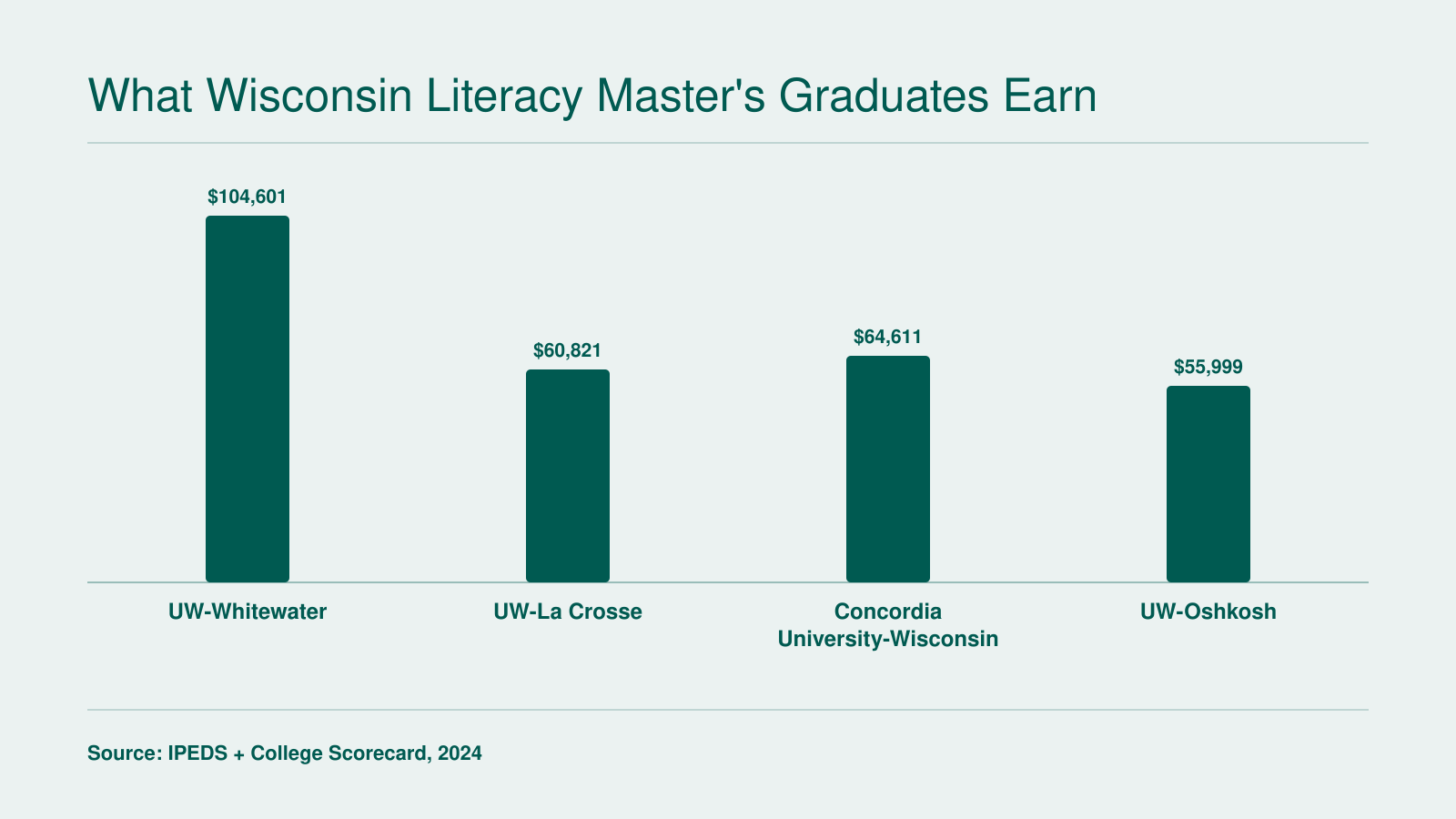
What Wisconsin Literacy Master's Graduates Earn
These are median earnings four years after finishing the program, drawn from federal program-level data. Schools without a published figure for that window are not charted. Pairing pay with median debt shows the return: UW-Whitewater graduates report $31,000 in debt, UW-La Crosse $25,247, and Concordia University-Wisconsin $16,864. Treat the Whitewater figure with care, since program cohorts are small and one year of graduates can move a median.
How We Ranked Wisconsin's Reading and Literacy Master's Programs
Every program here, including Accelerated Master's in Reading and Literacy Programs, was scored on verifiable federal figures: published graduate tuition, average net price, institution-wide completion rates, and, where available, program-level earnings and debt from the College Scorecard. Reputation, selectivity, and marketing claims carry no weight.
The limits matter. Graduation-rate and net-price figures are institution-wide averages covering all students, not reading and literacy candidates specifically, so they describe the school more than the degree. Earnings figures lag by several years and are not published for every program.
Before applying, confirm current per-credit tuition directly with the school, and verify that the coursework aligns with the Wisconsin DPI license you intend to hold.
Wisconsin Reading Master's FAQ
These answers cover the questions applicants ask most about the reading specialist license in Wisconsin. Requirements can differ by program, so confirm details with the school and the Wisconsin Department of Public Instruction before you apply.
Do I need teaching experience for a reading specialist master's in Wisconsin?
Can I earn a Wisconsin reading specialist license online?
What is the Wisconsin DPI 5017 license?
Can I add the 5017 license later if I already hold a master's in another education field?
Compare Reading & Literacy programs on the data that matters
Explore more Education & Teaching specializations or browse every graduate field.
All Education & Teaching programs