Best Master's in Special Education Programs
Compare 830+ accredited Special Education programs at 540+ schools, with graduate earnings, cost, debt, and completion data from IPEDS and the U.S. College Scorecard.

In-state graduate tuition across the ten top-ranked special education master's programs runs from under $10,000 at Purdue to nearly $58,000 at Vanderbilt. That spread is only the first problem. The second is that not every program leads to a teaching license. Clemson's online M.Ed., for example, is built for practicing educators and explicitly does not lead to a teaching license.
The ranking relies on federal College Scorecard outcomes and net price data rather than reputation surveys, so cost and results count for more than name recognition.
For working teachers, licensure eligibility in your own state often matters more than sticker price, because that is what moves you on a district salary schedule.
Key Points
- The top three schools show median earnings above $82,000 about ten years after entry.
- Published graduate tuition among ranked schools starts at $8,724 in-state, and online can cost more.
- Check in writing that your track meets state licensure rules before paying a deposit.
10 Master's in Special Education Programs
The top three programs separate themselves on clear outcome signals: Vanderbilt, Cal Poly, and the University of Maryland each report median earnings above $53,000 within the first year after completion and institution-wide graduation rates of at least 86%. Vanderbilt adds an unusually low median graduate debt figure among this group, while Maryland reports the highest first-year median earnings in the top three. The remaining schools are not far behind, with strong licensure pathways and more flexible online or hybrid formats.
Vanderbilt University
#1Nashville, TN · ~$58,000/yr (est.)
Best for: Aspiring special education leaders seeking high-touch mentorship
Vanderbilt Peabody's M.Ed. in Special Education combines a nationally regarded curriculum with multiple licensure-focused tracks in high incidence, severe disabilities, and visual disabilities. The program is field-based and research-oriented, with a required comprehensive exam and a master's project or thesis. Four years after completion, median program earnings are about $65,000, and the university reports median graduate debt near $14,000. The university graduates about 94% of students, and the program highlights a 100% job placement rate for job-seeking graduates.
- Three concentration options: High Incidence, Low Incidence: Severe Disabilities, and Low Incidence: Visual Disabilities
- Rolling admissions with a December 1 priority deadline
- 100% job placement rate for job-seeking graduates
- Thesis or capstone option with field-based learning and supervised research
- Teacher Pathway Scholarship and federal grant eligibility available
California Polytechnic State University-San Luis Obispo
#2San Luis Obispo, CA · ~$14,000/yr (est.)
Best for: Credential-seeking K-12 inclusion teachers
Cal Poly's M.S. in Special Education is built around the school's Learn by Doing model and pairs a Preliminary Education Specialist Credential with clinical practice in local K-12 classrooms. Year one is full-time and in-person, while year two moves online as students complete a master's project while teaching. Median first-year program earnings are about $53,700, and the program reports a 100% hiring rate. The university graduates roughly 86% of students overall.
- Preliminary Education Specialist Credential built into the degree
- Year one full-time and in-person; year two online with a master's project
- Cohort-based structure with clinical practice in San Luis Obispo and Santa Barbara county schools
- 100% job placement rate for graduates
- Emphasizes High Leverage Practices, Universal Design, and data-based decisions
University of Maryland-College Park
#3College Park, MD · ~$18,000/yr (est.)
Best for: Educators pursuing dual special education certification
Maryland's M.Ed. with Certification is a two-year, Maryland State Department of Education approved program that prepares candidates for mild to moderate disabilities in grades 1-8 and severe disabilities from birth through age 22. It includes a year-long internship in inclusive classrooms and emphasizes evidence-based practices, collaboration, and cultural competence. First-year median program earnings are just under $67,400, and four-year median earnings are about $75,800. The university graduates about 89% of students overall.
- Maryland State Department of Education approved
- Two-year program with a year-long inclusive classroom internship
- Prepares for mild to moderate grades 1-8 and severe birth-22 disabilities certification
- Evidence-based practices, collaboration, and cultural competence focus
- Requires 3.0 GPA, three letters, and Praxis Basic Skills exam
- Complete in 1 to 1.5 years with 30 credit hours
- Hybrid delivery combines online and campus learning
- Requires a valid special education certificate
- Serves students birth through grade 12
- Focus on inclusion, assistive technology, advocacy, and family support
University of Washington-Seattle Campus
#4Seattle, WA · ~$19,000/yr (est.)
Washington's special education master's options include an Early Childhood Special Education pathway and a High-Incidence Disabilities track, both field-based and hybrid with cohort support. The programs prepare graduates for Washington teacher certification and integrate practicum experiences in schools and early childhood settings. First-year median program earnings are about $73,500, and four-year median earnings are about $69,400. The university graduates roughly 85% of students.
- Prepares to work with children from birth through third grade
- Three pathways: initial certification with P-3 endorsement, add special education endorsement, or master's-only track
- 70 credit hours completed across six quarters
- Field-based hybrid format with full-time cohort enrollment
- Requires basic skills test (WEST-B) and 3.0 GPA
- Complete in 1 to 2 years
- Field-based hybrid format with cohort support
- Reading endorsement integrated into the program
- Prepares for Washington teaching certification
- Requires work experience, two letters, and 3.0 GPA
Purdue University
#5West Lafayette, IN · ~$10,000/yr (est.)
Purdue offers both licensure and non-licensure master's pathways in special education, with campus, online, and hybrid delivery. Coursework spans applied behavior analysis, literacy, math, transition education, and data-based decision making for learners with exceptionalities. The program is built for working educators who need format flexibility, and the university graduates about 83% of students overall.
- Licensure and non-licensure options available
- Offered in West Lafayette, online, and hybrid formats
- Covers learning disabilities, developmental disabilities, emotional behavioral disorders, and high functioning autism
- Six concentration options within the College of Education
- 30 total credit hours with capstone or portfolio requirement
- Online delivery focused on inclusive education
- Non-licensure program with courses in reading difficulties
- Policy, adaptive curriculum, and exceptional learner focus
The University of Texas at Austin
#6Austin, TX · ~$12,000/yr (est.)
UT Austin's M.Ed. in Special Education offers an Autism and Developmental Disabilities concentration that can be completed in 12 months of full-time study and meets coursework requirements for BCBA certification. The program is available through synchronous online classes, with an early childhood intervention option in a hybrid format. First-year median program earnings are about $60,800, and the university graduates roughly 89% of students.
- 12-month, 36-credit program with synchronous online classes
- Meets Behavior Analysis Certification Board (BCBA) coursework requirements
- Three practical experiences built into the curriculum
- No entrance exam required; test optional
- Evidence-based practices for autism and related disabilities
- Hybrid online and in-person format with small interactive classes
- Career focus on early childhood intervention and BCBA preparation
- Naturalistic Developmental Behavioral Interventions and caregiver-implemented training
- Culturally responsive intervention emphasis
Binghamton University
#7Vestal, NY · $10,000 – $15,000/yr (est.)
Binghamton's MSEd in Special Education is a fully online, asynchronous 36-credit program designed for teachers who already hold New York State initial certification. The curriculum emphasizes special education law, assessment, collaboration, and support for students with disabilities from diverse backgrounds. First-year median program earnings are about $55,800, and median graduate debt is reported around $18,500. The university graduates roughly 82% of students.
- 36-credit online, asynchronous program with fall, spring, and summer starts
- Designed for teachers already holding NYS initial certification
- Eligibility for NYS certification in Students with Disabilities All Grades (PK-12)
- Includes fieldwork, internship, and capstone project
- Requires B- or better in all courses
- Focus on special education law, policy, assessment, and diverse student backgrounds
North Carolina State University at Raleigh
#8Raleigh, NC · $12,000 – $33,000/yr (est.)
NC State's M.Ed. in Special Education is a flexible 30-credit program available online, hybrid, face-to-face, and through distance formats. It covers high incidence disabilities, applied behavior analysis, educational diagnosis, and intervention strategies, with an internship component. The university graduates about 85% of students overall.
- 30 credit hours; complete in about 1.5 years full-time
- Online, hybrid, face-to-face, and distance options
- 3.0 GPA minimum with provisional admission available
- Applied behavior analysis and high incidence disabilities focus
- Internship experience and nationally recognized faculty
Auburn University
#9Auburn, AL · $13,000 – $34,000/yr (est.)
Auburn's M.Ed. in Early Childhood/Elementary Special Education prepares teachers to work with infants, toddlers, preschoolers, and K-6 students with developmental delays or disabilities. The program is offered on campus and online, with coursework in child development, family collaboration, and inclusive teaching. First-year median program earnings are about $49,800, and median graduate debt is around $21,000. The university graduates roughly 82% of students.
- Prepares teachers for P-6 settings with evidence-based practices
- Offered on campus and online for working teachers
- Pathways for certified special education teachers or those certified in another teaching area
- Emphasis on child development, family collaboration, and inclusive strategies
Clemson University
#10Clemson, SC · $10,000 – $15,000/yr (est.)
Clemson's online M.Ed. in Special Education focuses on Multi-Tiered Systems of Support, applied behavior analysis, and advanced classroom management. The main program is 33 credits over 24 months and includes an ABAI Verified Course Sequence for BCBA coursework but does not lead to teaching licensure. The university graduates about 87% of students, and South Carolina teachers may qualify for a tuition reduction.
- 100% online, asynchronous eight-week terms
- 33 credit hours completed in about 24 months
- ABAI Verified Course Sequence meets BCBA coursework requirements
- Does not lead to teaching licensure
- South Carolina Teacher Incentive available
- 36 credit hours with practicum in emotional/behavioral disorders
- Prepares for South Carolina certification and Praxis II
- Requires valid teaching certificate and 3.0 GPA
- Applied behavior analysis and legal/policy coursework
- 36 credit hours with practicum in learning disabilities
- Prepares for South Carolina certification and Praxis II
- Focus on research-validated intervention strategies
- Requires valid teaching certificate
- 36 credit hours with practicum in intellectual disabilities and autism
- Prepares for South Carolina teaching certification
- Research-validated intervention strategies emphasis
- Final comprehensive exam required
Cost & outcomes by school
Federal data for the highest-earning Special Education programs, independent of the ranking above. Earnings are this field's master's graduates four years after completing, where the Scorecard reports them.
| School | Earnings | Tuition / yr | Debt | Grads/yr | Format |
|---|---|---|---|---|---|
| California State University-Dominguez Hills CA | $95,089 | $8,978 | — | 12 | Campus |
| CUNY City College NY | $94,601 | $11,402 | $23,914 | 127 | Hybrid |
| Notre Dame de Namur University CA | $94,588 | $15,300 | — | 16 | Online |
| CUNY Brooklyn College NY | $90,918 | $11,524 | $24,807 | 256 | Campus |
| University of San Francisco CA | $89,791 | $29,960 | — | 9 | Campus |
| CUNY Hunter College NY | $88,978 | $11,398 | $30,530 | 316 | Hybrid |
| Manhattan University NY | $87,967 | $25,485 | $25,131 | 19 | Campus |
| Point Loma Nazarene University CA | $86,603 | $11,880 | $42,073 | 10 | Online |
| College of Staten Island CUNY NY | $86,157 | $11,650 | $18,524 | 38 | Campus |
| National University CA | $85,908 | $16,416 | $53,471 | 352 | Online |
| California State University-Northridge CA | $85,826 | $8,982 | — | 43 | Campus |
| CUNY Queens College NY | $85,359 | $11,612 | $21,433 | 54 | Hybrid |
Sources: U.S. Department of Education. Tuition and graduates: IPEDS. Earnings and debt: College Scorecard, this field's master's graduates; a dash means no figure is reported.
Cost, debt & payoff
Median earnings of this field's master's graduates (4 yrs after completing) vs. their median federal loan debt · U.S. College Scorecard
Across these programs the median graduate earns about $62,368 and finishes with roughly $28,728 in debt — a ratio that clears a common rule of thumb (keep debt below first-year salary). Tuition and debt vary widely school to school, so check the per-school figures in the table above before you shortlist.
How We Rank the Best Special Education Master's Schools
What the ranking weighs
We compare each school using four public measures that matter to a working or aspiring special education teacher. Median earnings after completion shows whether graduates tend to earn enough to make the degree worthwhile. Median federal debt at completion shows how much students typically owe when they finish. Average net price estimates affordability after grants and scholarships. Institution-wide graduation rate shows how often enrolled students actually complete. All four come from College Scorecard and IPEDS.
What the numbers do and do not capture
Two limits matter. Graduation rate and average net price describe the whole institution, not the special education master's program specifically within Education & Teaching Master's Programs. Net price is an average after aid, so it is a comparison figure, not your personal quote. Program-level earnings and debt are not published for every school. When those data are unavailable, that program's card shows fewer statistics rather than estimated numbers.
We intentionally avoid inventing percentage weights. Instead, we present these outcomes side by side so you can weigh what matters for your budget, your district, and your long-term earnings.
What the ranking leaves out
We do not score accreditation or licensure eligibility. Those require a careful check against your state's rules. Look at the licensure and accreditation notes below before enrolling.
How Much Does a Master's in Special Education Cost?
When comparing Master's Programs by Degree and Field, the cheapest route to a special education master's usually depends on your residency, and the price of a flexible online program can still land well above a state school. Among the ranked schools, published graduate tuition starts at $8,724 in-state at the University of Utah, with Purdue at $9,992 and CUNY Hunter College at $11,398. Out-of-state, the same programs list $27,983 (Utah), $28,794 (Purdue), and $20,828 (Hunter). Public universities can charge nonresidents two to three times the in-state rate.
Estimating Total Program Cost
Per-credit rates make the comparison clearer. These are tuition-only estimates based on 2026 published rates:
- University of Nebraska at Kearney: $369 per credit in-state, $591 out of state, 36 credits. That is about $13,284 or $21,276 in tuition, plus roughly $2,113 in estimated fees.1
- University of Kansas Online: $595 per credit for 30 to 33 credits, or about $17,850 to $19,635, before textbooks and fees.2
- Penn State World Campus: $1,048 per credit for 33 credits, about $34,584 at the per-credit rate. Students taking 12 or more credits are billed $12,572 per semester instead.
- George Mason University: $804 per credit in-state, $1,050 out of state, and $683 for Virginia PK-12 educators. Fees include a $169 mandatory student fee, a $60 new student fee, and a $25 to $84 course fee. The program requires 30 credits, so confirm the total cost before budgeting.3
Kansas and Penn State list a single per-credit rate with no residency split in the figures we reviewed, but confirm that with each bursar.
Costs Readers Forget
Praxis special education tests are billed by ETS, separately from tuition, so check ETS for current fees. Budget also for fingerprint background checks and any state licensure application charges. The bigger hidden cost is the student-teaching semester. Many programs expect full-time classroom placement, which can limit outside work for a term or more.
Ways to Lower the Bill
The federal TEACH Grant may help if you commit to teaching in a high-need field at a qualifying school. Ask your district about tuition reimbursement, too. Indiana University-Bloomington's program, for one, notes that it supports employer reimbursement.
Ranked Programs With the Lowest Median Debt at Graduation
Debt at graduation matters for special education teachers because first-year salaries are often modest, and a lower federal loan balance keeps monthly payments manageable. The table shows the programs in this ranking with the lowest published median federal debt for program completers, along with the estimated 10-year payment when it is reported.
| School | Format | Median Federal Debt at Graduation (Program Completers) | Estimated Monthly Payment (10-Year Plan) |
|---|---|---|---|
| University of Utah | Campus | $20,689 | $235 |
| The University of Texas at Austin | Online | $23,912 | $272 |
| University of Delaware | Hybrid | $25,685 | $292 |
How Long It Takes to Earn a Master's in Special Education
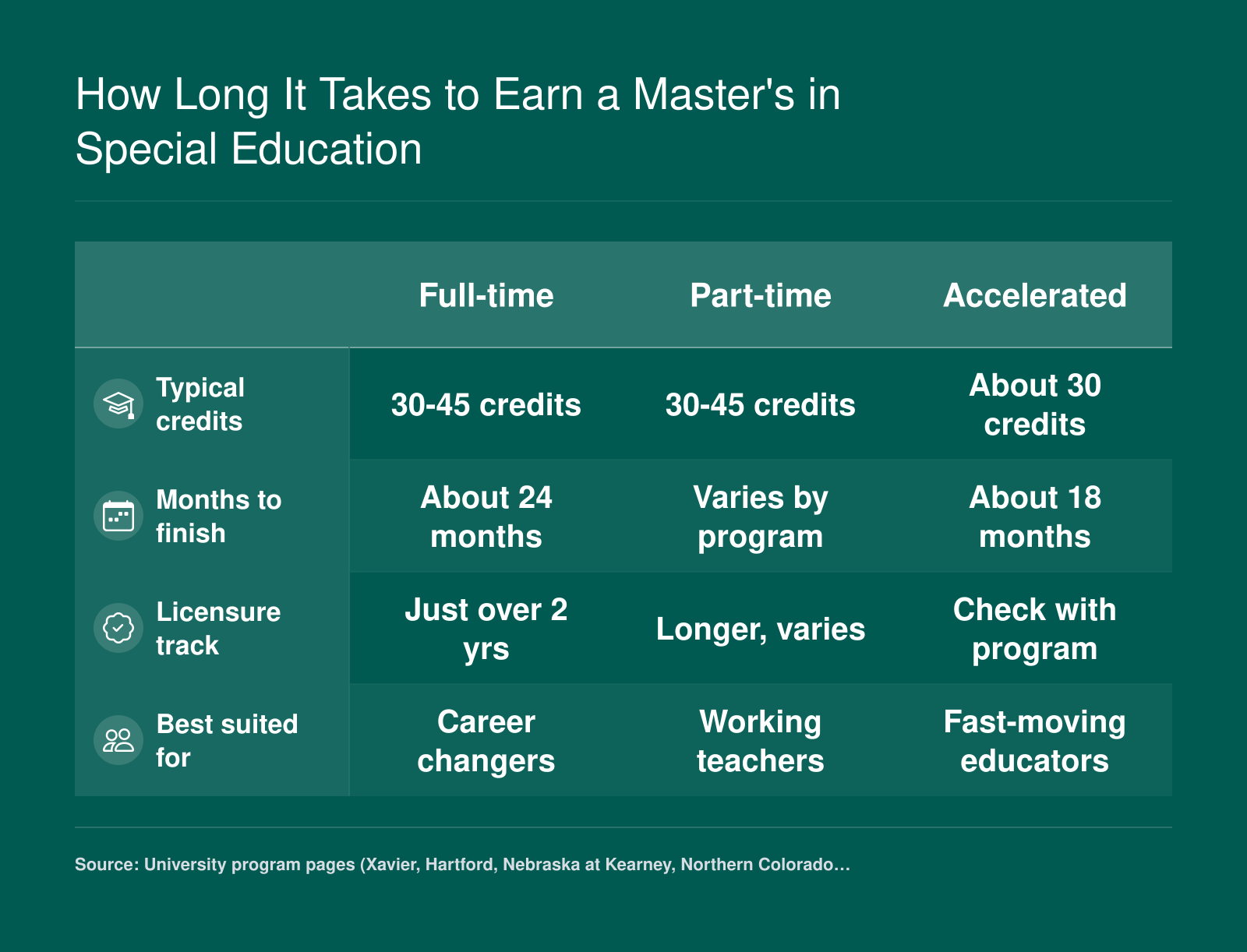
Most master's in special education programs take about 1.5 to 2 years of full-time study, though timelines vary by program. Non-licensure tracks typically run 30-38 credits, while initial-licensure tracks run 36-45 credits because they add student teaching. Part-time completion schedules differ widely by school, so confirm pacing with each program.
Related Articles
Online vs. Campus Special Education Master's Programs
Online special education master's programs move coursework off campus, but the field experience still happens in a real school near you. The biggest differences come down to where you can do fieldwork, which states a licensure track accepts, and whether you can count your own classroom. Confirm each of those with the program before you apply.
| Factor | Online format | Campus format |
|---|---|---|
| Flexibility | Coursework is fully online at Drexel and Niagara. Drexel has no on-campus requirements, and Kansas's online autism teacher track needs no campus visits. | Fixed class meetings on set days. Less room to fit around a full-time teaching schedule. |
| Cost structure | Pricing varies by program, so compare per-credit rates and fees directly. Online study can reduce commuting and relocation costs. | Commuting, parking, and possible relocation add costs beyond tuition. Check net price for each school. |
| Practicum and student teaching | Done in a local school with a site mentor. Teachers College requires two practicum placements at a partner school in your area. Drexel's field placement office coordinates local placements. | Placements are typically arranged through the school's own district partnerships. Grand Canyon requires student teaching in a local K-12 special education classroom. |
| Field hours (examples) | Teachers College: more than 100 hours. Niagara: 100 hours. Ohio University: 60 hours, plus a full-time internship unless you are a licensed teacher in your own classroom. | Hours vary by state licensure rules and program design. Ask for the hour total in writing. |
| Working in your own classroom | Often possible with approval. Louisville allows it when approved individually, Niagara may count workplace teaching hours, and Kansas allows practicum in your school. | Possible at some programs, but school-based placements are often arranged by the program. |
| Campus visits | Usually none for coursework, but some programs require onsite fieldwork. Temple requires onsite fieldwork, including practica and student teaching, at locations coordinated for you. | Attendance on campus is built in each term. |
| Faculty access | Through video sessions, email, and field supervisors. Mentor teachers carry much of the day-to-day coaching. | In-person office hours and informal contact with faculty and cohort peers. |
| Licensure portability | Often tied to one state. Louisville fieldwork must be completed in Kentucky, and Arcadia placements must be in your home state under a certified Pennsylvania educator. Programs may not accept students from every state for licensure tracks. | Typically aligned to the state where the campus sits, which is simplest if you plan to teach there. |
| Fit for working teachers | Strong fit for current teachers who want to keep their job and may use their classroom for fieldwork. | Better for career changers who want a structured, in-person cohort and school placement support. |
Specializations in Special Education Master's Programs: Autism, ABA, and Specific Learning Disabilities
Your specialization matters more than the school's name: it determines which students you can serve and which credential you leave with. Tracks vary by institution and state, but the common ones are autism, applied behavior analysis, specific learning disabilities, transition-to-adulthood, early childhood, and gifted/twice-exceptional.
Who Each Track Serves
- Autism: Students with autism.2 Federal personnel-preparation priorities specifically name autism expertise.1
- ABA: Autistic students and others who need systematic behavioral assessment and intervention.
- Specific learning disabilities (SLD): Students whose reading, writing, or math difficulties persist despite good instruction.3 Expect coursework in assessment, evidence-based instruction, IEPs, and progress monitoring.
- Transition: Secondary students preparing for college, work, and independent living.5
- Early childhood: Children with disabilities from birth to age 5, plus their families.4
- Gifted/twice-exceptional: Gifted students who also have autism, ADHD, dyslexia, or another SLD.6
The ABA and BCBA Catch
An ABA track is not automatically BCBA-qualifying. The Behavior Analyst Certification Board requires graduate coursework, supervised fieldwork, and a passing exam.1 Ask each program whether its sequence meets the BACB's current requirements, and get the exact coursework and fieldwork totals from the BACB directly.
Embedded or Added On
Some programs build the specialization into the degree. Others attach it as a certificate or endorsement, which can mean extra credits and time. Confirm that SLD coursework is approved by your state for the endorsement you want before you enroll.7
Quick Decision Guide
- Choose ABA for behavior-analytic practice and BCBA eligibility.
- Choose SLD for resource-room or inclusion settings.
- Choose transition to serve older students.
Questions to Ask Yourself
Do you already hold a teaching license, or do you need an initial-licensure track?
Initial-licensure tracks add student teaching and extra credits, which raises cost and length. If you are already licensed, an advanced or add-on endorsement program can be shorter and cheaper.
Will you teach in the state where the program is approved, or might you move?
Licensure is issued by states, and a program approved in one state may need extra steps elsewhere. Confirm reciprocity rules for any state you might work in before you commit.
Can you complete student teaching in your current classroom, or will you need unpaid time off?
Many initial-licensure programs require a full-time placement that can mean weeks without a paycheck. Ask whether the school allows an employment-based placement, since that can change your real cost.
Do you want a specialization such as autism or applied behavior analysis?
Specializations often add coursework, and behavior analysis tracks may require supervised hours toward BCBA certification. Check what the program verifies so the extra time actually counts toward credentials.
Special Education programs by state
Frequently Asked Questions About Special Education Master's Programs
Degree labels in special education overlap more than most students expect, so the program details matter more than the title. These answers draw on current program handbooks and published district salary schedules.
What is the difference between an MEd, MS, and MA in special education?
Do you need a teaching license to enroll in a master's in special education program?
What can you do with a master's in special education?
Can you work full time while earning a master's in special education?
Does a master's in special education raise a teacher's salary?
Compare Special Education programs on the data that matters
Explore more Education & Teaching specializations or browse every graduate field.
All Education & Teaching programs