Best Master's in Special Education Programs in Arkansas
Compare 11 accredited Special Education programs in Arkansas at 9 schools, with graduate earnings, cost, debt, and completion data from IPEDS and the U.S. College Scorecard.

Several Arkansas special education master's programs require a current teaching license before you can enroll, while others are built to produce that first license. That split decides which path fits you.
Budget narrows it further. In-state graduate tuition in the federal data runs from roughly $7,300 to nearly $14,900, and formats range from fully online to campus-based with supervised field hours.
Special education is a shortage area in Arkansas, so the question is less whether jobs exist than which program gets you licensed or endorsed at a cost you can recover.
Key Points
- Arkansas State University offers the lowest in-state net price among ranked programs.
- Special Education K-12 licensure requires Praxis 5355 with a passing score 132.
- A master's degree is not required for initial Arkansas special education certification.
Top Special Education Master's Programs in Arkansas, Ranked
These Arkansas master's programs stand out for their licensure pathways, online flexibility, and practical focus for working educators. The summaries below highlight what each school offers, from initial K-12 licensure tracks to endorsement and leadership options.
University of Arkansas
#1Fayetteville, AR · ~$12,000/yr (est.)
Best for: Aspiring special educators pursuing initial licensure
The University of Arkansas offers a 36-credit Master of Education in Special Education through the College of Education and Health Professions, with both online and hybrid options. The program requires the GRE and includes two internships at public school sites for at least 280 contact hours. It leads to initial K-12 licensure and is supported by the Arkansas Teacher Opportunity Program.
- 36 total credit hours
- Three-year completion path
- Requires GRE
- 280 clinical hours across two internships
- Online or hybrid coursework
- Leads to initial K-12 licensure
- Arkansas Teacher Opportunity Program grant available
Harding University
#2Searcy, AR · ~$15,000/yr (est.)
Best for: Licensed Arkansas teachers adding endorsements
Harding University's fully online Master of Education in Special Education K-12 is built for licensed Arkansas teachers. The 33-credit program takes about two years and includes the option to add a dyslexia endorsement with just two extra courses. The curriculum emphasizes evidence-based instruction, behavior interventions, and collaboration with families and professionals.
- 33 total credit hours
- Two-year completion path
- Requires current Arkansas teacher license
- Add dyslexia endorsement with two extra courses
- Science of Reading Proficiency required
- Comprehensive exams in final semester
Arkansas State University
#3Jonesboro, AR · $7,000 – $13,000/yr (est.)
Best for: Working educators seeking affordable online advancement
Arkansas State University's online MSE in Special Education, Instructional Specialist K-12, is aimed at licensed teachers who want to lead special education classrooms. The 36-credit program uses accelerated seven-week courses and can be completed in as few as 16 months. With $350 per credit tuition for in-state and out-of-state students, it is among the more affordable Arkansas options.
- 36 total credit hours
- $350 per credit hour
- 16-month accelerated path
- Seven-week fall and spring courses
- Requires valid teaching certificate
- Prepares for Praxis
- CAEP accredited
University of Central Arkansas
#4Conway, AR · $5,000 – $10,000/yr (est.)
The University of Central Arkansas offers a 30-credit Master of Science in Special Education fully online, with synchronous and asynchronous course options. The program includes a 21-hour core that leads to Arkansas K-12 special education licensure and aligns with CAEP and CEC standards. It is designed for both licensed teachers seeking advanced specialization and new educators pursuing initial licensure.
- 30 total credit hours
- Can be completed in two years
- Synchronous and asynchronous online options
- 21-hour core leads to K-12 licensure
- Aligned with CAEP and CEC standards
- Prepares for Praxis II
- 10 total courses
Arkansas Tech University
#5Russellville, AR · $5,000 – $10,000/yr (est.)
Arkansas Tech University offers a 30-hour online Master of Education in K-12 Special Education for licensed public school teachers. The program covers dyslexia, assessment, instruction for grades K-6 and 7-12, and includes a supervised practicum. Admission requires an Arkansas Teaching License, and conditional admission is available by program director appeal.
- 30 total credit hours
- Fully online
- Requires Arkansas Teaching License
- Conditional admission by program director appeal
- 3.0 GPA required after conditional admission
- Includes K-12 supervised practicum
- Prepares educators as special education leaders
Southern Arkansas University
#6Magnolia, AR · $5,000 – $10,000/yr (est.)
Southern Arkansas University's online Master of Education in Special Education is a 30-credit, two-year program for licensed teachers. It emphasizes instructional planning, diagnosis, classroom management, and inclusion, with a directed internship. The program is aligned with Council for Exceptional Children standards and offers out-of-state tuition waivers.
- 30 total credit hours
- Two-year completion path
- 100% online coursework
- Requires current teaching license
- Prepares for Praxis licensure exams
- Aligned with CEC standards
- Out-of-state tuition waivers available
University of Arkansas at Little Rock
#7Little Rock, AR · ~$8,000/yr (est.)
The University of Arkansas at Little Rock offers a 33-credit Master of Education in Special Education K-12 for initial licensure. It includes a provisional license track if candidates secure a teaching job, plus traditional field placements, and prepares students for Praxis II. The Trojan Teacher Residency Program offers a district-based residency with mentor teachers and financial support.
- 33 total credit hours
- Requires ACT
- Initial K-12 licensure
- Provisional license track with job offer
- Field placement in cooperating classroom
- Prepares for Praxis II
- Trojan Teacher Residency Program option
John Brown University
#8Siloam Springs, AR · $10,000 – $15,000/yr (est.)
John Brown University offers a 35-credit Master of Education in Special Education for post-baccalaureate candidates with a current teaching license. A 23-credit licensure-only option is available for educators who only need the Arkansas K-12 endorsement. Coursework covers special education law, IDEA principles, eligibility categories, and instructional strategies.
- 35 total credit hours
- 23-credit licensure-only option
- Requires current teaching license
- Praxis Special Education Core Knowledge #5354 required
- Arkansas K-12 endorsement focus
- IDEA principles and eligibility categories
- Special education law and ethics focus
Cost & outcomes by school
Federal data for the highest-earning Special Education programs, independent of the ranking above. Earnings are this field's master's graduates four years after completing, where the Scorecard reports them.
| School | Earnings | Tuition / yr | Debt | Grads/yr | Format |
|---|---|---|---|---|---|
| Arkansas State University AR | $53,700 | $7,322 | $20,500 | 82 | Online |
| Arkansas Tech University AR | $50,255 | $7,670 | — | 3 | Online |
| University of Central Arkansas AR | — | $7,446 | — | 15 | Online |
| Southern Arkansas University AR | — | $7,380 | — | 9 | Online |
| Henderson State University AR | — | $7,497 | — | 9 | Hybrid |
| University of Arkansas at Little Rock AR | — | $7,915 | — | 4 | Campus |
| University of Arkansas AR | — | $12,470 | — | 16 | Hybrid |
| Harding University AR | — | $14,572 | — | 32 | Online |
| John Brown University AR | — | $14,880 | — | — | Campus |
Sources: U.S. Department of Education. Tuition and graduates: IPEDS. Earnings and debt: College Scorecard, this field's master's graduates; a dash means no figure is reported.
What Earned an Arkansas Special Education Master's a Spot on This List
A working teacher weighing a special education master's degree asks four things: what will it cost, do students actually finish, what do graduates earn, and is the program legitimate? Federal IPEDS data supplies graduate tuition and graduation rates, and College Scorecard supplies earnings and debt. These graduation rates are institution-wide, not specific to the special education program.
Accreditation is the independent check. CAEP accreditation is confirmed for Arkansas State University's educator-preparation programs, including its online MAT in Special Education, and for the University of Arkansas's teacher-education programs.1 That is not the same as a separate stamp on each special education master's. The Arkansas Division of Elementary and Secondary Education lists the following Master's Programs in Arkansas as approved for 2026: University of Central Arkansas, Harding, Arkansas Tech, UA Little Rock and Southern Arkansas University. CAEP or AAQEP status for those schools, and for John Brown University, could not be confirmed, so check with the program directly.
Online and Hybrid Special Education Master's Options in Arkansas
The real tradeoff in an online master's in special education is convenience versus the supervised teaching hours your license still requires. Most of the programs below are fully online, with campus-based paths at UA Little Rock and John Brown University and a hybrid route at the University of Arkansas. Delivery differs meaningfully: University of Central Arkansas offers synchronous and asynchronous options, while Arkansas State offers an accelerated master's in special education with terms that run five weeks in summer and seven in fall or spring, with multiple start dates each year rather than a single cohort schedule. Online students still complete field work in person. A-State's MSE embeds activities in your own school or district, a major advantage for working teachers, while Harding keeps its K-12 practicum and internship off campus and UAF's initial licensure route requires internships at public school sites. Before enrolling, confirm the program is approved for Arkansas licensure.
Which Arkansas Special Education Master's Programs Skip the GRE?
A GRE waiver simply means the graduate school accepts GPA or other exam scores in place of the test, a policy common among master's programs with no GRE required. Here is what the published admissions pages show for master's in special education programs with no GRE required in Arkansas.
- University of Arkansas: GRE not normally required for the M.Ed.; a 3.0 GPA (overall or last 60 credits) covers the skill requirements, otherwise ACT, SAT, GRE or Praxis Core scores are needed.1
- Arkansas State University: The MAT lists no GRE; it asks for a 2.70 GPA (or 3.0 in the last 60 hours) and passing scores on Praxis 5511 and Praxis 5355. No teaching license needed.
- Arkansas Tech University: MAT requires a 2.75 GPA or 3.0 in the last 30 hours; its GRE policy is not stated.2
- University of Central Arkansas: Lists a 2.7 GPA or 3.0 in the last 60 hours; no GRE policy is published.
- UA Little Rock: GRE required in some cases, including conditional admission with a GPA of 2.5 to 2.74.
- Harding, Southern Arkansas, John Brown: No policy found; confirm with admissions.
All expect a bachelor's degree and transcripts. M.Ed. tracks often assume licensure; MATs do not.
Before you apply, ask each program whether working teachers can complete the practicum in their own classroom, and whether the GRE is required, optional, or waived.
Related Articles
Special Education Master's Cost and Arkansas Licensure Outcomes
Among the lowest-cost programs in the data, Arkansas State University, Arkansas Tech University, Southern Arkansas University, University of Central Arkansas, and University of Arkansas at Little Rock lead on net price. The cheapest in-state option is Arkansas State University, with published tuition and fees of $8,090 and an average net price of $12,366. Net price below is an approximate institution-wide figure from federal data, while the program cost column shows only published flat-rate totals such as Arkansas State's $350 per credit across 36 credits, or $12,600. UCA's separate MAT lists a flat $378 per-credit rate over 36 credits.
| School | In-state tuition | Out-of-state tuition | Average net price (approx.) | Program cost | Licensure outcome |
|---|---|---|---|---|---|
| Arkansas State University | $8,090 | $14,522 | $12,366 | $12,600 (MAT and M.S.Ed.) | Initial licensure (MAT) and advanced credential (M.S.Ed.) |
| Arkansas Tech University | $8,674 | $14,668 | $12,970 | N/A | Added endorsement or advanced credential (current license required) |
| Southern Arkansas University | $9,960 | $15,690 | $14,027 | N/A | Added endorsement or advanced credential (current license required) |
| University of Central Arkansas | $10,523 | $18,023 | $16,511 | N/A | Added Special Education endorsement (MSE); initial licensure via separate MAT |
| University of Arkansas at Little Rock | $9,748 | $22,158 | $17,248 | N/A | Initial licensure (K-12) |
Arkansas Special Education Licensure at a Glance
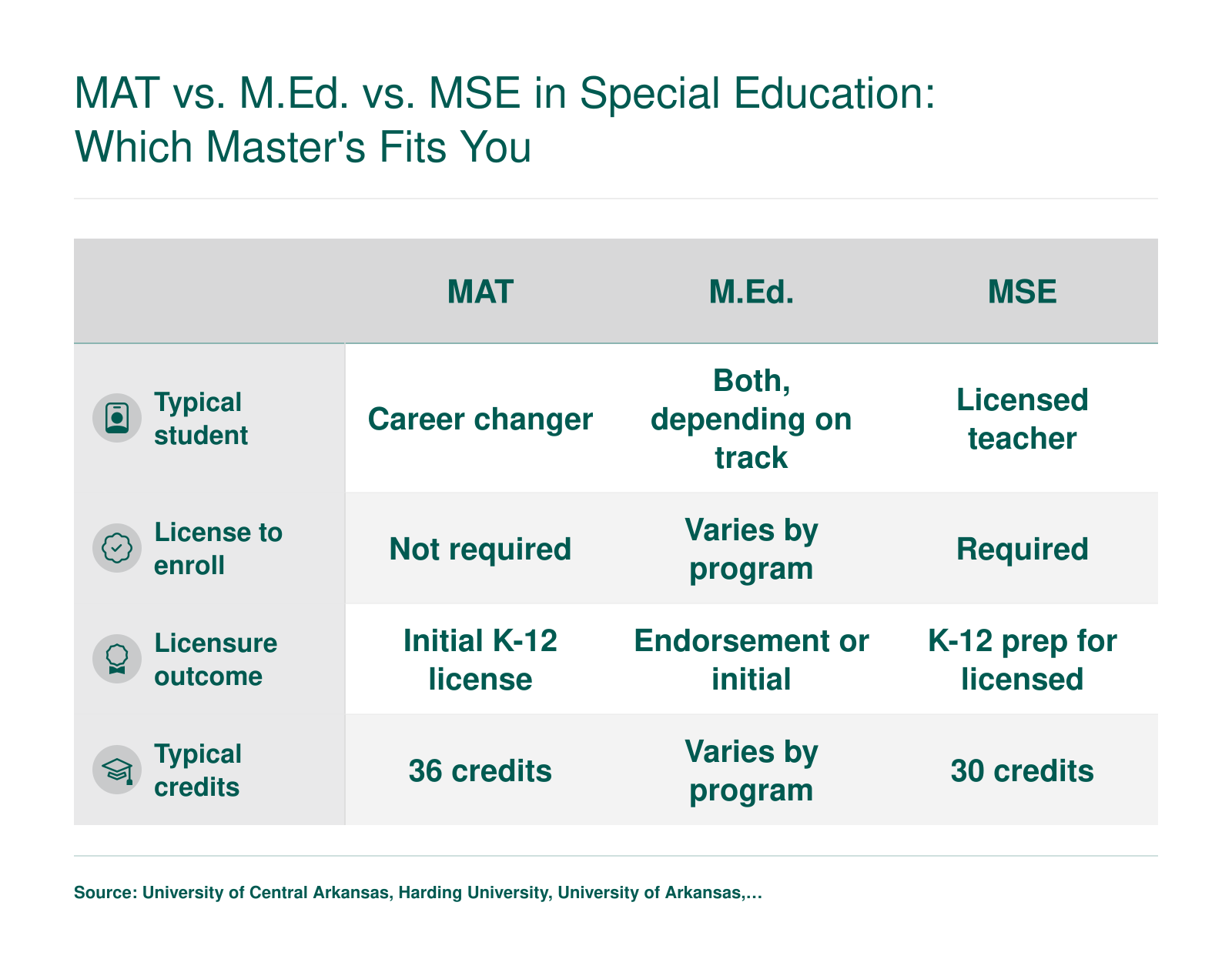
MAT vs. M.Ed. vs. MSE in Special Education: Which Master's Fits You
At Arkansas universities, the MAT usually serves unlicensed bachelor's holders seeking first-time licensure, while the MSE and many M.Ed. tracks are designed for already licensed teachers. Several programs here pair the master's with a separate Special Education Resource endorsement or dyslexia-related coursework: UCA's resource endorsement adds 12 credits and 4 courses, Harding's dyslexia endorsement adds 15 total credits including 2 additional courses, and UARK's resource plan requires 4 courses. Check each program's published plan before assuming an endorsement is embedded.
Graduate Earnings and Debt for Arkansas Special Education Master's Programs
The table below pairs the most recent program-level graduate earnings reported in IPEDS and College Scorecard data with median program debt and the estimated 10-year monthly loan payment where available.
| Program | Graduate earnings | Median program debt | 10-year monthly payment |
|---|---|---|---|
| Arkansas State University: M.S.E. in Special Education | $54,213 (five years after finishing) | $20,500 | $233 |
| Arkansas Tech University: M.Ed. in K-12 Special Education | $50,255 (four years after finishing) | $21,000 | N/A |
| University of Central Arkansas: M.S. in Special Education | $45,770 (one year after finishing) | $20,346 | N/A |
| University of Arkansas: M.Ed. in Special Education | N/A | $21,500 | N/A |
| John Brown University: M.Ed. in Special Education | N/A | $21,250 | N/A |
Arkansas Special Education Master's: Your Questions Answered
A quick look at cost, format, licensure, and timeline questions for Arkansas special education master's programs.
What is the cheapest master's in special education program in Arkansas?
Can you earn a special education master's degree fully online in Arkansas?
Do you need a teaching license to enroll in a special education master's program in Arkansas?
How long does a master's in special education take to finish in Arkansas?
Does Arkansas require a master's degree for special education certification?
How many practicum or field hours do Arkansas special education master's programs require?
Compare Special Education programs on the data that matters
Explore more Education & Teaching specializations or browse every graduate field.
All Education & Teaching programs